
Loading Plug-in Terminals on SMT Equipment: A Practical Feeding and Setup Guide | Southern Machinery
Loading plug-in terminals is the material-introduction step that decides whether an automated terminal cell runs at rate or spends the shift on stops. This guide covers what plug-in terminal loading involves on SMT/THT equipment - reel mounting, tape path, feed pitch, cover-tape peel and pick-point setup - where the step sits in a full PCB assembly line, how to run it without generating defects, and what to specify when buying a terminal insertion platform or reel terminal feeder from Southern Machinery (Shenzhen; founded 2011; 237+ global customers).
Sep 26, 2026 · Updated Sep 26, 2026 · Southern Machinery
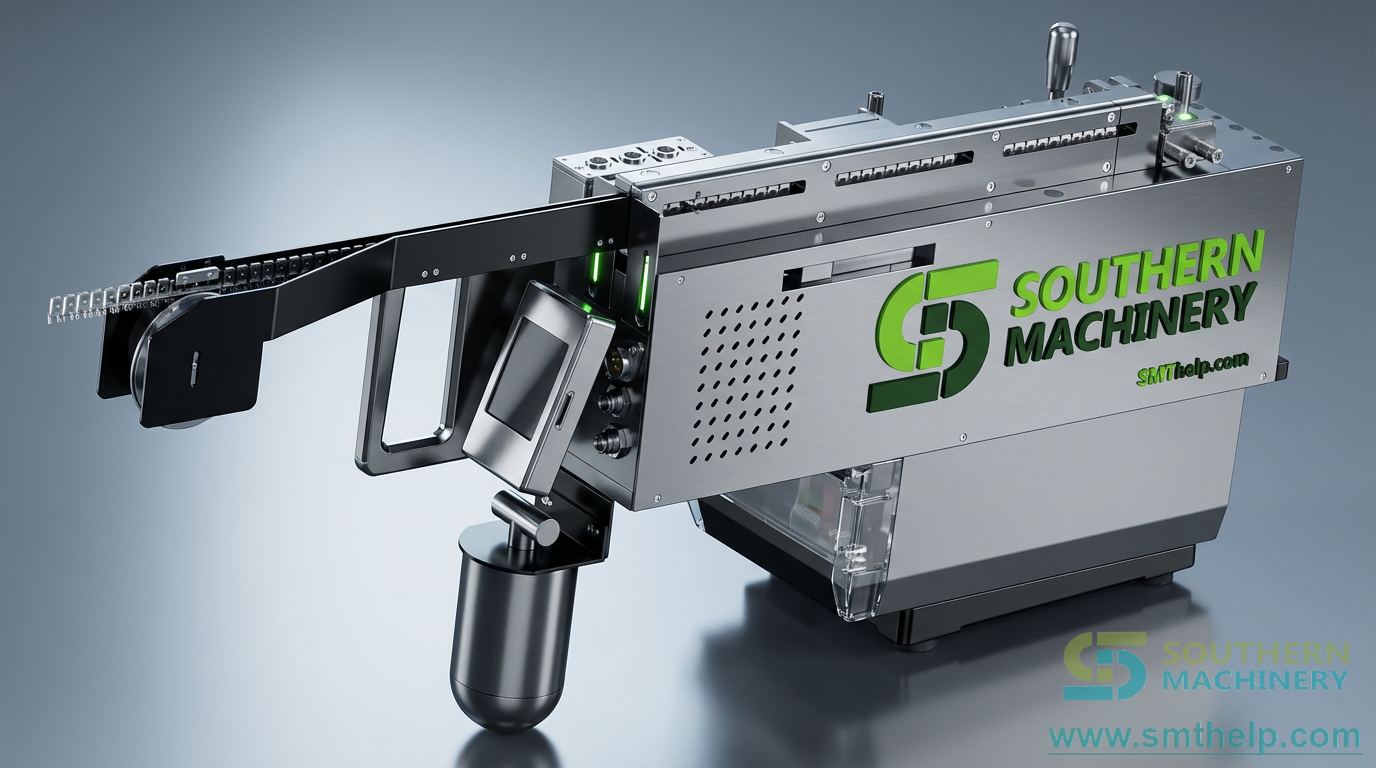
Loading Plug-in Terminals on SMT Equipment: A Practical Feeding and Setup Guide
Loading plug-in terminals onto insertion equipment is the step that decides whether an automated terminal cell runs at rate or spends the shift on stops. It looks like a two-minute job — hang a reel, thread the tape, press start — but the tape path, the feed pitch, the cover-tape peel and the pick-point height are all set during loading, and every one of them shows up later as a mis-inserted terminal at wave soldering.
This guide covers what plug-in terminal loading actually involves on SMT/THT equipment, where the task sits in a PCB assembly line, how to run the procedure without generating defects, and what to specify when you are buying a terminal insertion platform or a reel terminal feeder. Southern Machinery (Shenzhen, China; founded 2011; 237+ global customers) builds both the insertion machines and the customized feeders that go with them.
<iframe width="560" height="315" src="https://www.youtube-nocookie.com/embed/yOEP-Up40eA?rel=0" title="Efficient Guide for Loading Plug-in Terminals on SMT Equipment" frameborder="0" allow="accelerometer; autoplay; clipboard-write; encrypted-media; gyroscope; picture-in-picture" allowfullscreen></iframe>
Loading and feeding plug-in terminals on Southern Machinery insertion equipment — official product video from the @Smthelping channel.
What is this machine used for?
"Plug-in terminals" are the through-hole interconnect parts that get pushed into a plated hole and clinched before wave soldering: FASTON/TAB quick-connect tabs, ring and spade lugs, eyelets, pin terminals and similar stamped parts. On a manual line, an operator picks one out of a bag, orients it, presses it into the right hole and bends the lead with a hand tool.
On automated equipment, the same part arrives at the machine on a reel or in a bulk feeder, and the machine does the inserting, clinching and verification. Loading plug-in terminals is the material-introduction step of that process: mounting the terminal reel on the dereeler, routing the carrier tape through the feed track, engaging the indexing drive, setting the pick position, and confirming that the first terminal is presented squarely at the point the insertion head expects.
In practical buyer terms, this is the task that converts a reel of terminals into a running insertion program. It is also the task most likely to be done wrong, because the failure modes are quiet:
- The tape is loaded one pocket off, so every terminal lands one pitch out.
- The cover tape is peeled at the wrong tension, so terminals spring out of the pocket before the head picks them.
- The reel is wound the wrong way, so the terminal orientation is mirrored and the tab faces the wrong direction.
- The pick height is set by eye, so insertion depth varies from reel to reel.
None of those errors stop the machine. They show up as bent terminals, cracked barrels and rework after the wave, which is why the loading procedure deserves a written standard rather than tribal knowledge on one shift.
Typical applications
1. Home appliance control boards. Air conditioners, microwaves, induction cookers, rice cookers and kettles all use power terminals that must be seated squarely before wave soldering. Reel-fed loading keeps the terminal presentation identical board after board — the point when a single loose terminal means a field return.
2. Automotive and vehicle electronics. Car audio, vehicle power supplies and control modules use FASTON-style terminals for power distribution. Loading consistency is a traceability issue here, not a cosmetic one, and the machine-side insertion data is what makes the process auditable.
3. Power supply, ballast and LED driver PCBA. Power boards mix SMT control circuitry with through-hole power terminals and heavier leads. Reel-fed terminal loading upstream of wave soldering is what keeps the THT section of a mixed board flowing without a manual insertion island.
4. Power tools and appliance sub-assembly boards. High volume, standardised products with a small terminal count per board — the classic profile where feeder loading discipline pays back fastest, because the same program and the same loading routine run for weeks.
5. Mixed-model EMS and ODM DIP lines. A contract manufacturer switching between customer boards stores a program per board type and re-loads a different terminal reel per run. Here the loading routine is a changeover task, and the time it takes is a real line-efficiency number.
How it fits into a complete PCB assembly line
Terminal loading is a station-level task inside the full PCB assembly flow:
- SMT side (upstream). Solder paste printing, SPI, pick and place, reflow and AOI produce the SMD portion of the board. Southern Machinery supplies SMT peripheral equipment for this stage.
- THT automation. After reflow, leaded parts are inserted. Radial insertion machines such as the S-3010B cover standard radial components, odd-form insertion machines such as the S-70LD cover connectors, relays and transformers, and terminal insertion platforms — the S-7000T and the S7020 series — handle plug-in terminals. A reel terminal feeder such as the SRT7001 is the material-supply half of that cell: it dereels the tape and indexes each terminal to a fixed pick point. Southern Machinery documents the S-7000T as handling Zierick P/N 1021/6021/1198/6198 and TE Connectivity TAB/FASTON 6.35 mm (0.250 in) and 4.75 mm (0.187 in) terminals at 0.2 in (5.08 mm) pitch, and states it can process any manufacturer's reeled through-hole terminals.
- Soldering (downstream). Inward or outward clinching holds each terminal through flux, preheat and the wave. Lead-free dual-wave machines such as the S-WS450 and S-WS350B are the natural partner here.
- Handling and control. PCB loaders and unloaders (for example the SLD250/SUL250 magazine pair), SMEMA linking, and MES connectivity — the S-7000T documents an RS-232C interface — turn an insertion machine into a line station rather than an island.
- Inspection and finishing. AOI, X-ray and SPI equipment, plus stencil cleaning, PCBA cleaning and depaneling, close the loop around the terminal cell.
Because Southern Machinery builds the whole ecosystem, a terminal cell arrives with conveyor heights, speeds and control interfaces already matched to the rest of the line — and loading procedures that apply across the platform instead of one machine.
Loading procedure: what a controlled routine looks like
Exact steps differ by machine and terminal, so treat this as the checklist structure to confirm against your own manual. What matters is that each step has a pass criterion:
- Identify the terminal. Part number, tape width, pitch, terminal thickness and orientation convention — matched to the program and to the feeder track installed on the machine.
- Machine in a safe state. Stop the cycle, confirm the head is clear of the pick area, and load with the guards and interlocks respected.
- Mount the reel correctly. Reel on the dereeler, wound so the terminals arrive at the track in the orientation the program expects. This is the single most common source of mirrored or reversed parts.
- Route the tape through the guide track. Track and pocket geometry are machined to your terminal width; the tape must sit fully engaged and square, with no kinks or edge damage.
- Engage indexing. Confirm the sprocket or index drive captures the carrier tape and that tape motion is positive — no slip, no overrun past the pick point.
- Set cover-tape peel and tension. Enough tension to expose the terminal cleanly, not enough to lift it out of the pocket or distort the tape.
- Set the pick position and height. Reference against the program's pick coordinates; verify with a dry cycle before inserting into a board.
- Jog and index a few cycles. Watch presentation at the pick point: square, seated, correctly oriented, same place every cycle.
- First-article check. Insert into a test board, confirm insertion depth, angle and clinch form, and check the part against the drawing before releasing the run.
- Record it. Terminal part number, feeder used, program, and the operator's name — this is the traceability record that makes a later defect investigation possible.
Key selection parameters
Use these categories to compare terminal insertion platforms and reel feeders. Where a value follows, it is published on the official Southern Machinery product pages for the S-7000T and S7020 series — always re-confirm against the datasheet for your configuration.
- Terminal family and tape format. Which terminals do you actually run: Zierick, TE FASTON/TAB, eyelets, pin terminals, other manufacturers' reeled parts? Tab size, tab-fit tolerance and pitch drive the feeder track design.
- Terminal packaging. Reel/tape versus bulk. Both the S-7000T and the S7020 series document support for reel and bulk/bowl feeding, so the platform choice follows your packaging, not the other way round.
- Terminal thickness and material. Documented range on both platforms: ≥0.5 mm to ≤1.2 mm. Thicker or harder material changes head tooling and clinch force.
- Head count and insertion rate. The S-7000T is published at 5,000–6,000 CPH with 1–4 optional heads; the S7020 series is published at 12,000 CPH with 2 insertion heads. Match to your terminal count per board and to line takt, not to the headline number.
- Insertion angle and component mix. The S-7000T documents 360° insertion angle in 1° increments, with up to four different components applied at up to four different angles — relevant if one machine must cover several terminal positions.
- Clinch type. Inward, outward, or "N" clinch (optional on the S-7000T). Confirm which form your board layout and wave-soldering process require.
- Insertion stress control. The S-7000T page states the machine passes the IPC-9704 stress-test standard, with insertion stress within ±400 µε — ask for the equivalent statement for any platform you shortlist.
- PCB and hole requirements. Documented on the S-7000T: PCB 380 × 280 mm (enlargeable by customization), insertion hole 0.5 ± 0.1 mm larger than the component foot, minimum body distance ≥ 2 mm. Hole tolerance is the most common reason a terminal program fails to run reliably.
- Programming and data. Online visual programming, visual correction and Excel import, USB import or manual entry — programming effort is a real cost, so ask how long a new board takes to teach.
- Line integration and utilities. RS-232C for MES on the S-7000T, loader/unloader readiness, and single-phase 220 V AC 50/60 Hz, 2 kVA on both platforms. Verify against your facility before layout.
- Footprint and weight. Both platforms document 1700 × 1300 × 1600 mm and approximately 1200 kg in the 2-head configuration. Plan floor loading and access for reel changes.
- Service, spare parts and training. Confirm feeder tooling availability for your terminal, spare-part coverage and operator training — Southern Machinery's service ecosystem covers multi-brand spare parts, in-house nozzle and gripper design, repair and on-site training.
ROI and quality perspective
Treat terminal loading as a process-control issue rather than a chore, because that is where the money sits.
Labour. Hand-placed terminals are direct labour that scales with volume. Moving the task to a reel-fed insertion cell breaks that link — which is why Southern Machinery positions reel terminal feeding as roughly a 10x cost-saving step versus a manual terminal bench in its own product demo. Your multiple will depend on local labour rates, shift structure, terminal volume and defect cost; validate it against your numbers.
Yield and rework. A terminal loaded one pitch out, or presented marginally off-square, becomes a bent tab or a stressed hole that only surfaces after wave soldering. Controlled loading plus on-machine insertion verification moves detection upstream, where scrap costs a fraction of rework on a soldered board.
Mechanical reliability. Insertion force is the hidden quality risk: excessive stress cracks plated barrels and creates latent field failures. The S-7000T's documented compliance with IPC-9704, holding insertion stress within ±400 µε, is the kind of parameter worth specifying when your customer's quality system asks for evidence of controlled through-hole assembly.
Changeover time. For high-mix plants, reel loading and unloading is changeover. Standard loading routines, labelled feeder tracks and quick-change head options (documented as optional on the S-7000T) are what turn a changeover from hours into minutes.
Material waste. Terminals mishandled during loading — dropped, bent, mixed between reels — are scrapped parts. Disciplined reel handling and controlled feeding reduce that scrap, which ties directly to the zero-e-waste objectives EMS plants increasingly report against.
FAQ
What does "loading plug-in terminals" mean on SMT equipment?
It means introducing the through-hole terminals that a machine will insert — mounting the terminal reel or bulk supply, routing the carrier tape through the feed track, engaging the index drive, and setting the pick position so each terminal is presented squarely to the insertion head. On a manual line, the equivalent is an operator picking terminals one by one from a bin.
Which terminals can an automated terminal insertion platform handle?
Southern Machinery documents the S-7000T as handling Zierick terminals P/N 1021/6021/1198/6198 and TE Connectivity TAB/FASTON in 6.35 mm (0.250 in) and 4.75 mm (0.187 in) sizes at 0.2 in (5.08 mm) pitch, with terminal thickness from 0.5 mm to 1.2 mm, and states the ability to process any manufacturer's reeled through-hole terminals. The S7020 series documents bulk or reel packaging. Always confirm your own terminal against feeder tooling with samples before ordering.
How do I know if the terminal tape is loaded correctly?
Run dry cycles and watch the pick point: the terminal must appear in the same place, square and correctly oriented, cycle after cycle. If parts sit one pitch out, appear mirrored, or lift out of the pocket during peel, stop and re-check the reel winding direction, tape path and cover-tape tension before inserting into a board.
Does terminal insertion fit into an SMT line, or is it a separate THT process?
Both. Terminals are through-hole parts, so they are inserted after the SMT side of the board is complete (print, SPI, place, reflow, AOI) and before wave soldering. Supplied and integrated as a cell — inserter plus reel feeder, loader and unloader — the terminal station runs inline with the rest of the line and communicates with MES over RS-232C on the S-7000T.
What is the difference between a reel terminal feeder and the insertion machine?
The reel feeder is the material-supply module: it dereels the carrier tape and indexes terminals one pitch at a time to a fixed pick point. The insertion machine is the platform that picks, orients, inserts and clinches the terminal and verifies the result. Southern Machinery builds both, including customized feeder tracks machined to your terminal width.
How do I justify automating terminal insertion?
Build the case on labour-replacement plus defect cost: what the manual terminal bench costs per year at current volumes, what rework and scrapped boards cost, and what consistent insertion quality is worth to your customer. Southern Machinery publishes a one-year ROI target for the S-7000T as a planning indicator — treat it as a reference figure and run the calculation against your own labour rate and annual board volume.
Contact Southern Machinery
Southern Machinery (Shenzhen, China) has designed and manufactured SMT, THT and PCB assembly automation for 237+ global customers since 2011 — insertion machines, customized feeders and nozzles, wave soldering, board handling, cleaning and inspection, plus the spare parts, retrofit and training services around them.
If you are specifying a terminal insertion cell or replacing a manual terminal bench, send us your terminal part numbers (or samples), tape width and pitch, PCB data with hole positions, and target output. We will confirm the right insertion platform and feeder configuration.
- Email: [jasonwu@smthelp.com](mailto:jasonwu@smthelp.com)
- Website: www.smthelp.com
- Catalogs and documents: file.autoinsertion.com
- Product images: ph.smthelp.com — see the Pin, Eyelet & Terminal Odd-Form Insertion album
- Related reading: S-7000T Terminal Insertion Machine · SRT7001 Reel Terminal Feeder
Comments