
S-7000T Terminal Insertion Machine: Reel-Fed FASTON Insertion for Smart EMS THT Lines | Southern Machinery
Hand-inserting FASTON tabs, terminals and eyelets is one of the last manual bottlenecks on a THT line. The Southern Machinery S-7000T terminal insertion machine feeds terminals from tape or bulk, inserts and clinches them automatically, and verifies every insertion. With 1-4 insertion heads, 5,000-6,000 CPH, 360-degree programmable orientation and an RS-232C link to MES, it slots between the PCB loader and the wave soldering machine and turns DIP terminal assembly into a repeatable automated process. This guide covers what the machine does, where it fits, what to specify and how to justify the investment.
Sep 23, 2026 · Updated Sep 23, 2026 · Southern Machinery
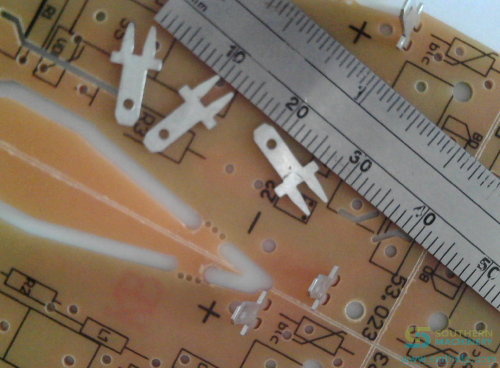
S-7000T Terminal Insertion Machine: Reel-Fed FASTON Insertion for Smart EMS THT Lines
Hand-inserting FASTON tabs, ring terminals and eyelets is one of the last truly manual bottlenecks on a through-hole line — and one of the hardest steps to make consistent. The S-7000T Terminal Insertion Machine from Southern Machinery feeds terminals from tape or bulk, inserts and clinches them automatically, and verifies each insertion. With 1–4 insertion heads, tape-fed terminals (including common TE FASTON and Zierick part numbers), 360° programmable orientation and an RS-232C link to MES, it sits between the PCB loader and the wave soldering machine and turns DIP terminal assembly into a repeatable, automated process. This guide covers what the machine does, where it fits in a line, what to specify, and how to justify the investment.
<iframe width="560" height="315" src="https://www.youtube-nocookie.com/embed/DnEYiLC77Hw?rel=0" title="Revolutionize Your Production with the S-7000T Terminal Insertion Machine" frameborder="0" allow="accelerometer; autoplay; clipboard-write; encrypted-media; gyroscope; picture-in-picture" allowfullscreen></iframe>
The S-7000T terminal insertion machine in operation — reel-fed terminal insertion for THT PCB assembly.
What is this machine used for?
The S-7000T is an automated through-hole terminal inserter. It picks terminals from a tape feeder or a bowl feeder, positions the PCB under the insertion head, drives the terminal into the plated through-hole, and clinches the lead so the part survives wave soldering. In one pass it replaces the bench operation where an operator picks a tab or terminal out of a bag, orients it, inserts it into the right hole and bends the lead with a hand tool.
That manual step is a genuine production problem, not a cosmetic one:
- Labour supply. General manual labour is getting scarcer and more expensive, and training a consistent terminal-insertion operator costs more every year.
- Consistency. Hand insertion produces variable insertion depth, variable clinch angle and variable seating — defects that only surface at wave soldering or at final test.
- Throughput. A bench operation is limited by human cycle time and human attention span across an eight-hour shift.
- Floor space and flow. Manual terminal benches are typically fed by bins of loose parts, which means kitting, sorting and material handling overhead around the line.
The S-7000T's documented performance addresses those four points directly: 5,000–6,000 CPH, servo-controlled motion with 0.001 mm/pulse resolution, a vertical error of ≤0.8°, and insertion verification so a missed or mis-seated terminal is detected at the machine rather than downstream. Tape-fed terminals can be applied at up to 2 insertions per second at 0.2 in (5.08 mm) pitch, and a single machine can be configured for up to 4 different components applied at up to 4 different angles.
Typical applications
1. Home appliance control boards. Air conditioner, microwave, induction cooker, rice cooker and washing machine control PCBs use FASTON-style tabs and terminal posts that must be seated squarely before wave soldering. This is the largest single application group for terminal insertion machines, and it is exactly the appliance industry segment Southern Machinery serves by name.
2. Automotive and vehicle electronics. Car audio, vehicle power supply and in-vehicle control boards use 6.35 mm (.250 in) and 4.75 mm (.187 in) FASTON tabs at high volume, where insertion depth variation is a reliability risk rather than a cosmetic one. The machine's insertion-verification and repeatable clinch behaviour is what makes this category worth automating.
3. Power supply, ballast and power-electronics PCBA. Power boards carry larger terminals and heavier leads; a servo-driven insertion head with programmable angle and controlled insertion height handles them more consistently than an operator with pliers.
4. Power tools and appliance sub-assembly boards. High-volume, standardised products where the terminal count per board is small but the annual volume is large — the classic case where automation pays back quickly.
5. Mixed-model EMS and ODM DIP lines. Because the machine stores programs per board type and imports data via USB, a contract manufacturer can switch between customer boards without rebuilding the mechanical setup, provided the terminal and hole dimensions fall inside the machine's window.
How it fits into a complete PCB assembly line
The S-7000T is a THT-process machine that belongs in the through-hole block, after the SMT side of the board is complete and before soldering:
- SMT side (upstream). Paste printing, SPI, pick-and-place and reflow produce the SMT side of the board. Southern Machinery supplies SMT peripheral equipment for this stage as part of the same ecosystem.
- THT block. The terminal inserter works alongside radial insertion machines and odd-form insertion machines — for example the S-3010B radial inserter for standard radial parts and the S-70LD odd-form inserter for connectors, relays and transformers. Radial, odd-form and terminal insertion together cover most of what used to be a fully manual DIP bench.
- Board handling. The S-7000T is designed to work with PCB loader and unloader machines so the insertion stage can run inline rather than load-to-load by hand — the machine's documentation explicitly states it is ready for this Industry 4.0 style configuration.
- Wave soldering (downstream). Inward or outward clinching holds each terminal in place through the flux, preheat and solder wave. The lead-free dual-wave machines in the Southern Machinery range — such as the S-WS450 and S-WS350B — are the natural partners for this stage.
- Inspection and finishing. AOI, X-ray and SPI equipment, plus stencil cleaning, PCBA cleaning and depaneling equipment, complete the line around the THT block.
- Data and MES. An RS-232C communication interface allows the S-7000T to be connected to an MES system, so insertion programs and production data can be managed at line level instead of on a memory stick.
Buyers should think in terms of the whole block: an insertion machine is only as productive as the loader feeding it, the wave solder accepting its output, and the material handling around both.
Key selection parameters
Use these categories when comparing terminal insertion machines. The values in brackets are the specifications published for the S-7000T 2-head configuration — always ask for the datasheet of the exact configuration you are quoted.
- Terminal types and packaging. Confirm which terminals you actually run. The S-7000T is documented for tape terminals including Zierick P/N 1021 / 6021 / 1198 / 6198 and TE Connectivity TAB / FASTON in 6.35 mm (.250 in) and 4.75 mm (.187 in), with tab fit 6.35 (±0.07) mm × 0.81 (±0.03) mm at 0.2 in (5.08 mm) pitch, plus bulk terminals. The page also states the machine can process any manufacturer's reeled through-hole terminal, subject to feeder tooling.
- Terminal thickness. [≥0.5 mm and ≤1.2 mm] — the insertion head and feeder are designed to the terminal thickness.
- Head count and throughput. [1–4 insertion heads optional; 5,000–6,000 CPH]. More heads means more terminals per cycle; match the number to your terminal count per board.
- Insertion angle and component mix. [360° with 1° increments; up to 4 different components at up to 4 different angles]. This is what lets one machine cover several terminal positions instead of several benches.
- Clinch type. [Inward clinching / outward clinching / "N" clinching — N optional]. Confirm which clinch form your wave-soldering process and board layout require.
- Insertion stress control. [Documented as passing the IPC-9704 stress-test standard, keeping insertion stress within ±400 µε]. This is a through-hole assembly quality parameter that is worth asking about explicitly, because excessive insertion strain damages plated barrels and barrel cracks rarely show up before field failure.
- PCB and hole requirements. [PCB 380 × 280 mm, enlarged sizes can be customised; insertion hole 0.5 ± 0.1 mm larger than the component foot; minimum body distance between components ≥2 mm]. Check these against your design guideline before committing — hole tolerance is the single most common reason a terminal insertion program fails to run reliably.
- Feeding system. [Tape feeder or bowl feeder plus feeding guide]. Reeled terminals and bulk terminals need different feeder concepts, so quote the feeder to the terminal you buy.
- Vision and programming. [Industrial high-definition camera with automatic visual correction software; online visual programming, visual correction and EXCEL-based programs; USB import or manual entry; 17-inch colour LCD; industrial PC with motion control card on Windows]. Programming effort is a real cost — ask how long a new board program takes on the machine.
- Changeover flexibility. [Optional quick-change head system]. For high-mix plants this option decides whether a changeover is minutes or hours.
- Line integration and utilities. [RS-232C for MES; loader/unloader ready; single 220 V AC 50/60 Hz 2 kVA; operating humidity 30%–70%]. Verify the electrical supply and footprint before line layout.
- Footprint and weight. [1700 × 1300 × 1600 mm for the 2-head configuration; approximately 1200 kg]. Plan floor loading and pit-free installation.
- Service and training. Confirm operator training, spare-part availability and local support coverage — in-house training and multi-brand spare parts are part of the Southern Machinery service offering.
ROI and quality perspective
Look at a terminal insertion machine as a labour-replacement and quality-stabilisation project, not as a process-technology experiment.
Labour. The bench operation it replaces scales linearly with volume: more boards means more operators, more shifts and more training cost. Automation breaks that link — one machine running at 5,000–6,000 CPH covers a volume that would need several manual positions at the same output, and it does not take breaks or rotate shifts. Southern Machinery publishes a target ROI of approximately one year for the S-7000T at typical labour-replacement volumes; treat that as the manufacturer's reference figure and run your own numbers against your local fully-loaded labour rate and your annual board volume.
Yield. Manual insertion defects — tilted terminals, insufficient insertion depth, wrong angle, missed positions — typically escape the bench and are found after wave soldering, which means rework on a soldered board. On-machine insertion verification moves detection upstream, where scrap and rework cost a fraction as much.
Board quality. Insertion force is the hidden cost in THT assembly: excessive stress cracks plated barrels and creates latent failures. The S-7000T's documented compliance with the IPC-9704 stress-test standard, with insertion stress held within ±400 µε, is precisely the kind of parameter to specify when your customer requires evidence of controlled through-hole assembly.
Consistency across shifts. A machine program produces the same insertion depth, angle and clinch on the first board of the first shift and the last board of the third. That is what makes output predictable enough to quote lead times confidently.
Material waste. Bulk terminals handled by hand spill, bend and get scrapped. Feeding from tape and using a bowl feeder with controlled handling reduces that scrap, which is also the direction of the zero-e-waste objective many EMS plants are now reporting against.
Footprint. Replacing two or three manual benches with one inserter plus a loader and unloader frees floor space that is usually more valuable than the machine's own capital cost.
FAQ
What is a terminal insertion machine used for?
A terminal insertion machine automatically inserts and clinches through-hole terminals — FASTON tabs, ring terminals, eyelets and similar parts — into a PCB before wave soldering. It replaces the manual bench operation of picking, orienting, inserting and bending terminals by hand.
How fast is the Southern Machinery S-7000T?
The S-7000T is published at 5,000–6,000 CPH with servo-controlled motion. For tape-fed FASTON-style terminals it is documented at up to 2 insertions per second at 0.2 in (5.08 mm) pitch, and it can be equipped with 1 to 4 insertion heads.
Which terminals can the S-7000T insert?
It handles tape terminals including Zierick P/N 1021 / 6021 / 1198 / 6198 and TE Connectivity TAB / FASTON in 6.35 mm and 4.75 mm sizes, with tab fit 6.35 (±0.07) mm × 0.81 (±0.03) mm at 0.2 in pitch, plus bulk terminals. Terminal thickness range is ≥0.5 mm to ≤1.2 mm. Always confirm your specific terminal against the feeder tooling with samples before ordering.
Does the S-7000T replace manual insertion labour?
It replaces the repetitive manual terminal-insertion task. In practice plants redeploy the headcount to inspection, kitting or other value-added work rather than removing it, so the business case is usually expressed as labour-cost avoidance plus yield and rework reduction.
How does the S-7000T connect to the rest of the line?
It is designed to work with PCB loader and unloader machines for inline operation, and provides an RS-232C interface for connection to an MES system. Inward or outward clinching prepares each terminal for the downstream wave soldering process.
What do I need to send for a terminal insertion machine quotation?
Send your terminal part drawings or part numbers, a component sample, the insertion-force requirement, your PCB photos and dimensions, the terminal count per board, and your target output. That is enough to confirm the feeding method, head configuration and tooling.
Contact Southern Machinery
Southern Machinery (Shenzhen, China) has designed and manufactured SMT, THT and PCB assembly automation for 237+ global customers since 2011 — insertion machines, wave soldering, board handling, cleaning, inspection and the training, spare parts and retrofit services around them.
If you are specifying a terminal insertion machine for a new DIP line, or replacing a manual terminal bench, send us your terminal samples and PCB data and we will confirm the right S-7000T configuration.
- Email: [jasonwu@smthelp.com](mailto:jasonwu@smthelp.com)
- Product page: S-7000T Terminal Insertion Machine
- S7000 series overview: PIN, Eyelet and Terminal Insertion Machine
- Catalogs and documents: file.autoinsertion.com
- Product images: ph.smthelp.com — see the Pin, Eyelet & Terminal Odd-Form Insertion album
- Website: www.smthelp.com
Comments