
ESD PCB Turnover Cart Specs by Southern Machinery
ESD PCB turnover cart specs: 350-630 mm slot plates, 200-600 board capacity, casters, buckles and cart length to verify before ordering from Southern Machinery.
Oct 7, 2026 · Updated Oct 7, 2026 · Southern Machinery
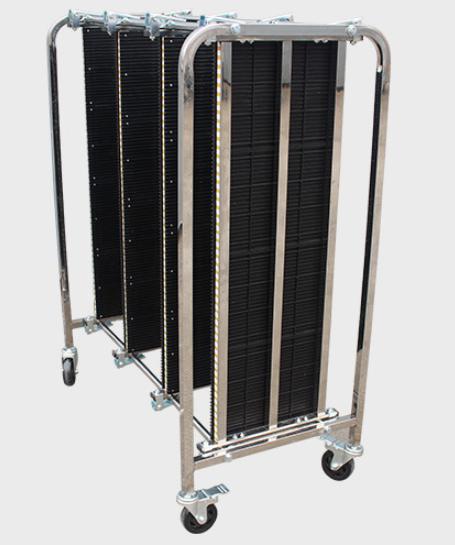
ESD PCB turnover cart specifications decide whether boards travel between stations without touching each other, without picking up static and without an extra handling step at every buffer. The Southern Machinery Anti-Static PCB Turnover Cart is a stainless steel ESD trolley whose adjustable anti-static slot plates hold 200 to 600 boards upright and separated from printing through placement, soldering, buffering and inspection. This guide covers slot plate and capacity selection, the specifications to verify before ordering, and line integration.
How does an ESD PCB turnover cart prevent board damage between stations?
Between the stencil printer and placement, and again between soldering and inspection, boards spend their most vulnerable minutes in transit. The cart targets the failure modes that later appear as scrap, rework or field returns.
Board-to-board contact in loose racks
Boards stacked or slid into loose racks scratch each other and chip components before the first test. On an ESD trolley every board sits in its own slot plate, so boards never touch and edge damage stops being a transport problem - most visible on double-sided assemblies and panels carrying tall parts after reflow.
Static discharge found late
Non-ESD racks let charge build up and discharge into sensitive boards, with the damage found later at ICT or at the customer. The cart holds boards upright in anti-static slot plates instead of against untreated surfaces.
Wasted capacity and double handling
Fixed-pitch racks lose space the moment board sizes change, so a batch needs more trips than it should. Moving boards between small racks and stations adds touches, time and ESD exposure. One cart per batch keeps boards separated through every buffer and removes re-handling at inspection.
What capacities and slot plate sizes does the turnover cart offer?
Four slot plate sizes are matched to board formats, each with a defined capacity per plate set. All figures below are the published values from the Southern Machinery product documentation.
Four slot plate sizes: 350, 460, 530 and 630 mm
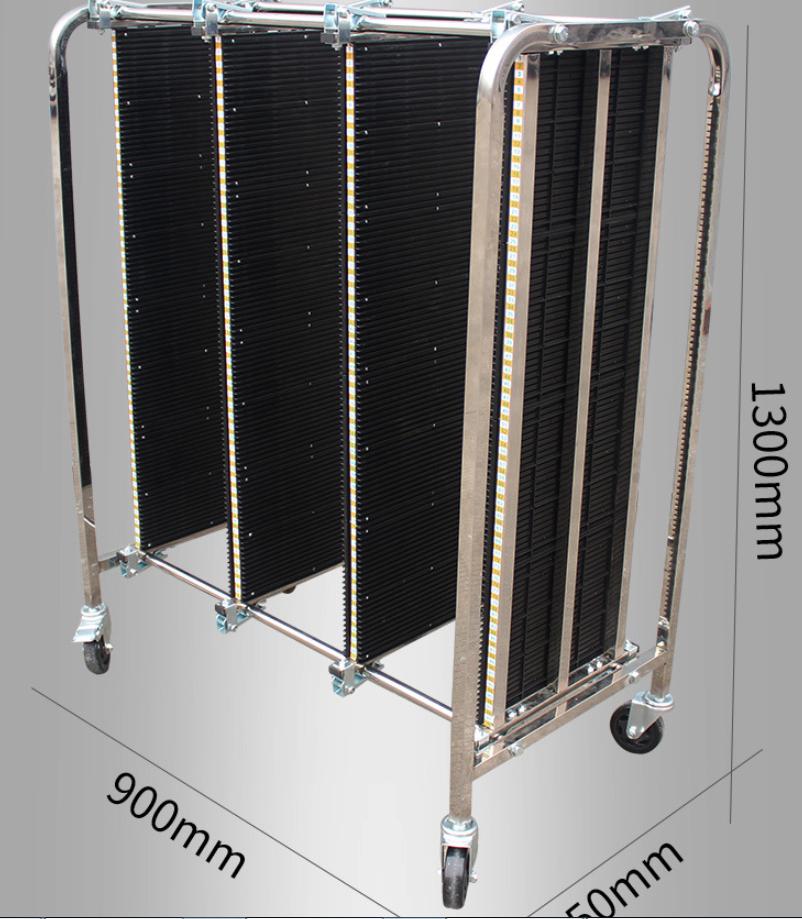
The 350, 460, 530 and 630 mm plates cover small boards up to larger LED panels. Cart dimensions follow the plate: 900 × 550 × 1300 mm for the 350 mm model, 900 × 600 × 1280 mm for the 460 mm, 900 × 650 × 1280 mm for the 530 mm and 900 × 700 × 1280 mm for the 630 mm.
Plate count sets the capacity per trip
Each slot plate set is configured for 200, 300, 400, 500 or 600 boards per set, so capacity per trip is a configuration choice rather than one fixed number. The documented reference is 600 PCBs per cart at maximum configuration, described as one trip instead of five. Column spacing stays adjustable per PCB thickness because every anti-static plate is fixed with four metal pressure buckles.
How do you choose the right configuration for your boards?
Configuration comes down to three inputs: board dimensions, board thickness and boards per batch.
Match the plate length to your PCB edge
Plate length tracks your largest board edge, from 350 mm for small assemblies to 630 mm for larger panels. An undersized plate leaves boards loose; an oversized one wastes slots and floor space. Because slot depth follows plate size, one cart body serves a fine-pitch control board or an LED panel once the plate size is reviewed.
Size capacity to your batch, not your peak day
A 200-piece set suits continuous small-batch flow, while a 500 or 600-piece set covers a full batch in one trip. In high-mix production the practical rule is one complete batch per cart, so the next product is staged while the current one is still in inspection.
Check the caster and brake setup against your floor
Two directional brake casters plus two swivel casters is the published configuration. On uneven epoxy or tile floors the brakes hold a loaded cart in position, and the swivel pair keeps the turning radius small between printing and placement.
Which specifications should you verify before you order?
Review these points against your own process before quotation, because several values are configuration-dependent and confirmed during the technical review:
- Slot plate size: 350 / 460 / 530 / 630 mm, matched to your board format
- Capacity per set: 200 / 300 / 400 / 500 / 600 boards, depending on plate count
- Cart dimensions: 900 × 550 × 1300 mm (350 mm plate) through 900 × 700 × 1280 mm (630 mm plate)
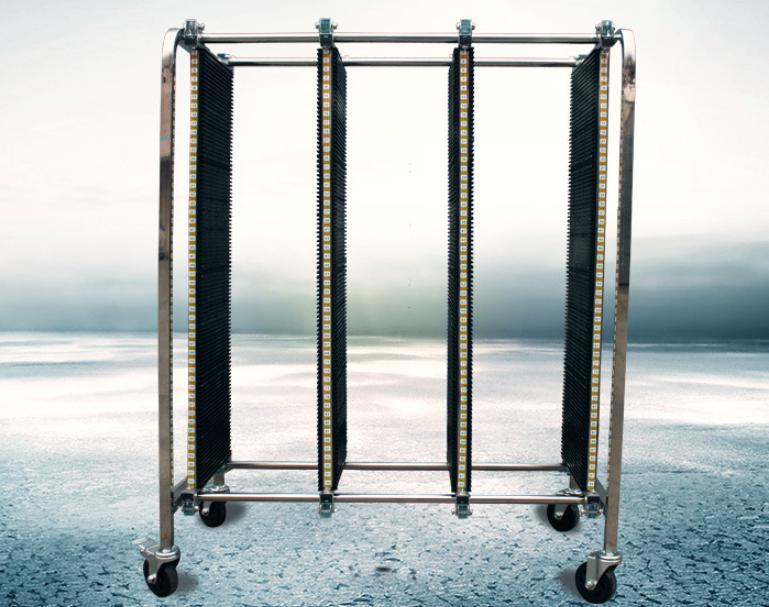
- Frame: stainless steel tube frame with corner rods and screw assembly
- Slot plates: anti-static (ESD) plates, each fixed with four metal pressure buckles
- Column spacing: adjustable per PCB thickness
- Casters: two directional brake wheels plus two universal swivel wheels
- Customization: cart length lengthened or built to your panel size
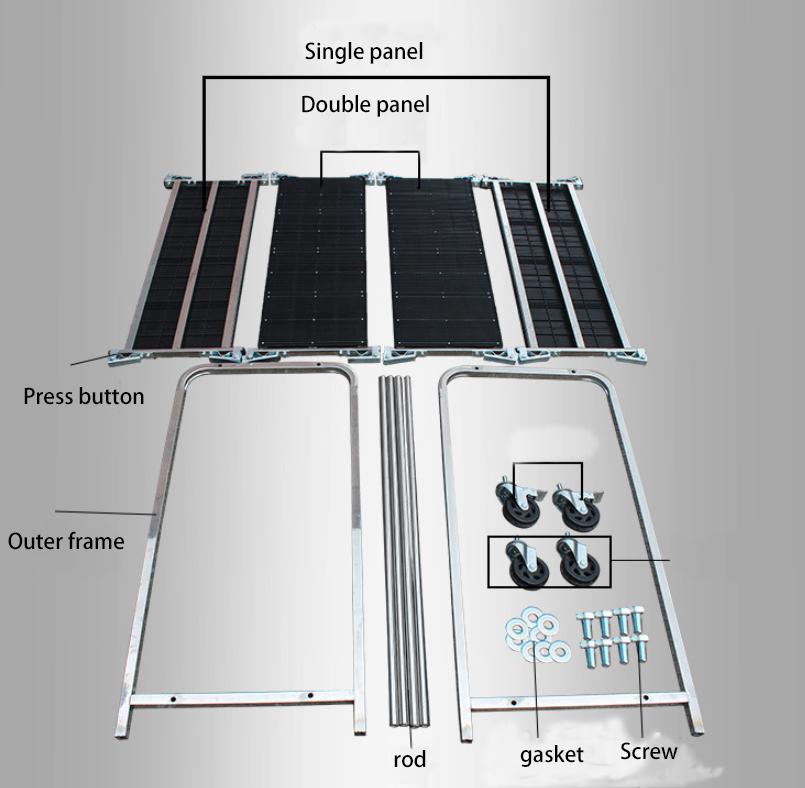
- Assembly: flat-packed, hand tools only, rods aligned to frame holes and four screws tightened
- Applications: SMT lines, THT and wave solder, reflow buffering, AOI and ICT staging, LED panels, ESD-controlled areas
ESD surface resistance values are not specified in the source documentation - request the material datasheet with your quotation to confirm the figure for your audit. Load rating in kilograms, certifications, price and delivery time are likewise not specified in source - contact Southern Machinery to confirm them for your configuration.
How does the cart fit a complete PCB assembly line?
Board handling is the thread that connects every process step, and the turnover cart is the moving buffer inside it. A typical SMT flow runs bare-board loading, stencil printing, placement, reflow, AOI and then depaneling or test; a THT flow adds insertion and wave or selective soldering. The cart carries boards upright between those stages and doubles as the staging point at AOI and ICT.
Southern Machinery builds the whole line around these transfer points - SMT line equipment, THT automation, wave soldering, board handling and inspection - alongside ESD products such as ESD trays with grids for component kitting, the ESD PCB turnover rack for vertical board storage and the ESD magazine rack range.
What is the handling value of a properly sized ESD cart?
The measurable change is trips per batch and touches per board. Use your own figures in the formula below; the example is illustrative only and depends on your configuration.
trips per batch   = boards per batch / boards per cart (round up)
touches per board = load touches + unload touches + re-handling at each buffer
Example (illustrative, depends on configuration, subject to final technical confirmation): a 2,400-board batch moved with a 600-piece cart set needs 4 trips, while the same batch split across 200-piece sets needs 12. The source documentation describes the 600-board configuration as one trip instead of five.
The quality side is the quieter saving: boards held in individual slots, upright and ESD-safe, avoid board-to-board contact and charge build-up from untreated surfaces, so defects that would surface at ICT or at the customer are removed where they are created.
Configuration support from review to after-sales
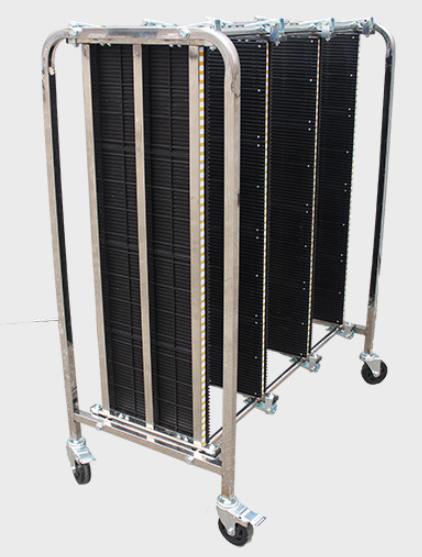
Send PCB dimensions, thickness and boards per batch; Southern Machinery recommends plate size, plate count and cart length, with custom configurations confirmed within 24 hours. Standard models ship quickly and custom lengths are built to your panel format. The cart ships flat-packed for hand-tool assembly with free installation guidance, and after-sales support covers worldwide spare plates and buckles with a one-day spare-part lead time culture.
FAQ
How many boards does one ESD turnover cart hold?
Each model is configured for 200, 300, 400, 500 or 600 pieces per set depending on the slot plate count you choose, with capacity referring to boards per set at the stated slot plate specification.
Which slot plate size do I need for my PCB?
Match plate length to your board edge: 350 mm for small boards through 630 mm for larger panels. Send your board dimensions and Southern Machinery recommends the exact configuration.
Can the column spacing change between products?
Yes. Each anti-static plate is fixed with four metal pressure buckles, so the distance between columns adjusts to the board thickness, which suits high-mix lines.
Is the turnover cart ESD-safe?
The slot plates are anti-static (ESD) material and boards are held separated and upright, eliminating board-to-board contact. For specific surface-resistance values, request the material datasheet with your quotation.
Can the cart be customized?
Yes. Cart length can be lengthened or customized to your panel size and line layout, and custom configurations are confirmed within 24 hours.
How is the cart delivered and assembled?
It ships flat-packed: align the rods with the frame holes, tighten four screws, clip the single and double panels into the buckle holes, then mount the wheels. Hand tools only, with free installation guidance included.
Next step: send your PCB size for the right cart configuration
Tell Southern Machinery your board dimensions, thickness and boards per batch. The reply gives you the slot plate model, plate count, capacity and quotation, standard and custom lengths included. Southern Machinery has supplied SMT and THT PCB assembly automation since 2011 from Shenzhen, serving more than 237 customers worldwide with global spare-parts and training support.
Review the full model tables in the Anti-Static PCB Turnover Cart catalog, or contact the team directly at info@smthelp.com, +86 13602562576, or through www.smthelp.com.
Comments