
Bulk Capacitor Lead Forming Payback: S-EPCOS by Southern Machinery
Payback for a bulk capacitor lead forming machine: capacity per shift, cost per formed part and the data to confirm before ordering with Southern Machinery.
Oct 7, 2026 · Updated Oct 7, 2026 · Southern Machinery
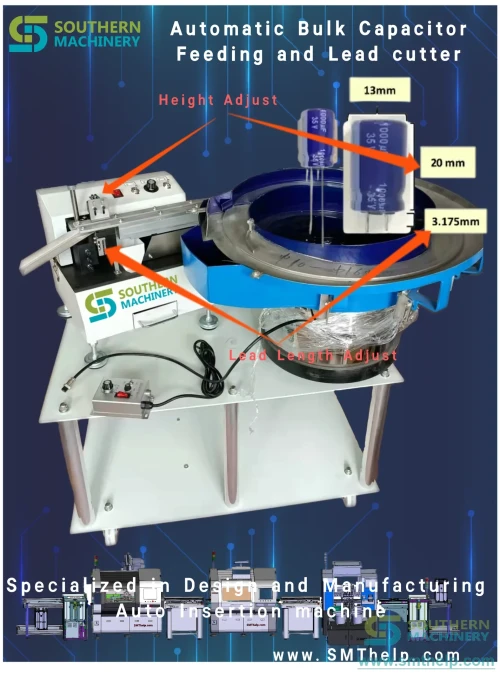
The S-EPCOS bulk capacitor lead cut and forming machine converts loose, randomly oriented capacitors into PCB-ready parts on an eight-station indexer: lead cutting, an X-direction 90° form, a Y-direction 90° form, K-leg forming and a secondary reshaping pass, at approximately 1,000 pieces per hour in the project's technical agreement. Payback is not decided by that rate alone: it is the bench labour the machine releases, the rejection cost the bench creates and the formed parts you need per year. This guide covers the documented data, the payback arithmetic and the inputs you supply before comparing quotations.
What is a bulk capacitor lead cut and forming machine used for?
A bulk capacitor lead cut and forming machine prepares loose, unsorted capacitors so their leads are cut to length and bent into the shape the board requires. The sequence is quoted step for step from the technical agreement: capacitors load into a vibratory rail, are pre-located by a stopper, picked by a manipulator, then pass through lead cutting, X-direction 90° forming, Y-direction 90° forming, K-leg forming and a secondary reshaping pass before discharge onto a conveyor. The forming requirement is stated as STATE AS-ASSEMBLED TO PCB, which is why the die is cut to the customer's drawing rather than a catalogue shape.

What the machine is not specified for
This is a loose bulk capacitor machine: parts arrive randomly oriented, and the rail orients them. Taped radial capacitors are handled by a different machine family in the same range.
How do you calculate the payback period for a capacitor lead forming machine?
The source document is blunt about this. The payback is calculated against the forming bench the machine replaces, not against a catalogue price, and the page carries no price at all. The method it publishes is one line:
simple payback in years = machine price ÷ annual freed bench labour
annual freed bench labour = operators released × loaded cost per operator per year
The four inputs you have to supply
- The quotation — excluded from the source document by design.
- Operators released — the bench heads the machine takes out of the step.
- Loaded cost per operator per year — wage plus plant overhead.
- Formed parts per year — the demand figure after your own derating.
The document is explicit about what the one-line method ignores: the rejection cost the machine removes, the rework the bench causes, and the value of the capacity multiple. The result is a floor, not a forecast.
A worked example
Example only — depends on configuration and subject to final technical confirmation. Suppose your quotation equals 2.5 × the annual loaded cost of the operators the machine releases. Then simple payback = 2.5 C ÷ C = 2.5 years, before any rejection or rework saving. The source document supplies no price and no wage.
The same arithmetic as cost per formed part
Cost per formed part = annual cost of the forming step ÷ formed parts per year. At the derated two-shift illustration below, a fixed annual cost of C works out at C ÷ 312,000 per part. The number falls as volume rises, so annual volume must be fixed before quotations are compared on price alone.
What does the machine replace on the forming bench?
Three bench failure modes are documented, each with a machine-side counterpart:
- Cut length drift — a lever jig cuts to a stop, not to a dimension, so the stop wears and the lead springs. A dedicated cutting station means the forming stations only hold form, not length.
- Two operators, two populations — the same jig in two pairs of hands gives two distributions. Averages pass incoming inspection while both sets are rejected at the insertion machine.
- Pick and orient — loose capacitors have no orientation, and this step scales worst because practice cannot improve it.
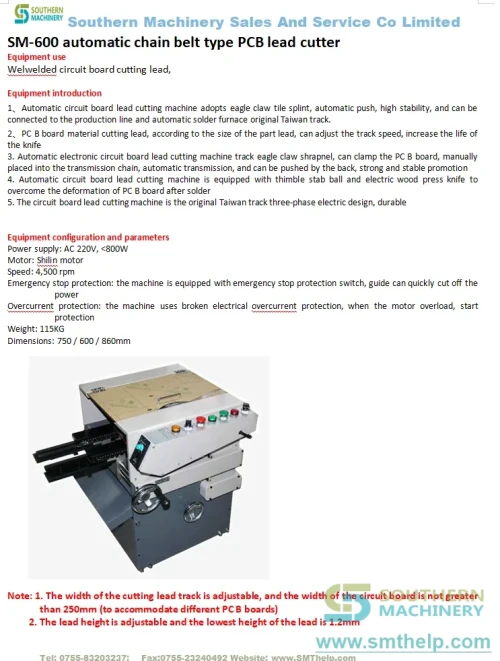
A material sensor confirms the part has reached position before releasing the next machine action, and a feed conveyor carries finished parts to a collection tray.
How many formed capacitors does it produce per shift?
The agreement quotes approximately 1,000 pieces per hour, described as a machine rate while the machine is running. Converted into planning figures:
- One shift, 8 h — 8,000 parts
- Two shifts, 16 h — 16,000 parts
- One month, two shifts (16 h × 26 d) — 416,000 parts before any derating
- One month, derated to 75% — 312,000 parts, covering bowl refill, die change and board supply
Derating is a planning choice, not a machine specification: choose a factor and keep it constant so comparisons stay honest. The 75% row is an illustration, not a promise.
Which drawing dimensions decide the die?
The die is cut to the customer's capacitor drawing, and where the drawing and a photograph of a sample disagree, the drawing governs. The figures read from the drawing on this project are:
- Bend radius — 2 × R 1.3 mm
- Outer radius — R 0.5 mm max
- Leg angle — 10° ± 0.5°
- Formed height — 12.11 ± 0.2 mm
- Formed offset — 5.82 ± 0.2 mm
- Body envelope — Ø 18.5 mm max
- Overall lead length before cutting — measured on the incoming part
The document also publishes a capability check: take ten formed parts at random from a shift and measure cut length, bend-to-bend distance and leg angle. If the spread on any one is wider than the drawing tolerance, the process is not capable, whoever is pulling the lever. Repeat it quarterly — a new capacitor supplier or a resharpened die shows up as a widening spread before it shows up as rejects.
How does the machine fit into a complete THT assembly line?
Component preparation sits between incoming material and insertion, so this machine feeds the same cell that puts the part into the board. In a THT line the parts it forms go on to THT insertion machines and then to wave soldering, with board handling moving magazines between stations and PCB assembly describing the full sequence. Where loose parts must be oriented before insertion, read the bowl-versus-belt bulk feeder trade-off alongside this machine.
What the site has to provide
- Power — AC 220 V ± 10%, 50 Hz
- Air supply — the agreement states 5–7 MPa; machine-class practice is 0.5–0.7 MPa (5–7 bar), under confirmation before order
- Footprint — approximately 1,800 × 1,200 mm, height approximately 1,900 mm, weight approximately 190 kg on an integrated cabinet, so the machine arrives as one item
- Working room — at the cutting tooling for die changes, at the scrap chute, and at the bowl end so refilling does not stop the indexer
What is documented, and what still needs confirmation?
The document prints conflicts rather than averaging them:
- Air supply — the agreement says 5–7 MPa; machine-class practice is 0.5–0.7 MPa. To be confirmed before order; the document will not ship against a guess.
- Machine model — metadata says BT-320 while the body text says non-standard, no model assigned. S-EPCOS is the project designation; a catalogue model is quoted once confirmed.
- Body diameter — the drawing's Ø 18.5 mm max governs; the photograph is evidence about a sample can, not a specification.
Not specified in source — contact Southern Machinery to confirm: price, lead time, warranty terms, rejection rates and wage levels for your plant.
FAQ
Is 1,000 pieces per hour a guaranteed output?
No. It is the machine rate quoted in the agreement while the machine is running. Shift and month figures depend on the derating factor you choose and on bowl refill, die change and board supply. Subject to final technical confirmation.
What is the difference between bulk capacitor lead forming and taped radial lead forming?
This machine is specified for loose bulk capacitors and orients them on a vibratory rail and bowl. Taped radial capacitors are handled by a different machine family in the same range.
What does the payback calculation leave out?
The rejection cost the machine removes, the rework the bench causes, and the value of the capacity multiple. The formula is a floor, not a forecast, so a payback that clears your hurdle on labour alone is the conservative case.
Can the machine form a different capacitor later?
A drawing change is a die change and nothing else, and a different can size needs different bowl and rail tooling rather than a different machine.
What should a buyer send with an enquiry?
The capacitor drawing, a photograph of the part as supplied and as formed, your formed-part volume, and the site services you can supply. The document's own suggestion is one capacitor and one drawing: Southern Machinery forms the sample and answers whether a die is right.
Next step
Send your capacitor drawing and a sample part. Southern Machinery will say which drawing dimension is likely to be tight, run the ten-part spread check on your parts, and confirm the air supply and model questions before anything is quoted. Founded in Shenzhen in 2011 and supporting 237+ global customers, Southern Machinery builds SMT and THT PCB assembly automation — insertion, wave soldering, board handling, inspection and the component preparation in front of them — with spare parts and operator training. Catalogues: file.autoinsertion.com.
Comments