
Belt Feeder vs Vibratory Bowl Feeder for Odd-Form Components by Southern Machinery
Compare belt feeders and vibratory bowl feeders for odd-form PCB assembly. This buyer guide explains where controlled belt feeding helps EMS and ODM factories reduce manual handling, stabilize component presentation, shorten configuration-dependent changeovers, and connect feeder automation into SMT, THT, odd-form insertion, board handling, and wave soldering lines. Southern Machinery supports global manufacturers with cost-effective automation, spare parts, training, and complete line integration guidance.
Jul 23, 2026 · Updated Jul 23, 2026 · Southern Machinery

Belt Feeder vs Vibratory Bowl Feeder for Odd-Form Components by Southern Machinery
For EMS, ODM, automotive electronics, medical electronics, and industrial control factories, odd-form component assembly is often where an otherwise efficient PCB assembly line slows down. Loose terminals, irregular components, and non-standard parts can force manual handling, extra operators, and unstable placement quality. The source analysis compares two approaches to this problem: the modern belt feeder and the traditional vibratory bowl feeder.
The practical question is not whether one technology is universally better. The right feeder depends on component shape, production mix, changeover frequency, space constraints, and how the feeder will connect to the pick-and-place machine or broader THT automation process. Southern Machinery uses this kind of comparison when helping buyers decide whether a belt-driven solution, a vibratory feeder, or a customized feeder platform is the more suitable route for a specific PCB assembly line.
What is this machine used for?
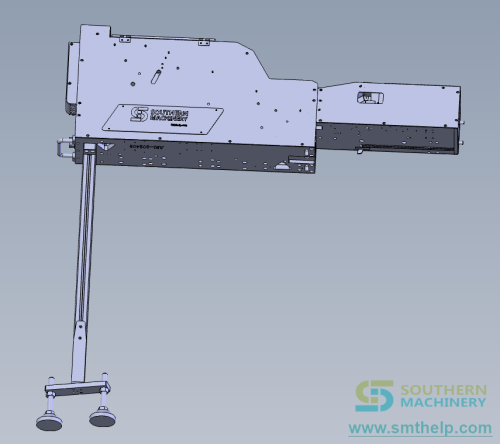
A belt feeder is used to present loose or odd-form components to automated assembly equipment in a controlled, repeatable way. Instead of relying mainly on vibration to orient parts, the belt feeder moves components along a guided transport path so they can be singulated, oriented, and delivered to a stable pick position.
In PCB assembly, this matters because many parts are not supplied in standard SMT tape-and-reel format. Factories may need to feed terminals, connectors, clips, formed leads, custom parts, or other non-standard components. When these parts are handled manually, the line can lose speed and quality consistency. A belt feeder helps reduce that manual dependency by creating a more predictable component presentation process for SMT mounters, odd-form insertion equipment, or THT automation cells.
The baseline problem: odd-form assembly is still labor-heavy
The source document identifies four recurring pain points in odd-form assembly: high labor cost, production bottlenecks, inconsistent quality, and manufacturing inflexibility. These are not abstract issues. They appear whenever operators must orient parts by hand, refill components frequently, recover from unstable feeding, or reconfigure hard-tooled feeders for a new product.
A vibratory bowl feeder can still be effective when one component runs in high volume for a long period. Its weakness appears when the factory needs agility. The source analysis describes bowl feeders as custom-tooled and slower to change over, while belt feeders are positioned as more flexible and gentler for varied components. That distinction is critical for high-mix PCB manufacturing.
Belt feeder vs vibratory bowl feeder: the practical difference
The first-principles difference is simple: vibration creates motion through agitation; a belt feeder creates motion through controlled transport. That mechanical difference changes the factory outcome.
A vibratory bowl feeder can be a strong choice for a stable, single-part, high-volume application. Once tuned, it can continuously feed one component type. But because the tooling and track geometry are usually tied closely to a specific part, product changes can require mechanical adjustment, retuning, or new tooling.
A belt feeder is better aligned with high-mix requirements. The source analysis highlights faster changeover, a smaller footprint, gentler handling, and easier operation as the key advantages. For delicate components or product families that change frequently, controlled belt movement can reduce part damage risk and make the process less dependent on technician experience.
Typical application scenarios
Belt feeders are especially relevant when a factory needs to automate loose component handling without locking the line into one fixed part geometry. Common use cases include:
- Feeding odd-form components for automated insertion or robotic pick-up.
- Presenting terminals, connectors, clips, or irregular parts that are not supplied in standard tape packaging.
- Supporting high-mix, low-volume production where frequent changeover is expected.
- Reducing manual orientation work before SMT, THT, or odd-form assembly.
- Creating a more compact feeding setup where floor space beside the line is limited.
The source comparison also points to quality-sensitive applications. A harsh vibration process may be unsuitable for delicate parts depending on component geometry and surface requirements. A belt-driven approach can be considered when gentle, linear movement is more appropriate.

How to connect a belt feeder into a complete PCB assembly line
A feeder is not an isolated purchase. Its value depends on how cleanly it connects to the rest of the line. In a Southern Machinery project, the feeder selection normally starts with the component and ends with the complete process flow.
For an SMT line, a customized feeder may be installed to present components to a compatible mounter or robotic handling station. For THT automation, the feeder may support insertion equipment, odd-form insertion machines, terminal insertion stations, or downstream handling before wave soldering. For a full PCB assembly line, the feeding cell should be planned together with board handling, conveyors, inspection checkpoints, and the soldering process.
Southern Machinery was founded in Shenzhen, China in 2011 and focuses on SMT and THT PCB assembly automation equipment. The company supports complete line planning across SMT lines, THT insertion, wave soldering, board handling, inspection, spare parts, training, and global service. For feeder projects, that line-level view is important because the best feeder is the one that improves the actual process constraint, not only the one that looks efficient on a standalone demo.
Key selection parameters for buyers
Before choosing between a belt feeder and a vibratory bowl feeder, engineering and purchasing teams should confirm these points:
- Component type, geometry, size range, and sensitivity to vibration or abrasion.
- Whether the part must be singulated, oriented, aligned, or only transported.
- Expected product mix and changeover frequency.
- Required pick position repeatability, subject to final technical confirmation.
- Target integration method with SMT mounter, robot, odd-form insertion machine, or THT insertion cell.
- Available floor space and access for operators and maintenance.
- Refill method, magazine/bin capacity, and operator intervention frequency.
- Required documentation, spare parts plan, training, and remote support.
- Whether the process needs a dedicated high-volume feeder or a more flexible feeder platform.
The source document includes example ROI inputs and comparison values such as feeder cost assumptions, changeover time assumptions, relative footprint, and a market index model. Those figures should be treated only as examples for evaluation. Actual cost, payback, footprint, and cycle impact depend on the final component, feeder configuration, integration method, and production schedule.
ROI, quality, and capacity value
The most direct ROI driver is labor reduction. If operators currently orient and load odd-form components manually, automation can shift that work into a more repeatable process. The next driver is changeover efficiency. The source analysis emphasizes that belt feeders can support faster, software-oriented adjustments compared with mechanically retooled bowl feeders, but the exact time saving must be confirmed on the real component and line setup.
Quality value comes from repeatable presentation. If parts arrive in a stable orientation at a defined pick point, the downstream machine has a better chance of placing or inserting consistently. For components that may be damaged by vibration, gentler belt transport can also reduce risk. Capacity value comes from fewer line stops, faster changeovers, and reduced dependence on highly experienced feeder tuning.
This does not mean every factory should replace every bowl feeder. The stronger conclusion is narrower: for high-mix, changeover-heavy, space-constrained, or delicate-component applications, a belt feeder deserves serious evaluation. For single-part, long-run applications, a tuned bowl feeder can remain a practical solution.
Where Southern Machinery fits
Southern Machinery serves 237+ global customers with high-efficiency, cost-effective SMT and THT automation equipment. For buyers evaluating belt feeders, the useful support is not only the feeder hardware. It is the engineering check around the component, pick-up method, line layout, installation plan, spare parts, and operator training.
A good feeder project should answer three questions before purchase: Can the part be presented reliably? Can the machine pick or insert it consistently? Can the line run with fewer manual interventions than before? Southern Machinery can help review those points and propose a configuration that fits the broader PCB assembly process.
FAQ
Is a belt feeder always better than a vibratory bowl feeder?
No. A belt feeder is usually stronger for flexible, high-mix, compact, or gentle-handling requirements. A vibratory bowl feeder can still be effective for stable high-volume production of one component type.
Can one belt feeder handle multiple component types?
The source analysis positions belt feeders as more adaptable than bowl feeders, but compatibility depends on component shape, feeding path, orientation requirement, and final fixture design. Each component should be confirmed technically before production use.
Does a belt feeder guarantee faster ROI?
No guaranteed ROI should be assumed. Payback depends on labor cost, downtime cost, changeover frequency, feeder configuration, and actual production schedule. Any ROI calculation should be treated as an example until validated with factory data.
How does a belt feeder improve quality?
The main quality benefit is stable, repeatable component presentation. Belt transport can also be gentler than vibration for some delicate components, depending on the part design and feeding method.
Can Southern Machinery integrate feeders with SMT and THT lines?
Yes. Southern Machinery focuses on SMT and THT PCB assembly automation and can support feeder integration with SMT mounters, THT insertion, odd-form insertion, board handling, wave soldering, and inspection-related line planning.
What information is needed for feeder evaluation?
Provide component drawings, photos, samples if available, target machine model, required output, current manual process, line layout constraints, and changeover expectations. Final feasibility and specifications are subject to technical confirmation.
CTA: send your component for feeder evaluation
If your PCB assembly line still depends on manual loading for odd-form components, terminals, connectors, or custom loose parts, send Southern Machinery your component details and target production process. Our team can review whether a belt feeder, vibratory feeder, or customized feeder solution is the better fit for your SMT/THT automation line.
Comments