
Simple Economical Odd Form Automation: Southern Machinery's THT Insertion Solution
Hand-inserting transformers, relays, connectors, fuse holders and other odd-form parts caps THT line throughput and hides costly rework behind operator wages. Southern Machinery's vision-guided odd-form insertion automation places non-standard through-hole components consistently at every cycle, upstream of wave soldering, without changing your existing conveyor or soldering infrastructure. Backed by 237+ global customers since 2011, the Shenzhen-based company matches a machine to your board size, component family and volume. This article explains what odd-form insertion machines do, typical applications, how the S-70LD platform fits a complete SMT/THT PCB assembly line, and the parameters buyers should evaluate first.
Sep 7, 2026 · Updated Sep 7, 2026 · Southern Machinery
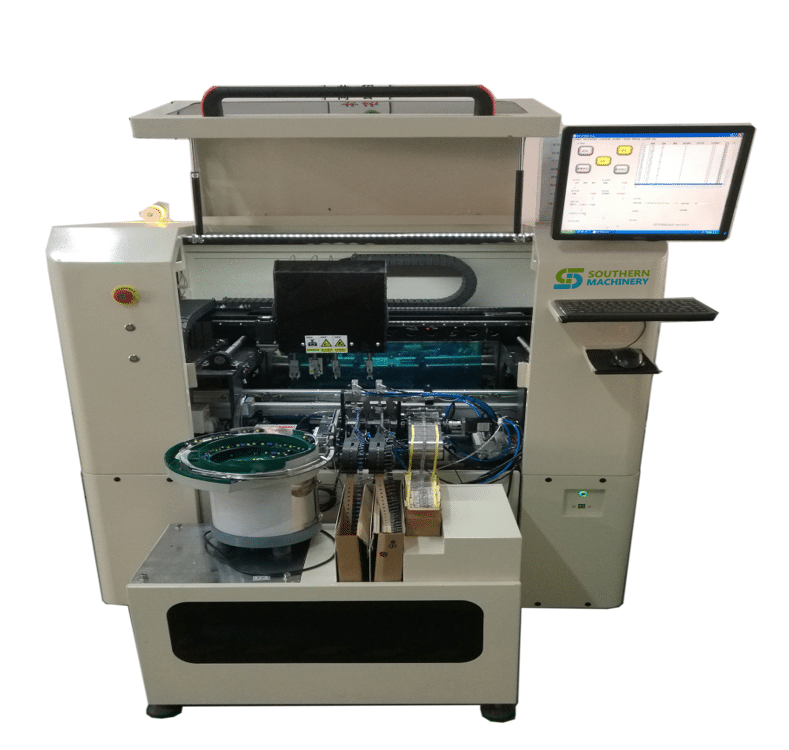
Simple, Economical Odd Form Automation: Southern Machinery's THT Insertion Solution
Transformers, relays, connectors, fuse holders, terminal blocks — the "odd-form" through-hole components that do not fit radial or axial tape are the last parts many EMS factories still insert by hand. Southern Machinery's short demo video, Your Solution for Simple Economical Odd Form Automation, shows how a vision-guided odd-form inserter removes that manual bottleneck without turning the DIP line into a complex automation project.
Southern Machinery (founded 2011, Shenzhen, China) designs and builds SMT and THT assembly automation for more than 237 global customers. The odd-form insertion platform demonstrated in this video — the same family as the S-70LD documented on smthelp.com — is the company's answer for factories that want simple, economical automation of non-standard through-hole parts.
What Is This Machine Used For?
An odd-form insertion machine automates the placement of through-hole (THT) components that cannot be fed from standard radial or axial tape. These parts arrive in trays, tubes, vibration bowls or loose bags; their bodies are asymmetrical and their lead pitches vary.
The machine shown in the demo does three jobs that manual operators do inconsistently:
- Picks the part from tape, vibration plate or ladder/tube feeding.
- Orients and verifies it with a vision system that reads the lead geometry and checks polarity before placement — 180°-rotated or reversed parts are caught at the machine, not at AOI.
- Inserts every lead to a programmed depth with consistent force, eliminating "floating high" components that pass wave soldering only to fail functional test.
On Southern Machinery's S-70LD platform, published product-page figures include an insertion speed up to 4,000 CPH (3,800 CPH for radial resistors), ±0.05 mm insertion accuracy, and handling of parts from 3×3 mm to 30×30 mm with body height up to 50 mm. For a buyer, the practical meaning is simpler: one operator supervises a station that replaces several manual insertion positions, and the output no longer depends on who is on the line or which shift is running.
Typical Applications
Odd-form automation pays off wherever the same non-standard component families repeat across boards:
- Power supplies and adapters — transformers, inductors, fuse holders, radial E-CAP capacitors and radial resistors on the same board (a classic power-board component mix).
- Home appliance control boards — relays, optoelectronic components and connectors on rice cooker, induction cooker, washing machine and TV power/control PCBs.
- Industrial controls and instrumentation — terminal blocks, relays and optocouplers on medium-volume, high-reliability boards.
- LED lighting and lamps — lamp boards combining radial E-CAPs, axial resistors and inductors, where manual polarity errors are common.
- Automotive and vehicle electronics — connectors and relays in sealed, high-vibration assemblies where a single non-seated pin is a field failure.
The common thread: these are standard odd-form families shared across multiple PCB variants, with medium-to-high volume per run.
How It Fits Into a Complete PCB Assembly Line
An odd-form inserter is one station in the THT/DIP half of a mixed-technology line:
SMT section: solder paste printing → SPI → pick and place → reflow → AOI.
THT section: radial auto insertion (S-3010B / S-3000 family) and axial insertion for taped components → odd-form insertion for non-standard parts → wave soldering → cleaning → depaneling → final AOI/functional test.
The odd-form station is designed to drop into this sequence with minimal disruption. It accepts boards through the standard SMEMA handshake on your existing conveyor and sits upstream of wave soldering, so your wave solder machine, cleaning equipment and board-handling infrastructure stay unchanged. Programmable insert orientations and fine product management let one station serve several SKUs, which keeps changeover cost per board low when component families are shared across variants.
Southern Machinery sells the full ecosystem — radial and axial inserters, odd-form platforms, wave soldering machines such as the S-WS450 and S-WS350B lead-free dual wave, PCB cleaning, depaneling and board handling systems — so the line can be engineered as one system rather than a collection of islands.
Key Selection Parameters
Buyers evaluating an odd-form insertion machine should compare these parameters against their own board and component data:
- Component envelope — largest body size and tallest component your mix contains; lead pitch and lead count of the worst-case part.
- PCB dimensions and thickness — board size range and panel thickness the machine must accept.
- Feeder flexibility — whether your parts come in tape, vibration bowl or tube/ladder presentation, and how many different feeders the machine can carry without re-setup.
- Vision capability — polarity checking, lead-geometry recognition and how the system reacts to a wrong-orientation part.
- Changeover time — how quickly you can switch between SKUs that share odd-form families.
- Line integration — SMEMA handshake, conveyor height match, and upstream/downstream compatibility with existing wave soldering.
- Utilities and footprint — power, air pressure and floor space available in your DIP area.
- Support structure — spare parts, programming training and service response.
As a published reference point, the S-70LD product page on smthelp.com lists: 4 insertion heads; 4 feeders (tape or vibration plate, adjustable); insertion speed up to 4,000 CPH; ±0.05 mm insertion accuracy; component size 3×3–30×30 mm; component height up to 50 mm; PCB size 50×50–300×300 mm; PCB thickness 0.8–5.0 mm; machine weight about 1,000 kg; 220 V AC, 0.8 kVA power; 0.4–0.6 MPa air pressure; and noise level at or below 75 dB. Use these as a baseline, then ask Southern Machinery to size a configuration from your actual panel and component list.
ROI and Quality Perspective
The visible cost of manual odd-form insertion is the operator wage. The invisible cost is larger. A connector or relay hand-inserted by an operator typically takes 4 to 10 seconds depending on familiarity, orientation and presentation; over a 5,000-board run with four odd-form parts per board, that variability can add 8 to 16 hours of unplanned labor per shift. Defects — floating high, misinsertion and reverse insertion — are usually caught only at AOI or functional test, after the board has already passed wave soldering and cleaning. Rework then means desoldering, clearing the through-holes, reinserting and re-soldering: roughly 3 to 5 minutes per board, with risk of damaging adjacent components. For a transformer with 6 to 10 pins, a single non-seated pin can cause a field failure that costs 20 to 50 times the board's assembly value to repair.
A vision-guided odd-form inserter changes the calculation: every part is seated to the same depth every cycle, polarity is verified before placement, and cycle time is predictable regardless of shift. That makes line balancing and throughput forecasting reliable instead of hopeful. The economics work best at medium-to-high volume per SKU (roughly 500+ boards per run with repeat orders) where standard odd-form families are shared across multiple board variants — exactly the profile of power supplies, appliances and industrial controls.
FAQ
What is an odd-form insertion machine?
An odd-form insertion machine is a THT automation station that places non-standard through-hole components — transformers, relays, connectors, fuse holders, terminal blocks and similar parts that cannot be fed from radial or axial tape. It picks the part from tape, vibration or tube feeding, verifies orientation with vision, and inserts it into the PCB.
What components can an odd-form insertion machine handle?
Typical parts include transformers, relays, connectors, fuse holders, terminal blocks, radial E-CAP capacitors, radial and axial resistors, inductors, and lamp/optoelectronic components. On the S-70LD platform, Southern Machinery publishes a component envelope of 3×3 mm to 30×30 mm with body height up to 50 mm.
How does odd-form automation improve quality compared with manual insertion?
Manual insertion produces variable seating, floating-high components, misinsertion and reverse (polarity) errors that are usually found only after wave soldering. Vision-guided odd-form insertion checks lead geometry and polarity before placement and applies consistent insertion force, so every lead seats to programmed depth at every cycle.
Can an odd-form inserter be added to an existing wave soldering line?
Yes. The machine is designed as an inline station that accepts boards via SMEMA handshake on the existing conveyor and sits upstream of wave soldering. Existing wave soldering, cleaning and board-handling infrastructure remain unchanged.
When does odd-form insertion automation make financial sense?
Typically at medium-to-high volume per SKU — roughly 500+ boards per run with repeat orders — when the same odd-form component families are shared across several PCB variants, so changeover cost per board stays low.
How do I get a specification and quotation for an odd-form insertion machine?
Contact Southern Machinery directly with your board size, component list and monthly volume. The team will recommend a feeder and configuration match, and can share the product catalog and specification sheets.
Contact Southern Machinery
If your DIP line still inserts transformers and relays by hand, an odd-form insertion machine is the most economical first automation step — it removes the highest-variance manual operation without rebuilding your line.
- Email: jasonwu@smthelp.com
- Website: www.smthelp.com
- Catalog and technical files: file.autoinsertion.com
- Product images: ph.smthelp.com
- Watch the demo: Your Solution for Simple Economical Odd Form Automation
Comments