
SMT Pick and Place Machine: How Tiny Chips Are Placed on a Phone Motherboard | Southern Machinery
Phone motherboards are among the densest PCBAs in mass production: hundreds of 0402 and 01005 chips, fine-pitch ICs and board-to-board connectors placed on a board the size of a credit card. This guide explains how an SMT pick and place machine actually works — how nozzles pick components from tape-and-reel feeders, how vision alignment corrects for placement offset, and how speed (CPH) and accuracy decide whether a line is profitable. Southern Machinery builds and supplies SMT placement machines, feeders, nozzles and line peripherals from Shenzhen, China, serving 237+ EMS and OEM customers worldwide. You'll learn what to evaluate before buying a mounter, how placement fits between the printer, SPI, reflow and AOI, and where quality and ROI are really won.
Sep 11, 2026 · Updated Sep 11, 2026 · Southern Machinery
SMT Pick and Place Machine: How Tiny Chips Are Placed on a Phone Motherboard
A modern smartphone mainboard can carry well over a thousand components on a board roughly the size of a credit card — 0402 and smaller chip resistors, capacitors, fine-pitch QFN/QFP ICs, BGA packages and board-to-board connectors, all placed onto pads that are thinner than a human hair. Watching a pick and place machine work at full speed looks like magic. It is not. It is a tightly controlled sequence of feeding, vision alignment and closed-loop placement, repeated tens of thousands of times per hour.
This guide explains what an SMT pick and place machine actually does, where it sits in a PCB assembly line, what to evaluate before you buy one, and how to think about ROI. It follows the theme of our video "You Won't Believe How Tiny Chips Are Placed on a Phone Motherboard!"
What is this machine used for?
The pick and place machine — also called a chip mounter or placement machine — is the station that physically puts surface-mount components onto the PCB. It performs four steps, over and over:
- Pick a component from a feeder (tape-and-reel, tube, tray or stick) using a vacuum nozzle.
- Align it — modern machines use a vision camera (flying or on-head) to measure the part's position and rotation and correct the offset.
- Place it onto the solder-paste-printed pad with controlled downward force.
- Repeat at high speed across the board — then the board indexes to the next position or exits the machine.
For a phone motherboard, the challenge is not one big component: it is hundreds of tiny ones at very fine pitch, with almost no margin for error. Placement accuracy and repeatability, not just headline speed, determine whether the board passes AOI and reflow with an acceptable first-pass yield.
Typical applications
- Mobile phones and tablets — high-density mainboards, camera modules and flex boards.
- Consumer electronics — wearables, smart-home devices, TV and appliance control boards.
- LED lighting and displays — LED boards, drivers and modules where placement speed drives cost.
- Power supplies and adapters — vehicle power supplies, energy-saving power supplies and ballast boards.
- Automotive and industrial electronics — control boards, sensors and instrument PCBs.
How it fits into a complete PCB assembly line
Placement is one link in a chain, and the line is only as fast as its slowest station:
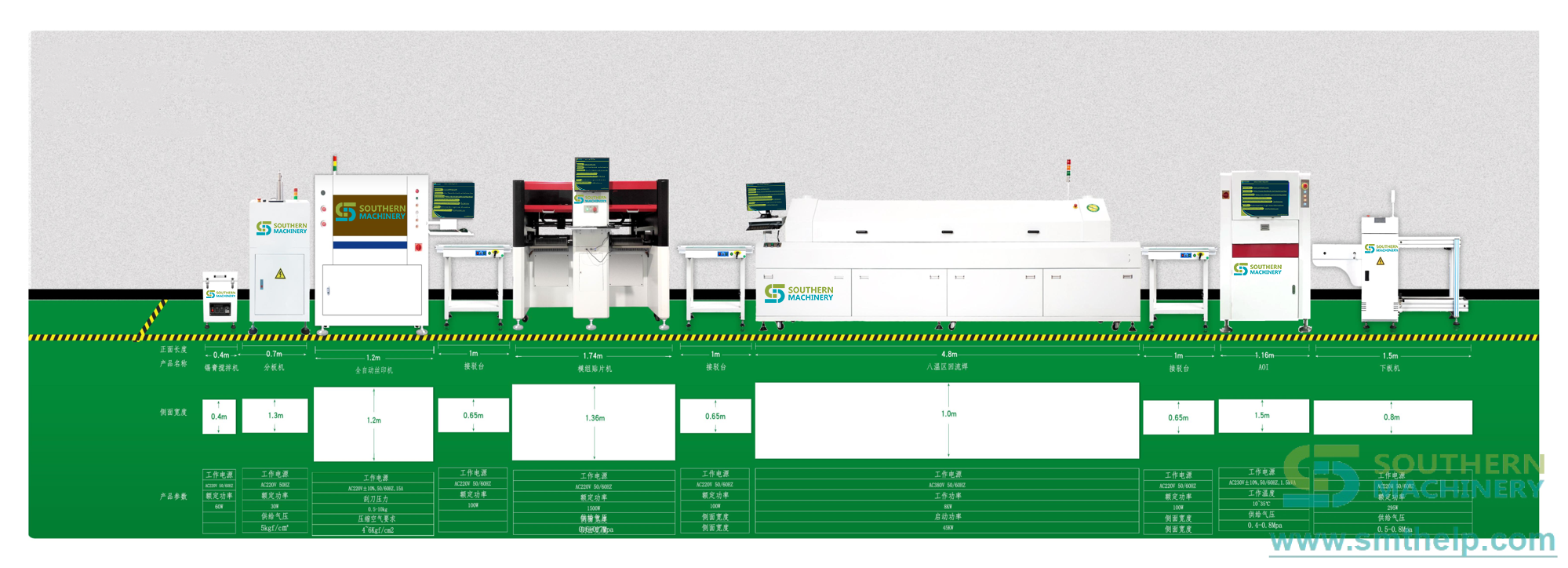
Solder paste printer → SPI → Pick and place → Reflow → AOI → (THT insertion) → Wave soldering → Cleaning → Depaneling → Board handling
In a typical SMT flow the pick and place stage sits between solder-paste printing/inspection and the reflow oven. Boards arrive from the printer on SMEMA-compatible conveyors, are populated, then move on to reflow, AOI and — for mixed-technology products — through-hole assembly.
Southern Machinery supports the whole chain, not only the mounter:
- SMT placement — semi-automatic and automatic pick and place machines such as the S-600-L, S-1200-SV, S-530L series and S-200V.
- THT auto insertion — S-3010B radial insertion machine, S-70LD odd-form insertion machine and S7020 pin/eyelet terminal inserters for the through-hole parts a mounter cannot handle.
- Wave soldering — S-WS450 and S-WS350B lead-free dual-wave soldering machines.
- Inspection and cleaning — 3D SPI/AOI machines plus ultrasonic, stencil and pallet cleaning systems.
- Board handling, feeders, nozzles and smart reel storage — the supporting equipment that keeps a line running.
Key selection parameters
When you compare placement machines, these are the parameters that decide the fit. Ask for documented values, not marketing numbers:
- Component range — smallest and largest chip size, minimum pitch, maximum component height and body size.
- Placement speed — expressed in CPH (components per hour) or seconds per chip; confirm whether it is a theoretical maximum or a realistic mixed-board value.
- Placement accuracy and repeatability — the figures that govern fine-pitch yield.
- Feeder capacity and types — number of feeder slots and support for tape, tube, tray and stick feeders.
- PCB size and handling — maximum/minimum board dimensions, thickness, and whether auto-width conveyor adjustment is supported.
- Vision system — on-head vs flying camera, and how it handles polarity, offset and bad-pick detection.
- Head / gantry configuration — number of nozzles and single vs dual gantry.
- Software and integration — offline programming, Gerber/BOM import, and MES / Industry 4.0 connectivity.
- Nozzle and tooling ecosystem — availability of the exact nozzles and grippers your component mix needs.
For reference, documented configurations in Southern Machinery's placement range include the automatic four/six-head S-600-L (0402–2512 chips, fine pitch down to 0.5 mm, ICs up to 16×12 mm) and the S-1200-SV (35,000 CPH, placement accuracy 0.1 mm, movement accuracy 0.02 mm, PCB length up to 1200 mm). High-speed LED configurations such as the six-head platform are documented at up to 38,000 CPH with 0603–7474 component coverage. Always confirm the current specification sheet for your exact configuration.
ROI and quality perspective
From a buyer's point of view, a placement machine pays back through three levers:
- First-pass yield. Better alignment and pick validation mean fewer reflows, fewer touch-ups and less scrap of expensive boards.
- Throughput per operator. Placement is the line's pace-setter; the right CPH for your mix keeps printers and ovens fully utilized.
- Changeover and uptime. Feeder setup, nozzle changes and programming time decide how many different products you can run profitably per shift.
A machine that is fast but cannot hold fine-pitch accuracy will cost more in rework than it saves in cycle time. The right approach is to match the machine to your component mix and volume, then invest in feeders, nozzles and inspection so the whole line performs consistently.
FAQ
What is an SMT pick and place machine?
It is the machine that picks surface-mount components from feeders with a vacuum nozzle and places them onto solder-paste-printed pads on a PCB, using a vision system to align each part.
What does CPH mean in SMT?
CPH means "components per hour" — a measure of placement speed. Compare real mixed-board throughput, not just the headline maximum.
Can a pick and place machine handle phone motherboards?
Yes. High-density boards with 0402 and smaller chips, fine-pitch ICs and BGAs are exactly what a modern placement machine is designed for; accuracy and repeatability matter more than raw speed.
What is the difference between semi-automatic and automatic pick and place?
Semi-automatic machines combine manual loading with automated placement for flexible, lower-volume production. Automatic inline machines integrate with the conveyor line for high-volume, hands-off operation.
Why is vision alignment important?
The camera measures each component's position and rotation and corrects the placement offset — essential for fine-pitch and small chips where mechanical positioning alone is not accurate enough.
How do I choose a placement machine for my production volume?
Start from your component mix and daily board volume, then match component range, accuracy, feeder count and PCB size. Southern Machinery can review your BOM and recommend a configuration.
Talk to Southern Machinery
Shenzhen Southern Machinery Sales And Service Co., Ltd has supplied SMT and THT assembly equipment since 2011, serving 237+ EMS and OEM customers worldwide from Shenzhen, China. Beyond placement machines we provide feeders, nozzles, spare parts, service, training and line peripherals for a complete smart-EMS factory.
- Email: jasonwu@smthelp.com
- Website: https://www.smthelp.com
- Catalog downloads: https://file.autoinsertion.com
- Product images: https://ph.smthelp.com
Send us your board size, component mix and target volume, and we will recommend the right placement configuration for your line.
Watch the video: You Won't Believe How Tiny Chips Are Placed on a Phone Motherboard!
Comments