
Yamaha Nozzle Tip Material Guide by Southern Machinery
A placement head doesn't pick a component — it picks a position through a tip, and the tip material decides whether a 0402 lifts square, whether a MELF hangs on its bore, and whether a terminal can be held at all. This g
Oct 8, 2026 · Updated Oct 8, 2026 · Southern Machinery
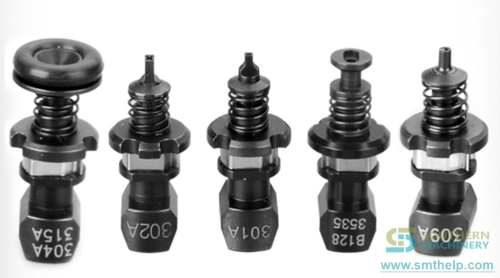
Nozzle tip material decides whether a 0402 lifts square, whether a MELF hangs on its bore, and whether a terminal can be held at all. Southern Machinery manufactures Yamaha-compatible pick-and-place nozzles in four tip-material families — ceramic, tungsten or spring steel, rubber or silicone, and metal with an O-ring — dimensionally matched to the OEM head holder for YS12, YS24, YSM, YG100, YG200, YG300, YV88, YV100, YV112, YT16 and MG heads. This guide walks through the material choice by component body, the documented mounter-to-part-number mapping, and the arithmetic of running a tip past its life.
What does the nozzle tip material actually change?
Material is a wear-and-grip trade-off: the same bore in ceramic, tungsten and rubber behaves differently on the same component, because hardness sets how fast the tip drifts and how much grip it applies.
Ceramic tips — fine-pitch chips that must not drift
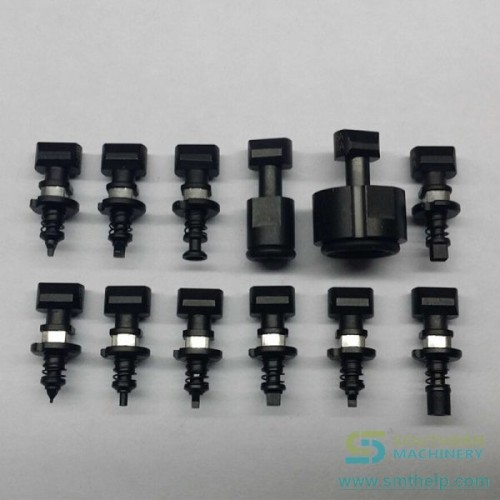
Ceramic is hard, wears slowly and carries low static — the documented choice for 0402, 0603 and 1005 chips where the pick centre must not move. It releases the part cleanly when the vacuum breaks.
Tungsten and spring-steel tips — heavy, tough bodies
Tungsten and spring steel are the rugged metal options for larger chips, MELF, IC and SOP/QFP bodies. A big bore with a ceramic edge would chip on a heavy part; metal absorbs the same pick force, so the body decides the material.
Rubber and silicone tips — sensitive and irregular bodies
Rubber and silicone grip softly and conform, which is what a fragile coating, a large electrolytic or a MELF body needs. Rubber hardens and loses grip over its life, so these tips belong with a cycle-counted swap interval.
Metal with O-ring — grippers that close on a lead
A terminal or odd-form part with no flat surface cannot be held by vacuum at all. The answer is a gripper: a metal tip with an O-ring that closes on the lead, with mini-chuck and E-cap variants alongside the vacuum tips.
How do you match tip material to the component on your line?
Read the part body and weight, and the pick force the head applies, then match the documented fields.
- Tip size window: 0.25 × 0.35 mm micro-chip tip up to Φ15.0 mm large-component tip
- Component coverage: 0402, 0603, 1005, 1608, 2012, 2125, 3216, 4532, 5650, 7343, ALC, VR, SOP, QFP, MELF and IC
- Tip materials: ceramic; tungsten or spring steel (metal); rubber or silicone; metal with O-ring
- Vacuum bore (inner/outer): Φ0.4/Φ0.7 up to Φ6.0/Φ4.5 mm
- Action and pitch: 1D/1S and 2D/2S configurations; pitch P = 0.8 – 2.0 mm
- Special geometries: V-shape, narrow-pitch, reflector, Y-shape (王), octagon and rectangle
Bore, action and pitch — the numbers that must match
The bore decides whether the part sticks and releases; a bore that is too narrow for a MELF leaves the vacuum partly engaged and the part hangs on. Action (1D/1S or 2D/2S) and pitch set how the tip meets lead spacing, so confirm all three alongside the material.
Where the odd-form geometries fit
V-shape tips cradle a cylindrical body, narrow-pitch tips reach a fine-pitch IC without disturbing its neighbours, reflector tips handle reflective parts that confuse the sensor, and Y-shape (王), octagon and rectangle profiles cover specific IC and MELF bodies.
Which Yamaha mounter family takes which nozzle series?
The mapping is documented by machine. Representative P/N series are KM0, KV6, KV7, KV8, KGS, KGT, KGR, KHN, KHY and KLF for placement, plus LC1, LC6 and LG0 for dispensing heads.
- YS12, YS24, MG-3: KLF-M77xx / KLF-M87xx — 0.35 × 0.65 → Φ8.0 mm, ceramic or metal
- YSM40, YV100X / YV100X-F: KV8-M77xx / KV8-M71Nxx — 0.25 × 0.35 → Φ15.0 mm, ceramic
- YG100R, MG-1 / MG-8: KGT-M77xx / KV8-M71Nxx — 0.35 × 0.65 → Φ4.0 / 3.0 × 2.0 mm, ceramic or metal
- YG200, YG300: KGS-M77xx / KV7-M77xx — 0.35 × 0.65 → Φ15.0 mm, ceramic or O-ring
- YV88XG, YV100II: KV7-M71xx / KV6-M71xx / KM0-M71xx — 0.7 × 0.8 → Φ15.0 mm, metal or reflector
- YS12 / YS100, YG12 / YG300: KHN-M77xx / KHY-M77xx — 0.25 × 0.35 → Φ8.0 mm, ceramic or metal
Why the part-number prefix matters more than the photo
Part numbers shown as M77xx or M71xx are series prefixes, not full numbers, and the prefix is the only reliable identity once laser marking has worn off a curved ceramic body. Machine model and head position never wear off, so label the spares register with both — not only the P/N.
Why does the wrong nozzle tip material cost more than the nozzle?
A worn or mismatched tip does not announce itself. It shows up as a rising reject rate, a skewed part that passes inspection and fails at wave solder, and the occasional stopped head mid-shift: running a tip past its life spends head time to save a purchase order.
nozzle purchase saving = nozzles replaced per year x (OEM price - Southern price) x share switched
downtime avoided       = changeover hours saved per year x downtime cost per hour
total annual saving    = nozzle purchase saving + downtime avoided
saving per nozzle      = OEM price - Southern price
Example arithmetic — every input is an assumption, not a quoted figure (example only / depends on configuration / subject to final technical confirmation; the source document publishes no prices): 400 nozzles replaced per year, OEM $85 against an aftermarket $28, 60% of that spend switchable, downtime at $120 per hour and 12 changeover hours saved per year. Purchase saving = 400 × ($85 − $28) × 0.60 = $13,680; downtime avoided = 12 × $120 = $1,440; total ≈ $15,120, or $57 per nozzle switched.
How do you tell a nozzle problem from a feeder or program problem?
Freeze the program and the feeder, then run the same part on a known-good nozzle of the correct series. If the mispick follows the nozzle, it was the tip; if it follows the position on the bank, it is the feeder; if it follows the coordinates, only then look at the program.
Then swap on evidence rather than on failure: track the cycle count per tip, clean the vacuum channel on a schedule, and set the interval from the reject rate you see. Pairing the nozzles with an S-6200 or SCM24 automatic cleaner recovers suction between swaps.
What should a Yamaha nozzle RFQ include?
- Machine model and head position: YS12, YS24, YSM, YG100, YG200, YG300, YV88, YV100, YV112, YT16 or MG
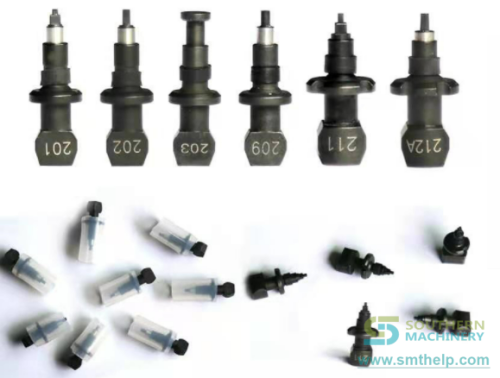
- The exact part number: or a clear straight-on and side photo of the tip next to a coin for scale
- The component: body, weight and the class you place at that head
- Volume: from a single replacement piece to a full production batch
Three documented service points belong in the enquiry: a 5-day design service for custom odd-form tips from three photographs, no CAD drawing required; a 1-day spare-parts lead time on the standard nozzle family; and a pre-ship check of tip diameter, bore, concentricity and shank fit, for a drop-in fit without re-tramming. ASM/Siemens, JUKI, FUJI NXT, Panasonic NPM and Hitachi nozzles come from the same documents.
How do these nozzles fit a complete PCB assembly line?
A nozzle is a consumable inside a placement stage. Southern Machinery builds SMT and THT automation equipment and supplies the parts that keep it producing — printing, placement, odd-form insertion, wave soldering, board handling, inspection and the spares behind them. Start from the SMT machine category or the THT machine category, the board-handling and PCB assembly categories, and the machine catalogue. Founded in Shenzhen in 2011, Southern Machinery serves 237+ customers worldwide with SMT/THT equipment, spare parts and training.
Can you make a tip that is not in the list?
Yes. The custom path starts from a photograph, because most stalled projects stall on a drawing that does not exist. Three photographs plus machine model and daily volume are the documented inputs to the 5-day design service.
Do these tips fit genuine Yamaha heads?
Yes — the shank and holder interface are matched dimensionally to the OEM nozzle for your mounter family, so the nozzle drops in without re-tramming. Send the exact part number; a first-article pick on your own tape is the final check.
Which tip material should I choose for a MELF?
The document lists rubber and metal tips for MELF-class bodies, with ceramic available depending on bore and the wear you accept. Read body and pick force first, then confirm the material with bore, action and pitch.
What is the minimum order and lead time?
From a single replacement piece to a full production batch. The standard family carries the documented 1-day spare-parts lead time; custom tips follow the quoted schedule after design.
How do I get more life out of a nozzle?
Keep the vacuum channel clean, track the cycle count per tip, and swap from a named part number before the reject rate moves.
Match your Yamaha nozzle today
Send the machine model, head position and the part number printed on the nozzle — or a clear photo of the tip — and Southern Machinery will match it against the Yamaha Mounter Nozzle List and quote a dimensionally matched nozzle with the documented 1-day lead time on the standard family. Request a quote, read the FAQ, or contact the engineering desk.
Comments