
What Is SMEMA? Auto Insertion Machine Line Integration | Southern Machinery
What SMEMA means for THT auto insertion: how the standard handshake links loaders, inserters and wave soldering into one automated PCB line.
Sep 6, 2026 · Updated Sep 6, 2026 · Southern Machinery
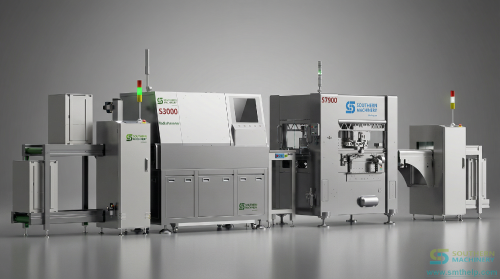
What Is SMEMA? How THT Auto Insertion Machines Use It in PCB Assembly Lines
SMEMA (Surface Mount Equipment Manufacturers Association) is the industry-standard interface that lets PCB assembly machines talk to each other and transfer boards automatically. For EMS factories running THT auto insertion machines — radial inserters, axial inserters, odd-form and terminal inserters — SMEMA compatibility is what turns a row of standalone machines into one continuous line.
This guide explains what SMEMA is, how the handshake works, and what it means when you integrate a THT auto insertion machine into an SMT/THT PCB assembly line.
What is SMEMA?
SMEMA started as the Surface Mount Equipment Manufacturers Association, the industry body that defined a common electrical interface for conveyorized PCB assembly equipment. The standard (now maintained under the IPC umbrella as IPC-SMEMA-9851) specifies how machines signal each other so a PCB can move from one process station to the next without an operator pressing buttons at every step.
In practice, "SMEMA" on a machine datasheet means the equipment can be linked inline with the rest of your line: it can tell the upstream machine "send me a board" and tell the downstream machine "I am sending you a board", using a standardized handshake.
What is this machine used for?
A THT auto insertion machine is used to place through-hole components — radial capacitors, axial diodes, relays, connectors, terminal pins, transformers and other odd-form parts — into a PCB automatically, replacing manual insertion stations. In a SMEMA-linked line, the machine works like this:
- The upstream loader or conveyor signals that a board is available.
- The insertion machine accepts the board, clamps it, and inserts components from tape, tube, tray or bulk feeders.
- The machine signals the downstream conveyor (for example, a wave soldering input conveyor) that the board is ready to move on.
No operator needs to load or unload boards between processes. The same handshake applies whether the machine is a radial insertion machine, an axial inserter, or an odd-form inserter handling mixed component types.
Why SMEMA matters for THT auto insertion
THT insertion is usually sandwiched between SMT and wave soldering. Without a standard interface, each handoff is a manual job: an operator takes boards off one machine, places them into the next, and manages buffers. That adds labor, creates handling defects, and makes the line's true cycle time hard to control.
With a SMEMA-compatible auto insertion machine:
- Boards flow automatically from the SMT reflow exit into THT insertion, then into wave soldering.
- Line balance improves — conveyors and buffers smooth out speed differences between placement, insertion and soldering.
- Fewer handling defects — boards are not touched by operators between processes, reducing ESD and mechanical damage risk.
- MES and Industry 4.0 integration is simpler — the machine can report board counts and status alongside the rest of the line.
How SMEMA works with insertion machines
The SMEMA interface is a simple, reliable electrical handshake between adjacent machines. The upstream machine signals "board available"; the downstream machine signals "ready to accept". When both conditions are met, the board transfers on the conveyor. This is why Southern Machinery's THT insertion machines and board handling equipment are described as SMEMA-compatible: they can be inserted into an existing line without custom wiring between every pair of machines.
The practical result: a loader feeds bare boards, the inserter places THT components, and an unloader or next conveyor takes the assembled board onward — all coordinated by the same standard signals used across the SMT industry.
Typical application scenarios
- EMS / contract manufacturing: mixed SMT + THT lines where the same line must run different board types with fast changeover.
- Automotive electronics: power boards, BMS control boards and instrument clusters with connectors, relays and electrolytic capacitors that cannot be reflowed.
- Home appliances: control PCBs for washing machines, air conditioners, microwaves and induction cookers with high-volume through-hole content.
- Industrial control: PLC and inverter boards with terminal blocks, transformers and large radial components.
- LED lighting and power supplies: LED driver boards and lighting PCBAs where axial and radial parts dominate.
Integrating auto insertion into a complete SMT/THT line
A typical Southern Machinery full line looks like this:
- SMT side: stencil printer → pick-and-place → reflow oven (optional SPI/AOI).
- THT side: PCB loader/magazine unloader → auto insertion machine (radial, axial, odd-form) → wave soldering or selective soldering → lead cutting and post-solder handling.
- Quality and logistics: inline AOI, cleaning, depaneling, and board handling conveyors linking every step.
Because the machines speak the same SMEMA language, you can add THT automation to an existing SMT line, or build the THT section first and connect SMT later, without redesigning the material flow.
Key selection parameters to confirm with Southern Machinery
- PCB size range and board thickness your insertion machine must accept.
- Component mix: radial vs axial vs odd-form, tape pitch (12.7 mm, 15.0 mm, etc.), bulk or tube-fed parts.
- Required insertion rate (boards per hour) to match your SMT and wave soldering capacity.
- SMEMA and conveyor interface details: rail width adjustment, board transfer height, and signal compatibility with your existing equipment.
- Clinch and cut options for leads, and whether downstream wave soldering needs specific board orientation.
- Changeover needs: how often you switch products and whether program-based setup is enough.
- After-sales support: spare parts availability, training for operators, and service response for your region.
ROI, quality and capacity
Automating THT insertion pays back through direct labor reduction, consistent insertion quality, and higher predictable throughput. Manual insertion quality depends on the operator's attention; a machine inserts every component the same way, every cycle. In high-volume EMS production, the combination of SMEMA-linked board flow and auto insertion typically removes the bottleneck between SMT and wave soldering, letting existing reflow and soldering capacity run closer to full utilization.
FAQ
What does SMEMA stand for?
SMEMA stands for Surface Mount Equipment Manufacturers Association. Its interface standard (IPC-SMEMA-9851) defines how PCB assembly machines signal each other for automatic board transfer.
Is SMEMA the same as SMEMA-compatible?
Yes, in practice. When an auto insertion machine or conveyor is described as SMEMA-compatible, it means the equipment can be linked inline using the standard handshake signals.
Can a SMEMA auto insertion machine be added to an existing SMT line?
In most cases, yes. The machine connects to your existing loader/unloader or conveyor system through the standard interface, which is why Southern Machinery emphasizes SMEMA compatibility on its board handling and THT equipment.
What machines in a PCB assembly line use SMEMA?
Printers, pick-and-place machines, reflow ovens, AOI, auto insertion machines, wave soldering machines, and the conveyors and buffers between them can all use the SMEMA interface for automatic board transfer.
Do I need MES to use SMEMA?
No. SMEMA is a simple electrical handshake between adjacent machines and works without MES. MES can be added later for production tracking, using the same machine signals for board counting and status reporting.
Which Southern Machinery THT machines support SMEMA-linked lines?
Southern Machinery's radial, axial, odd-form and terminal insertion machines, together with its PCB loaders, unloaders, conveyors and buffers, are designed to integrate into SMEMA-compatible SMT/THT lines. Contact Southern Machinery with your board size and component mix for a configuration recommendation.
Contact Southern Machinery
Southern Machinery (founded 2011, Shenzhen, China) designs and manufactures SMT/THT PCB assembly automation equipment and has served 237+ customers worldwide. From single THT insertion machines to complete SMT/THT lines — stencil printing, placement, reflow, insertion, wave soldering, board handling and inspection — the company provides high-efficiency, cost-effective automation with global support, spare parts and training.
- Ask for a configuration recommendation: jasonwu@smthelp.com / +86 13602562576
- Browse the machine catalog: https://file.autoinsertion.com
- See machine photos: https://ph.smthelp.com
- Watch the demo video: https://www.youtube.com/watch?v=bP93XcT-c2U
Comments