
Wave Soldering Fingers and Titanium Claws: The Conveyor Consumable That Decides THT Solder Quality
Every THT board that crosses a Wave Soldering machine is carried by its edges on conveyor fingers — the claw-shaped links that hold the PCB through fluxing, preheat, the solder wave and cooling. They are among the least expensive parts on the line and among the most decisive: worn or corroded claws change board flatness, wave contact and solder bridging. This guide from Southern Machinery covers titanium claws and resin claws — what they do, how to choose between L and V profiles, what to confirm before ordering, and how the consumable fits a complete SMT/THT PCB assembly line.
Sep 22, 2026 · Updated Sep 22, 2026 · Southern Machinery
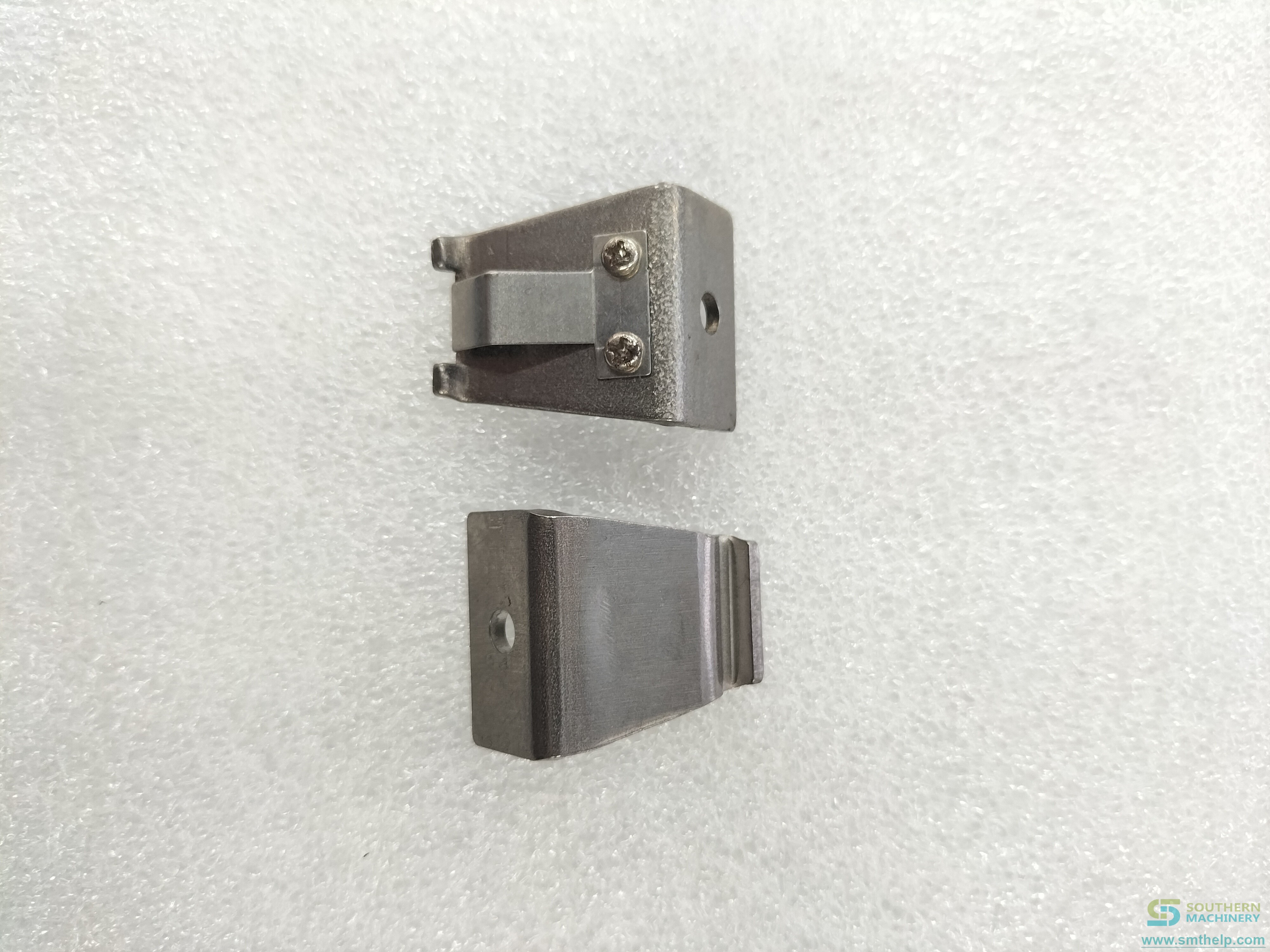
Wave Soldering Fingers and Titanium Claws: Selecting the Conveyor Consumable That Decides THT Solder Quality
Every THT (through-hole technology) board that crosses a Wave Soldering machine is carried by its edges on conveyor fingers — the claw-shaped links that hold the PCB through fluxing, preheat, the solder wave and cooling. They are among the least expensive parts on the line and among the most decisive. A worn, corroded or misaligned claw changes how flat the board sits, how deeply it enters the wave, and how much solder bridges between pads.
Southern Machinery Sales And Service Co., Ltd has supplied these consumables since 2011 from Shenzhen, Guangdong, to SMT and THT assembly operations in electrical appliance, power supply, LED lighting, automotive and general electronics manufacturing. This guide explains what wave soldering fingers do, how titanium claws compare with resin claws, which selection parameters actually matter, and how the consumable sits inside a complete PCB assembly line.
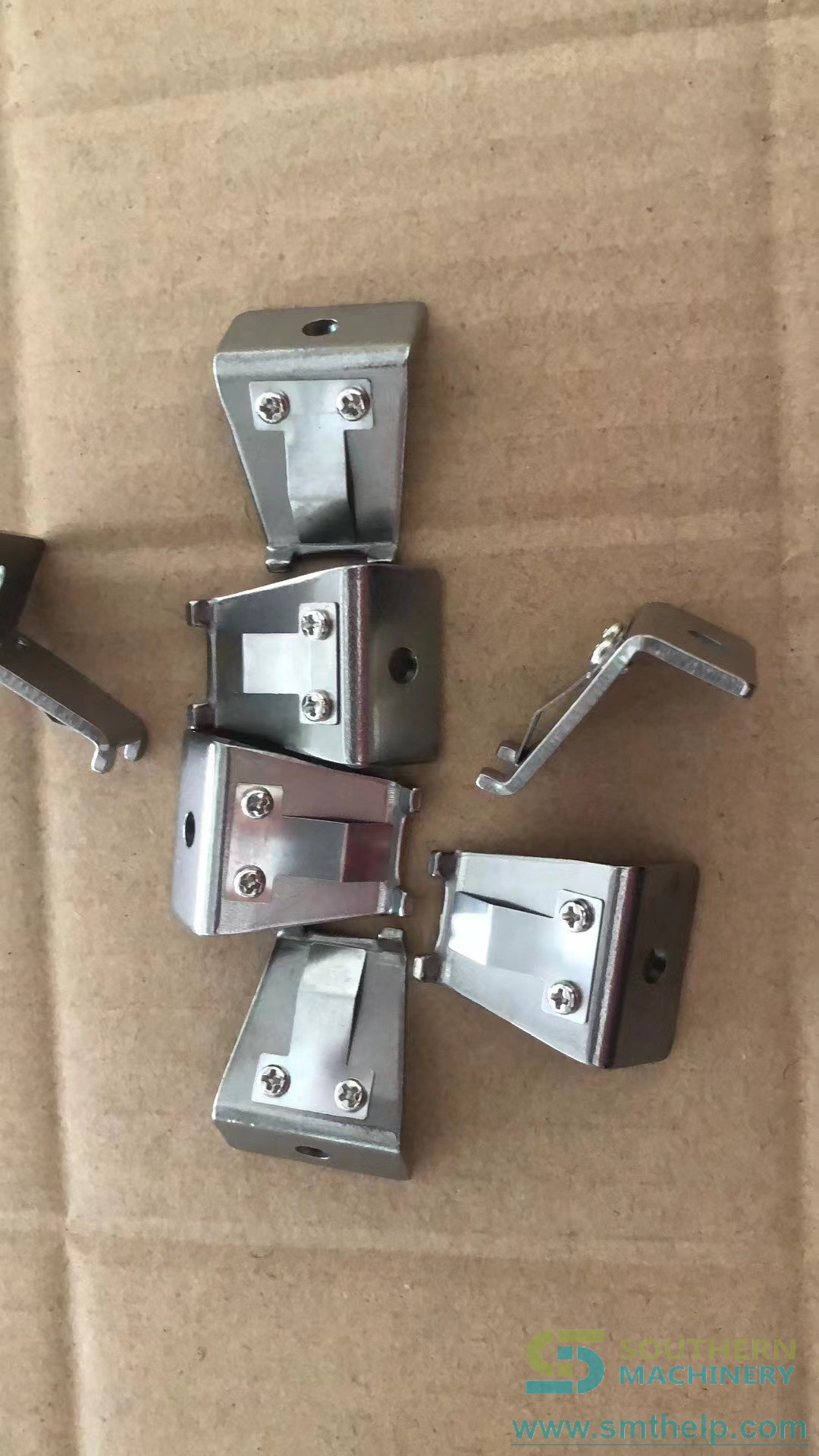
What is a wave soldering finger used for?
A wave soldering finger — also called a conveyor claw, chain claw, or titanium finger — is the board-carrying element of a wave soldering conveyor. Mounted at intervals along the two conveyor chains, each claw grips one edge of the PCB by a few millimetres and transports it through every process zone of the machine.
In short: the finger is what holds the board while it is soldered. It must do four things at once.
- Grip without damaging the board edge. The claw holds the PCB edge; the contact area must be enough to carry the board without marking the laminate or the finished copper.
- Survive continuous immersion in molten solder. The claw passes over the wave alongside the board, on every cycle, for the life of the consumable.
- Resist flux and flux fumes. Aggressive water-soluble and high-solids fluxes attack metal quickly.
- Stay dimensionally stable at process temperature. A claw that deforms will not return the board to the same height and angle on the next pass.
Why the consumable decides solder quality more than most buyers expect
Wave soldering quality is largely settled before the solder touches the joint. Board flatness, board height and wave contact depth all depend on the tooling that carries the board. When claws wear or corrode, the typical shop-floor symptoms are:
- Uneven hole fill between the two board edges — one claw sits lower than the other, so one edge meets the wave shallower than the other.
- Bridging and solder balls — a board that does not sit flat flows solder where it should not.
- Component shadowing and skipped joints — the wave cannot reach behind large components when board attitude drifts.
- Board drop and line stops — a claw that has lost its grip releases the board into the machine.
- Flux transfer to the next board — contaminated claws and carry-over residues reintroduce defects on the following panel.
This is why Southern Machinery publishes dedicated process material on this single consumable, including Wave Soldering Machine Titanium Finger Claws Process Control and Wave Soldering Machine Finger Claw Control — Maximizing Soldering Yield, both listed on the company's product pages.
Titanium claws vs resin claws: the material decision
Southern Machinery supplies both the metal and the composite variants, and the choice is driven by machine type, alloy and flux chemistry rather than by price alone.
Titanium fingers and claws
Full-titanium fingers are the standard fit on the company's own wave soldering machines and are the reference consumable for lead-free processes. Southern Machinery states plainly on its finger product pages: "We supply Titanium fingers and supports for leading Wave solder machine. All fingers are manufactured from high grade materials and to high engineering quality standards."
Titanium is specified where:
- the line runs lead-free alloys at high pot temperature,
- the flux chemistry is aggressive water-soluble or high-solids,
- the product mix includes heavy or multi-layer boards that need stable dual-edge grip,
- claw life and dimensional stability matter more than unit cost.
Resin claws
Resin claw fingers are the composite, lower-weight option. Southern Machinery's published position is that they are custom-made to the machine: "Only one sample is needed to customize." They are typically chosen for lighter boards and where a non-metallic claw footprint is preferred at the board edge.
The published comparison, stated simply
| Material | Where it is the reference choice | What the buyer should verify |
|---|---|---|
| Titanium finger / claw | Lead-free Wave Soldering; aggressive flux; heavy and multi-layer boards; long-life consumable policy | Claw profile (L or V), chain pitch and link interface for your machine, alloy compatibility |
| Resin claw | Lighter THT boards; non-metallic edge contact preference | Hardness and temperature rating at your pot setpoint, sample fit test before volume order |
The practical answer for most EMS and ODM lines running lead-free solder is titanium as the baseline, with resin claws as a targeted fit for specific board families.
Typical applications
Wave soldering fingers and claws are consumed wherever a conveyorised soldering process runs. In Southern Machinery's customer base that means:
- Power supply and ballast assembly — dense THT boards with large electrolytics and transformers that need a stable, flat board attitude over the wave.
- Electrical appliance control boards — air conditioner, TV, microwave, induction cooker and electric kettle PCBs, where high daily volume multiplies the value of consumable life.
- LED lighting and LED display — driver boards, lighting strips and display modules, frequently narrow and long, where edge grip geometry is critical.
- Automotive electronics and vehicle power supply — boards with heavier copper and stricter cosmetic requirements at the board edge.
- General EMS / ODM contract manufacturing — high-mix environments where several claw types must be held in stock as a maintenance item rather than ordered per job.
The same consumable logic applies across the company's wave soldering range, from the compact S-WS250 for boards up to 250 mm wide, through the S-WS350B and S-WS450 for 350 mm and 450 mm board classes, to the S-SW450 titanium double claw nitrogen machine.
How the finger consumable connects to a complete PCB assembly line
A wave soldering conveyor is a chain of claws. Southern Machinery's own published machine specifications show how tightly the consumable is tied to the process:
| Machine | Published conveyor and pot data | Published finger / claw specification |
|---|---|---|
| S-WS450 | Conveyor speed 0–2000 mm/min; conveyor angle 4–7°; PCB up to 50–450 mm; full titanium solder pot; pot temperature 350 °C with ±1–2 °C control precision; lead-free pot capacity 450 kg | Finger: Double hook claw (standard); finger cleaning system: brush |
| S-WS350B | Conveyor speed 300–1800 mm/min; PCB 50–350 mm; tin stove 9 kW, approximately 320 kg; tin stove temperature room temperature to 300 °C, ±1–2 °C; PC + PLC control with auto add tin as an option | Chain claws: titanium alloy stamping parts, 2.0 mm thickening |
| S-WS250 | Conveyor speed 0–1.8 m/min; conveyor angle 3–7°; PCB up to 50–250 mm; two solder pot waves; solder pot 6 kW, approximately 200 kg; pot temperature room temperature to 300 °C, ±1–2 °C | Double-wave conveyor with fan cooling stage |
| S-SW450 (nitrogen) | Inert nitrogen atmosphere; full titanium solder pot casting; quick-change solder pot for two or more alloys | Titanium double claw conveyor for heavy or complex boards |
Read across that table and the line-integration logic becomes obvious. The claw specification is not an accessory — it is written into the conveyor specification, the pot capacity and the flux system.
Where the line fits around the consumable
A complete THT flow using this consumable looks like this:
- Component preparation — lead forming, and where applicable odd-form component preparation.
- Insertion — by hand or by auto insertion machine for radial, axial and odd-form parts.
- Fluxing — reciprocating spray or, on the S-SW450, an ultrasonic atomizing spray system with titanium nozzle and horn assemblies.
- Preheat — multi-zone; for example four zones over 1800 mm on the S-WS450, and three PID zones at 15 kW over 1800 mm on the S-WS350B.
- Wave soldering — the board carried on its fingers crosses the solder wave.
- Cooling — for example the centrifugal wind convection cooling knife on the S-WS350B.
- Outfeed and unloading — board handling modules, unloaders and inspection.
- Inspection — AOI and, upstream, SPI where SMT and THT share the board.
Southern Machinery supplies at every one of those steps — auto insertion machines, wave soldering machines, board handling, cleaning and inspection equipment — plus the spare parts and consumables that keep the line running. That is what makes a consumables conversation with the company useful: the finger recommendation comes with the conveyor, pot and flux specification of the machine it has to survive.
Key selection parameters to confirm before ordering
Southern Machinery publishes the finger profile (L or V type) and the fitted-machine compatibility, but the following parameters are board- and line-specific. Confirm each one in writing before placing a volume order — this is a checklist, not a set of generic values.
| Parameter | What to confirm |
|---|---|
| Claw profile | L type or V type, and the profile matched to your existing chain links |
| Machine compatibility | The exact wave soldering machine brand and model the claw must fit |
| Chain pitch and link interface | Claw spacing and the mounting interface on your conveyor chain |
| Material | Titanium versus resin claw, matched to alloy and flux chemistry |
| Board edge contact | Board thickness range and permitted edge contact area |
| Process temperature and alloy | Pot setpoint and whether the alloy is lead-free |
| Flux chemistry | Water-soluble, high-solids or no-clean, and the resulting corrosion demand |
| Consumable policy | Quantity held as line-side spare versus ordered per campaign |
| Cleaning method | How claws are cleaned in service — the S-WS450, for example, specifies a brush finger cleaning system |
Published compatibility, customisation and commercial terms
Southern Machinery's finger product pages publish the service envelope directly, which makes qualification straightforward:
- Compatible wave solder machine brands (as published): Soltec, Electrovert, Seho, Sensby, Senju, Koki and JT. The company states it manufactures titanium fingers and supports for leading wave solder machines and can produce customised variants on request.
- Model designation: L or V type.
- Condition and testing: new, and 100 % tested workable.
- Customisation: resin claws and titanium claws can be custom made — only one sample is needed to customise.
- Commercial terms as published on the product page: free sample support, a 7-day lead time, a 3-month warranty, and video and online after-sales support. Place of origin: Guangdong, China.
- Consumables value positioning: Southern Machinery publishes an average saving of up to 40 % on its made-in-China SMT nozzles, feeders, spare parts and consumables.
Because these figures are published terms rather than project-specific quotations, treat them as the starting point for a written confirmation covering your claw profile, quantity and machine model.
ROI, quality and throughput: the business case for treating claws as a managed consumable
Claws are a consumable, so they are usually bought reactively — when a board drops or an operator notices a bad edge. Four cost lines argue for managing them deliberately instead.
1. Solder defect cost. Bridging, incomplete hole fill and solder balls are rework or scrap. The mechanism is often mechanical — unequal claw height or a board that does not sit flat — not chemical. Replacing worn claws at a planned interval removes a whole class of defects from the Pareto chart.
2. Dross and solder consumption. Southern Machinery states on its S-SW450 nitrogen machine page that standard wave soldering faces three expensive problems, the first being high dross generation: "Oxygen exposure creates solder dross (waste), costing factories thousands of dollars monthly in lost material." Poorly maintained claw geometry that lets boards sit badly drives more solder contact time in the wrong places. Consumable discipline and pot discipline are the same project.
3. Line stoppage. An unexpected claw failure stops the wave. A planned change-out during a low-load window costs minutes; an unplanned stop costs a shift. For lines running the S-WS450 at conveyor speeds up to 2000 mm/min, the throughput value of every stopped minute is easy to calculate.
4. Pot and machine life. The published S-SW450 feature set includes a lifetime warranty on the solder pot casting for the original owner, and a quick-change solder pot for switching between two or more alloys. Consumables that corrode and shed material into the pot work against that asset. Treating claws, fingers and the pot as one maintenance scope protects the machine.
Set the review at a fixed interval — quarterly for high-volume lines — and record claw condition, defect type and board edge quality together. That gives a defensible consumable change interval rather than a reactive one.
FAQ
What is a wave soldering finger?
A wave soldering finger (conveyor claw, chain claw or titanium finger) is the board-carrying element mounted on the wave soldering conveyor chain. It grips the PCB edge and transports the board through fluxing, preheat, the solder wave and cooling.
What is the difference between a titanium claw and a resin claw?
Titanium claws are metal fingers used as the reference consumable for lead-free Wave Soldering, aggressive fluxes and heavy or multi-layer boards, where dimensional stability and life matter. Resin claws are the composite option, typically used for lighter THT boards and customised to the machine — Southern Machinery states that only one sample is needed to customise.
Which wave soldering machines can Southern Machinery's fingers fit?
The company publishes compatibility with Soltec, Electrovert, Seho, Sensby, Senju, Koki and JT wave solder machines, in L or V type profiles, and offers customised fingers for other machine models.
How long does it take to get wave soldering fingers?
Southern Machinery publishes a 7-day lead time for the L or V type titanium finger, with free sample support and a 3-month warranty. Confirm against your specific profile and quantity at quotation.
Can worn conveyor claws really cause solder defects?
Yes. Claws set board flatness, board height and wave contact depth. Unequal or deformed claws produce uneven hole fill between board edges, bridging, solder balls, component shadowing, and in the worst case board drop. Much of what looks like a process chemistry problem is actually tooling geometry.
Do wave soldering fingers need to be part of a maintenance plan?
They should be. Because claws are consumables, they are often replaced reactively. Managing them as a planned maintenance item — with a defined interval, a line-side spare quantity and a record of claw condition against defect type — converts an unpredictable stoppage risk into a scheduled cost.
Get a configuration recommendation from Southern Machinery
Southern Machinery Sales And Service Co., Ltd has designed and manufactured SMT and THT PCB assembly equipment from Shenzhen since March 2011, serves 237+ customers worldwide, and supports complete line solutions across SMT, THT, Wave Soldering, board handling and inspection.
To move from this guide to a quotation, send us four things: your wave soldering machine brand and model, the claw profile (L or V), the alloy and flux chemistry, and your monthly board volume. We will confirm the finger specification, the sample arrangement and the spare-quantity recommendation for your line.
- Email: jasonwu@smthelp.com
- Phone / WhatsApp: +86 13602562576
- Product images and machine photos: ph.smthelp.com
- Catalogues, manuals and PDF downloads: file.autoinsertion.com
Browse the full wave soldering, auto insertion, board handling and cleaning portfolio at smthelp.com, or ask us for a line configuration recommendation.
Titanium claws for wave soldering machines — supplied by Southern Machinery in L and V type profiles, customisable to your conveyor.
Comments