
Washing Machine Control PCB Assembly: Axial & Radial Auto Insertion by Southern Machinery
Automate washing machine control PCB assembly with Southern Machinery axial and radial auto insertion: consistent THT quality, less labor and fewer defects.
Sep 5, 2026 · Updated Sep 5, 2026 · Southern Machinery
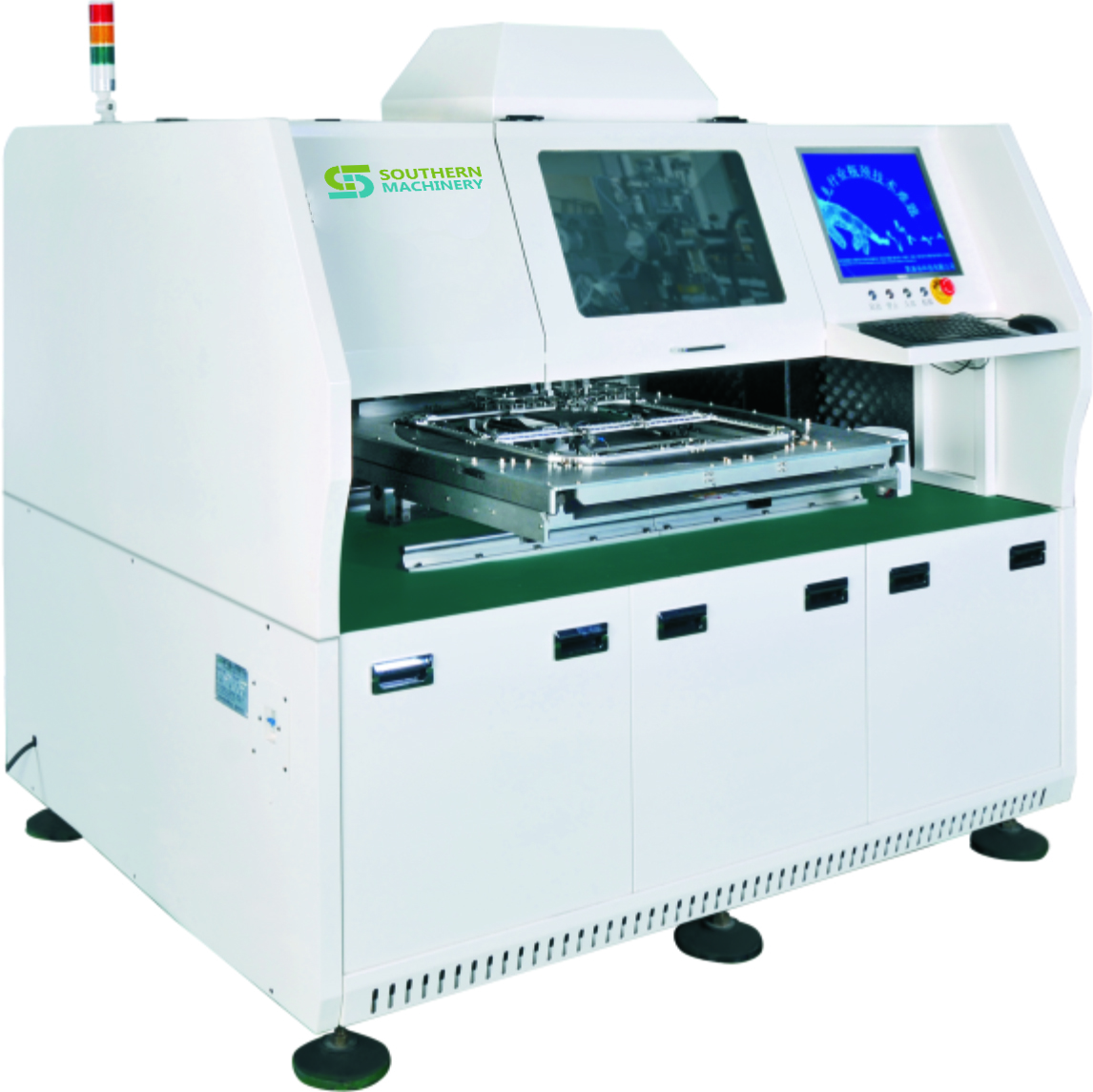
Washing Machine Control PCB Assembly: Axial & Radial Auto Insertion by Southern Machinery
Washing machine control boards are classic high-volume through-hole (THT) products: a power supply section with bridge rectifiers, triacs and relays; a motor drive area with large electrolytic capacitors; and a logic section where resistors and diodes arrive on taped axial or radial carriers. On a busy appliance line, those components are still often inserted by hand—operator after operator, board after board.
Southern Machinery (Shenzhen, China) showcases the automated alternative on its official channel: an axial and radial insertion machine assembling washing machine control PCBs at an appliance manufacturing site in Uzbekistan. The demo shows the same taped axial and radial parts that dominate washing machine, air conditioner and other white-goods control boards being cut, formed, inserted and clinched automatically. This article explains how axial and radial auto insertion works for washing machine control PCB assembly, what to verify before you buy, and how the automation pays for itself.
What is this machine used for?
An axial and radial auto insertion machine automatically places the through-hole (THT) components on appliance control PCBs. In the context of a washing machine control board:
- The radial station feeds taped radial-lead parts—electrolytic and film capacitors, transistors, varistors, and similar components whose two leads exit from the same side of the body.
- The axial station feeds taped axial-lead parts—resistors, diodes and jumpers whose leads exit from opposite ends of the body.
Each station cuts the leads from the tape, forms them to the correct span, inserts them into the plated through-holes, and clinches them under the board. The board leaves the machine with components mechanically locked in place, ready for wave soldering—with no operator-dependent variation in insertion depth, lead forming or polarity judgment.
In the field video from Uzbekistan, the machine is shown running washing machine control PCBs—exactly the component mix described above, on a board that repeats in high volume across a production week.
Why washing machine control PCBs suit auto insertion
Three characteristics make white-goods control boards a natural fit:
- High volume with a stable BOM. A washing machine model runs for years with the same control board design. Once the program and feeder setup are proven, the same insertion pattern repeats without rework.
- THT-heavy, taped components. Most of the through-hole content on appliance control boards—resistors, diodes, capacitors, varistors—is supplied on taped carriers, which is precisely what axial and radial inserters are built to consume.
- Consistency that manual insertion cannot match. Insertion depth, clinch quality and polarity remain identical at the end of the shift as at the start. For safety-related boards inside a 220 V appliance, that consistency matters.
Typical application scenarios
- Washing machine manufacturers — control PCB assembly for front-load and top-load machines, including the power, motor-drive and display sections of the board.
- Other white-goods and appliance OEMs — air conditioner indoor/outdoor control boards, microwave oven control boards, rice cookers, induction cookers and electric kettles use the same component families and can run on the same machine platform with a program change.
- EMS/ODM factories serving the appliance market — contract manufacturers who build control boards for multiple appliance brands benefit from fast program changeover rather than a dedicated hard-wired line.
- Industrial control and power supply producers — the same axial and radial platforms handle power supply boards, relay boards and motor control PCBs with comparable THT mixes.
How axial and radial insertion fits a complete PCB assembly line
A washing machine control board typically follows this flow:
PCB loading → axial & radial insertion → optional odd-form/manual station → wave soldering → post-solder lead cutting → cleaning → inspection/test
Southern Machinery supplies the line end to end:
- Board handling — magazine loader/unloader and conveyors feed bare boards and carry them between stations using standard SMEMA-compatible interfaces.
- Axial and radial insertion — the S4000 axial insertion machine handles taped axial resistors and diodes; the S3000-family radial insertion machine places radial capacitors, transistors and varistors. On the S3000 platform, component replenishment can be done without stopping the machine, and PCB loading can be manual or automatic.
- Odd-form and manual stations — connectors, relays, transformers and other non-taped parts are added by an odd-form insertion machine or a short manual station with guided assembly.
- Wave soldering — a lead-free wave soldering machine solders all through-hole joints in one pass.
- Post-solder processing — inline lead cutting, cleaning and inspection close the loop before functional test and final assembly.
Because each machine is a standard conveyor-width module, the same equipment can also be added to an existing line one station at a time.
Verified platform highlights
The following points come from Southern Machinery's published product documentation:
- S3000 radial insertion platform — offered in single-, dual-, triple- and quad-span variants with lead-span capability up to 10 mm, covering the capacitor and transistor lead pitches typical of appliance control boards. The platform supports component verifier checking, component replenishment without machine stoppage, manual or automatic PCB load/unload, a configurable sequencer (in-line or straight-back), and a graphical operator interface.
- Electrical safety testing — the S3000 radial insertion machine has been tested against EN 60204-1 (safety of machinery—electrical equipment), with the test report covering the S3000/S3010/S3020/S3040/S3060 model family and listing 220–230 V~, 50/60 Hz, 10 A input at 1.6 kW power.
- S4000 axial insertion machine — designed for taped axial components with an easy-to-use operator interface; the S4000 documentation highlights strong machine flexibility, lower cost of ownership, and reduced load time by running two PCBs at once. Southern positions it for LED, electrical, vehicle, energy-saving lighting and power supply electronics—the same industries that build washing machine control boards.
Treat these as platform capabilities, not a universal spec for every configuration. The machine is configured per product, so confirm the exact span, sequencer and load/unload options against your board set with Southern Machinery.
Key selection parameters to confirm before purchase
| Parameter | What to verify with the supplier |
|---|---|
| Component mix | List of taped axial parts (resistors, diodes) and radial parts (capacitors, transistors, varistors) on your control board |
| Lead span | Radial lead pitch (2.5 / 5.0 / 7.5 / 10.0 mm class) and axial body lengths your boards use |
| Board size range | Minimum and maximum PCB dimensions and thickness the machine accepts |
| Insertion rate | Rated CPH for your actual component mix, not a headline number |
| Sequencer / feeder count | Number of different part numbers on the board vs. available component inputs |
| Polarity and orientation handling | How diodes, capacitors and transistors are checked—component verifier, vision or mechanical setup |
| Load/unload mode | Manual load, or automatic loader/unloader for in-line operation |
| Line integration | SMEMA conveyor interface and compatibility with your existing loader, wave solder and board handling |
| Changeover time | Time to switch between different appliance board models |
ROI, quality and capacity perspective
The business case for washing machine control PCB insertion automation has three parts:
- Labor: one insertion machine replaces several manual insertion operators on a high-volume appliance board, and removes the bench time spent cutting, forming and placing each lead by hand.
- Quality: mechanically consistent insertion depth, clinch and polarity cut the defect classes that manual THT assembly produces—missed insertions, bent leads, reversed diodes and capacitors that fail at wave soldering or in functional test.
- Capacity and predictability: machine-paced insertion makes throughput per shift predictable, which matters when an appliance OEM is synchronizing PCB supply with final assembly lines.
Capacity planning should start with your forecast—boards per month, THT component count per board, and how many appliance models share the line. That determines whether a single standalone inserter, an axial + radial pair, or a full board-handling loop with wave soldering gives the best payback. Southern Machinery's engineers can recommend a configuration from your board files.
FAQ
What types of components can this machine insert on a washing machine control PCB?
Taped radial-lead parts such as electrolytic and film capacitors, transistors and varistors go through the radial station; taped axial-lead resistors, diodes and jumpers go through the axial station. Non-taped parts such as relays and connectors are added by an odd-form station or manual insertion.
Is this machine limited to washing machine boards?
No. The same axial and radial platform runs air conditioner, microwave oven, rice cooker, induction cooker and other appliance control boards, plus power supply and industrial control PCBs—the main change is the program and feeder setup.
Does it integrate with an existing SMT/THT line?
Yes. Southern Machinery machines use standard SMEMA-compatible conveyor interfaces and can be added to an existing line, or supplied as part of a complete line with board handling, wave soldering and inspection.
Can I start with one machine instead of a full line?
Many appliance producers start with a single radial or axial insertion machine for their highest-volume board, then add stations as volume grows. Southern Machinery supplies both standalone machines and complete lines.
How does automation improve quality versus manual insertion?
Automated insertion gives consistent depth, clinch and polarity on every board, removing the operator-dependent variation that causes missed parts, bent leads and reversed polarity on appliance control boards.
Where can I see this machine in operation?
Southern Machinery's official YouTube channel shows the axial and radial insertion machine assembling washing machine control PCBs in the field. Contact Southern Machinery for more application videos and live or recorded demonstrations for your board type.
Get a configuration recommendation from Southern Machinery
Southern Machinery Sales and Service Co., Ltd, founded in Shenzhen in 2011, has served more than 237 customers worldwide with high-efficiency, cost-effective SMT/THT PCB assembly automation—insertion machines, wave soldering, board handling, cleaning and inspection—backed by spare parts supply, training and global support.
Send your washing machine or appliance control board files to Jason Wu — jasonwu@smthelp.com | +86 13602562576 for a configuration recommendation, line layout and quotation. Browse machine catalogs at file.autoinsertion.com, see real machine photos at ph.smthelp.com, and visit www.smthelp.com for the full product range.
Comments