
V-Cut PCB Depanelizer: S-D508 Guide by Southern Machinery
A V-cut PCB depanelizer separates a pre-scored panel by rolling a round blade along the V-groove while a flat blade supports the board underneath, so the bending moment stays inside the score line instead of loading the solder fillets beside it. The Southern Machinery S-D508 is a moveable-blade V-cut PCB depanelizer for FR4, aluminium-backed and copper panels from 0.2 to 5.0 mm thick, with a 360 mm standard cutting length and a 500 mm option, a 0 to 2 mm blade height adjustment and a 0.1 to 0.2 mm blade gap. This guide covers the documented settings, the position of the cut in a THT assembly line, derived cycle arithmetic, and the six open points the source documents leave unresolved.
Oct 7, 2026 · Updated Oct 7, 2026 · Southern Machinery
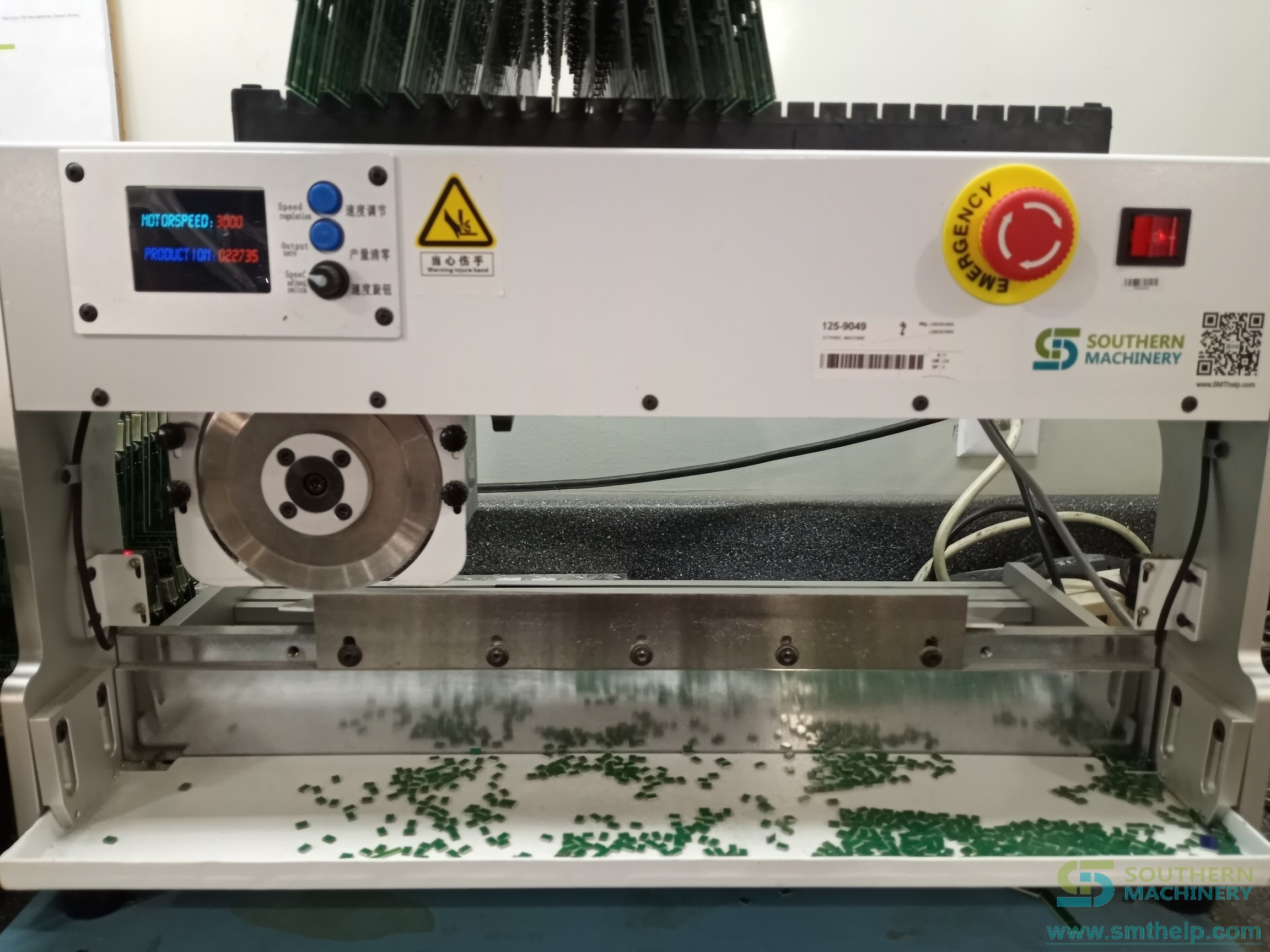
A V-cut PCB depanelizer separates a pre-scored panel by rolling a round blade along the V-groove while a flat blade supports the board underneath, so the bending moment stays inside the score line instead of loading the solder fillets beside it. The S-D508 from Southern Machinery is a moveable-blade V-cut PCB depanelizer for FR4, aluminium-backed and copper boards from 0.2 to 5.0 mm thick, with a 360 mm standard cutting length and a 500 mm option. Below is what the documents state, and where they disagree.
What does a V-cut PCB depanelizer do that hand snapping cannot?
The bending moment is the whole argument
Hand separation puts a bending moment across the whole panel rather than the groove, so the crack starts at the score line and finds the stiffest part of the board: usually a row of solder fillets. The S-D508 changes where the load goes. A circular upper blade rolls along the score line while a straight lower blade backs the panel beneath the cut, keeping the board either side flat. The brochure describes the cut as free of fibre and burr.
The expensive defect is the one that passes test
A cracked fillet that is still electrically continuous clears in-circuit test, passes functional test and ships, then opens a few hundred thermal cycles later as a warranty claim with no traceable cause. Training cannot fix it, because the operator cannot see the crack either. The countermeasure is a separation audit: separate ten panels by hand and ten on the machine, inspect every fillet within 20 mm of the score line under magnification, count micro-cracks, thermal-cycle both groups and count again.
How do you choose between V-cut separation and routing?
A fixed blade carries a geometric constraint
A fixed-blade separator holds the tool in one position and feeds the panel past it, so blade length and stop position must suit the longest panel in the run. On the S-D508 the panel is supported and the head travels. The brochure states there is no restriction on the width of the target PCB, and the stop is set to the panel length through key points at 0, 100, 200, 300 and 400.
Count your score-line lengths before you buy
List the score-line length of every panel you ran last month. If more than a third of the volume is short panels, a fixed blade is leaving capacity on the table; more than two distinct lengths favours a machine that adapts to the panel.
When the S-D508 is the wrong machine
The manual states the S-D508 is built for boards with a pre-scored V-cut, not for routing or snapping, so a panel without a V-groove needs a different process. Where V-cut applies, the cut edge is the reason to separate on a machine rather than over a table edge, especially on LED metal-core panels and boards that ship without a wash.
How does the S-D508 fit into a complete PCB assembly line?
Upstream of the cut
Depaneling sits after soldering and before final pack. Panels arriving from DIP or wave soldering are the typical feed, and the machine accepts 0.2 to 5.0 mm board thickness with up to 2.0 mm across the V-slot. Both stages belong to the same THT flow on the PCB DIP assembly line and wave soldering machine pages.
Downstream board handling
A conveyor outfeed is an option on the separator series and carries the separated board away from the blade, specified on the SC-509 sheet as L1030 x W220 x H130 mm. Panels then enter the usual board handling system chain of magazines, buffers and conveyors, or move straight to inspection.
In the wider line
One supplier covers both sides of that flow: SMT assembly equipment for the surface-mount stages and THT equipment for insertion, soldering and separation, with a one-stop PCB assembly package for lines specified as a whole. Southern Machinery has built equipment in Shenzhen since 2011 and serves more than 237 customers.
What has to be specified before you order?
Panel and score geometry
- Board thickness accepted: 0.2 to 5.0 mm
- Maximum thickness across the V-slot: 0.25 to 2.0 mm
- Panel width: no restriction stated in the separator brochure
- Score: pre-scored V-cut boards only, not routing and not snapping
- Component clearance: the manual requires you to confirm nothing on the board collides with the body or the blade, and offers a pre-machined blade for tight cases
Tooling and adjustment ranges
- Upper blade height, fine adjustment: 0 to 2 mm
- Upper-to-lower blade gap: 0.1 to 0.2 mm
- Blade coplanarity: both cutters in the same plane, error within 0.1 mm
- Platform height adjustment: 0 to 50 mm
- Cutting length: 360 mm standard, 500 mm option, blade length customizable
- Cutting speed: 0 to 500 mm/s in the brochure, 300 to 500 mm/s in the operation manual
- Display readouts: motor speed and a production total
Utilities, environment and service
- Working voltage: 230 V / 50 Hz or 110 V / 60 Hz, at 40 W
- Operating 10 to 35 C, storage minus 20 to 50 C
- Warranty per the operation manual: one year from purchase with lifetime maintenance
- Blades are consumables and can be re-sharpened, answered as two to three times on the series sheet
What does the cut cost per hour?
The formula
Boards per hour = 3600 divided by (handling allowance per board + cut length divided by travel speed)
A worked example
At the source document's published 500 mm/s travel speed and its stated handling allowance:
- 200 mm score line: 1,059 boards per hour theoretical, 953 at 90 percent availability, 847 at 80 percent
- 360 mm score line: 968 / 871 / 774
- 500 mm score line: 900 / 810 / 720
Derived arithmetic from the source, not a measured figure; example only, depending on configuration, subject to final technical confirmation.
What the payback model needs from you
Machine cycle per board, manual breaking-off time per board, boards per day, production days, operators and the loaded wage produce machine time per board, handling hours released per month, labour released per year and a payback period. The source's own calculator refuses to print a payback when the machine is not faster than the manual method. Time the manual operation over a whole batch, not one panel.
Where the supplied documents disagree
Six open points to confirm in writing
- Model naming: SC-D508 in the 2019 brochure, S-D508 in the operation manual and certificate, ASC-508 in the Chinese-market manual
- Dimensions: L620 x W400 x H430 mm in the brochure against 600 x 395 x 425 mm in the manual
- Net weight: 37 kg in three documents, while the SC-500 sheet prints 350 kg
- Blade grade: SK61D in the manual, SKD61 in the ASC-508 manual, imported high speed steel in the brochure, SHD61 on the SC-500 sheet and SKH-9 in an SC-509 FAQ answer
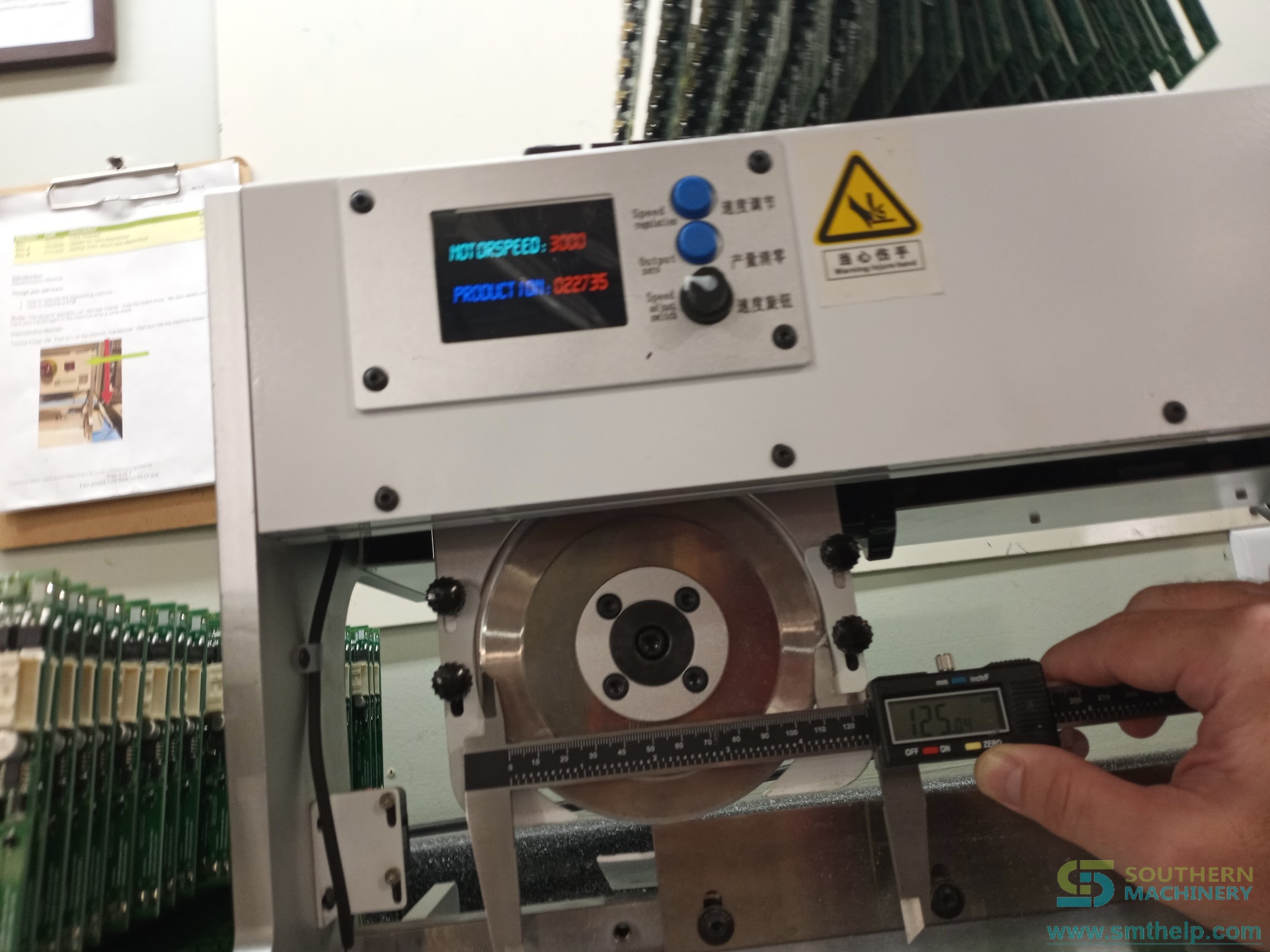
- Speed controller: the manual describes a maximum in the range of 70, while a field photograph shows MOTOR SPEED 3000 with a production total of 622735
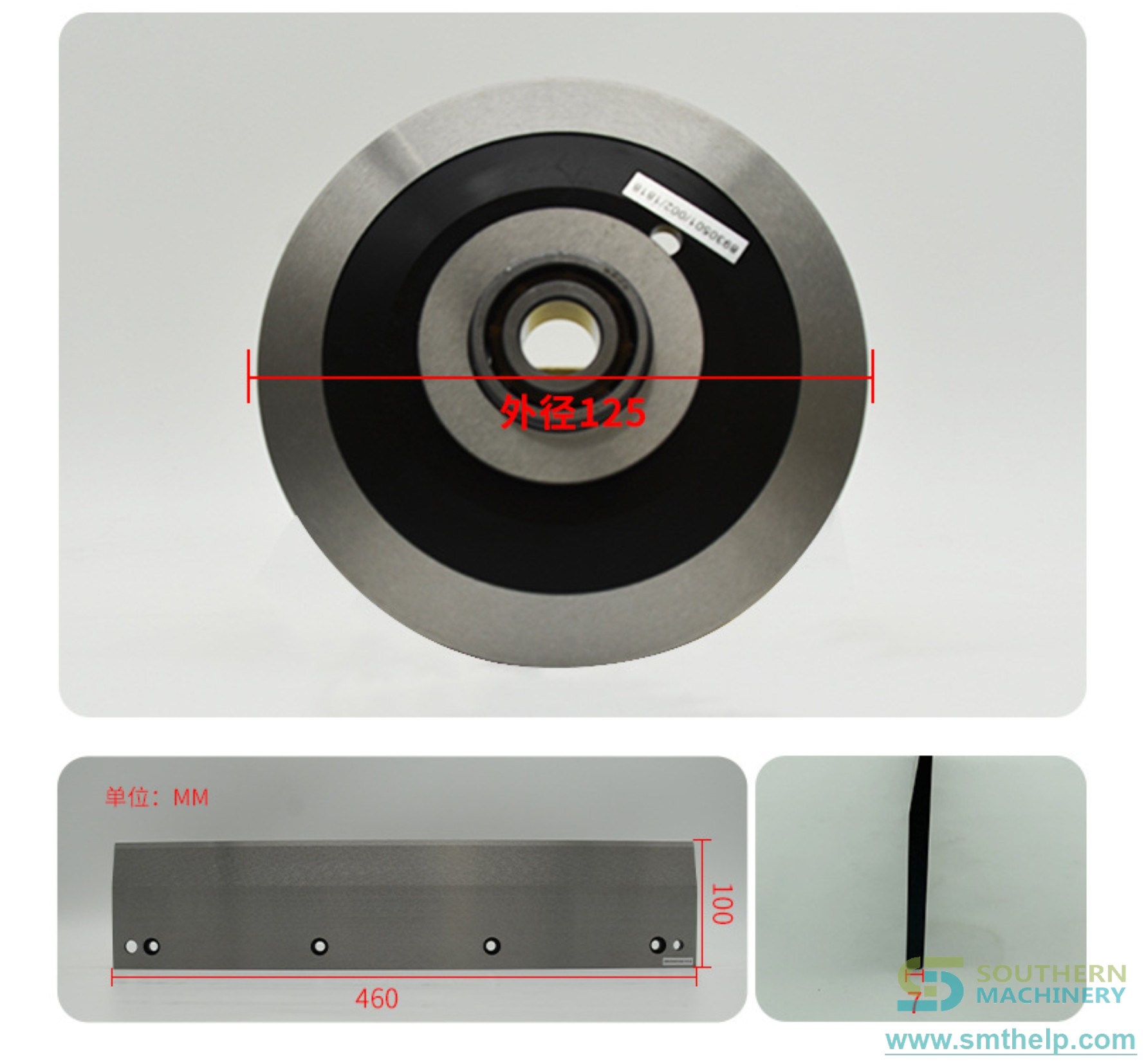
- Cutting length against blade length: 0 to 360 mm and a 360 or 500 mm option are stated, while the library's blade drawing marks the lower blade at 460 x 100 mm and the upper round blade at 125 mm outside diameter
Certification as printed
The source library holds a Certificate of Conformity, HTT202112242L, for the V-cut PCB Separator Machine series listing S-D508 and S-D509. It prints the directive as EMC Directive 2006/42/EC, while 2006/42/EC is the Machinery Directive; confirm the current certificate before you file it.
FAQ
Is the S-D508 suitable for panels that are not pre-scored?
No. The manual states it is built for pre-scored V-cut boards and not for routing or snapping, so a panel without a V-groove needs a different process.
What board thickness can it separate?
Boards from 0.2 to 5.0 mm, with a maximum of 0.25 to 2.0 mm across the V-slot. The V-slot figure decides whether the score can be separated by rolling rather than by force.
Which cutting length should I order?
360 mm is standard and 500 mm is listed as the alternative, with the blade length customizable. Measure your longest score line and confirm the blade length you receive, because the library drawing marks the lower blade at 460 x 100 mm.
How are the blades maintained and replaced?
They are consumables: keep them clean, grease the blades and guards, check screw tightness, verify the 0.1 to 0.2 mm gap and the 0.1 mm coplanarity, and oil them before a long idle period.
Can the machine be connected to a conveyor?
Yes, a conveyor outfeed is an option on the series and the SC-509 sheet specifies that belt as L1030 x W220 x H130 mm. Send your line layout and we will confirm the interface.
Send the panel drawing, not just the enquiry
Send a photograph of the scored panel with the depth of the V-groove, plus your board, score and monthly volume, and we will confirm whether the S-D508 separates it cleanly, which blade height and gap to set.
Comments