
Southern Machinery Odd Form Insertion Machine: Automating TV Board THT Assembly
TV main boards mix dense SMT with through-hole odd-form components — transformers, relays, connectors, fuse holders, terminal blocks, and large electrolytic capacitors. Manual insertion of these parts is slow, variable, and defect-prone, driving rework that most cost models never see. Southern Machinery's S-70LD Odd Form Insertion Machine automates this step with vision-guided placement: four heads, tape or vibration feeders, consistent seating force, and polarity checking before every placement. Built for DIP lines, it connects inline via SMEMA handshake upstream of wave soldering with no conveyor changes. This guide covers what the machine does, typical TV board applications, how it fits a complete PCB assembly line, key selection parameters, and the ROI perspective for EMS manufacturers.
Aug 16, 2026 · Updated Aug 16, 2026 · Southern Machinery
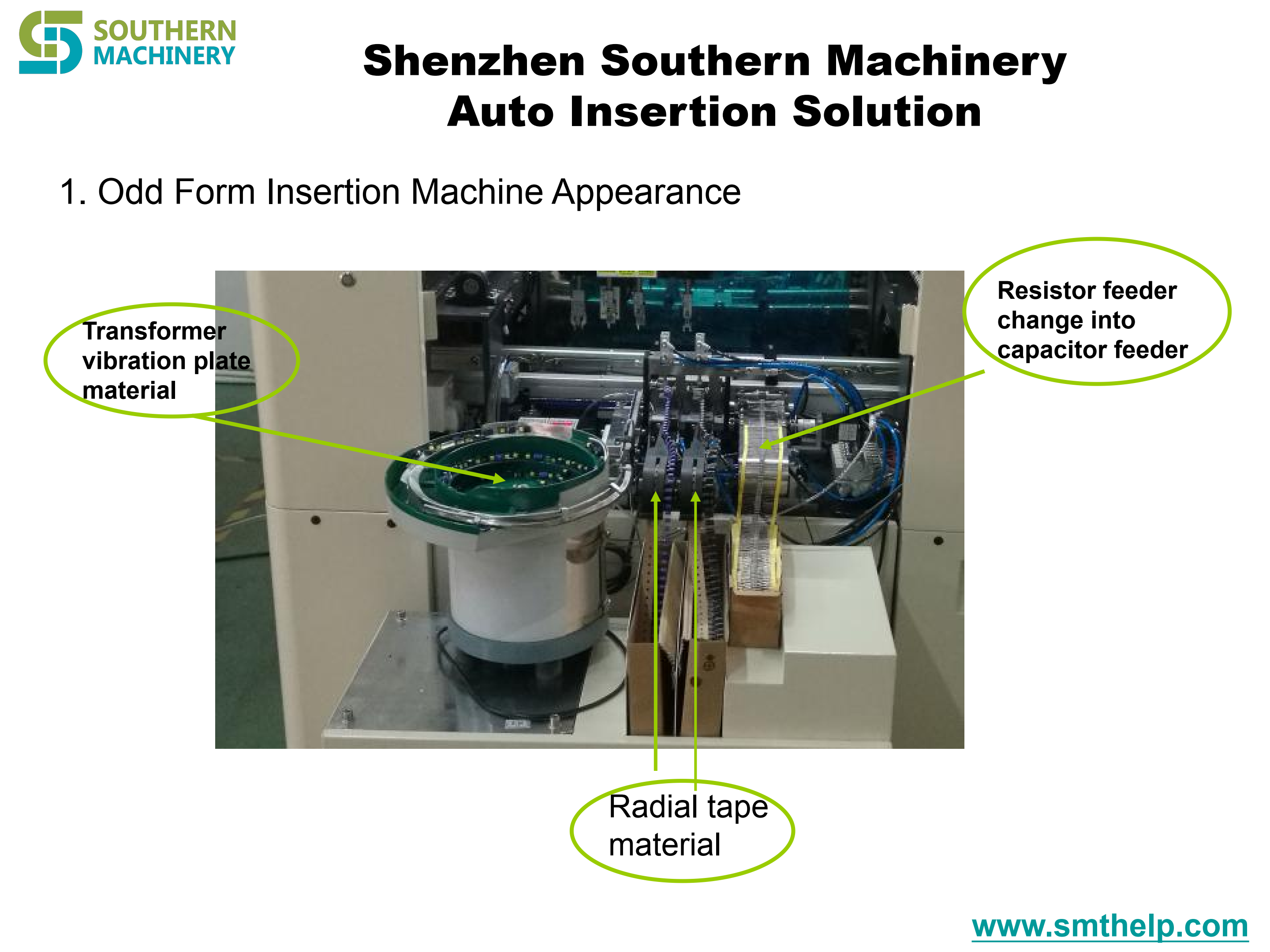
Southern Machinery Odd Form Insertion Machine: Automating TV Board THT Assembly
TV main boards are among the most mixed-technology assemblies in consumer electronics: a dense SMT side for ICs and passives, plus a through-hole side that carries transformers, relays, connectors, fuse holders, terminal blocks, and large electrolytic capacitors. On many production floors, that through-hole side is still populated by hand — and it is usually the slowest, most variable step on the line.
The Southern Machinery S-70LD Odd Form Insertion Machine replaces the most unpredictable part of manual DIP assembly with a vision-guided inline insertion station, purpose-built for the component families that dominate TV board production. Based in Shenzhen, China, Southern Machinery has served 237+ global customers since 2011 with SMT, THT, and PCB assembly automation — including insertion machines, wave soldering, board handling, and peripheral equipment.
<iframe width="560" height="315" src="https://www.youtube-nocookie.com/embed/muME9Gt2TaM?rel=0" title="TV board auto assembly insert by odd form machine" frameborder="0" allow="accelerometer; autoplay; clipboard-write; encrypted-media; gyroscope; picture-in-picture" allowfullscreen></iframe>
What is this machine used for?
An odd form insertion machine places through-hole (THT) components that do not fit standard radial or axial tape formats. These parts — transformers, relays, connectors, terminal blocks, fuse holders, inductors, and radial electrolytic capacitors — usually arrive in trays, tubes, or loose vibration-bowl feed, with irregular bodies and varying lead pitches.
The S-70LD automates this work with an industrial computer and vision guidance. The vision system locates each part and recognizes its lead geometry regardless of how it is presented in the feeder, checks polarity before placement (rejecting 180°-rotated parts), and inserts every lead to a programmed depth with consistent force — eliminating the "floating high," misinsertion, and reverse-insertion defects that manual operators produce under shift pressure.
In plain buyer terms: it takes the odd-form components that are hardest to hire for and hardest to inspect, and moves them from manual stations into an automated, repeatable process on the DIP line.
Typical applications
TV board assembly is the classic use case, but the machine's component envelope suits any high-volume THT board with standard odd-form families:
- TV main board transformer insertion — power and flyback transformers with multiple pins are among the most expensive manual insertions on a TV line; a single non-seated pin can cause a field failure.
- Relay and fuse holder insertion on power boards — boards for power supplies, ballasts, and appliance control cards share these parts.
- Connector and terminal block placement — HDMI, terminal blocks, and wire-to-board connectors where lead pitch and body shape vary by part number.
- Electrolytic capacitor and inductor insertion — radial E-CAP and inductor families fed by tape or vibration bowl, including capacitor-and-resistor combination stations on mixed boards.
- Lamp and optoelectronic board assembly — radial E-CAP, axial resistor, and inductance solutions for lighting and display control boards.
The machine handles component sizes from 3×3 mm to 30×30 mm with component heights up to 50 mm, which covers the standard odd-form families shared across multiple PCB variants in TV and appliance production.
How it fits into a complete PCB assembly line
The S-70LD is designed as an inline station, not a standalone island. It accepts boards via SMEMA handshake and connects to the existing conveyor system upstream of wave soldering — the DIP line layout works like this:
- SMT line — solder paste printing, SPI, pick-and-place, reflow, AOI for the surface-mount side.
- THT insertion — radial auto insertion (e.g., Southern's S-3010B for standard radial parts) plus the S-70LD odd form insertion for non-standard components.
- Wave soldering — boards then pass through a lead-free dual wave soldering machine (such as the S-WS450) that solders all through-hole joints in one pass.
- Post-solder — cleaning, depaneling, and inspection complete the process.
Because the S-70LD returns boards to the same conveyor, existing wave soldering, cleaning, and material-handling infrastructure stays unchanged — a key advantage when retrofitting automation into a running DIP line. Tape-fed odd-form insertion also produces carrier-tape waste, which can be handled by an automatic reel scrap tape cutting machine like the S-680A.
Key selection parameters
When evaluating an odd form insertion machine for TV board or general THT production, buyers should compare these parameters — and here is how the S-70LD positions:
| Selection parameter | What to evaluate | S-70LD (verified product data) |
|---|---|---|
| Component envelope | Size range, height, lead pitch flexibility | 3×3 to 30×30 mm, height up to 50 mm |
| PCB size range | Board dimensions your line runs | 50×50 to 300×300 mm |
| Feeders | Tape, tube, or vibration-bowl flexibility | 4 feeders, tape or vibration adjustable |
| Insertion heads | Number of heads vs. cycle-time target | 4 heads |
| Vision capability | Polarity check, lead-geometry recognition | Industrial PC with vision guidance; 180°-rotated parts detected and rejected |
| Seating consistency | Insertion force control to avoid floating high | Consistent insertion depth programmed per part |
| Speed | CPH balanced against your line rate | 4,000 CPH (3,800 CPH for radial resistor insertion) |
| Accuracy | Placement repeatability | ±0.05 mm |
| Utilities & footprint | Power, air, noise, floor space | 220V AC, 0.8 kVA; 0.4–0.6 MPa air; ≤75 dB; ~1,000 kg |
Request the current data sheet from Southern Machinery to confirm these figures against your specific PCB and component set — your board stack-up, feeder mix, and line speed should drive the final selection.
ROI and quality perspective
From a buyer's perspective, the ROI case for odd-form automation is rarely about replacing a wage; it is about removing hidden cost. A hand-inserted connector can take 4 to 10 seconds depending on operator familiarity and part presentation, and that variability adds unplanned labor over every shift. Manual odd-form insertion consistently produces higher rates of floating high, misinsertion, and reverse insertion — defects that are only caught at AOI or functional test, after wave soldering and cleaning, when rework means desoldering, clearing through-holes, reinserting, and re-soldering at 3 to 5 minutes per board.
Quality risk compounds on TV and power boards: a transformer with 6 to 10 pins needs every pin fully seated in its plated through-hole, and a single bad joint can turn into a field failure costing 20 to 50 times the board's assembly value to repair.
Automation changes the calculation in three concrete ways:
- Consistent insertion force — every component is seated to the same depth, cycle after cycle, eliminating floating high.
- Vision-based polarity verification — reverse insertion is detected and corrected before the board moves downstream.
- Predictable cycle time — insertion timing no longer depends on the shift, the operator, or the day of the week, so line balancing and throughput forecasting become accurate.
For EMS companies running 500+ boards per SKU with repeat orders and standard odd-form component families, the machine pays for itself through lower rework, stable output, and the ability to scale production without scaling headcount.
FAQ
What is an odd form insertion machine?
An odd form insertion machine is a THT automation station that places non-standard through-hole components — parts that do not fit radial or axial tape formats, such as transformers, relays, connectors, and terminal blocks. It uses vision guidance and programmable tooling to locate, orient, and insert these parts into the PCB automatically.
Which components can the S-70LD insert on a TV board?
The S-70LD handles component sizes from 3×3 mm to 30×30 mm and heights up to 50 mm, covering transformers, relays, connectors, fuse holders, terminal blocks, radial electrolytic capacitors, inductors, and radial/axial resistors — the standard odd-form families found on TV main boards and power boards.
Does an odd form insertion machine replace wave soldering?
No. Odd form insertion only places the components into the plated through-holes. The boards still pass through wave soldering afterward, which solders all through-hole joints in one pass. The machine is designed to sit inline upstream of the wave solder machine.
What is the difference between radial insertion and odd form insertion?
Radial insertion machines handle standard radial components on tape (resistors, small capacitors) at very high speed. Odd form insertion machines handle non-standard components in trays, tubes, or vibration bowls — larger bodies, irregular shapes, and varying lead pitches that radial machines cannot process. Many DIP lines use both: radial for standard parts, odd form for the rest.
How does the machine prevent reverse (polarity) insertion errors?
The vision system recognizes each part's lead geometry and checks polarity before placement. Parts presented 180° rotated are detected and rejected or corrected, so polarity-sensitive components such as electrolytic capacitors and transformers are inserted in the correct orientation.
Can the S-70LD be added to an existing DIP line?
Yes. The machine is designed as an inline station that accepts boards via SMEMA handshake and returns them to the same conveyor, upstream of wave soldering. Existing wave soldering, cleaning, and conveyor infrastructure remain unchanged, which makes it practical to retrofit into a running line.
Contact Southern Machinery
Ready to evaluate odd form insertion for your TV board or THT line? Southern Machinery's team works with EMS and electronics manufacturers worldwide on machine selection, line integration, and after-sales support — spare parts, training, and upgrades included.
- Email: jasonwu@smthelp.com
- Product catalog: file.autoinsertion.com
- Product images: ph.smthelp.com
- Website: www.smthelp.com
Comments