
TO-90 90-Degree Bend Radial Lead Insertion: Low-Profile THT Automation by Southern Machinery
By Southern Machinery | Shenzhen, China | Founded 2011 | 237+ global customers served
What Is This Machine Used For?
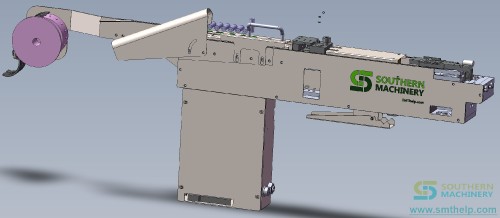
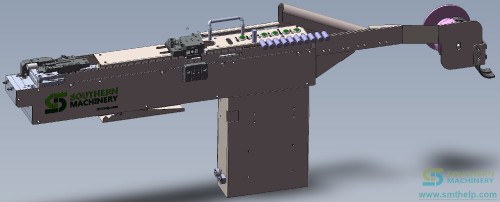
The TO-90 is a THT (through-hole technology) auto-insertion solution that bends tall radial-lead components 90 degrees before or during insertion, so the component body lies flat against the PCB instead of standing upright. It is built on Southern Machinery's radial insertion platform — the same servo-driven, vision-corrected architecture used in the S3000 and S3010A radial inserters — with dedicated lead-forming tooling for tall parts.
It answers a specific production problem: tall radial components such as large electrolytic capacitors, film capacitors, and high-body LEDs create clearance issues in low-profile enclosures (LED drivers, power supply adapters, ballasts, display and appliance control boards). Operators traditionally bend these leads by hand before insertion — slow, inconsistent, and a frequent source of bent leads and mis-insertion. The TO-90 performs the 90-degree lead bend automatically, then inserts and clinches the component in one repeatable cycle.
What Does "90-Degree Bend" Mean for Your PCB?
When a tall radial component is bent 90 degrees, its body lies parallel to the board surface. The assembled board height drops from the component's standing height to roughly the component body thickness. That single change enables:
- Lower final product profile — fits thinner enclosures for LED lamps, slim adapters, and flat appliances
- Better airflow and thermal behavior — components laid flat distribute heat differently and avoid tall-part shadows in Wave Soldering
- Less handling damage — the bend is formed by the machine, not by an operator
- Consistent bend geometry — every part bent to the same angle, so insertion and clinching stay predictable
The radial machines' insertion head supports full 0° to 360° insertion direction (per the S3000/S-3010B specifications), and Southern Machinery's IPC-based THT design guideline recommends inserting from 0° to 90° for maximum throughput — the same operating window the 90-degree bend capability targets.
Typical Application Scenarios
The TO-90 capability is most valuable in industries where tall radial parts must fit tight enclosures and where manual bending currently bottlenecks the line:
- LED lighting — driver boards with large electrolytic capacitors and tall film capacitors that must fit slim lamp housings
- Power supply and adapters — low-profile chargers, vehicle power supplies, and energy-saving ballasts
- Appliance control boards — rice cookers, induction cookers, microwave and air-conditioner control PCBs with tall capacitors and coils
- Display and instrumentation — boards where standoff height must stay under a hard mechanical limit
- General EMS / ODM lines — any high-mix THT line where one or two tall components force a manual station today
How It Fits Into a Complete PCB Assembly Line
The TO-90 is designed to drop into a mixed SMT/THT line without re-engineering the material flow:
- SMT portion upstream — stencil printer, Pick and Place, Reflow Oven (SMT side done first)
- THT auto-insertion portion — axial and radial inserters sequence through-hole parts; the TO-90 station handles the tall radial components with 90-degree lead bending, followed by standard radial insertion and odd-form insertion as required
- Wave Soldering — all inserted THT components are soldered in the same pass
- Post-soldering — inline lead cutting, PCBA cleaning, AOI/SPI inspection, and depaneling complete the line
Southern Machinery supplies the full equipment set for each zone — insertion machines, Wave Soldering, board handling, cleaning, and inspection — so a line can be quoted and integrated as one scope from a single partner. MES-ready interfaces and offline programming keep changeover time short for EMS and ODM production.
Key Selection Parameters to Confirm With Your Supplier
Because the TO-90 is configured to the customer's component set, confirm these parameters against your actual BOM before quoting:
- Component envelope — maximum component height and body diameter of the tallest radial parts (the S3000 platform documents up to 20 mm component height / 13 mm body diameter; S3010A up to 22 mm tall with no derate)
- Lead span and lead diameter — supported spans (2.5 / 3.5 / 5.0 / 7.5 / 10.0 mm in the radial platforms) and maximum lead diameter for your capacitor or LED leads
- Bend angle and position — confirm 90-degree bending is performed on the lead or on the body, and where the bend lands relative to the component body
- PCB size and thickness — board dimensions and thickness range (S3000 documents 50×50 mm to 400×300 mm, 0.79–2.36 mm thickness)
- Clinching requirements — clinch angle and clinch length for your product's mechanical strength and IPC compliance (Southern's guideline: clinch angle 0°–45°, length 1.28–1.80 mm)
- Throughput target — CPH expectations based on board mix; radial platforms quote 10,000–20,000 CPH spec with realistic actual throughput confirmed by demo
- Component verification — polarity/value check prior to insertion for polarized capacitors
- Utilities — air supply and power requirements for your factory floor
No two BOMs are identical, so Southern Machinery recommends sending your component list and PCB panel drawings for a configuration review rather than ordering against a generic datasheet.
ROI, Quality, and Throughput Perspective
Labor. A manual 90-degree bend station typically needs one operator per shift to pre-bend and insert tall parts. Moving that step into the auto-insertion cycle removes the operator from the critical path and frees the same headcount for line supervision or secondary processes.
Quality. Hand-bent leads vary in angle, which shows up as tilted components, rework, and solder defects at Wave Soldering. A machine-formed bend is identical part to part, which stabilizes clinching and reduces the rework/scrap loss that shows up on THT lines.
Throughput. Radial auto insertion runs orders of magnitude faster than manual insertion (S3000: 20,000 CPH spec / 10,000 CPH actual; S3010A: 12,000 CPH real throughput at 1000 ppm reliability), and inserting in the 0°–90° window avoids the throughput penalty of arbitrary insertion angles.
Payback. Because the TO-90 replaces a dedicated manual station with the least-expensive automation on the THT side, EMS and ODM buyers typically evaluate payback on labor savings plus defect reduction — Southern Machinery's published line materials emphasize ROI in under one year for comparable radial insertion investments.
FAQ
Q: What components can a 90-degree bend insertion machine handle? A: Tall radial-lead components — typically large electrolytic and film capacitors, high-body LEDs, and similar parts whose standing height creates clearance problems. The platform's documented envelope covers components up to 20–22 mm tall with lead diameters up to about 0.7–0.8 mm; confirm your exact parts with the supplier.
Q: Is the 90-degree bend done before or during insertion? A: The bend is formed by the machine's lead-forming tooling as part of the insertion cycle — the component is fed, the leads are bent 90 degrees, the part is positioned and inserted, then clinched. This is what removes the manual pre-bending step.
Q: Does bending components 90 degrees affect Wave Soldering quality? A: When the bend geometry is consistent, Wave Soldering results are actually more predictable because component standoff and orientation are identical on every board. Confirm the clinch angle and clinch length are within your IPC-based process window.
Q: Can this machine also insert standard upright radial components? A: Yes. The 90-degree bend capability is tooling on the radial insertion platform, so the same machine can be configured for standard upright insertion of radial capacitors, transistors, and LEDs alongside the bent-lead operation.
Q: How does Southern Machinery support a THT line with this capability? A: Southern Machinery (Shenzhen, founded 2011, 237+ global customers) supplies the full THT equipment scope — radial/axial/odd-form insertion, Wave Soldering, board handling, lead cutting, cleaning, and inspection — plus retrofit, spare parts, and training services, so the line can be integrated and supported as one system.
Q: How do I get a configuration review? A: Send your component list and PCB panel drawings to Southern Machinery (jasonwu@smthelp.com) for a configuration and ROI review. Product catalogs are available at file.autoinsertion.com, and machine photos at ph.smthelp.com.
Contact Southern Machinery
For configuration advice, a line layout, or a live machine demo, contact:
- Jason Wu (Co-Founder / CEO / Sales & Service Engineer) — jasonwu@smthelp.com — +86 13602562576
- Website: https://www.smthelp.com
- Product catalogs & PDFs: https://file.autoinsertion.com
- Machine photo gallery: https://ph.smthelp.com
Machine Gallery

Comments