
THT Terminal Insertion Cell: DD-8600 Two-Head Line by Southern Machinery
THT terminal insertion cell: DD-8600 reel-fed terminals at 0.25 s on two heads in a 4,650 mm line. Check parameters, line fit and payback before you quote.
Oct 6, 2026 · Updated Oct 6, 2026 · Southern Machinery
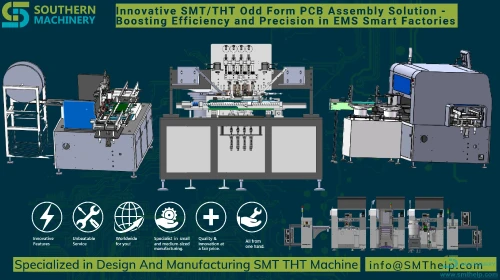
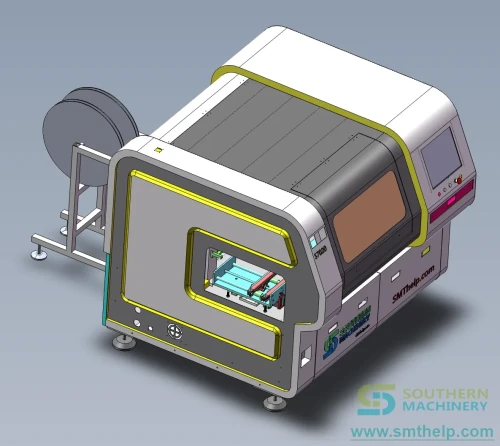
A THT terminal insertion cell is a dedicated through-hole machine for reel-fed tab terminals: it presses 187 and 250 formats into a PCB at a documented 0.25 seconds per insert, then clinches the legs from below so the part survives wave soldering. The DD-8600 documented here runs that rate on two heads sharing one feeder family, so its loader-to-unloader segment fits in 4,650 mm without a manual bench.
What is a THT terminal insertion cell used for?
A terminal insertion cell automates the through-hole operation that stays on the bench the longest: pressing tab terminals onto a board by hand and bending the legs. The documented case is a board whose through-hole list is dominated by tab terminals in 187 and 250 formats, with and without parallel legs, arriving on reels at matching pitch.
Rather than a generalist odd-form machine optimised for variety, the customer installed a DD-8600 built around one component family. Both heads draw from reel feeders with built-in cutting, and the two terminal families are documented as mutually interchangeable on the same feeder format at matching pitch, so a format change is a reel swap and a program call rather than a feeder rebuild.
The sizing rule: if one terminal family owns more than half of your through-hole insertion minutes, a dedicated cell is the cheaper way to automate those minutes, and every hour of generalist flexibility you skip is mixed-feeder maintenance you do not owe.
What does 0.25 seconds per insert actually buy?
Insertion speed is published as 0.25 s per component on a two-head cell - a terminal-machine rate, not a generalist one. Companion machines in the same press family are documented at 0.4-0.8 s per piece (DD-8700) and 1-2 s per piece (DD-9000). Two qualifications come straight from the source document:
- The ceiling is computed, not published. At 0.25 s per insert the arithmetic ceiling is 14,400 insertion points per hour; the deck publishes no board-level cycle table, so any boards-per-hour claim would be arithmetic pretending to be engineering.
- Board change is published separately at 3 s, so the denominator of your throughput calculation is your own pieces-per-panel count.
The practical method: divide your terminal count per panel by the press rate, add the 3-second board change, then divide the shift into cycles. Because both heads can run two formats at once, or gang up on the highest-count line item, the advantage grows with the depth of the part list.
Dedicated terminal cell or generalist odd-form machine?
All three machines in this family share the same press DNA - electric head, electric base, vacuum seating, cam clamp, V-groove lead guide and a sensing bottom die. They differ in appetite:
- DD-8600 terminal cell: 0.25 s per piece, two reel-fed heads, reel and tandem feeding only, boards up to 400 x 300 mm.
- DD-8700 odd-form platform: 0.4-0.8 s per piece, one to four cam-driven heads, five feeding families (bowl, tube, tape, tray, reel), boards up to 380 x 280 mm.
- DD-9000 vision gantry: 1-2 s per piece, Y servo dual-drive gantry, three 500 W cameras, electric gripper, boards up to 450 x 300 mm.
A generalist cell can insert these terminals. What it adds is the changeover tax: feeder swaps, die changes, program re-teaches, a bowl that runs dry between two line items. The dedicated cell buys one family an exemption from it, so compare cost per insert point, not cost per feature.
How does the cell connect to a full PCB assembly line?
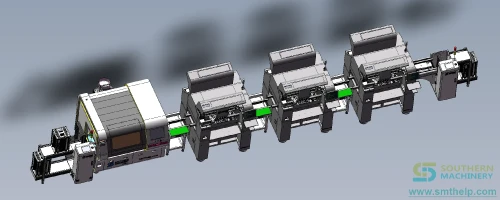
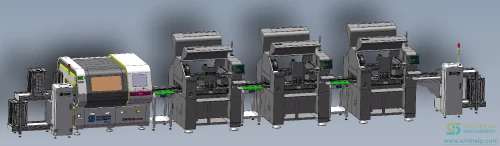
The documented layout is deliberately short: automatic loader, DD-8600 cell, automatic unloader, 4,650 mm end to end. That makes the cell easy to place as a standalone station or to retrofit between existing conveyors feeding a THT line. The insertion sequence is the integration argument:
- Load. The loader presents the panel, the electric base clamps it and the vision program locates the fiducials; documented board change is 3 s.
- Supply. Both heads draw from reel feeders with built-in cutting at matching pitch.
- Insert. Vacuum seats the component by its body outline, an electric cam holder clamps the shape, and a V-groove guide aligns the lead tips so the terminal enters square at 0 to 360 degrees in 1-degree steps.
- Clinch. A circuit test through the bottom die confirms each lead passed the hole before the die bends the legs - on multi-cell lines that clinch also stops earlier parts popping out downstream.
- Unload. The unloader stacks panels for wave soldering or test, handing off to a wave soldering machine without a manual buffer.
Where the BOM also carries axial or mixed odd-form parts, the same floor plan extends with an axial auto-insertion machine or a general odd-form insertion machine.
Which specifications should you confirm before ordering?
Every value below is quoted from the machine's technical parameter table; values the source does not state are named as such rather than estimated.
- Model and speed: DD-8600 fully automatic terminal insertion machine; 0.25 s per component.
- Heads and direction: 2 heads, each able to insert a different terminal or odd-form part; 0-360 degrees in 1-degree steps.
- Feeding and formats: reel feeder with built-in cutting (packaging reel or tandem strip); 187 and 250 tab terminals, parallel-leg or straight, interchangeable at matching pitch.
- Board range and change: 100 x 100 mm up to 400 x 300 mm, larger by custom build; PCB load and unload 3 s.
- Lead and PCB requirements: lead deformation no worse than 0.1 mm; clampable board edge 5 mm or more; component hole 0.5 mm or more; at least 2 mm between component bodies, with a high-density option.
- Motion, drive and control: 0.001 mm per pulse resolution; Panasonic servo controller and motors; imported THK precision ballscrews (0.01 mm class); AirTAC cylinders; SMC solenoid valves; self-developed industrial PC with motion control card and 17-inch colour LCD.
- Programming: online vision programming and correction, Excel-style process editor, USB import or manual entry, RS-232C communication; bottom-die leg bending with dies designed per process.
- Utilities and footprint: single-phase 220 VAC 50/60 Hz at 2 kVA; air 5-6 kg (0.5-0.6 MPa) at 0.6 m3/min; environment 10-30 degrees C and 30-70 % RH; main unit 1550 x 1500 x 1700 mm and 1500 kg; documented line 4,650 mm including loader and unloader.
- Not specified in source - contact Southern Machinery to confirm: board-level cycle time, price and delivery schedule.
The wider documentation is available as a S7000 odd-form insertion machine manual and a pre-purchase auto-insertion readiness checklist.
What does a terminal insertion cell pay back?
The source publishes no price, so a payback figure has to be built from your own quotation and wage data. The structure is a floor, not a forecast:
Simple payback (years) = line price / annual freed bench labour
Annual freed bench labour = operators displaced x loaded wage per hour x working hours per day x working days per month x 12
Example, for illustration only and depending on configuration: a cell that frees a share of two operators at a loaded wage of $3 per hour, over 10 hours a day and 26 days a month, addresses roughly $18,700 a year of bench labour before any quality effect. The simplification ignores the rework a manual bench still creates on mis-seated tabs, the WIP it queues and the supervision it needs, so use it as a floor.
How Southern Machinery supports the cell
Shenzhen Southern Machinery Sales and Service Co., Ltd. has designed and manufactured SMT and THT automated assembly and cleaning equipment since 2011 and has equipped EMS factories on six continents. For this platform the documented service set is factory acceptance before shipping with your boards run, installation supervision and commissioning, operator and maintenance training on vision programming, die changes and feeder setup, and stocked spares, dies, grippers, cams and shear parts.
FAQ
What is a terminal insertion cell?
A dedicated machine for reel-fed tab terminals - 187 and 250 formats, parallel-leg or straight - running one feeder family at terminal speed. The DD-8600 documented here inserts at 0.25 s per piece on two heads.
Can both heads run the same terminal?
Yes. The source documents both modes: two heads on two formats, or both heads on one high-count part, which doubles that line item's rate.
How are the legs held before wave soldering?
The bottom die rises with the press, confirms each lead passed the hole by circuit test, and bends the legs. On multi-cell lines the clinch also stops earlier parts popping out downstream.
What board design makes terminal insertion cheap?
A clampable edge of 5 mm or more, holes of 0.5 mm or more, leads straight within 0.1 mm, and terminal pitches chosen so one reel format covers the most line items.
How much floor does the cell need?
The documented line is 4,650 mm end to end - loader, cell, unloader - the shortest automation segment in the series.
Send us the terminal list
Formats, pitches and counts per board are enough to size the cell. Southern Machinery will return a configuration sheet quoted from the same document behind every number on this page, and can run a sample insertion on your own board before you commit. For the wider platform, see the odd-form insertion machine series or the S7000 odd-form machine.
Comments