
Southern Machinery THT Terminal Auto Insertion Machine for Smart EMS PCB Assembly
The S-7000T THT terminal auto insertion machine from Southern Machinery automates reel-fed FASTON, TAB, pin, and eyelet insertion for smart EMS factory PCB assembly. Servo-controlled at 5,000-6,000 CPH, it verifies every insertion in real time, controls clinch stress per the IPC-9704 standard, and connects to MES for full traceability. Designed for home appliance, automotive, power supply, and LED lighting boards, it replaces manual terminal seating ahead of wave soldering. Founded in 2011 in Shenzhen and serving 237+ global customers, Southern Machinery engineers the complete SMT/THT line - insertion, wave soldering, and board handling - from one supplier.
Aug 25, 2026 · Updated Aug 25, 2026 · Southern Machinery
Southern Machinery THT Terminal Auto Insertion Machine for Smart EMS PCB Assembly
Watch the short demo: THT Terminal Auto Insertion machine — design and manufacturing for Smart EMS factory PCB assembly
If your THT line still seats FASTON tabs, eyelets, and reel-fed terminals by hand, you already know the cost: inconsistent clinch quality, insertion stress that cracks solder joints, and operators who cannot keep up with a reflow-fed SMT line. Southern Machinery designs and manufactures the S-7000T terminal insertion machine to close that gap — a servo-controlled, vision-corrected THT auto insertion machine built for smart EMS factory PCB assembly.
What is this machine used for?
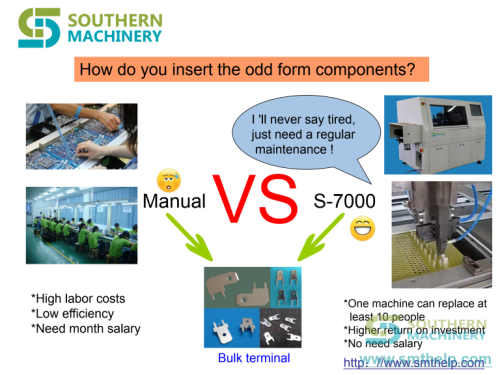
The S-7000T is a terminal auto insertion machine that automatically feeds, inserts, and clinches reeled through-hole terminals into a PCB before wave soldering. It replaces the manual bench step where operators push FASTON or TAB quick-connect terminals, pins, and eyelets into plated through-holes and bend the leads over (clinching) to hold the part in place.
The machine is designed around the parts that are hardest to automate with a standard pick-and-place system:
- Reeled tape terminals — Zierick-type terminals (e.g., P/N 1021/6021/1198/6198) and TE Connectivity TAB/FASTON terminals in 6.35 mm [.250 in] and 4.75 mm [.187 in] tab widths
- Bulk or bowl-fed terminals — loose terminals oriented and guided into the insertion head
- Pins and eyelets — discrete pin or eyelet insertion where penetration sensing verifies each part seated correctly
On the published configuration, the S-7000T runs at 5,000–6,000 CPH with servo control, feeds tape at a 5.08 mm (0.2 in) pitch, and can insert up to 2 terminals per second at that pitch. Up to four different components can be applied on one machine, at up to four insertion angles across 360° in 1° increments. An optional quick-change head system keeps changeover fast when product mix shifts.
Two engineering details matter most to buyers:
- Insertion verification. The S7000 series uses electrical continuity or discrete pin penetration sensing, so every terminal is confirmed seated in real time. No separate QC step is required, and QC data is stored on the system PC for 100% traceability.
- Stress-controlled clinching. The machine is built to pass the IPC-9704 stress-test standard, holding insertion stress within ±400 µε, with inward clinching, outward clinching, or "N" clinch selectable per program.
Typical applications
Terminal insertion automation earns its keep wherever a product family repeats the same terminal pattern board after board:
- Home appliance control boards — air conditioner, microwave, induction cooker, and electric kettle PCBs where FASTON tabs carry mains or motor current and must survive vibration.
- Automotive electronics — car audio, vehicle power supply, and body-control boards where clinch consistency and traceability are audited by customers.
- Power supply and ballast assembly — energy-saving power supplies and electronic ballasts with high terminal counts per board and tight pitch requirements.
- LED lighting and display drivers — LED driver, lighting, and luminous-character control boards where terminals are inserted before wave soldering.
- General electronics — instruments, digital watches, and consumer devices that use reeled terminals rather than connectors.
If your factory inserts any of these parts manually for more than a few hours per shift, the machine is a candidate for payback analysis.
How it fits into a complete PCB assembly line
The S-7000T is not a standalone gadget — it is designed to sit inside a mixed SMT/THT line. Southern Machinery supplies the surrounding ecosystem, so one supplier can engineer the whole material flow:
- SMT section — solder paste printing, SPI, pick-and-place, reflow, AOI.
- THT section — radial insertion (S-3000/S-3010B), axial insertion (S-4000), odd-form insertion (S-70LD/S7000 series), and terminal insertion (S-7000T) for the parts that cannot go through placement.
- Soldering — lead-free wave soldering (S-WS450, S-WS350B) or selective soldering for the through-hole side.
- Board handling — loaders, unloaders, conveyors, and buffer stations connect each stage; the S-7000T product page lists loader/unloader board handling as a standard companion, ready for Industry 4.0.
- Inspection and post-process — 3D SPI/AOI, X-ray, PCB cleaning, and depaneling.
The machine's Windows-based operating system runs on an industrial PC with a motion control card, and an RS-232C interface can connect to your MES system. Production data, equipment parameters, and I/O diagnostics are all accessible on the host — which is what "smart EMS factory" means in practice: the insertion step stops being a black box.
Key selection parameters
Every terminal insertion project is different, so evaluate these parameters with your actual boards in hand (the list below is a buyer's checklist, not a spec sheet):
| Parameter | What to confirm |
|-----------|-----------------|
| Terminal format | Reeled tape, bulk, or bowl-fed; terminal thickness range (published S-7000T range is 0.5–1.2 mm) and tab width (e.g., 6.35 mm / 4.75 mm FASTON) |
| Tape pitch | Feeding pitch compatibility with your reeled terminals (e.g., 5.08 mm) |
| PCB size | Maximum board dimensions (published S-7000T: 380 × 280 mm, enlarged sizes customizable) and hole-to-foot clearance (hole should be about 0.5 ± 0.1 mm larger than the component foot) |
| Insertion heads | Number of heads (1–4 on the S-7000T) and number of different components per machine (up to 4) |
| Angles and clinch | Insertion angles needed (up to 360° in 1° increments) and clinch style: inward, outward, or "N" |
| Verification method | Continuity or pin-penetration sensing if you need in-machine QC and traceability |
| Line integration | MES connectivity (RS-232C or higher), loader/unloader pairing, and board transfer height |
| Facility requirements | Footprint, weight, power (e.g., 220 V/AC, 50/60 Hz), and humidity range for your plant |
Note: Specific values vary by configuration. Send your terminal samples and PCB drawings to Southern Machinery to confirm the parameters match your production requirements.
ROI and quality perspective
Buyers usually justify terminal insertion automation on three lines:
- Labor. One terminal insertion machine replaces a manual station that needs at least one operator per shift — and often two on high-terminal-count boards. Manual seating is also a repetitive-motion injury risk that automation removes entirely.
- Quality. Hand-inserted terminals vary in seating depth and clinch angle; an inconsistent clinch is a latent solder-joint defect that shows up in vibration or thermal cycling. Because the S-7000T verifies each insertion and controls stress within ±400 µε per the IPC-9704 stress-test standard, your first-pass yield and field reliability both improve. Stored QC data gives you audit-ready traceability without a separate inspection step.
- Throughput stability. At 5,000–6,000 CPH with servo control, output does not fade at the end of a shift the way manual output does. The manufacturer quotes a one-year payback target for typical high-volume applications and a 60-day lead time on a standard configuration — useful numbers to plug into your own calculation.
On the cost side, remember to budget the terminal feeding tooling (tape feeder or bowl feeder), any custom insertion head for non-standard terminals, and integration with your existing loader/unloader. Southern Machinery provides training, spare parts, and retrofit support, so the machine stays productive long after commissioning.
FAQ
Q: What types of terminals can a THT terminal insertion machine handle?
A: Reeled tape terminals such as Zierick-type and TE Connectivity FASTON/TAB terminals (6.35 mm and 4.75 mm tab widths), plus bulk or bowl-fed terminals, pins, and eyelets. Terminal thickness capability depends on the insertion head; the S-7000T covers 0.5–1.2 mm.
Q: Why is clinching important in terminal insertion?
A: Clinching bends the terminal leads over on the solder side so the part stays seated through wave soldering. Inward, outward, and "N" clinch styles are selectable per program. Controlled clinching also limits mechanical stress on the plated through-hole and solder joint — the S-7000T is designed to pass the IPC-9704 stress-test standard with insertion stress within ±400 µε.
Q: Can the machine verify that a terminal was inserted correctly?
A: Yes. The S7000 series uses electrical continuity or discrete pin penetration sensing to confirm each terminal is seated in real time. This eliminates a separate QC step and stores data on the system PC for full traceability.
Q: How does the terminal insertion machine connect to a smart factory or MES?
A: The machine runs a Windows-based operating system on an industrial PC and provides an RS-232C communication interface that can be connected to an MES system. Production data, equipment parameters, and I/O diagnostics are accessible on the host computer, and loader/unloader board handling can be integrated for Industry 4.0 material flow.
Q: What is the typical throughput of the S-7000T?
A: The published configuration runs at 5,000–6,000 CPH with servo control and can insert up to 2 terminals per second at a 5.08 mm (0.2 in) tape pitch. Up to four different components can be applied in one machine at up to four angles.
Q: What PCB size does the machine accept?
A: The standard S-7000T handles PCBs up to 380 × 280 mm, with enlarged sizes customizable. The insertion hole should be approximately 0.5 ± 0.1 mm larger than the component foot for reliable seating.
Contact Southern Machinery
Southern Machinery (founded 2011, Shenzhen, China) is an SMT/THT/PCB assembly automation specialist with 237+ global customers in the EMS industry. We design and manufacture the S-7000T terminal insertion machine as part of a complete line — SMT placement, radial/axial/odd-form insertion, terminal insertion, wave soldering, board handling, and inspection — so your line is engineered by one supplier with one service point.
- Email: jasonwu@smthelp.com
- Phone / WhatsApp: +86 13602562576
- Catalog: file.autoinsertion.com
- Machine images: ph.smthelp.com
- Website: www.smthelp.com
Send your terminal samples, PCB drawings, and target output; we will confirm machine configuration, tooling, and line layout for your application.
Comments