
Odd-Form Insertion Cell: 6,853/h by Southern Machinery
Single-cell THT odd-form insertion: reel, bowl and tube feeding on one DD-8700 cell, 6,853 inserts/h. Check line fit, parameters, panel math and payback.
Oct 6, 2026 · Updated Oct 6, 2026 · Southern Machinery
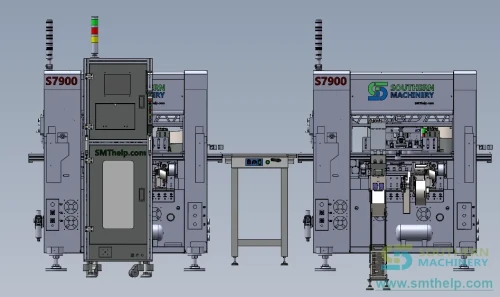
A single-cell odd-form insertion line is the smallest automated answer to hand-inserted through-hole parts: one machine feeding terminals, connectors and relays from reel, bowl and tube at once. In the documented case below, one DD-8700 odd-form insertion cell runs an 1x8 panel through a 29.4-second cycle — 979 small boards and 6,853 insertion points an hour, watched by one operator. Southern Machinery builds SMT and THT PCB assembly automation in Shenzhen and has equipped EMS factories since 2011.
What is a single-cell odd-form insertion machine used for?
An odd-form insertion cell handles the through-hole parts no SMT nozzle will place: tab terminals, multi-pin connectors, boxed optocouplers, relays, trayed ICs, taped capacitors, switches and buzzers. The case documented here is an audio-power manufacturer's board carrying four odd-form types — 187 tab terminals, a 2-pin vertical connector, a 6-pin horizontal connector and a relay — seven pieces per small board. Every figure in this article is quoted from the customer solution deck behind that case.
- 187 tab terminal — 4 per board, reel feeder with built-in cutting, 0.45 s
- 2-pin vertical connector — 1 per board, vibratory bowl, 0.45 s
- 6-pin horizontal connector — 1 per board, vibratory bowl, 0.45 s
- Relay — 1 per board, tube feeder, 0.6 s
Seven insertion points per board across three packaging technologies — the part list stopped being an obstacle once it was read as a mounting plan.
Why feed reel, bowl and tube from one odd-form insertion cell?
Mixed packaging is where most THT automation projects stall: terminals on reels, connectors loose, relays in tubes — and the usual answer is three machines, three integrations and three spare-parts shelves. The DD-8700 mounts one to four heads, each taking its own feeder, so a reel station, a vibratory bowl and a tube rack share one pick-and-press platform. This case uses three of the five documented feeder families; the others are tape and tray. Packaging decides feeding quality: the bowl orients connectors and screens cosmetic defects on the way up the elevator, a tube fixes relay polarity by its own moulding, and a reel removes orientation altogether because the feeder cuts each tab free at the instant of insertion.

How does an odd-form insertion cell connect to a complete PCB assembly line?
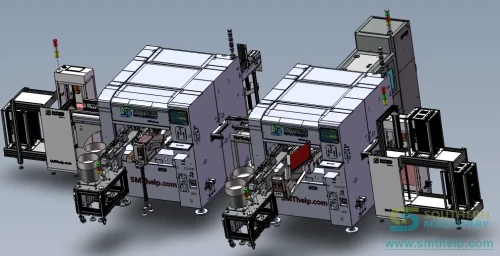
The cell sits mid-line only because the bottom die clinches every leg before the board travels on. Keeping a manual segment beside the automated cells is the deck's own choice: the red-marked components in its product analysis stayed at the bench. The layout is not a stand-alone machine: loader, vertical terminal insertion cell, connecting conveyor, the odd-form insertion cell, lift module, a retained manual line for hand-seated parts, then wave solder and unloader — 13,300 mm in total.
- Machine family: odd-form insertion machine
- Four-head platform: S7000 odd-form insertion machine
- Axial work on the same line: S4000 axial auto insertion machine
- Solder and finish: wave soldering machine
- Wider equipment scope: THT machines
Which parameters decide your THT odd-form insertion cell?
These are the DD-8700 values as published in the solution deck's technical parameter table.
- Insertion speed: 0.4 s per component (case figure); 0.45 s for tabs and connectors, 0.6 s for the relay; PCB load/unload 3 s
- Board size: 100 x 100 mm to 380 x 280 mm (larger by custom)
- Heads and direction: 1-4 heads per machine, each feeding a different part; 0-360 degrees in 1-degree steps
- Feeding systems: vibratory bowl, tube rack, taped feeder, tray magazine, reel
- Lead and board prerequisites: lead deformation within 0.1 mm; edge 5 mm or more, hole 0.5 mm or more, 2 mm or more between bodies (high-density option)
- Verification: bowl checks orientation and cosmetic defects; bottom-die circuit test checks every leg
- Motion: 0.001 mm per pulse; Panasonic servos, THK ballscrews (0.01 mm class), AirTAC cylinders, SMC valves
- Control: industrial PC plus motion control card, 17-inch colour LCD, online vision programming, USB or RS-232C
- Utilities and environment: single-phase 220 VAC 50/60 Hz, 2 kVA; air 5-6 kg (0.5-0.6 MPa) at 0.6 m3/min; 10-30 degrees C, 30-70 % RH; main unit 1950 x 1500 x 1530 mm, 1500 kg
Companion decks document the siblings: the DD-8600 reel-only terminal specialist at 0.25 s per piece, the DD-8700 at 0.4-0.8 s per piece, and the DD-9000 vision gantry at 1-2 s per piece.
Why panelise 1x8? The cycle-time math behind 6,853 inserts an hour
One number in every insertion cycle does not care what you insert: the board change, published as 3 s, repeating whether the panel carries one board or eight.
- Station insert time: 3.3 s · board pass: 3 s · format: 1x8
- Panel cycle: 29.4 s
- Throughput: 3600 / 29.4 x 8 = 979 small boards per hour
- Insertion points: 979 x 7 = 6,853 per hour
The machine did not get faster between a bare board and a panel — the move from roughly 570 to 979 boards an hour is answered entirely by board design. Panelisation also shares every vision datum, fiducial correction and clamp cycle across eight boards, so board-to-board variance becomes intra-panel repeatability.
What does the hand-insertion bench cost that the wage sheet hides?
Seven hand inserts per board looks small until it meets monthly volume, and the wage line is only the receipt. The rest of the bill is shift-to-shift variance, rework found after wave solder, WIP queued in front of the bench, and the supervision keeping it honest. A cell converts those variable costs into one fixed asset with a published cycle time, verified at every insert by the bottom-die circuit test.
What board design rules keep THT automation cheap?
Five rules from the deck, all decided upstream of the machine.
- Give the conveyor something to hold: 5 mm or more of clampable board edge.
- Drill for the pin: component holes of 0.5 mm or more.
- Ship the parts straight: leads deformed beyond 0.1 mm are rejected at the feeder.
- Leave the bodies room: 2 mm minimum; the high-density option is an option, not a default.
- Panel for the takt: the 1x8 format is what turns 3.3 s of insertion into 6,853 points an hour.
What is the ROI of a single odd-form insertion cell?
The deck's payback calculator uses one deliberately simple formula:
simple payback (years) = line price / annual freed bench labourIllustration only — example figures, depends on configuration, subject to final technical confirmation: freeing an insertion team with a loaded cost of USD 90,000 a year against a quoted line price of USD 180,000 gives a simple payback of 2.0 years, before any credit for avoided rework or reduced WIP. The source document supplies no prices or payback figures; every value here is an illustration, not a quotation.
How do you start THT automation without replacing the whole line?
Start with the part that hurts most — highest volume, tightest takt, most rework — and count the neighbours sharing its rhythm. Four types and seven pieces justified one cell here. When volume grows, the platform adds heads before machines and machines before floor space: the five-cell, twenty-type line in this series is this cell bought four more times.
FAQ
What counts as an odd-form component?
Anything an SMT nozzle will not handle: tab terminals, multi-pin connectors, boxed optocouplers and relays, trayed ICs, taped capacitors and switches.
How fast is the insertion itself?
The deck rates this cell at 0.4 s per component, with 0.45-0.6 s per part in the case table and a 3 s board change.
What does the line actually produce?
On this board — 1x8 panelled, four types, seven pieces — the deck computes a 29.4 s panel cycle: 979 small boards and 6,853 insertion points per hour.
How are the legs held before wave solder?
The bottom die rises with the press, confirms by circuit test that the lead passed the hole, then bends the legs — and on multi-cell lines the clinch stops earlier parts popping out downstream.
Can one machine mix reel, bowl and tube feeding?
Yes — that is the case itself: the 187 tab reel, the connector bowl and the relay tube rack run on one DD-8700 with three heads.
When is a single cell the right answer?
When the part list is focused, volume is steady, and the panel format can carry the changeover cost.
Send the board, and we will send the station plan
Southern Machinery supports SMT and THT lines worldwide from Shenzhen with factory acceptance before shipping, installation supervision, training, and stocked spares, dies and retrofits. Send the packaging column of your BOM — it is enough to size the first cell.
- Request an insertion evaluation or a configuration sheet
- S7900 odd-form machine 2025 catalogue
- Auto-insertion readiness checklist
- Email info@smthelp.com or message WhatsApp +86 13602562576
Figures are quoted from the customer solution deck in the source document and are subject to engineering change.
Comments