
THT Odd-Form Insertion Case Study: Five Linked Inserter Machines by Southern Machinery
Documented five-machine THT odd-form insertion line replaced a 14-operator bench: 0.4-0.8 s per part, clinched leads before wave soldering, payback math.
Oct 6, 2026 · Updated Oct 6, 2026 · Southern Machinery
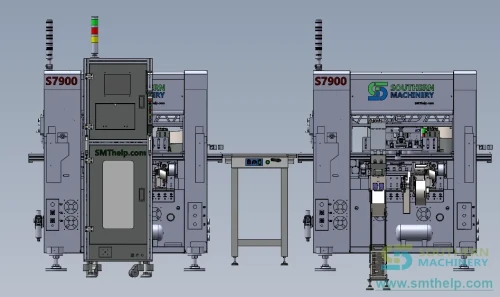
Direct answer: this THT odd-form insertion case study documents a five-machine line - a loader, five linked odd-form insertion machines on conveyors, and an unloader - that replaced a fourteen-operator manual through-hole bench feeding an existing wave soldering oven. Components place and clinch at 0.4-0.8 seconds each, boards exchange in three seconds, and no board leaves with a lead unbent. Every figure below is quoted from the source case-study document or the S7900 family catalogue, and where the two documents disagree, both numbers are printed.
What did the manual bench cost before the machines arrived?
Before automation: SMT printed, placed and reflowed, then every connector, optocoupler, relay, tab and large capacitor inserted by hand.
The bench sets the takt
A dozen or twenty operators inserting at their own rhythm means output follows the shift roster, not the plan: the wave oven runs when the bench feeds it, and test stations idle when the bench falls behind.
The defect classes the bench owns
A reversed optocoupler, a connector with one un-bent lead, a relay that floats up in the wave - inspection catches some and the field catches the rest. Standard inserters also assume tape and reel, while odd-form parts arrive in bulk bags, tubes, trays and mixed reels.
How does a five-machine THT odd-form insertion line replace a manual bench?
The documented configuration is one sealed rhythm across five stations, measured at 14,750 mm end to end.
- Loader - feeds panels onto the rail; 1200 x 740 mm station
- Inserter #1 - 187/250 tabs and connectors; 5 components, 2.5 s insert, 3 s board pass, 900 boards/h
- Inserter #2 - tabs and connectors; 5 components, 2.5 s insert, 3 s board pass, 900 boards/h
- Inserter #3 - connectors and pin headers; 4 components, 2.0 s insert, 3 s board pass, 1,000 boards/h
- Inserter #4 - optocouplers, ICs and switches; 5 components, 2.5 s insert, 3 s board pass, 900 boards/h
- Inserter #5 - safety capacitors and relays; 4 components, 2.6 s insert, 3 s board pass, 923 boards/h
- Wave soldering - the customer's existing oven; boards arrive with leads already bent and held
- Unloader - final rail section, 3600 mm
Documented rate formula: hourly rate = 3600 s / (slowest insertion time x placements per panel) + board exchange. A two-machine variant with manual assist is documented at 13,300 mm.
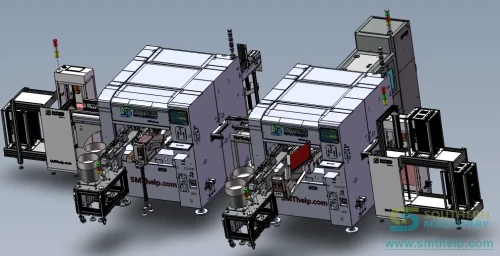
Feed per packaging family
Vibration bowls take bulk connectors, buzzers and safety capacitors; tube racks take optocouplers, relays, eight-pin ICs and side-actuated switches; reel feeders take 187/250 tabs with built-in cut-off; tray magazines take bulky parts. Each head is married to one family.
Insert with locating, then clinch in the same motion
Vacuum locates the component by its body, an electric cam clamp holds the body shape (never the leads), V-groove guides align lead tips before entry, and the push rod drives the part home. The base die then rises synchronously with the insertion, a circuit check confirms seating, and the leads bend - outward, inner, circular or two-turn.
Bowl optics also reject wrong-orientation and lead-deformed parts before the head picks them, and on a linked line the clinch is what stops machine five from pushing out the part inserted at machine one.
Odd-form insertion machines vs the manual bench: what actually changes?
- Pacing - operator rhythm, shift dependent, versus a fixed servo cycle at 0.4-0.8 s a component
- Part orientation - visual check after the fact versus optical check before the head picks
- Lead condition - operator judgement, usually unchecked, versus die-checked and bent at clinch
- Board movement - component sits loose until the wave versus clinched before the panel leaves the station
- Staffing - fourteen operators at the bench versus tenders, first-piece checks and feeder loading
- Traceability - none at the bench versus programs and process data on an industrial PC
What does your board need before an odd-form inserter will run it?
Automation amplifies board discipline. Documented machine requirements:
- Conveyor edge: at least 5 mm
- Insertion hole: at least 0.5 mm
- Lead deformation: within 0.1 mm
- Body-to-body clearance: at least 2 mm (high-density option available)
- Board size on the case platform: 100 x 100 mm minimum to 380 x 280 mm maximum, larger on request
Documented parameters, and the two documents' own differences
- Insertion heads - case document 1-4 heads per machine; catalogue S7900-II/IV/VI with 2/4/6 heads
- Speed per component - case document 0.4-0.8 s; catalogue 0.6-0.8 s (S7900-IV-P with lead clinching: 2 s)
- Maximum PCB - case document 380 x 280 mm; catalogue up to 410 x 500 mm board, 500 x 550 mm carrier
- Accuracy - case document 0.001 mm per pulse resolution; catalogue +/-0.05-0.06 mm placement accuracy
- Power and air - case document 220 VAC 50/60 Hz, 2 kVA, air 0.5-0.6 MPa at 0.6 m3/min; catalogue 4.5-6.6 kW max, air 0.5-0.65 MPa
- Weight and footprint - case document 1500 kg, 1950 x 1500 x 1530 mm; catalogue 1250-1800 kg by model
Other documented values: insertion direction programmable 0-360 degrees in 1 degree steps; Panasonic servos with THK ball screws of the 0.01 mm class; 17-inch colour display with online vision programming, an Excel-like process editor, USB import and RS-232C handshake; 10-30 degrees C at 30-70% RH. The catalogue adds an air note of a minus 17 degrees C frost point.
What does the line insert?
The documented component list runs to 187/250 reel tabs, bulk connectors from 2 to 7 pins, VH and horizontal connectors, pin headers, tube optocouplers, eight-pin ICs, side-actuated switches, bulk buzzers, safety and high-voltage capacitors, and tube relays.

How do you calculate payback on a THT odd-form insertion line?
The source page ships a calculator and no price; the arithmetic is deliberately boring.
manual insertion hours per day = boards per day x odd-form parts per board x manual seconds per insert / 3600
hours freed per day            = manual insertion hours per day x share of manual time freed
annual bench labour addressed  = hours freed per day x working days per year x loaded wage per hour
simple payback                 = quoted line price / annual bench labour addressed
Worked example (example only - depends on configuration and is subject to final technical confirmation): 2,000 boards a day, 10 odd-form components a board and 8 manual seconds per insertion gives 2,000 x 10 x 8 / 3600 = 44.4 operator-hours a day on the bench. At 95% freed that is about 11,100 hours a year, and at an illustrative loaded wage of 6 USD an hour roughly 66,000 USD of addressed bench labour - so a line quoted at 300,000 USD shows a simple payback near 4.5 years on labour alone. The simplification ignores rework, scrap, schedule gains and real wage rates, which is why it is called conservative.
How does the line connect to your existing SMT and wave soldering flow?
Solder paste printing, SMT placement and reflow happen first; the mixed-technology board then reaches the through-hole side, where inserters place and clinch before the same wave soldering oven finishes the joints. Southern Machinery supplies the machines and the line around them - see the odd-form insertion machine range, the S7000 odd-form inserter, the S4000 axial inserter, the wave soldering machines and the full THT machine category. Headcount does not vanish; it moves to feeder loading and first-piece verification.
What does the floor need before the crates open?
- Floor: rated for 1500 kg per machine, 10-30 degrees C, 30-70% RH, rail height matched to your wave oven
- Power and air: single-phase 220 VAC at 2 kVA and 0.5-0.6 MPa dry air at 0.6 m3/min per machine
- Layout: 14,750 mm for the documented five-machine line including loader, conveyors, wave oven and unloader
- Commissioning: vision programming, program import, feeder change and die change, trained on your board files
Documents behind this case study
- S7900 odd-form machine catalogue 2025
- S7900 odd-form machine operation manual
- THT PCB design guideline 2022
- Auto-insertion readiness checklist
- Southern Machinery odd-form insertion solution deck
Frequently asked questions
Which components can this line insert?
The documented case line handles 187/250 reel tabs, bulk connectors from 2 to 7 pins, VH and horizontal connectors, pin headers, tube optocouplers, eight-pin ICs, side-actuated switches, bulk buzzers, safety or high-voltage capacitors and tube relays.
How fast is insertion, really?
0.4-0.8 seconds per component, with a 3-second board exchange, and 900-1,000 small boards per hour per machine in the customer's capacity table.
What is clinching and why does it matter before wave soldering?
The base die bends the leads as the component seats - outward, inner, circular or two-turn - so the wave cannot float the part and later insertions cannot push it out.
How many machines does a board like mine need?
The documented line split fourteen-plus component types across five machines by feeder family. Machine count falls out of your feeder map and takt; send the BOM with packaging and volumes.
Do we need robot programmers to run it?
No. Programming is online vision teaching plus an Excel-like process editor, with commissioning training on your own board files.
What utilities does each machine need?
On the case platform: single-phase 220 VAC at 2 kVA and 0.5-0.6 MPa dry air at 0.6 m3/min. Higher head-count catalogue models draw up to 4.5-6.6 kW.
Send the board file, get the feeder map
Attach the BOM with packaging as received and your daily volume, and the reply is a feeder map, a clinch die proposal and a capacity table. Southern Machinery has supplied SMT and THT equipment since 2011 from Shenzhen, serves 237+ customers worldwide, dispatches spare parts within one working day and engineers customised feeders and dies within a month. Contact info@smthelp.com or WhatsApp +86 136 0256 2576.
Comments