
THT Odd-Form Insertion Case Study: Cam + Vision Gantry Line by Southern Machinery
THT odd-form insertion: 16 part types on three cam DD-8700 cells plus two DD-9000 vision gantries - 9 s cycle, 800 boards/h, with clinch and no-clinch.
Oct 6, 2026 · Updated Oct 6, 2026 · Southern Machinery
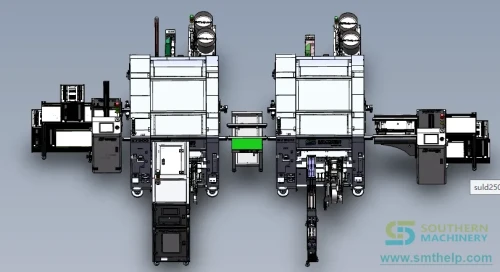
A cam-plus-vision THT odd-form insertion line automates the through-hole parts no mounter will place, and keeps the parts that must not be bent out of the press. The case behind this article is a 36 W power board carrying 16 odd-form types and 20 pieces per 1x2 panel, built on five linked cells — three cam-driven DD-8700 inserters and two DD-9000 vision gantries — on a 15,790 mm line running one panel every 9 seconds: 800 small boards per hour. All figures are quoted from the customer solution deck behind that line.
A THT odd-form insertion line is used wherever a PCB carries through-hole parts no pick-and-place feeder accepts — tab terminals, connectors, sockets, optocouplers, fuse holders, capacitors, magnetics — inserting, verifying and, where allowed, clinching them before wave soldering.
What is a THT odd-form insertion line used for?
Odd-form insertion answers one failure mode: the SMT side of the factory is automated and the through-hole side is still a bench. On the documented board every lead was pushed by hand, on a bench that set its own pace, clinch angle and defect rate. Twenty hand operations per panel fix headcount to the part list, and each new operator relearns seating, polarity and clinch feel at their own speed — so a connector can stand proud by half a millimetre, pop out in the conveyor or sit reversed, and the cost surfaces after the wave as rework.
Three mechanisms hold a through-hole part in the wave, and this board uses all three: the hook (the bottom die bends the legs — tabs, sockets, connectors, optocouplers, capacitors), the fit (fuse holders and press-fit parts rely on the hole itself) and the mass (a transformer or inductor sits on weight and surface tension, which works only if it was placed square).
Which odd-form parts belong on cam cells — and which behind cameras?
The clinch-or-not decision, part by part
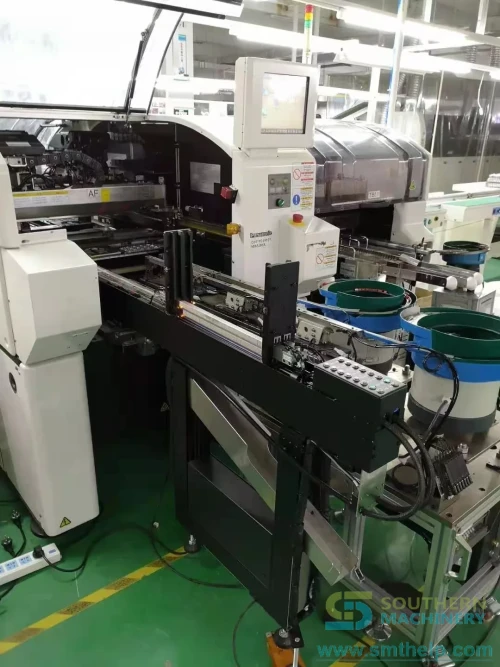
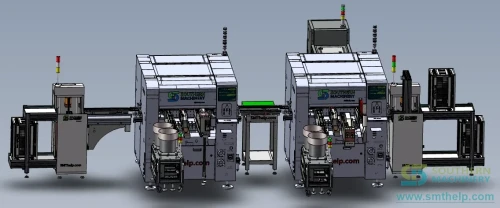
Cells one to three are cam-driven DD-8700s: tabs from reels, connectors and capacitors from bowls, optocouplers from tubes — 0.4-0.6 s per component, with the rising bottom die testing the circuit before it bends a leg. Cells four and five are DD-9000 vision gantries on a no-clinch program: three fuse holders from taped feeders, plus an inductor and a transformer from bulk. No clinch means the die supports the press but does not bend the legs; retention comes from the hole fit, body weight and the surface tension of the wave.
Four questions that split your BOM
- May the legs bend? Ceramic bodies, magnetic cores and press-fit retention say no — those parts go behind cameras.
- Is the lead guideable? A V-groove needs a thin, straight, regular lead; thick transformer pins defeat it.
- Does the part need force control? The DD-9000's electric gripper adjusts width and clamping force; a cam clamp applies a fixed one.
- What is the rhythm? The deck balanced part counts until both families landed on the same 9-second cycle rather than compromising on speed.
How does a five-cell line hold 800 boards an hour?
The board is panelled 1x2 and the deck assigns sixteen types to five cells so every station lands on the same cycle:
- Cell 1 — DD-8700: 4 types, 6 pieces per board, 3 s insert, 3 s pass, 800 small boards/h
- Cell 2 — DD-8700: 4 types, 6 pieces, 3 s insert, 3 s pass, 800 boards/h
- Cell 3 — DD-8700: 3 types, 3 pieces, 3 s insert, 3 s pass, 800 boards/h
- Cell 4 — DD-9000: 3 types, 3 pieces, 3 s insert, 3 s pass, 800 boards/h
- Cell 5 — DD-9000: 2 types, 2 pieces, 3 s insert, 3 s pass, 800 boards/h
Every cell is 3 s of insertion plus 3 s of pass — a 9-second panel cycle repeated five times. Published per-part speeds are 0.5 s for tabs, sockets, optocouplers and capacitors; 1 s for the SCR, electrolytics and fuse holders; 1.5 s for the inductor and transformer. Because no station waits on another, the bottleneck stops being a machine and becomes the line.
hourly rate = 3600 s / (slowest insertion time x placements per panel) + board exchangeWhich feeding technologies does the case line use?
- Vibratory bowl — bulk: loose connectors, headers and capacitors, oriented and screened for direction and defects.
- Taped feeder: 2.5 / 3.5 / 5.0 / 7.5 / 10 / 15 mm pitches on vertical feeders that check polarity.
- Tube rack: optocouplers, relays and IC blocks — polarity fixed by the packaging, tubes recyclable.
- Tray magazine: stacked trays take trayed ICs, amplifiers and heavy parts.
- Reel and tandem: 187 and 250 tab terminals on dedicated reel feeders with built-in cutting, sharing one feeder format.
What parameters decide the configuration?
DD-8700 cam-driven inserter — published values
- Insertion speed: 0.4-0.6 s per component, depending on the part · PCB load / unload: 3 s · Motion resolution: 0.001 mm per pulse
- Board size: 100 x 100 mm to 380 x 280 mm, larger by custom · Heads: 1-4 per machine, each feeding a different odd-form part · Direction: 0-360°, settable in 1° steps
- Board prerequisites: clampable edge >= 5 mm, component hole >= 0.5 mm, lead deformation <= 0.1 mm, bodies >= 2 mm apart
- Lead fixing: bottom-die leg bending (clinch), or a no-clinch program per part
- Drives: Panasonic servo controller and motors, imported THK ballscrews (0.01 mm class), AirTAC cylinders, SMC solenoid valves
- Control: industrial PC plus motion control card, 17-inch colour LCD, online vision programming
- Utilities: single-phase 220 VAC 50/60 Hz, 2 kVA; air 5-6 kg (0.5-0.6 MPa) at 0.6 m3/min; 10-30 °C, 30-70 % RH
- Footprint: 1950 x 1500 x 1530 mm main unit, 1500 kg
DD-9000 vision gantry inserter — published values
- Insertion speed: 1-2 s per component · Structure: gantry with Y-axis servo dual-drive for speed and stability
- Cameras: three 500 W cameras — two read the component's legs, one reads the PCB · Gripper: electric, auto-adjusting width and clamping force
- Board size: up to 450 x 300 mm · Footprint: 1100 x 1350 x 1680 mm, 1200 kg
How does the line connect to a full PCB assembly line?
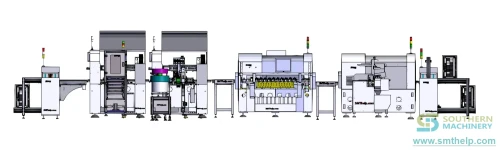
The documented line is not an island: loader, three DD-8700 cells, two DD-9000 cells, wave solder and unloader — 15,790 mm — so panels stay on one conveyor and one program plan from first insertion to solder. The SMT side prints, places and reflows first, this line adds the through-hole content, and wave soldering bonds the clinched and straight-leg parts alike. Where the mix narrows to terminals only, the S7000 terminal insertion machine is the cheaper answer; the whole selection sits under THT automation, the odd-form insertion machine platform and the product-line catalogue.
What is the payback on a THT odd-form insertion line?
Price the bench on four cost lines, not just wages: wages, variance and rework, work-in-progress queued on a cart, and supervision. This line replaced twenty hand operations per panel with five machines and one attendant, and the deck's simplification is deliberately conservative:
simple payback = line price / annual freed bench labourWorked example — example only, depends on configuration, subject to final technical confirmation. With six operators freed at a loaded-wage placeholder of $3.00/h and 4,000 production hours a year, annual bench labour addressed is 6 x 3.00 x 4,000 = $72,000; against a placeholder line price of $300,000 the simple payback is 300,000 / 72,000 = 4.2 years. Treat that as a floor — it ignores rework avoided after wave solder, the WIP the bench no longer queues and the supervision one attendant replaces.
THT odd-form insertion line FAQ
Why mix cam and vision machines on one line? Because the part list splits. Bendable, high-rhythm parts run fastest on cam-driven DD-8700 heads; parts that must stay straight — fuse holders, inductors, transformers — need camera verification and an adaptive gripper, which is the DD-9000's job.
Can the cam cells run the no-clinch parts too? The press can, the verification cannot. The DD-8700 confirms legs by bottom-die circuit test, which suits bent retention; magnetics and fuse holders want dimensional verification instead.
What do the DD-9000's cameras actually check? Two 500 W cameras read the component's legs — presence, coplanarity, deformation — and the third reads the PCB, fiducials and hole positions.
When is a five-cell mixed line the wrong answer? When the part list is narrow. A terminal-only mix wants a dedicated two-head cell, and a modest odd-form list runs on one DD-8700.
Send the board — we will send the station plan
Mark the parts that must not be bent and Southern Machinery will plan the rest: a one-page station plan naming every cell, every feeder and every cycle time, quoted from the same method as this case. Ask for a sample insertion run or a full configuration sheet — your board, your components, our factory cell — at info@smthelp.com or on WhatsApp at +86 13602562576. Southern Machinery has built SMT and THT automated assembly equipment since 2011, supporting lines worldwide with spare parts, retrofit, training and overhaul.
Comments