
THT Odd-Form Insertion Case Studies by Southern Machinery
Four documented THT odd-form insertion lines compared — 20 types at 900 boards/h, a 6,853 inserts/h single cell, and a 4.65 m terminal-only cell.
Oct 6, 2026 · Updated Oct 6, 2026 · Southern Machinery
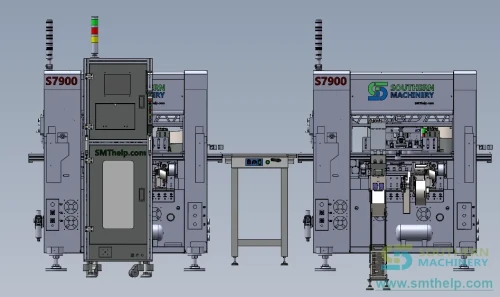
Odd-form insertion is not one machine — it is a platform family sized to the part list. This page compares the four THT odd-form insertion lines Southern Machinery has documented in customer solution decks: a five-cell all-cam line automating 20 types at 900 boards/h, a single DD-8700 cell turning a mixed-package list into 6,853 inserts/h, a terminal-only DD-8600 cell at 0.25 s per insert on a 4.65 m line, and a cam-plus-vision line built for parts that must not be bent. Every number below is quoted from its deck; where a deck publishes nothing, this article says so.
What does a THT odd-form insertion line actually automate?
Through-hole work splits into two problems. Radial and axial parts feed on tape, so one machine model covers most of the list. Odd-form parts — tab terminals, connectors, relays, transformers, bulk capacitors, and anything arriving in a tube, tray or loose in a bowl — have no standard footprint and no standard feeding method. The decks apply one rule: the package decides the feeder, and the feeder decides the machine.
Typical odd-form work therefore lands on power-supply, audio-power, LED driver and industrial control boards — dense, mixed-package through-hole content that is expensive to place by hand. Southern Machinery builds the answer as a platform family rather than a fixed model: DD-8700 cam cells, DD-9000 vision cells and the DD-8600 terminal specialist, combined as heads per cell, cells per line and feeders per head. Founded in Shenzhen in 2011 and serving more than 237 customers worldwide, the company sizes each line against a real part list rather than a brochure specification.
Which THT odd-form insertion case looks like your board?
The four documented cases answer four different buyer questions. Match the shape of your part list to the shape of the line:
- Wide part list (fifteen or more odd-form types) — start with the five-cell all-cam case, the widest mix documented on one line.
- Focused list in mixed packages — start with the single-cell case, where reel, bowl and tube feeding share one DD-8700 platform.
- Terminals dominate the list — start with the DD-8600 terminal specialist, a two-head reel-fed cell on the shortest documented line.
- Some parts must not be bent — start with the cam-plus-vision case, where each no-clinch decision is marked row by row.

Four documented odd-form lines, compared
Case 1 — Five all-cam cells: 20 types at 900 boards/h
A power-supply (SMPS) board with the widest mix in the series: 23 pieces across 20 odd-form types as a 1×2 panel. Five DD-8700 cam cells and five feeding technologies produce a 7–8 s panel cycle, 900 boards/h, on a 13,300 mm line. That is the answer when no single feeder family carries the list.
Case 2 — One cell, 1×8 panel: 6,853 inserts/h
An audio-power board with 7 pieces across 4 types as a 1×8 panel. One DD-8700 cell carries reel, bowl and tube feeding on the same platform at a 29.4 s panel cycle — 979 boards/h, or 6,853 insertion points per hour from a single documented cell.
Case 3 — Terminal specialist: 0.25 s per insert
High-count tab terminals, with 187 of 250 machine formats in use. The DD-8600 uses two reel-fed heads at 0.25 s per insert, and loader to unloader fits in 4,650 mm. One honest note: the deck publishes the machine rate but no board-level panel cycle, so the points-per-hour ceiling here is computed from 0.25 s and labelled as computed.
Case 4 — Cam heads plus a vision gantry: 16 types at 9 s
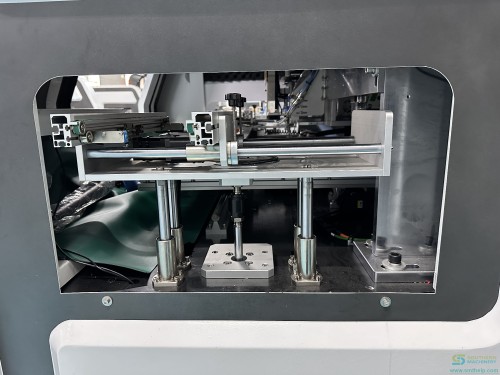
A 36 W power board with 20 pieces across 16 types as a 1×2 panel. Three DD-8700 cam cells and two DD-9000 vision cells run on one 15,790 mm line at a 9 s panel cycle for 800 boards/h. Vision exists here for a specific reason: some parts must not be bent — ceramic, magnetic and press-fit bodies — and the deck records the no-clinch decision for every affected row.
The four lines, side by side
- Five-cell all-cam — 5 × DD-8700 · 20 types / 23 pcs · 1×2 panel · 7–8 s · 900 boards/h · 13,300 mm
- Single mixed cell — 1 × DD-8700 · 4 types / 7 pcs · 1×8 panel · 29.4 s · 979 boards/h · 13,300 mm with the manual line
- Terminal specialist — 1 × DD-8600 · 187 / 250 formats · panel cycle not published · 14,400 pts/h ceiling (computed from 0.25 s) · 4,650 mm
- Cam + vision — 3 × DD-8700 + 2 × DD-9000 · 16 types / 20 pcs · 1×2 panel · 9 s · 800 boards/h · 15,790 mm
What does a THT odd-form line cost per inserted part?
The decks print their formula, so you can run your own numbers:
Output per hour = 3600 ÷ (insertion time per piece × pieces per panel + board change time) × boards per panel
Worked example (example only — depends on configuration; subject to final technical confirmation): take the five-cell case at a 1×2 panel and an 8 s panel cycle. 3600 ÷ 8 = 450 panels per hour, so 900 boards per hour, about 7,200 boards in one 8-hour shift, and roughly 4,320,000 boards a year across two shifts and 300 working days. Apply your own labour and reject cost to your own inserted-part count — the arithmetic above is throughput only.
Prices are quoted per part list, never per brochure. Send the board and the BOM: the evaluation — part list sorted by package, clinch audit, station plan — is free until a sample run ships.
How to scope odd-form automation: the six-step method
Every table in the series came out of the same planning sequence.
1. Sort the part list by package
Bulk, tube, tape, tray, reel — the package decides the feeder. Parts that resist the sort are flagged for the bench.
2. Audit the clinch per part
Which legs must survive the wave with a hook, and which must stay straight? That answer splits cam cells from vision cells, and the decks mark it row by row.
3. Balance cells to one cycle
Types per head, heads per cell, cells per line — divided until every station lands on the same cycle. The five-cell cases prove it: identical cycles, no waiting heads.
4. Publish the arithmetic
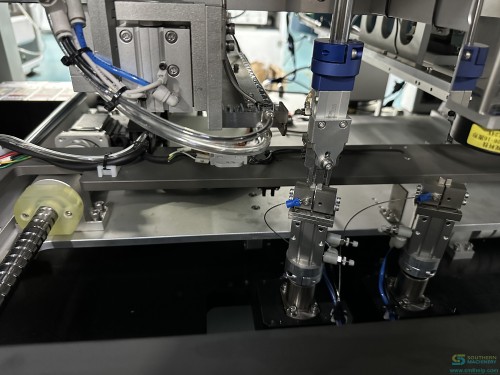
The formula above, printed rather than implied. A vendor who cannot show the division is showing a brochure.
5. Sample on your board
Your components, your panel, the factory cell — acceptance on your own product before the crate closes.
6. Keep the honest notes
Where a deck disagrees with itself, both numbers are printed; where it publishes nothing, the value is computed and labelled.
How odd-form cells fit a complete PCB assembly line
An odd-form cell is a stage, not a standalone project. The documented lines run loader to unloader, and the cam-plus-vision case shows the pattern: cam and vision cells sharing one conveyor, with the clinch decision deciding which legs are formed before wave soldering. Line length follows from the inputs — 4,650 mm for a terminal-only cell, 15,790 mm for a five-machine cam-plus-vision line.
For the wider line around the cells, see the THT machine category, the odd-form insertion machine and S7000 odd-form insertion pages, the wave soldering machine stage that follows insertion, and the machine catalogue for the full equipment board.
FAQ: THT odd-form insertion case studies
Why publish customer solution decks at all? Because the odd-form market runs on claims nobody can check. Each case traces back to a deck produced for a real part list — customer names withheld, engineering facts published, computed values labelled.
Which case is closest to my board? Wide list, start with the five-cell case. Focused but mixed in package, the single cell. Terminals dominant, the DD-8600 specialist. Parts that must not bend, the cam-plus-vision line.
Can these lines be mixed or grown? The platform is modular by design: heads per cell, cells per line, feeders per head. The single-cell case becomes the five-cell case by adding what the part list earned.
What do the lines cost? Prices are quoted per part list, never per brochure. Send the board and the BOM — the evaluation is free until a sample run ships.
What is deliberately not published? Board-level cycles where a deck documented machine rate only, and customer identities. Where a figure is missing, this series leaves it missing or labels it computed.
Next step: send the board, get the station plan
One padded envelope starts the same six steps that produced all four documented lines. Send your board, your BOM and your package mix, and Southern Machinery returns the part list sorted by package, the clinch audit, the station plan and the cycle arithmetic for your own panel format. Contact the engineering team at info@smthelp.com or on WhatsApp — and treat every figure above as the example it is: sourced from a customer solution deck, subject to final technical confirmation on your board.
Comments