
THT Auto Insertion Machines — Smart EMS Factory PCB Assembly by Southern Machinery
THT auto insertion machines automate through-hole component placement for EMS factories. Southern Machinery (Shenzhen, est. 2001) offers axial, radial, odd-form, and terminal insertion machines for power supply, LED, aut
Jul 2, 2026 · Updated Jul 2, 2026 · Southern Machinery
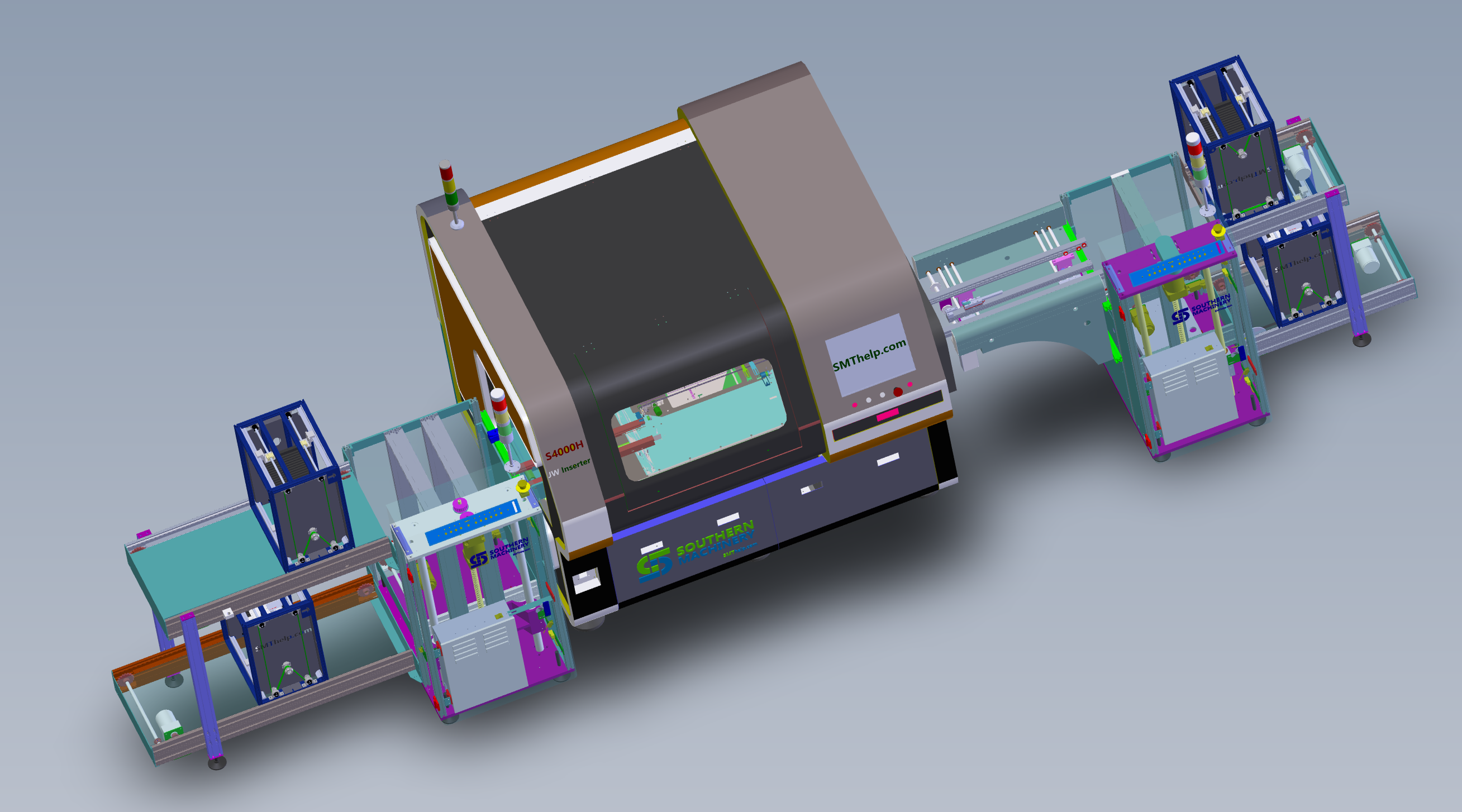
THT Auto Insertion Machines for Smart EMS Factory PCB Assembly — Southern Machinery
What Is a THT Auto Insertion Machine Used For?
A THT (Through-Hole Technology) auto insertion machine automates the placement of leaded components—like axial resistors, radial capacitors, diodes, transistors, connectors, and PIN terminals—into pre-drilled holes on a printed circuit board. After insertion, the machine typically cuts and clinches the leads to prepare the board for wave soldering.
In an EMS (Electronics Manufacturing Services) factory, the THT auto insertion machine replaces manual insertion, eliminating the variation, fatigue, and errors inherent in hand assembly. Modern machines integrate with inline conveyors, programmable controllers, and various component feeders (tape, tray, tube, or vibratory bowl) to deliver consistent, repeatable throughput.
Founded in 2001 in Shenzhen, China, Southern Machinery designs and manufactures a complete range of THT auto insertion machines, serving over 237 global customers. The portfolio covers axial component insertion, radial component insertion, DIP assembly, odd-form component handling, and PIN/eyelet terminal insertion—making it a one-stop solution provider for through-hole automation.
Typical Applications
1. Power Supply PCB Assembly
Power supply boards use large quantities of axial diodes, resistors, and radial capacitors. An auto insertion machine handles these components at high speed, cutting and clinching leads in one pass. Typical components include bridge rectifier diodes, film capacitors, and fusible resistors.
2. LED Lighting Driver Boards
LED driver boards combine axial and radial components in high volumes. A THT auto insertion machine with dual-function capability (axial + jumper wire insertion) reduces PCB jump lines and eliminates secondary operations. This is especially critical for outdoor LED lighting and streetlamp driver boards where reliability matters.
3. Appliance Control Board Assembly
Control boards for air conditioners, microwaves, and induction cookers rely on THT components for power handling and signal isolation. Auto insertion machines handle multiple component types in a single production run, with programmable skip-pattern insertion for mixed bill-of-materials (BOM) scenarios.
4. Automotive Electronic Modules
Car audio systems, vehicle power supplies, and automotive control modules require highly reliable through-hole connections. Auto insertion machines provide consistent lead clinching angles and insertion depth, meeting the mechanical and electrical requirements of automotive-grade PCBs.
5. Industrial and Telecom Infrastructure Boards
Industrial controllers and telecom switches use large connectors, transformers, and bulky odd-form components that standard pick-and-place machines cannot handle. An odd-form auto insertion machine (such as the S-70LD) automates these challenging components that would otherwise require manual labor.
How It Fits Into a Complete PCB Assembly Line
In a smart EMS factory, the PCB assembly line integrates SMT, THT, and final assembly processes. The THT auto insertion machine occupies a specific position in the through-hole workflow:
Solder Paste Printing → Pick and Place (SMT) → Reflow Oven → AOI Inspection → (Transfer to THT Line) → THT Auto Insertion → Wave Soldering → Lead Cutting → Cleaning → Final Inspection
The machine typically sits upstream of the wave soldering machine. For inline systems (like the S3000 or S-4000), the machine receives PCBs via conveyor from the SMT transfer section, inserts all THT components, and sends the populated boards directly into the wave soldering fluxer and preheat zone.
Southern Machinery also offers board handling systems (conveyors, buffers, shuttles, turners, stackers, magazines) that bridge the gap between SMT and THT lines, ensuring smooth material flow without manual board transfer.
The ecosystem includes:
- S-4000 Axial Auto Insertion Machine — high-speed axial component and jumper wire insertion
- S-3010B Radial Insertion Machine — standalone radial component insertion for batch production
- S3000 PCB Dip Assembly Radial Insertion Machine — inline radial insertion for continuous dip assembly lines
- S-70LD Odd Form Insertion Machine — non-standard component automation
- S7020 PIN/Eyelet Terminal Insertion Machine — terminal connection point assembly
- S-WS450 / S-WS350B Wave Soldering Machines — lead-free dual wave soldering downstream
This complete line integration reduces work-in-progress inventory, eliminates manual handling defects, and enables lights-out manufacturing for high-mix through-hole production.
Key Selection Parameters
When evaluating a THT auto insertion machine for your EMS factory, consider these parameters:
Component Compatibility
- Axial vs. radial leaded components—some machines handle only one type
- Component body size range (diameter, height, lead pitch)
- Tape or bulk feeding compatibility
- Jumper wire substitution capability
Production Integration
- Inline (conveyor-ready) vs. standalone (offline batch) operation
- PCB size and thickness range the machine can accommodate
- Changeover time between different component types
- Compatibility with existing conveyor height and PCB carriers
Process Quality
- Lead clinching angle and mechanism (anvil vs. mechanical)
- Lead cut length adjustment range
- Component presence verification and rejection system
- Insertion depth repeatability
Operational Factors
- Available floor space and machine footprint
- Air supply and power requirements
- HMI interface language and ease of programming
- Spare parts availability and local service support
Note: Specific numerical specifications (CPH, insertion accuracy, PCB size limits) vary by model and configuration. Contact Southern Machinery for datasheet values matching your production requirements.
ROI and Quality Perspective
From a production manager's perspective, the decision to invest in THT auto insertion is driven by three factors: labor reduction, quality improvement, and throughput stability.
Labor Reduction
Manual through-hole insertion typically achieves 200–400 components per hour per operator. An auto insertion machine replaces 5–15 operators per shift depending on the component mix and board complexity. In regions with rising labor costs, the payback period is typically under 12 months for medium-volume production lines.
Quality Improvement
Manual insertion introduces variability—bent leads, missed components, reversed polarity, inconsistent clinch angles. Auto insertion machines deliver repeatable quality across every board. This reduces AOI false calls, wave soldering defects caused by incomplete lead preparation, and field failure rates related to loose component mounting.
Throughput Stability
Automated insertion runs at consistent speed regardless of shift timing, operator fatigue, or break schedules. For high-mix EMS factories, programmable insertion patterns allow instant switching between different PCB types without the retraining delay required for manual operators.
Total Cost of Ownership
Southern Machinery's THT auto insertion machines are manufactured in Shenzhen, offering competitive CapEx compared to Japanese or European alternatives. With over 25 years of SMT/THT engineering experience and a global spare parts network, the total cost of ownership is well-suited for mid-market EMS providers looking to automate.
FAQ
1. What is the difference between axial and radial auto insertion machines?
Axial insertion machines handle components with leads exiting from both ends (resistors, diodes) in a straight line. Radial insertion machines handle components with leads exiting from the same side or parallel (capacitors, LEDs, transistors). Southern Machinery offers both types.
2. Can THT auto insertion machines handle jumper wires?
Yes. Models like the S-4000 axial auto insertion machine can process jumper wires simultaneously with axial components, reducing the need for separate jumper insertion stations and reducing PCB jump lines.
3. How do I know if my PCB is suitable for auto insertion?
PCBs designed for auto insertion need standard hole patterns with sufficient pad spacing, consistent hole diameters, and board edge clearance for tooling fixturing. Most power supply and appliance boards designed in the last decade already conform to industry-standard auto insertion requirements.
4. What is the typical ROI period for an auto insertion machine?
Depending on production volume, local labor costs, and component mix, EMS factories typically recover their investment within 8–18 months through labor reduction, defect reduction, and increased throughput.
5. Can an auto insertion machine handle odd-form or non-standard components?
Yes. Southern Machinery's S-70LD Odd Form Insertion Machine is specifically designed for irregular components such as transformers, connectors, relays, coils, shielding enclosures, and crystal oscillators that cannot be processed by standard axial or radial machines.
6. What after-sales support does Southern Machinery provide?
Southern Machinery offers spare parts sourcing (Panasonic, Fuji, JUKI, Yamaha, Siemens, DEK, Universal), sub-assembly and retrofit kits, repair services, machine training, and full overhaul support. The company also provides custom SMT nozzle design and manufacturing.
---
Ready to automate your THT assembly line?
Contact Southern Machinery:
- Jason Wu — jasonwu@smthelp.com
- Phone / WhatsApp: +86 13602562576
- Catalog download: https://file.autoinsertion.com
- Machine images & videos: https://ph.smthelp.com
- Website: https://www.smthelp.com
Southern Machinery — Smart EMS factory partner since 2001. 237+ global customers. Made in Shenzhen, China.
Comments