
THT Auto Insertion Machine Line Solution by Southern Machinery
Southern Machinery's THT Auto Insertion Machine Line Solution helps EMS and OEM factories reduce manual through-hole insertion work, improve placement consistency, and integrate jumper wire, radial, and axial insertion i
Jul 3, 2026 · Updated Jul 3, 2026 · Southern Machinery
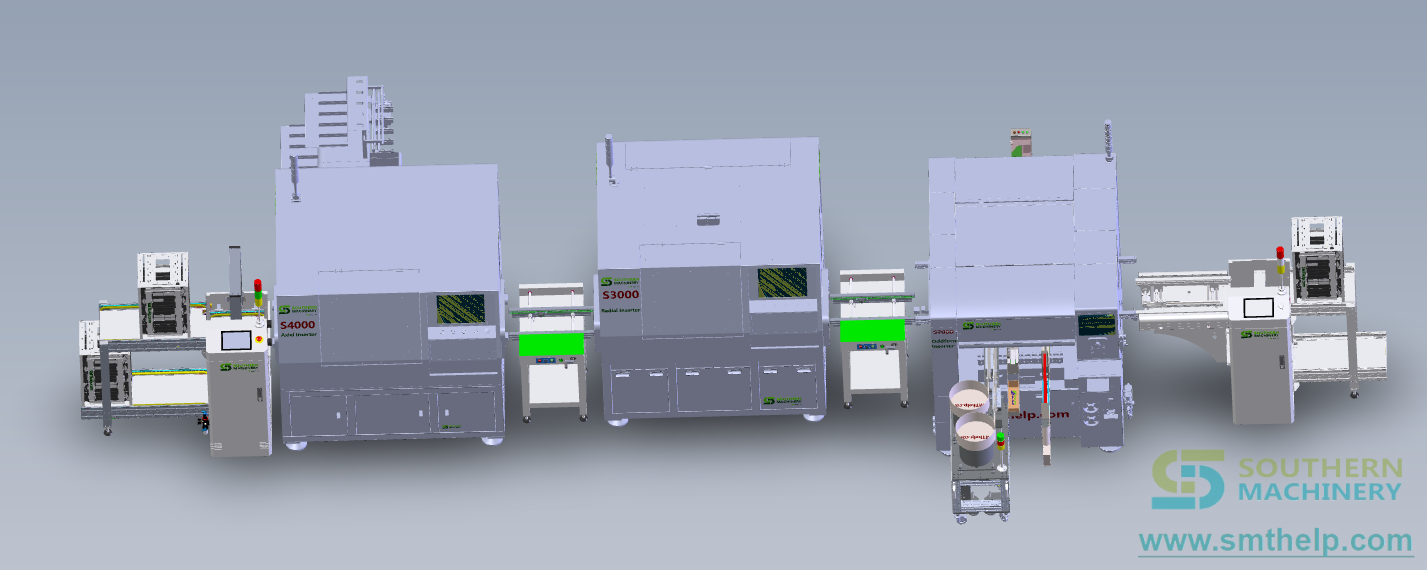
THT Auto Insertion Machine Line Solution by Southern Machinery
Manual through-hole insertion remains one of the most expensive and inconsistent steps in many PCB assembly factories. Operators can handle mixed components, but speed, repeatability, training time, and quality consistency become harder to control as volumes increase.
Southern Machinery builds THT auto insertion machine line solutions for EMS and OEM factories that want to replace repetitive manual insertion with a more stable, modular automated flow. The source page positions the solution as a low-cost, high-efficiency way to automate jumper wire, radial component, and axial component insertion, and to scale from standalone machines into a complete inline production system.
Founded in Shenzhen, China in 2011, Southern Machinery focuses on SMT and THT PCB assembly automation equipment. Our support covers SMT lines, THT insertion, wave soldering, board handling, inspection, spare parts, training, and global service. For overseas buyers, the value lies not only in the machine but in the complete line planning tailored to your PCB, component mix, and factory layout.
What Is This Machine Used For?
A THT auto insertion machine line automatically inserts leaded through-hole components into printed circuit boards. In practical EMS production, this includes radial components such as capacitors, LEDs, and transistors; axial components such as resistors and diodes; jumper wires; and other THT parts that would otherwise need manual insertion before soldering.
The goal is straightforward: shift repetitive insertion work from operators to controlled machinery, so the factory can improve output consistency, reduce handling errors, and prepare boards for downstream wave soldering or selective soldering with a more stable process.
Typical Production Problems This Line Solves
THT areas often look productive because many operators work simultaneously, but manual variation still limits the line.
- Operators insert at different speeds, creating uneven line balance.
- Wrong orientation or missing parts cause rework before soldering.
- Training new workers takes time, especially for high-mix products.
- High-volume boards—such as those for LED lighting, power supplies, industrial controls, and automotive electronics—often require more repeatability than manual insertion can provide.
- SMT lines may run fast, but final output is still blocked by the THT insertion section.
Southern Machinery designs the THT section around the actual component classes, then connects it with board handling, soldering, and inspection, making it an integrated part of the complete PCB assembly flow.
Recommended Line Architecture
For a practical THT auto insertion project, choose a machine as part of a planned line, not in isolation.
1. Upstream SMT Section
For mixed-technology boards, the SMT side usually comes first:
- Magazine loader or PCB loader
- Conveyor
- Automatic stencil printer or semi-auto printer (depending on volume)
- Pick-and-place machine
- Reflow oven
- AOI (if required by quality targets)
- Buffer or transfer conveyor before THT
Size the THT automation section so it does not become the bottleneck after SMT.
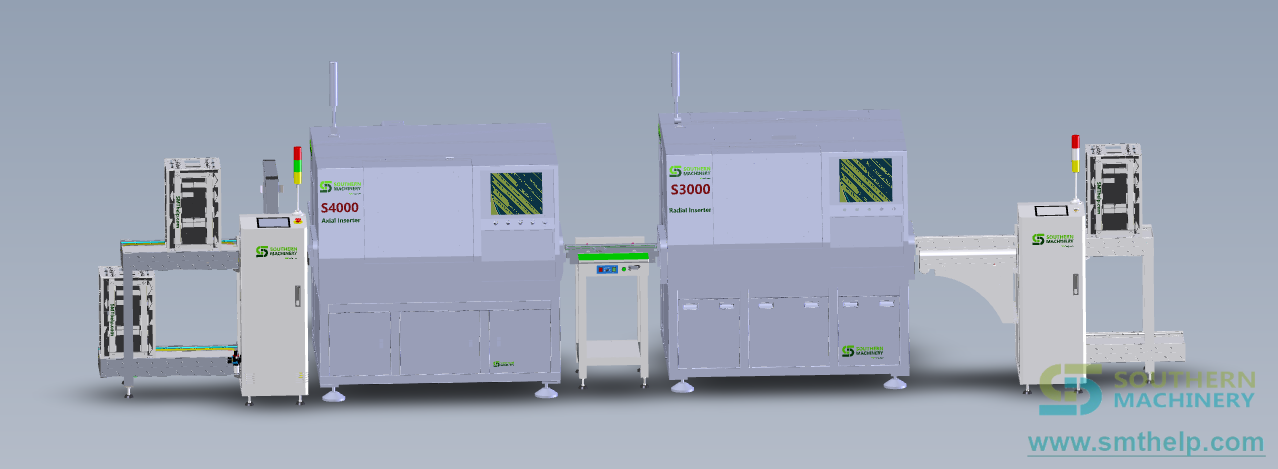
2. THT Auto Insertion Section
The source page groups the solution into three practical insertion families:
- Jumper wire insertion – replaces repetitive manual wire insertion.
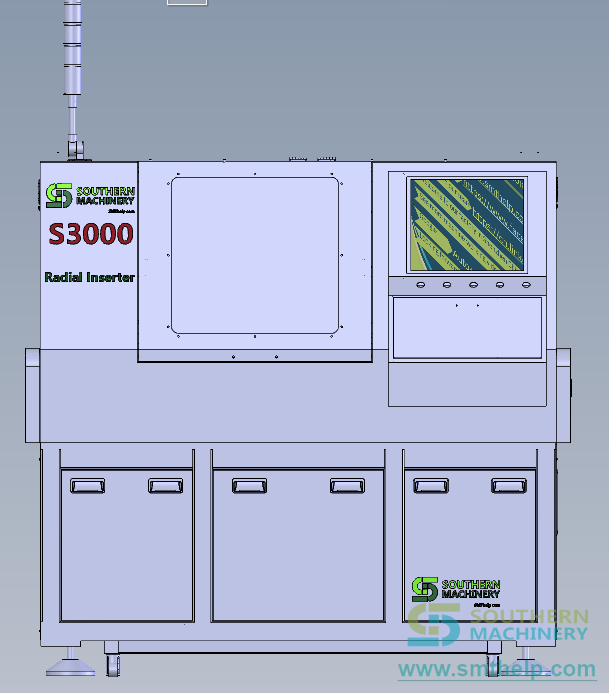
- Radial component insertion – for capacitors, LEDs, and transistors.
- Axial component insertion – for resistors and diodes.
Select the exact machine model after checking PCB size, pitch, component body dimensions, lead forming requirements, and target output. If the source page provides example speed figures, treat them as reference examples; final technical confirmation is needed for the selected configuration.
3. Board Handling and Transfer
A serious production line needs stable board flow, not just insertion equipment. Typical board handling options include:
- PCB loader and unloader
- Linking conveyors
- Buffers between SMT and THT sections
- Magazine handling
- Inverter (if board flipping is needed)
- OK/NG sorting after inspection
An automated inserter loses value if operators must manually carry PCBs between stations.
4. Soldering After Insertion
After insertion, the board normally moves to wave soldering or selective soldering.
- Wave soldering – efficient for boards with dense THT parts and stable process windows.
- Selective soldering – better when boards have sensitive SMT areas, keep-out zones, or mixed technology that requires more control.
Southern Machinery can help match the soldering process to board design, thermal mass, connector types, and quality targets.
5. Inspection and Traceability
For higher reliability products, the THT line can also include:
- Visual inspection station
- THT AOI (where suitable)
- Barcode scanning
- Production data collection
- MES connection (for factories that require traceability)
This is especially useful for automotive, medical, industrial control, power electronics, and export EMS work where process records matter.
Key Selection Parameters for Buyers
Before choosing a THT auto insertion line, prepare these details:
- PCB size range, thickness, and panelization.
- Product type (e.g., LED driver, power supply, industrial control board, charger, inverter, or automotive module).
- Main THT component classes (jumper wire, radial, axial, odd-form connector, transformer, relay, terminal, heatsink, or large capacitor).
- Component package and lead dimensions.
- Required lead cutting, bending, or forming.
- Target output per shift or per month.
- Current number of manual operators in the THT section.
- Whether the line will connect to wave soldering or selective soldering.
- Quality target (e.g., IPC class, internal defect limits, or customer audit requirements).
- Automation level (standalone machine, semi-automatic cell, or fully inline line).
With this information, Southern Machinery can match the closest equipment configuration from its catalog instead of forcing a one-size-fits-all machine into your factory.
ROI, Quality, and Capacity Value
The business case for THT auto insertion typically comes from three areas.
Labor Reduction
Manual insertion uses many operators for repetitive work. Automation can reduce operator dependency and allow workers to focus on inspection, line setup, material preparation, or higher-value production tasks.
Quality Stability
Automated insertion helps control position, sequence, and repeatability. This reduces wrong insertion, missed parts, component damage, and unstable soldering caused by inconsistent manual handling.
Line Balance
If SMT output is already strong, the THT area often becomes the bottleneck. A properly designed THT auto insertion line helps bring the downstream process closer to upstream SMT capacity.
ROI depends on local labor cost, product mix, component count, uptime, and final machine configuration. Calculate it with your real shift pattern and output target—not from generic marketing claims.
Typical Application Scenarios
THT auto insertion is a good fit when a PCB has repeated leaded parts and production volume is high enough to justify automation.
Common use cases include:
- LED lighting and LED driver boards.
- Power supplies and chargers.
- Industrial control boards.
- Automotive electronics modules.
- Home appliance controllers.
- Consumer electronics with mixed SMT and THT assembly.
- EMS factories handling repeated customer models with stable BOMs.
For very low-volume, high-mix products, a semi-automatic line or manual assist process may be more practical. For medium and high-volume production, a modular auto insertion line usually provides a better balance of labor savings, quality consistency, and future expansion.
How Southern Machinery Integrates the Full PCB Assembly Line
Southern Machinery is not limited to one machine type. A complete project can include:
- SMT: loader, stencil printer, pick-and-place, reflow oven, AOI.
- THT: jumper wire, radial, axial, or odd-form insertion equipment.
- Wave soldering or selective soldering.
- Board handling: conveyors, buffers, loaders, unloaders, inverters, and sorting.
- Inspection and traceability: AOI, barcode scanning, and data collection.
This one-stop planning is useful for buyers who want a working production flow—not isolated equipment that later creates new bottlenecks.
FAQ
Is THT auto insertion suitable for every through-hole component?
No. Some components are easy to automate, while others require custom feeding, lead forming, nozzle, or gripper design. Large transformers, irregular connectors, terminals, or fragile parts should be reviewed component by component.
Can this line connect with an existing SMT line?
Yes, in many cases. The practical design depends on board size, line height, current conveyors, available floor space, and whether you want standalone operation or inline transfer.
Should I choose wave soldering or selective soldering after insertion?
Wave soldering is efficient for many THT-heavy boards. Selective soldering is better when the board has sensitive SMT areas, special keep-out zones, or local soldering requirements. The board design decides the best process.
What information is needed for a technical proposal?
Share the PCB drawing, board size, panel layout, BOM, component photos or datasheets, target output, current manual process, and factory layout. This is enough to start a practical configuration discussion.
Can Southern Machinery provide training and support?
Yes. Southern Machinery supports overseas buyers with installation guidance, operator training, remote support, spare parts, and long-term service planning, depending on the final project scope.
How should I estimate ROI?
Use your real data: number of current operators, labor cost, shifts per day, working days per month, defect/rework cost, and target throughput. Southern Machinery can help build a project-specific comparison after reviewing your production details.
Next Step: Share Your THT Process Details
If your SMT line is already running well but THT insertion still depends heavily on manual labor, send Southern Machinery your PCB size, component list, target output, and current THT process photos or videos.
Our engineering team can recommend whether you need a standalone THT insertion machine, a semi-automatic cell, or a complete inline THT auto insertion line with board handling, soldering, inspection, training, and spare parts support.
Comments