
THT Auto Insertion Line for Axial, Radial and Odd-Form Components by Southern Machinery
For EMS, ODM, automotive electronics, medical electronics and industrial control factories, manual through-hole insertion can become a costly bottleneck. Southern Machinery designs cost-effective THT auto insertion lines that combine axial insertion, radial insertion, odd-form insertion, feeders, loaders, unloaders and downstream soldering preparation into one practical automation solution. The goal is simple: reduce manual handling, stabilize insertion quality, and make the THT section easier to integrate with a complete PCB assembly line.
Jul 22, 2026 · Updated Jul 22, 2026 · Southern Machinery
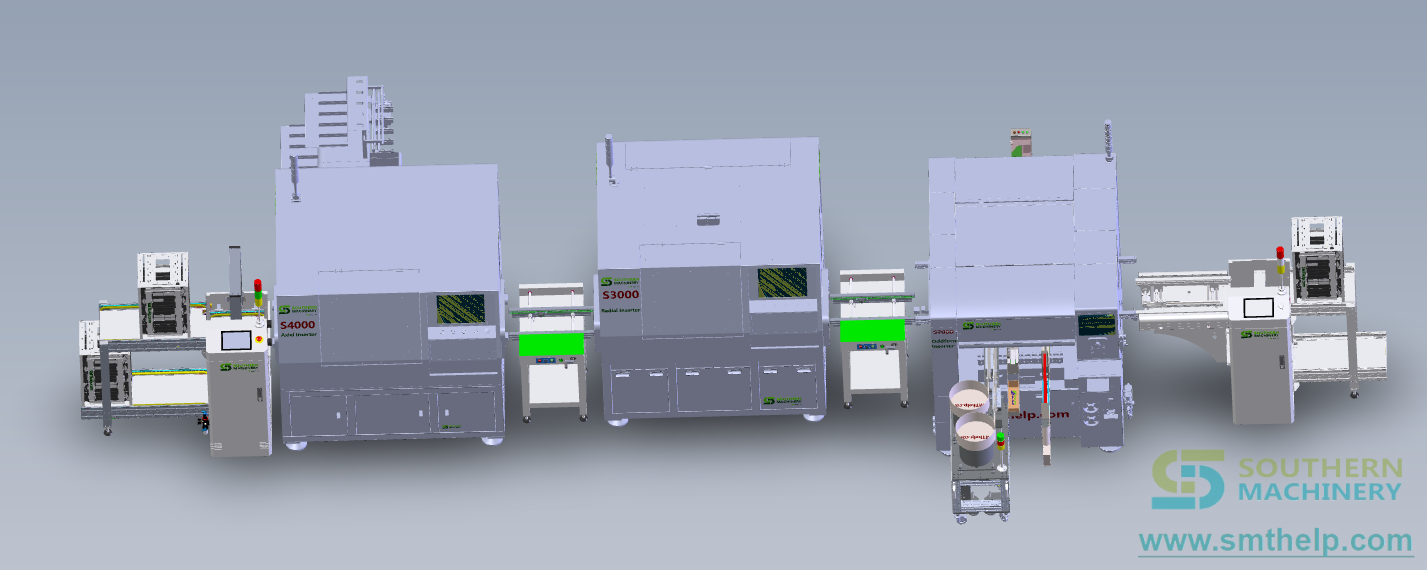
THT Auto Insertion Line for Axial, Radial and Odd-Form Components by Southern Machinery
Manual through-hole insertion is still common in power supplies, LED lighting, appliance control boards and industrial electronics. But once volume grows, manual insertion usually becomes the slowest and least stable part of the factory. A THT auto insertion line helps move axial, radial, DIP and odd-form component insertion from operator-dependent work into a repeatable automated process.
Southern Machinery, founded in Shenzhen in 2011, focuses on high-efficiency and cost-effective SMT/THT PCB assembly automation equipment. For buyers who need more than a single standalone machine, we can help configure the complete flow: SMT, THT insertion, wave soldering, board handling and optional inspection.
What is this machine used for?
A THT auto insertion line is used to automatically insert through-hole components into PCBs before soldering. Depending on the product and component package, the line can include axial insertion for taped axial parts, radial insertion for radial components, DIP or odd-form insertion for special parts, and board handling modules such as magazine loaders, conveyors and unloaders.
In simple terms, it replaces repetitive manual component insertion with a controlled machine process. This is especially useful when the same board or component family is produced frequently and manual labor is limiting throughput or quality consistency.
Typical Applications
This type of THT automation is suitable for products where through-hole parts remain important for mechanical strength, current handling or reliability.
Common applications include:
- Consumer electronics and home appliance control boards
- LED lighting boards and power supply modules
- Automotive electronics, sensors and control units
- Industrial control boards and power electronics
- EMS factories handling mixed SMT plus THT assembly
- Products with axial, radial, DIP and odd-form component combinations
For example, a power supply board may use SMT parts on the first process, then require radial capacitors, axial resistors, connectors or other THT parts before wave soldering. In that case, automating only SMT does not solve the full factory bottleneck. The THT section also needs a matching automation plan.
Recommended Line Configuration
A practical Southern Machinery THT auto insertion line can be configured as a full process section rather than one isolated machine.
THT Insertion Section
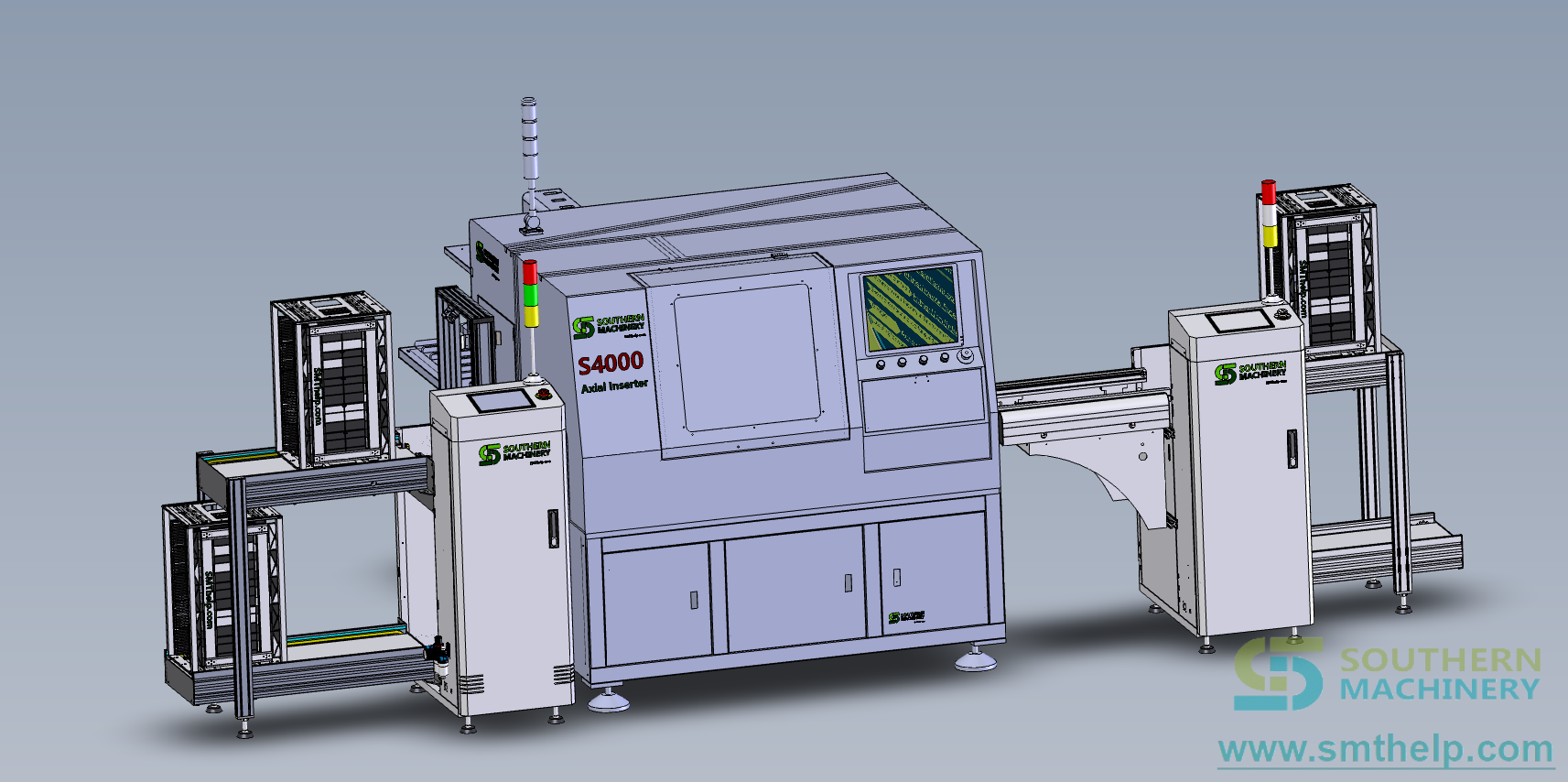
- Axial insertion machine for taped axial components
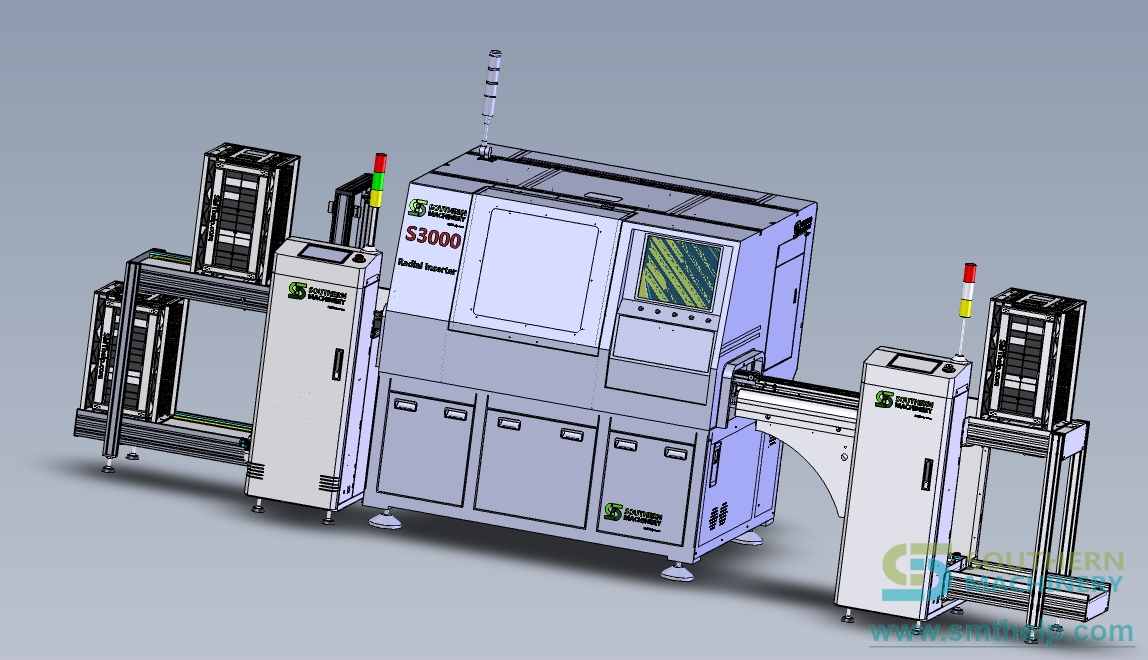
- Radial insertion machine for radial components
- DIP or odd-form insertion machine when special shapes are required
- Configurable feeders and grippers based on component packaging
- Vision and motion control for component recognition and insertion control
Board Handling Section
- Magazine loader or PCB loader at the line entry
- Conveyor connection between machines
- Buffer when different machines have different cycle times
- Unloader or OK/NG sorting after insertion or inspection
- SMEMA interface support for connection with standard PCB assembly equipment, depending on final line layout
Soldering and Inspection Connection
After insertion, the boards normally continue to wave soldering, selective soldering or manual soldering depending on the board design. Southern Machinery can also support the broader PCB assembly setup, including wave soldering equipment, board handling, and inspection options such as AOI where the quality plan requires it.
Key Selection Parameters
Before selecting the exact machine class and line layout, buyers should confirm these points:
- PCB size range and panelization format
- Board thickness and warpage tolerance requirements
- Component categories: axial, radial, DIP, connectors or odd-form parts
- Component packaging: tape, tube, tray, bulk or custom feeder requirement
- Required output in boards per hour or components per hour
- Number of working shifts and target utilization
- Whether the THT line must connect to existing SMT, wave soldering or MES systems
- Required inspection level, such as visual inspection, AOI or process traceability
The source material gives example configuration figures such as insertion speed up to 20,000 CPH, insertion accuracy around +/-0.05 mm, PCB size from 50 x 50 mm to 500 x 450 mm, and feeder configurations up to 100 stations. These should be treated as configuration-dependent examples and are subject to final technical confirmation for the selected model, feeder type, component body and PCB design.
ROI, Quality and Capacity Value
The main value is not only speed. The real value is a more stable THT process.
- Reduced manual insertion labor for repetitive components
- More consistent insertion position and process discipline
- Fewer operator-dependent mistakes on high-volume boards
- Easier planning when the SMT and THT sections are connected as one line
- Better scalability as product volume increases
A cheaper manual-assist setup may still be the right choice for prototype or very high-mix production. But if the same THT component process repeats every day, a configured auto insertion line often gives a clearer path to stable output and lower dependence on manual staffing.
How It Fits Into a Complete PCB Assembly Line
A full PCB assembly line may look like this:
- SMT loader and conveyor
- Automatic stencil printer
- Pick-and-place machine
- Reflow oven
- AOI if required by quality target
- THT auto insertion section for axial, radial or odd-form components
- Wave soldering or selective soldering
- THT inspection, test and final unloading
Southern Machinery can help buyers configure the whole line instead of forcing the factory to integrate unrelated machines by itself. That matters for EMS and ODM teams because line balance, board transfer height, communication interface, spare parts and operator training all affect real production stability.
Why Work With Southern Machinery?
Southern Machinery is a Shenzhen-based manufacturer established in 2011, serving 237+ global customers with SMT and THT PCB assembly automation equipment. Our strength is complete-line thinking: SMT lines, THT insertion, wave soldering, board handling, and optional inspection can be matched as one practical manufacturing solution.
For overseas buyers, we also focus on installation guidance, professional training, remote technical support and spare parts support. The goal is a high-efficiency line that fits the factory budget and can be maintained over the long term.
FAQ
Can one THT line handle axial, radial and odd-form components?
Yes, but it normally requires different machine modules, feeders or grippers. The final configuration depends on the exact component list and packaging format.
Is this only for high-volume production?
Not always. It is most valuable when repeated THT insertion is creating labor pressure, quality variation or output bottlenecks. For very low-volume work, a semi-automatic or manual-assist process may be more cost-effective.
Can it connect with an existing SMT line?
Yes, the line can be planned with loaders, conveyors, buffers and standard interface requirements such as SMEMA, depending on your existing equipment layout.
What information is needed for a quotation?
We need PCB size, product type, component list, packaging format, target output, current process flow and automation budget level. Photos or drawings of special components are very helpful.
Does Southern Machinery provide wave soldering and board handling too?
Yes. Southern Machinery can support complete PCB assembly automation, including SMT, THT insertion, wave soldering, board handling and optional inspection equipment.
Are the speed and accuracy figures fixed for every project?
No. Figures such as CPH, insertion accuracy, PCB size and feeder count depend on final machine configuration, component type and board design. They should be confirmed during technical evaluation.
Next Step
Send your PCB size, monthly output target, component list and current SMT/THT process. Southern Machinery can then match the closest THT auto insertion line configuration and show where loaders, buffers, soldering and inspection should be placed for a cost-effective complete PCB assembly solution.
Comments