
Through-Hole Insertion Machine Line by Southern Machinery
For EMS factories still relying on manual through-hole insertion, labor cost, inconsistent quality, and component handling complexity can become serious production bottlenecks. Southern Machinery provides automated through-hole insertion machine solutions for axial, radial, DIP, and odd-form components, with configurable feeders, vision and motion control, SMEMA-ready line integration, and support for MES/ERP data flow. Built in Shenzhen by a manufacturer focused on SMT and THT PCB assembly automation since 2011, this solution helps buyers plan a more stable, cost-effective path from manual THT work to a complete automated PCB assembly line.
Jul 4, 2026 · Updated Jul 4, 2026 · Southern Machinery
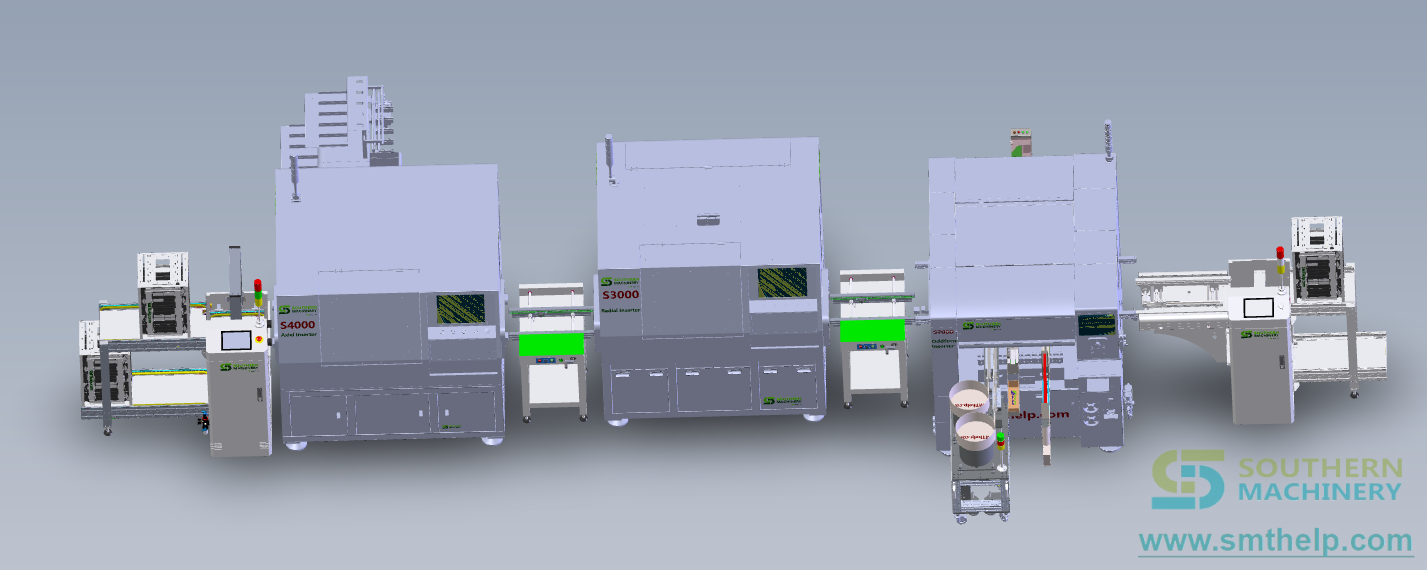
Through-Hole Insertion Machine Line by Southern Machinery
Manual through-hole insertion is still common in many EMS factories, especially for power boards, LED drivers, industrial control PCBs, automotive modules, and other products with connectors, capacitors, coils, terminals, and odd-form parts. The problem is simple: manual insertion is flexible, but it is also labor-heavy, slow, and difficult to keep consistent across shifts.
Southern Machinery's through-hole insertion machine solution is designed to move this process into a more stable automated line. The source product page positions the system around automated insertion for axial, radial, DIP, and odd-form components, supported by feeder and gripper designs, vision and motion control, and integration with loaders, unloaders, SMT equipment, and factory MES/ERP systems.
What is this machine used for?
A through-hole insertion machine is used to automatically insert leaded components into PCB holes before soldering. In a typical mixed-technology PCB assembly process, SMT components are placed and reflow soldered first. Then the board moves to the THT section, where axial, radial, DIP, terminal, connector, or odd-form components are inserted and sent to wave soldering, selective soldering, or downstream inspection.
For factories that still use manual operators for this step, automation can reduce repetitive handling, improve insertion consistency, and make the line easier to scale. It is especially useful when the same through-hole components repeat across many boards or when daily output is too high for stable manual insertion.
Main production problems this solution addresses
The source page highlights three common THT bottlenecks.
First, manual insertion creates high labor cost and low efficiency. Operators may become the bottleneck even when the SMT line can run faster.
Second, manual work can create inconsistent quality. Missed positions, wrong polarity, bent leads, and handling damage can affect downstream solder quality and final yield.
Third, through-hole components are not all the same. Axial, radial, DIP, and odd-form components often require different feeding, gripping, orientation, and insertion methods. That is why a complete THT automation plan must consider the component package, PCB size, feeder format, and connection to the rest of the PCB assembly line.
Recommended line architecture
A practical Southern Machinery THT automation project is usually configured as a line, not a single standalone machine.
1. Upstream SMT section
The SMT section can include PCB loader, stencil printer, pick-and-place, reflow oven, and optional AOI/SPI depending on product quality needs. After SMT reflow, the board enters the through-hole section.
2. Automated THT insertion section
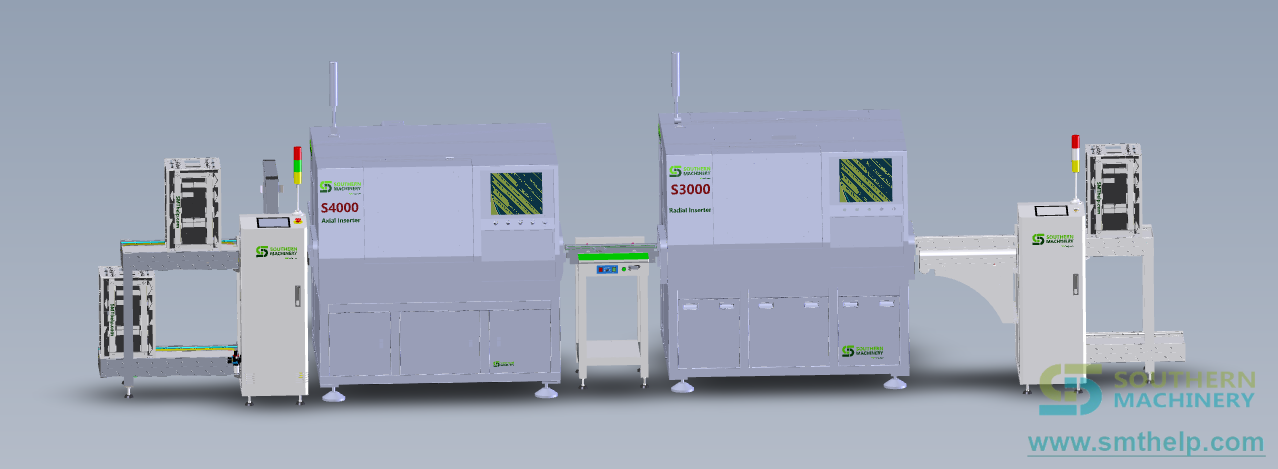
The THT insertion section can be configured around the actual component mix:
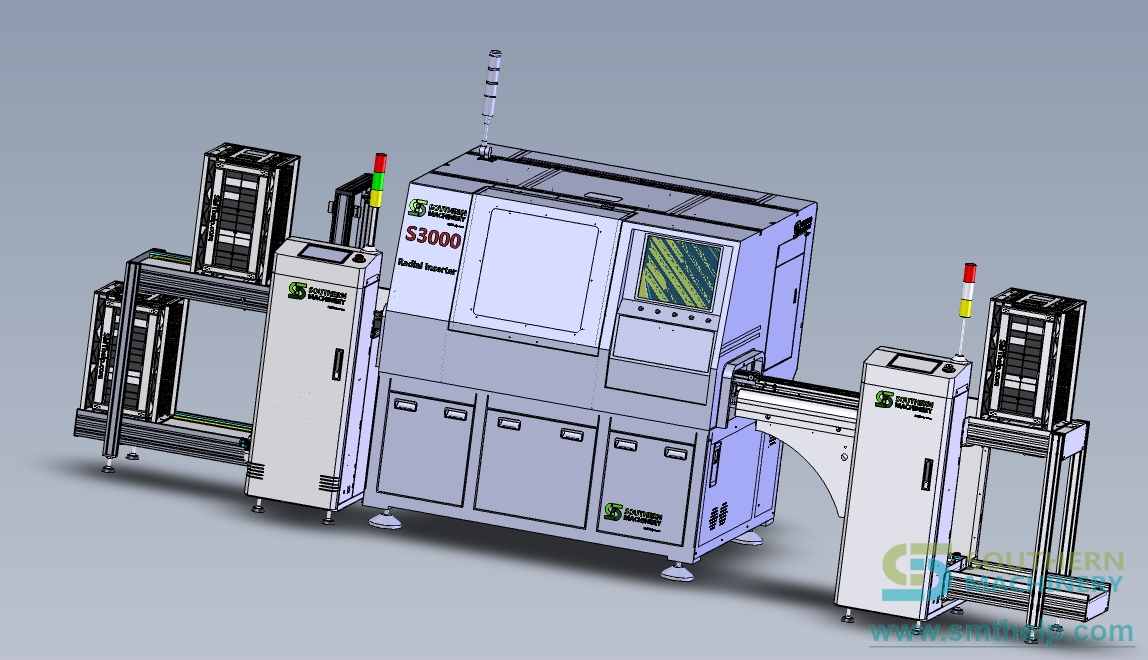
- Radial insertion for radial taped components.
- Axial insertion for axial leaded components.
- DIP or odd-form insertion for larger or special-shaped components.
- Custom feeders and grippers when the component cannot be handled by a standard feeder.
The source page describes flexible component handling for axial, radial, and complex odd-form components, plus feeder and gripper designs for different production needs.
3. Board handling and line connection
For a stable factory layout, the insertion machines should connect with loaders, unloaders, buffers, conveyors, or other handling equipment. The source page states that the machines are designed for integration with standard SMEMA interfaces and can connect with loaders, unloaders, and other SMT equipment.
4. Soldering and inspection
After insertion, the PCB usually moves to wave soldering or selective soldering. The best choice depends on component clearance, thermal mass, board design, solder side layout, and production mix. For higher quality control, the line can also include visual inspection, AOI, ICT/FCT, barcode tracking, or MES data collection.
Key machine features from the source document
The product page emphasizes several capability areas that matter for buyers.
Advanced vision and motion control
The page describes high-resolution cameras and precision servo control for component recognition and placement, including support for warped PCBs. For THT automation, this is important because hole alignment and component orientation directly affect insertion reliability.
Flexible component handling
The system is positioned for axial, radial, DIP, and odd-form components. This matters because a power supply board may combine electrolytic capacitors, film capacitors, resistors, coils, connectors, and terminals. A single generic feeding method is rarely enough.
Smart software and MES/ERP integration
The source page mentions an intuitive programming interface and integration with MES/ERP systems. For EMS factories, this can support traceability, production data, recipe management, and more controlled changeover.
Robust industrial design
The page also positions the machines for long-term stability and lower maintenance in demanding production environments. In practical terms, the buyer should confirm machine structure, spare part availability, maintenance plan, and local support requirements during final technical review.
Technical selection parameters to confirm
The source document includes example or configurable technical data. Treat these as project-dependent and subject to final technical confirmation.
| Selection item | What to confirm |
|---|---|
| Insertion speed | Source page lists up to 20,000 CPH depending on configuration and application. |
| Insertion accuracy | Source page lists +/-0.05 mm; final suitability should be confirmed against PCB and component tolerance. |
| PCB size | Source page lists 50 x 50 mm minimum and 500 x 450 mm maximum, customizable. |
| Component types | Axial, radial, DIP, and odd-form components. |
| Feeder stations | Source page lists up to 100 stations, configurable. |
| Power supply | AC 220V/380V, 50/60Hz. |
| Air pressure | 0.5 to 0.7 MPa. |
| Dimensions | Varies by model; source page gives 1800 x 1500 x 1600 mm as an example. |
Before quoting a final line, Southern Machinery should confirm the actual BOM, component package photos, tape or bulk feeding format, PCB hole tolerance, board size, panelization, required output, available floor space, and preferred soldering process.
Typical application scenarios
The source page lists several application areas where through-hole automation is relevant.
Consumer electronics
For televisions, appliances, and personal electronics, automated THT insertion can help when product volume is high and manual insertion becomes difficult to control.
Automotive and industrial electronics
Control units, sensors, and power systems often require stable insertion and traceable production. In these applications, consistency is usually more important than simply chasing the lowest machine cost.
LED lighting and power supplies
LED drivers and power modules often include leaded power components and larger parts. Automated insertion can reduce repetitive manual work and make downstream wave soldering or selective soldering more predictable.
ROI, quality, and capacity value
The business value is not only machine speed. For many EMS and ODM factories, the stronger case is the combination of labor reduction, more stable insertion quality, better line balance, and easier scaling.
A cheaper manual process may look attractive at low volume. But once output grows, the hidden cost shows up in operator training, missed insertions, rework, unstable takt time, and quality variation between shifts. A properly configured THT insertion line gives the factory a repeatable process that can be connected with board handling, soldering, inspection, and traceability.
Southern Machinery is based in Shenzhen and has focused on SMT and THT PCB assembly automation equipment since 2011. With service experience for 237+ global customers, the team can support not only single machines but also complete line planning across SMT, THT, wave soldering, board handling, inspection, spare parts, and professional training.
How to specify the right Southern Machinery solution
To avoid overbuying or under-sizing the line, buyers should prepare a practical data package:
- Product type and target industries.
- Monthly or daily output target, shifts per day, and working hours per shift.
- PCB size range, thickness, panelization, and board layout.
- BOM with axial, radial, DIP, terminal, connector, and odd-form components clearly marked.
- Component packaging format such as tape, tube, tray, bulk, or reel.
- Existing SMT/THT equipment and current bottleneck.
- Soldering process requirement: wave soldering or selective soldering.
- Inspection and traceability requirement, including AOI, barcode, MES, or ERP connection.
- Budget level and automation target: semi-automatic, inline, or full smart factory integration.
With this information, Southern Machinery can match the closest machine configuration from its catalog instead of forcing a one-size-fits-all model.
FAQ
1. Can this machine replace all manual THT insertion?
It depends on the component mix and production volume. Repeated axial, radial, DIP, and certain odd-form components are good candidates. Very low-volume or constantly changing parts may still need manual assist or custom feeding evaluation.
2. Can it connect with an existing SMT line?
Yes. The source page states that the machines support standard SMEMA integration and can connect with loaders, unloaders, and other SMT equipment. Final layout should be confirmed by PCB flow direction, line height, available space, and upstream/downstream equipment.
3. Is wave soldering or selective soldering better after insertion?
Wave soldering is common when many through-hole joints can be soldered together. Selective soldering is better when the board has sensitive areas, limited clearance, or mixed SMT/THT constraints. The correct answer depends on the PCB design and component layout.
4. What information is needed for a quotation?
At minimum, provide PCB size, BOM, component photos, package format, target output, current process, available floor space, and quality or traceability requirements. This allows Southern Machinery to recommend the right insertion machine, feeders, board handling, and soldering connection.
5. Are the listed speed and accuracy guaranteed for every board?
No. The source page gives technical figures such as up to 20,000 CPH and +/-0.05 mm accuracy, but real performance depends on component type, PCB design, feeding method, insertion program, and final machine configuration. Final values should be confirmed during technical review.
6. Does Southern Machinery provide support after installation?
The source page describes installation, calibration, hands-on training, technical support, spare parts, and maintenance support. For overseas projects, the exact service plan should be confirmed based on destination country, project scope, and line complexity.
Talk to Southern Machinery
If your factory is still using manual through-hole insertion, send Southern Machinery your PCB size, BOM, component photos, output target, and current bottleneck. We can help evaluate whether radial insertion, axial insertion, odd-form insertion, or a combined THT automation line is the most cost-effective route for your PCB assembly process.
Southern Machinery provides high-efficiency, cost-effective SMT and THT automation solutions for EMS factories, including board handling, wave soldering, selective soldering, inspection, traceability, spare parts support, and operator training.
Comments