
Capacitors and Passive Components in Modern Electronics Manufacturing | Southern Machinery
Capacitors, resistors and inductors are the quiet majority of every PCB BOM, and they decide whether a board survives its warranty. This buyer-oriented guide explains what passive components actually do in a circuit, which machines place them on an SMT/THT line, how placement changes with the package, and what an EMS team should specify before buying equipment. It also shows where radial insertion fits between the chip mounter and the wave-soldering machine, and how automated placement cuts rework and field failures. Written by Southern Machinery, the Shenzhen SMT and THT equipment builder trusted by 237+ global customers since 2011.
Sep 24, 2026 · Updated Sep 24, 2026 · Southern Machinery
Capacitors and Passive Components in Modern Electronics: How They Are Placed on the PCB Assembly Line
Capacitors, resistors and inductors rarely make the headline of a bill of materials, yet they are the components that decide whether a board survives its warranty. On a typical modern PCB, passives can outnumber active devices many times over, and every one of them has to be placed, soldered, inspected and — increasingly — traced. This guide explains what capacitors and passive components actually do in a circuit, which machines place them on an SMT/THT line, how the placement method changes with the package, and what a buyer should evaluate before choosing equipment. It is written for EMS engineers, PCB assembly production managers and procurement teams building or upgrading a line in 2026.
<iframe width="560" height="315" src="https://www.youtube-nocookie.com/embed/E_lC2jFiKmk?rel=0" title="The Role of Capacitors and Passive Components in Modern Electronics" frameborder="0" allow="accelerometer; autoplay; clipboard-write; encrypted-media; gyroscope; picture-in-picture" allowfullscreen></iframe>
On the PCB, the connection of capacitors and passive components is vital — the capacitor stores and regulates energy and shields against voltage spikes. Video: @Smthelping (Southern Machinery).
What is this machine used for?
Strictly speaking, there is no single machine for capacitors and passive components — and that is exactly the point a buyer has to understand. Passive parts are split across two very different placement worlds, and each world has its own equipment.
Surface-mount (SMD) passives — 0402, 0603, 0805, 1206 chip resistors, MLCCs and small inductors — are placed by the chip mounter (the SMT pick-and-place machine) directly from reels, then reflow-soldered. A modern high-speed mounter with multi-head gantries and flying vision is the machine doing this work, at tens of thousands of components per hour.
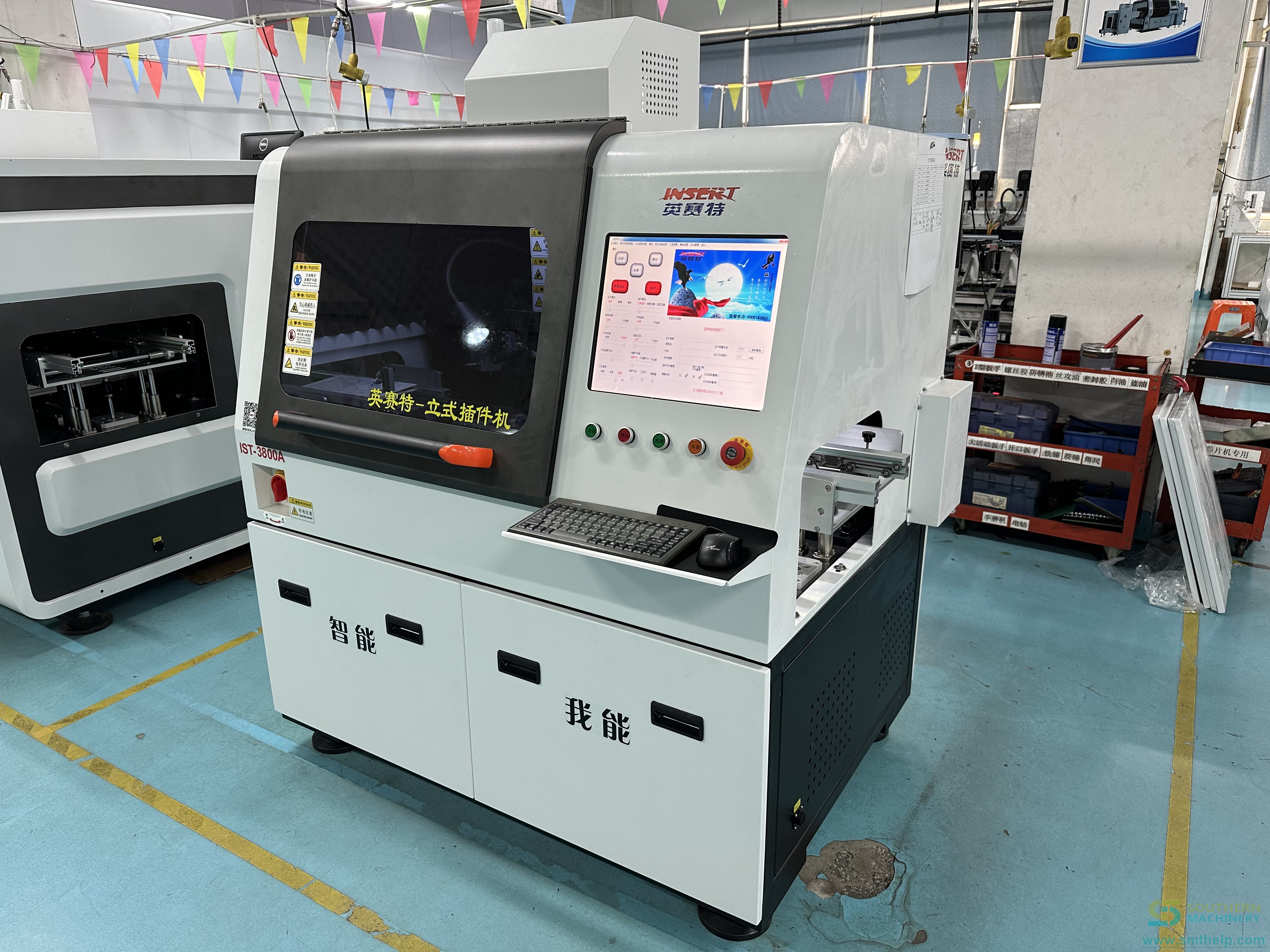
Through-hole (THT) passives — radial-leaded electrolytic capacitors, film capacitors, transistors, LEDs and key switches on tape — are placed by a radial insertion machine. Southern Machinery's S3000 Automatic Radial Component Insertion Machine is built for precisely this class of part. Its official specification states the machine is designed for tape-packed THT components such as capacitors, transistors, LEDs and key switches, and it combines high-speed insertion with machine vision correction, programmable insertion angles and automatic lead cutting and clinching. Published parameters include a maximum mechanical speed of 18,000 CPH and typical production throughput of approximately 10,000 CPH, support for 2.5 mm and 5.0 mm lead spans, an insertion direction of 0–360° adjustable in 1° increments, a servo-driven 13.0 mm insertion head with an "N"-type clinch base, and a PCB envelope of 50 × 50 mm (min) to 400 × 380 mm (max) at 0.79–2.36 mm thickness.
So the honest answer to "what is this machine used for?" is this: when the video shows a capacitor on a PCB, the machine behind it is either a chip mounter (for the SMD version) or a radial insertion machine (for the leaded version). The rest of this article explains how to choose between them and how they fit together.
Typical applications
Passive components appear in every electronics category, but a few application profiles dominate the demand Southern Machinery sees from EMS and OEM customers:
- Power supply and power-electronics boards. Electrolytic and film capacitors dominate the THT content of switch-mode supplies, ballasts, LED drivers and vehicle power supplies. Radial insertion machines place these leaded capacitors consistently, which matters because a single mis-inserted polarity can scrap a whole assembly at test.
- Home appliance control boards. Air conditioners, TVs, microwave ovens, induction cookers and electric kettles use large numbers of radial capacitors, relays and switches. Mixing one radial inserter with a chip mounter for the SMD side keeps a high-volume appliance line balanced.
- LED lighting and display modules. LED boards combine SMD passives with leaded LEDs and radial electrolytics. This is a classic SMT + THT hybrid, so both placement technologies have to be specified together.
- Automotive and instrument electronics. Vehicle audio, dashboard instruments and control modules demand long-term reliability, where capacitor quality and correct insertion (polarity, lead clinch, seating) directly affect field failure rates.
- Communication and industrial control boards. Connectors, key switches and radial passives sit alongside dense SMD logic, so the line has to sequence reflow and wave-soldering processes correctly to avoid reworking passives twice.
How it fits into a complete PCB assembly line
Passive components are placed at two distinct points in the line, and getting the sequence right prevents double handling.
On the SMT side, the flow is: bare-board loader → solder-paste printer → SPI (solder paste inspection) → high-speed chip mounter (placing all the SMD passives and actives) → reflow oven → AOI. The passives are already soldered before the board sees a wave.
On the THT side, the flow is: magazine loader → radial insertion (the S3000 places tape-packed capacitors, transistors, LEDs and key switches) → odd-form insertion (optional machines such as the S-70LD handle non-standard parts) → wave soldering (the S-WS450 standard wave or the S-WS350B lead-free dual-wave machine) → AOI / X-ray → PCB cleaning → magazine unloader.
The radial inserter is the pivot of that THT block. Its automatic lead cutting and clinching is what makes the downstream wave-soldering step reliable: the clinch holds the capacitor in the hole and creates a sound solder joint as the wave passes. Southern Machinery supplies the whole chain — loaders and unloaders, conveyors, wave-soldering machines, depaneling, cleaning, AOI/SPI and X-ray — so a line can be built or upgraded in modules rather than in one risky capital step.
Key selection parameters
This is the checklist a buyer should work through. Specific values must always be confirmed against the datasheet for the actual model, because they vary by configuration:
- Component scope and package types — which radial/leaded parts must the machine accept (capacitor body size, lead diameter, polarity requirement), and does the package come tape-packed or loose?
- Lead span and insertion geometry — the span(s) supported (e.g. 2.5 mm / 5.0 mm / 10 mm families) and whether insertion direction is programmable in fine angular increments.
- Throughput class — distinguish maximum mechanical speed from typical production throughput; the second number is the one that plans your takt time.
- Position correction — machine-vision correction versus mechanical referencing; vision matters as board density and hole tolerance tighten.
- Lead cutting and clinching — whether the machine cuts and clinches in-cycle, and the clinch length / clinch angle range available, since these determine wave-solder yield.
- Board envelope and thickness — minimum and maximum PCB size, thickness range, and whether the frame can be enlarged later.
- Feeder and programming model — number of feeders, offline programming support, and the software platform and interface language.
- Line integration — off-line (stand-alone) or in-line SMEMA transfer, and how the machine will sit with your wafer/board handling.
- Utilities and footprint — power phase and rating, air pressure and consumption, machine dimensions and weight against your floor plan.
- Service and spares — genuine spare-part availability, feeder and nozzle support, and operator training.
ROI and quality perspective
For a buyer, passive components are where cost quietly leaks. Manual insertion of leaded capacitors is slow, tiring and inconsistent: an operator can invert a polarity, under-seat a part or bend a lead, and none of that shows up until functional test — or until a field return. Automating the placement converts a variable human process into a repeatable, programmable one. The gains are not just labour: consistent insertion depth and clinch quality raise first-pass yield at wave soldering, vision correction reduces mis-insertion on dense boards, and offline programming means the line keeps running while the next product is prepared.
The quality argument is even stronger than the labour argument. As customers push toward IPC-class workmanship and traceability expectations, a machine that places and clinches every capacitor the same way, board after board, is easier to validate than a manual bench. Southern Machinery has been building SMT and THT equipment in Shenzhen since 2011 and supports 237+ customers worldwide with machines, spare parts, repair, nozzle design, retrofit kits and operator training — which matters when the goal is a line that stays productive for a decade, not a single machine that looks good on a quotation.
FAQ
What is a passive component in PCB assembly?
A passive component is a device that does not generate or amplify power — capacitors, resistors, inductors and similar parts. It stores, filters or limits energy and signals, and it works alongside active devices such as transistors and ICs.
What does a capacitor do on a PCB?
A capacitor stores and releases electrical energy. It smooths power-supply output, filters noise, blocks DC while passing AC, and protects circuits against voltage spikes.
Can a pick-and-place machine place capacitors?
Yes — chip mounters place surface-mount (SMD) capacitors directly from reels. Leaded, through-hole capacitors are usually placed by a dedicated radial insertion machine instead, because the mounter cannot drive and clinch a lead into a hole.
What is a radial insertion machine used for?
A radial insertion machine automatically inserts tape-packed radial-leaded components — capacitors, transistors, LEDs and key switches — into plated through-holes, cuts and clinches the leads, and prepares the board for wave soldering.
Why does passive component placement affect reliability?
Because passives are everywhere and are often the last line of defence in a circuit. Incorrect polarity, poor seating or a weak clinch can cause early field failure, so repeatable placement directly improves product reliability.
Should I automate capacitors first or buy a full line?
Most teams start with the highest-volume, most repetitive placement step — usually radial insertion for leaded capacitors — then add board handling, wave soldering and inspection in phases. Southern Machinery supports both single-machine and turnkey approaches.
Contact Southern Machinery
Southern Machinery is a Shenzhen-based manufacturer of SMT and THT PCB assembly equipment, serving EMS and OEM customers worldwide since 2011. If you are specifying a radial insertion machine for capacitors, planning an SMT/THT line, or need spare parts, feeders, nozzles, repair or operator training:
- Email: jasonwu@smthelp.com
- Phone / WhatsApp: +86 136 0256 2576
- Website: https://www.smthelp.com
- Machine catalog & downloads: https://file.autoinsertion.com
- Machine photos: https://ph.smthelp.com
Tell us your board size, component list and target takt time, and we will recommend the right configuration — including the S3000 Radial Insertion Machine for leaded capacitors and our full line of loaders, wave-soldering machines, cleaning equipment and inspection systems.
Comments