
SUL250 PCB Unloader: The Line-End Machine That Sets Your SMT Line Takt | Southern Machinery
Most SMT investment is justified at the mounter, but the line's real pace is set at the end. Southern Machinery's SUL250 PCB magazine unloader takes finished boards off the conveyor and racks them at a selected pitch, with PLC control, four magazine pitch options (10/20/30/40 mm), SMEMA handshaking and a regulated pneumatic pusher designed to stage boards without damage. This guide covers what the SUL250 does, how it fits a complete SMT/THT line, the parameters buyers must confirm before ordering, and the line-balance economics of end-of-line automation. Southern Machinery has built SMT and THT peripheral equipment in Shenzhen, China since 2011 and serves 237+ customers worldwide.
Sep 21, 2026 · Updated Sep 21, 2026 · Southern Machinery
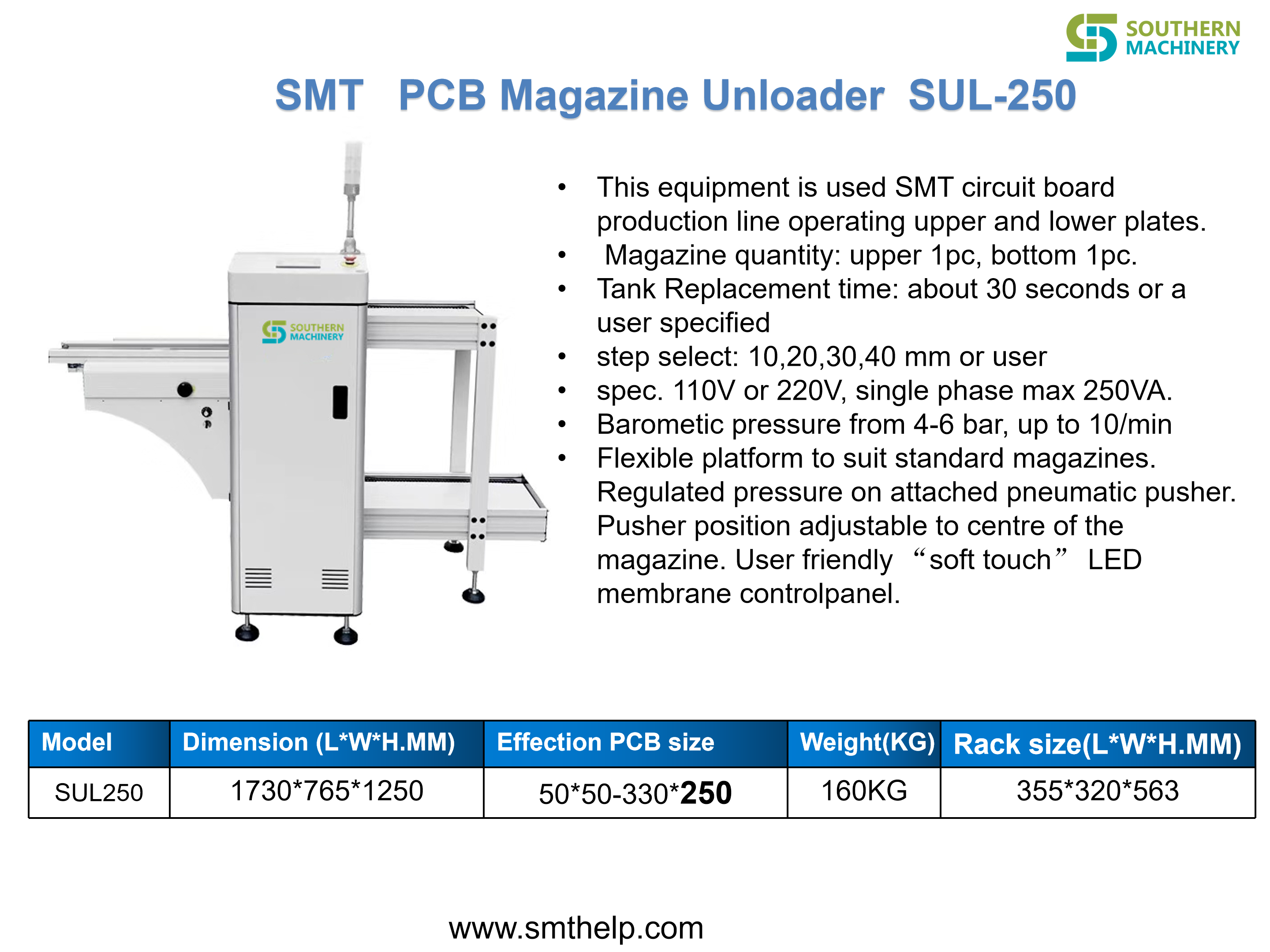
SUL250 PCB Unloader: The Line-End Machine That Sets Your SMT Line Takt
Every SMT line investment is argued at the mounter. That is where the CPH is, that is where the capital is, and that is where the payback model lives. But ask any production manager where the line actually stops, and the answer is usually at the end: a rack of finished boards waiting for someone to carry it away, a conveyor blocked because nobody changed the magazine, a mounter sitting idle because its downstream neighbour could not accept another board.
The SUL250 PCB magazine unloader from Southern Machinery exists to close that gap. It is an inline board-handling machine that transfers finished or processed PCBs off the line conveyor and loads them into a standard SMT magazine at a controlled pitch, without an operator standing at the line end.
This article is written for the engineers and procurement teams who have to size one: what the SUL250 does, where it belongs in a complete PCB assembly line, the parameters that must be confirmed before ordering, and the line-balance economics that decide whether an end-of-line unloader pays for itself.
Watch the machine in operation: SUL250 PCB Unloader — product demo
What is the SUL250 PCB unloader used for?
The SUL250 takes boards off the end of a conveyor and racks them into a standard PCB magazine, automatically, in sequence.
In practical terms, it does four jobs:
- Board transfer. It accepts a board from the upstream machine over a SMEMA-compliant interface and moves it into the magazine loading position.
- Racking at a selected pitch. The magazine platform indexes at one of four pitch settings — 10, 20, 30 or 40 mm — so slot spacing matches the board thickness and clearance your process needs. Direction can be configured left-to-right or right-to-left.
- Safe insertion. A pneumatic pusher, running on regulated air pressure, pushes the board into the magazine slot. The pusher position is adjustable to the centre of the magazine, and the platform is flexible so it accepts standard magazines. The design intent, as documented on the product page, is that the board is not damaged when it is pushed — which is exactly the failure mode that manual racking introduces.
- Counting and fault signalling. Automatic counting and fault alarms mean the magazine state is known to the line rather than to an operator's memory.
Power is documented as 110 V or 220 V single phase at a maximum of 250 VA, with air supply at 4–6 bar and up to 10 l/min. Control is by PLC with a "soft touch" LED membrane operator panel — which matters more than it sounds: at a line end, the interface should not require a trained programmer to change a pitch or clear an alarm.
Typical applications
- End of an SMT line, after AOI. This is the classic position. The unloader takes inspected boards off the conveyor and racks them for the next stage — test, sub-assembly, packing, or transport to the warehouse — instead of leaving them stacked at the line end.
- End of a THT / DIP line, after wave soldering, lead cutting and cleaning. A DIP line that runs loader → inserter → wave solder → lead cutter → wash still hands boards to a human at the end. The SUL250 closes that loop the same way it does on the SMT side.
- High-mix, low-volume (HMLV) lines in EMS factories. When changeover is frequent, the ability to standardise the output interface — one rack format, one pitch setting, one SMEMA handshake — removes a variable that otherwise changes with every product.
- Lines feeding a separate downstream cell. If boards move to a functional test bench, conformal coating, or an AGV/material-handling route, the magazine is the transfer unit. The unloader is what makes that hand-off automatic.
- Mixed automation levels. Where the upstream machines are already automated but the last three metres are still manual, a single unloader is often the lowest-cost way to remove the last full-time manual station on the line.
How it fits into a complete PCB assembly line
Southern Machinery builds the whole peripheral ecosystem around the process machines, which is why board-handling equipment is designed to line up rather than be made to fit.
SMT side:
PCB loader (e.g. SLD250) → solder paste printer → SPI → pick and place → reflow oven → AOI → SUL250 unloader → downstream handling / storage
Where the AOI output needs sorting rather than simple racking, an NG/OK unloader such as the SBH250 or SBH460460 series sits between AOI and the magazine unloader.
THT / DIP side:
PCB loader → radial inserters (S-3010B), odd-form inserters (S-70LD), pin/eyelet terminal inserters (S7020 series) → wave soldering (S-WS350B lead-free dual wave or S-WS450) → auto lead cutter (S-320AT) → PCBA cleaning → depaneling (S-D601) → SUL250 unloader
Supporting modules complete the picture: buffer conveyors (SBN250, S-350C) to decouple machine cycle times, shuttle and turning conveyors (SPD330, S-460) for line layout, stack/unstack machines where bare boards need destacking, and ESD magazine racks for storage.
Two integration points decide whether an unloader is plug-and-play or a project:
- SMEMA interface. SMEMA (Surface Mount Equipment Manufacturers Association) defines the mechanical and electrical board-transfer interface between machines — the conveyor rail heights, edge support and the handshake signals that tell the upstream machine "I can accept a board" and the downstream machine "board delivered". A SMEMA-compliant unloader is a line component; a non-compliant one is a bench machine. The SUL250 is documented as SMEMA compliant.
- Rack standard. The SLD250 loader and SUL250 unloader are built around the same rack format (documented magazine size 355 × 320 × 563 mm) and the same effective PCB range, so the input and output ends of the line can be standardised on one magazine fleet. The two chassis differ, incidentally: the load-side SLD250 is documented at 1330 × 765 × 1250 mm / 140 kg, the unload-side SUL250 at 1730 × 765 × 1250 mm / 160 kg — the extra 400 mm and 20 kg are what the unload-side mechanism adds.
Key selection parameters
These are the parameters that decide the specification. The values shown in brackets are the documented platform values for the SUL250; anything not documented should be confirmed on the datasheet or the quotation for your build.
| Parameter | What to confirm |
|---|---|
| Effective PCB size | Smallest and largest board the line will ever run, including panels and arrays — documented range 50 × 50 to 330 × 250 mm for the SUL250. Wider formats move to the SUL390 or SUL460 class unloaders. |
| Board thickness range | Thickness determines how much clearance the slot pitch must leave. |
| Magazine / rack standard | Documented rack size 355 × 320 × 563 mm; the rack must also match the loader and any offline racks in the plant. |
| Pitch setting | Four selections documented: 10, 20, 30, 40 mm. |
| Direction of flow | Left-to-right or right-to-left, optional at order — confirm against your line layout. |
| Line interface | SMEMA compliant (documented); conveyor transport height must be confirmed to match the upstream machine's standard height. |
| Footprint and staging space | Documented machine size 1730 × 765 × 1250 mm, weight 160 kg — plus the floor space for a second, staged magazine, because that is what makes fast exchange possible. |
| Utilities | 110 V or 220 V single phase, max 250 VA; air 4–6 bar at up to 10 l/min (documented). |
| Control and interface | PLC control with LED membrane panel; confirm what counting, alarm and line-status signals your MES or line controller needs. |
| Automation level | Inline SMEMA module vs. standalone transfer; and whether the lower-cost mini unloader (S-MUL250 / S-MUL350) is sufficient for a lighter duty cycle. |
Two practical notes on this list. First, pitch is a capacity decision, not a cosmetic one: the same rack holds twice as many boards at 20 mm pitch as at 40 mm pitch. Choose the tightest pitch that still clears your boards and any components or fixtures on them, and you halve the number of interruptions per shift. Second, direction and height are order-time decisions. They are trivial for the OEM to build in and expensive to change later.
ROI and quality perspective — the buyer's case
An end-of-line unloader is rarely justified by labour savings alone, because a single operator covering the line end may look cheap on paper. It is justified by line balance, and line balance is where the money actually is.
The blocking cascade. A blocked unloader stops accepting boards. A stopped conveyor backs up to the AOI or the reflow outfeed, and eventually the mounter has nowhere to place the next board. You are not paying for the unloader's cycle time; you are paying for the mounter's — and the mounter is ten to fifty times the capital cost. Line throughput is set by the slowest element in the chain, and at the end of the line the slowest element is usually a human being or a full magazine.
The magazine swap. The product page documents a rack replacement time of around 30 seconds, or as specified by the user, with one magazine in position and one staged (upper 1 pc, bottom 1 pc). That is the design intent: exchange, don't stop. The difference between a staged two-magazine routine and an operator walking to the line end when an alarm finally sounds is measured in minutes per shift, and every one of those minutes propagates upstream as idle machine time.
Quality. Every manual racking action is a handling touch: an edge grip, a stack, a slide. Each one is a scratch, a chip, an ESD risk, and an opportunity to put a board in the wrong rack. The unloader's documented design intent is that the board is not broken when pushed into the magazine — a failure mode that shows up as a rejected board after the process value is already sunk, not before it. Automatic counting and fault alarms also keep the WIP record straight, which matters when you need per-lot traceability for a customer audit or an MES record.
Where it does not pay. If throughput is low and the line genuinely pauses between batches, if the largest board in the mix exceeds the 330 × 250 mm range (look at the SUL390/SUL460 class or the S-MUL mini unloader range instead), or if the last three metres are not actually a constraint in your data, then it is a convenience, not a return. Measure the line-end stop time for a week before you buy. That measurement makes the decision obvious either way.
About Southern Machinery
Southern Machinery has been building SMT and THT peripheral equipment in Shenzhen, China since 2011, and serves 237+ global customers with machines, spare parts, layout support, training and after-sales service. The board-handling portfolio spans loaders and unloaders, buffer and shuttle conveyors, turning conveyors, NG/OK unloaders, magazine racks, pallet handling and AGV-based material movement — plus radial, odd-form and terminal insertion machines, wave soldering, cleaning, depaneling, AOI/SPI and X-ray inspection for the rest of the line.
FAQ
What is the SUL250 PCB unloader used for?
It is an inline end-of-line machine that takes PCBs off the production conveyor and racks them into a standard SMT magazine automatically, at a selectable pitch, so boards leave the line without an operator collecting and stacking them manually.
What board sizes does the SUL250 handle?
The product page documents an effective PCB size range of 50 × 50 to 330 × 250 mm. Larger board formats are covered by the wider SUL390 and SUL460 class unloaders, and lighter-duty or space-constrained lines by the S-MUL250/S-MUL350 mini unloaders. Confirm your exact panel dimensions with the supplier before ordering, including any fixtures.
Can the SUL250 be added to an existing SMT or THT line?
Yes, provided the interfaces match. It is documented as SMEMA compliant, with direction selectable left-to-right or right-to-left at order time. The two things to verify are the conveyor transport height of the upstream machine and the magazine standard used elsewhere in your plant.
How many PCBs does one magazine hold, and how often must it be changed?
Capacity is not a fixed number — it is a function of the magazine's internal depth and the pitch setting you choose. The machine documents four pitch options (10, 20, 30 and 40 mm), and the same rack holds roughly twice as many boards at 20 mm pitch as at 40 mm pitch. The rack exchange itself is documented at about 30 seconds, so the practical answer is: pick the tightest pitch that clears your boards, and stage a second magazine so the exchange happens without stopping the line.
Does an automatic unloader really reduce board damage?
That is its design intent. Manual racking introduces edge contact, stacking and mis-racking on every board. The SUL250 uses a regulated-pressure pneumatic pusher with the pusher position adjustable to the magazine centre, and the product documentation states the design is intended to avoid breaking boards as they are pushed in, which reduces defect rate. Automatic counting and fault alarms additionally prevent mis-sequenced lots.
Is the SUL250 an inline machine or a standalone unit?
It is built as an inline board-handling module for a production line, with SMEMA handshaking to the upstream machine. Its footprint is documented at 1730 × 765 × 1250 mm at 160 kg, so allow line-end floor space for the machine plus the staged magazine.
What utilities does it need?
A single-phase supply of 110 V or 220 V at a maximum of 250 VA, plus compressed air at 4–6 bar and up to 10 l/min. Control is by PLC with a soft-touch LED membrane panel.
Next step
Send us your board size range (including panels), thickness, magazine standard, line direction and conveyor height, and we will confirm the correct SUL-series configuration — or tell you honestly if a mini unloader, an NG/OK unloader or a buffer is the better answer for your line.
- Contact: Jason Wu — [jasonwu@smthelp.com](mailto:jasonwu@smthelp.com) | +86 13602562576
- Machine catalog and drawings: file.autoinsertion.com
- Product photos and albums: ph.smthelp.com
- Product website: smthelp.com
- Product page for this machine: SMT PCB Magazine Unloader SUL-250
Specifications quoted in this article are the documented platform values published on the SUL250 / SLD250 product pages at smthelp.com, checked on 21 September 2026. Confirm the final specification, direction, pitch and rack standard on your quotation; custom configurations are available.
Comments