
STP1001 Tray Feeder Setup and Uptime by Southern Machinery
STP1001 tray feeder setup is a five-step commissioning job - feeder plate, 220 V supply, 0.4-0.6 MPa air, host handshake or self-control, then the tray teach - and tray feeder uptime afterwards rests on four sensor checks per shift rather than on repairs. The Southern Machinery STP1001 presents blister-tray transformers, relays, hardware, memory module sockets and large capacitors at a 3 s feed rate with +/- 1 mm precision, and it is verified on Panasonic CM602, JUKI, YAMAHA and Mirae odd-form machines. This guide covers the commissioning sequence, the parameters to confirm before the unit ships, the five adjustments that decide whether the setup holds, the shift sensor routine, line integration, and a payback calculation marked as an illustrative example.
Oct 15, 2026 · Updated Oct 15, 2026 · Southern Machinery
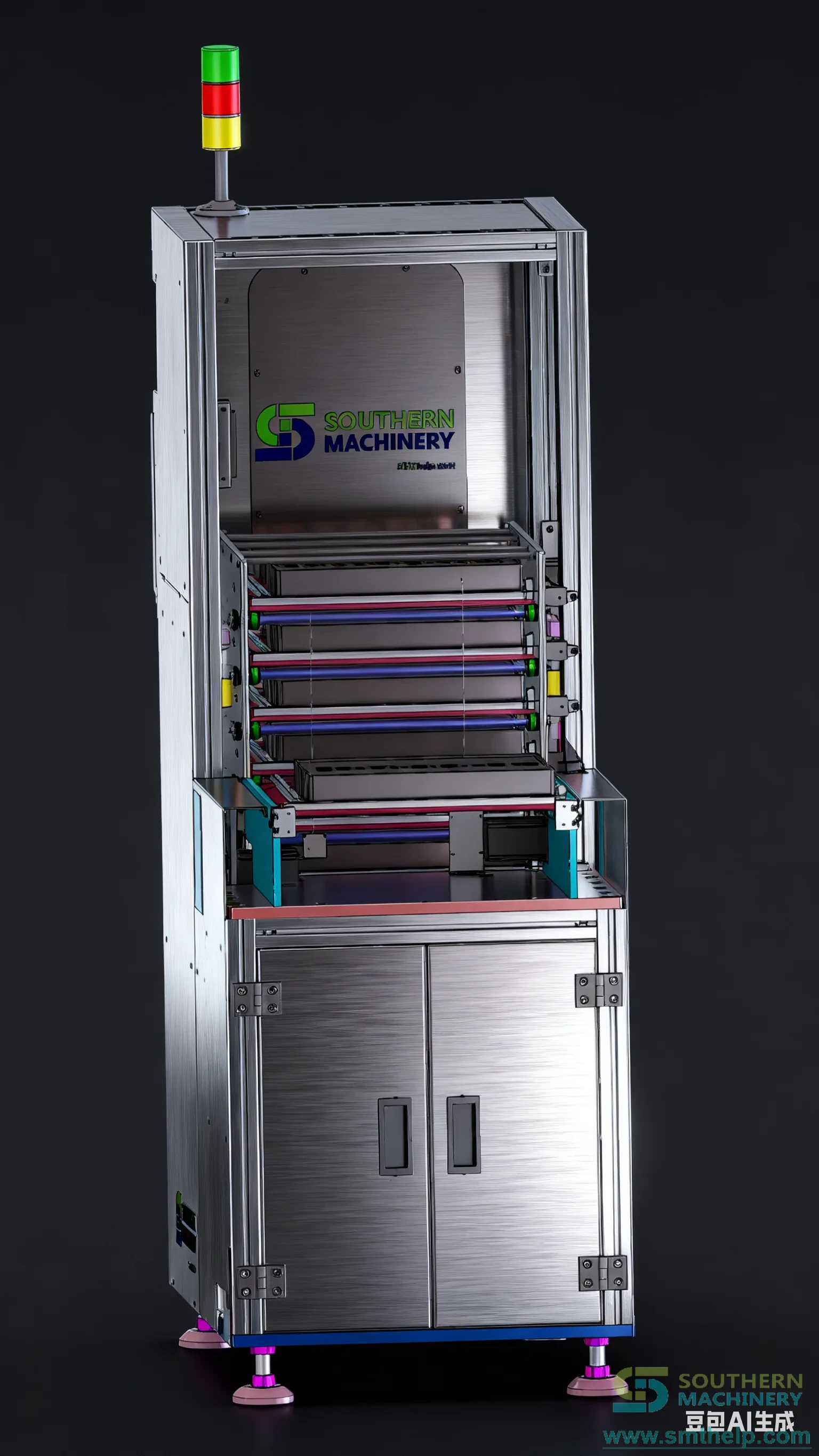
STP1001 tray feeder setup is a five-step commissioning job: mount the feeder on the mounter's existing feeder plate with the positioning key and clamping block, wire a single-phase 220 V supply and 0.4–0.6 MPa air, connect the 8-core 16 mm aviation plug or switch the unit to self-control, load the tray stack, then teach the pocket index on the touch screen. After commissioning, tray feeder uptime on a live line is held by four sensor checks per shift rather than by repairs.
The STP1001 is an automated tray feeder built by Shenzhen Southern Machinery for SMT mounters and odd-form placement machines. It presents blister-tray transformers, relays, hardware parts, memory module sockets and large capacitors to a host mounter at a 3 s feed rate with ±1 mm precision, and it is verified on Panasonic CM602, JUKI, YAMAHA and Mirae odd-form machines.
What is STP1001 tray feeder setup and what happens in each step?
The feeder is delivered crated and pre-commissioned. On-site work is the four physical interfaces — feeder plate, power, air, host — plus the tray teach; a trained team completes it in a single shift and then runs a timed empty cycle before production parts go on the belt.
Step 1 — Mount on the existing feeder plate
Use the positioning key and clamping block to fix the STP1001 to the feeder plate already on the machine. For the standard plate size no custom bracket is needed, and because the feeder keys into the plate, the pick position repeats after the feeder is swapped out. The unit measures 1,160 × 790 × 1,530 mm and weighs 75 kg, so it is a two-person lift with no crane required.
Step 2 — Wire 220 V and 0.4–0.6 MPa air
The working voltage is 220 V single-phase. Budget the line for 8 A on inrush rather than the 5 A average current, because the lifting servo draws hardest at the start of each tray lift. Air is set on the regulator to 0.4–0.6 MPa. Below 0.4 MPa the magazine clamp will not hold; above 0.6 MPa the pneumatic seals start to leak. The regulator has to hold that band through the magazine lift, not only at rest, so check the gauge while the stack is moving.
Step 3 — Connect the host handshake, or run self-control
The upper-computer connection is an 8-core 16 mm aviation plug — a standard industrial plug, so a spare cable is easy to source locally. The STP1001 supports IO communication with the host mounter, or self-control with no communication at all; in self-control mode the feeder cycles on its own and the host picks at its own pace. Either way the host sees the same component-in-position signal. The control architecture is a general-purpose PLC rather than a locked proprietary board.
Step 4 — Load the tray stack
The lifting magazine holds 40 trays of components under 10 mm tall, or 20 trays of taller parts. A servo-driven screw rod lifts one tray at a time and the conveyor belt returns the empty tray to the magazine for collection. The specification caps the load at 3 kg per material tray — heavier trays deflect on the conveyor belt, and a deflected tray is a failed index.
Step 5 — Teach positions and run a 30-minute empty cycle
Teach the first tray's pocket index on the touch screen, then run an empty-cycle test for 30 minutes before the first board runs production parts. Setup is done on the touch screen; cycle start, stop and reset stay on hard buttons. Skipping the empty cycle is the most common way to discover a wrong pocket index on a live board instead of on an empty belt.
What tray feeder parameters must be confirmed before commissioning?
Each of these comes from the supplied STP1001 documents. Confirm them against your component list before the unit ships, because every row decides either whether the feeder fits the line or whether the part fits the feeder.
- Model and machine type: STP1001, automated tray feeder for SMT mounters and odd-form placement machines.
- Component families: transformers, relays, hardware parts, memory module sockets, large capacitors.
- Component size band: 3 × 3 × 3 mm to 50 × 50 × 50 mm.
- Blister tray size: 150 × 150 mm to 200 × 300 mm, PET plastic film.
- Maximum load per material tray: 3 kg — heavier trays deflect on the conveyor belt.
- Magazine capacity: 40 trays for parts under 10 mm tall, 20 trays for parts taller than 10 mm.
- Footprint and mass: 1,160 × 790 × 1,530 mm, 75 kg.
- Power: 220 V single-phase, 5 A average / 8 A peak.
- Air supply: 0.4–0.6 MPa at the regulator.
- Feeding speed and precision: 3 s per material feed, ±1 mm.
- Interface: 8-core 16 mm aviation plug; IO communication or self-control.
- Motion: 400 W lifting servo and 100 W conveying servo, 3,000 rpm maximum.
- Verified host platforms: Panasonic CM602, JUKI, YAMAHA and Mirae odd-form machines.
Which five adjustments decide whether the setup holds?
Five adjustments decide whether an STP1001 runs cleanly, and every one of them is easy to skip during a hurried commissioning.
- Tray position on the belt. The first pocket in the tray must line up under the pick point. Teach the pocket index before the first tray runs; an index that is off by one pocket makes every pick wrong.
- Belt speed. The 3 s feed rate is the nominal setting. The conveyor servo will run faster if asked to, but overshoot then fails the pick, so leave the default in place.
- Magazine height. The 40-tray magazine is sized for small parts. If tall trays are loaded into a 40-tray stack, beyond the height limit, the screw rod will not lift the stack. Count the trays instead of eyeballing the stack height.
- Air pressure. The regulator must hold 0.4–0.6 MPa through the lift cycle.
- The host handshake. The 8-core aviation plug is wired to a specific pin map. When the host mounter is changed for a different model, re-check the pin map — a mis-wired handshake is the most common commissioning fault.
How does tray feeder uptime hold across shifts?
Four sensor checks per shift catch most unplanned stops before they happen, and together they take about eight minutes. None requires opening the cabinet; the states are readable on the touch screen.
- Magazine-low sensor. This is the signal that tells the host the stack is below five trays. If the host never sees it, the magazine runs dry mid-shift and the line stops. Verify the sensor lights when the stack drops below five.
- Conveyor-index sensor. This confirms that a pocket is at the pick point. A dirty sensor face produces phantom picks and a falling cycle rate, so wipe it with a dry wipe at each shift change.
- Lift-position sensor. This confirms the screw rod is at the right height. A drifting sensor stacks trays unevenly and the belt cannot seat the next tray, so check the sensor bracket for tightness.
- Air-pressure sensor. The regulator is mechanical but the sensor reporting pressure to the PLC is electronic. If it fails, the host reads pressure while the clamp does not hold, so compare the gauge against the PLC reading.
The factory baseline behind those checks is a 500-feeding continuous test and a 48-hour continuous aging test, both run with no abnormality and both quoted from the STP1001 documents. The four checks are the line-side equivalent that keeps those results true on your floor.
Does the tray feeder fit the host mounter and the rest of the part mix?
The STP1001 fits the existing feeder plate through the positioning key, and it is listed as verified on four odd-form machine families: Panasonic CM602, JUKI, YAMAHA and Mirae, in each case working alongside bowl feeders and radial tape feeders. Any SMT mounter that exposes an IO feeder interface can drive it through the aviation plug; a host with no spare interface can still use the feeder in self-control mode.
For a mixed board, the tray feeder handles the heavy leaded parts while a bowl feeder covers small odd-form parts and a radial tape feeder covers through-hole parts. The same IO handshake serves all three, so pairing tray plus bowl, tray plus radial, or all three on one mounter is a line-configuration decision, not a firmware change.
One disambiguation worth keeping on file: the STP1001 is the tray-only machine. The tray feeder with robotic-arm pickup is a larger unit in the same family (1,300 × 554 × 1,763 mm, 500 kg, CCD vision, a different PLC), and the DIMM connector tray feeder is a third variant. Their figures are not interchangeable with the numbers above.
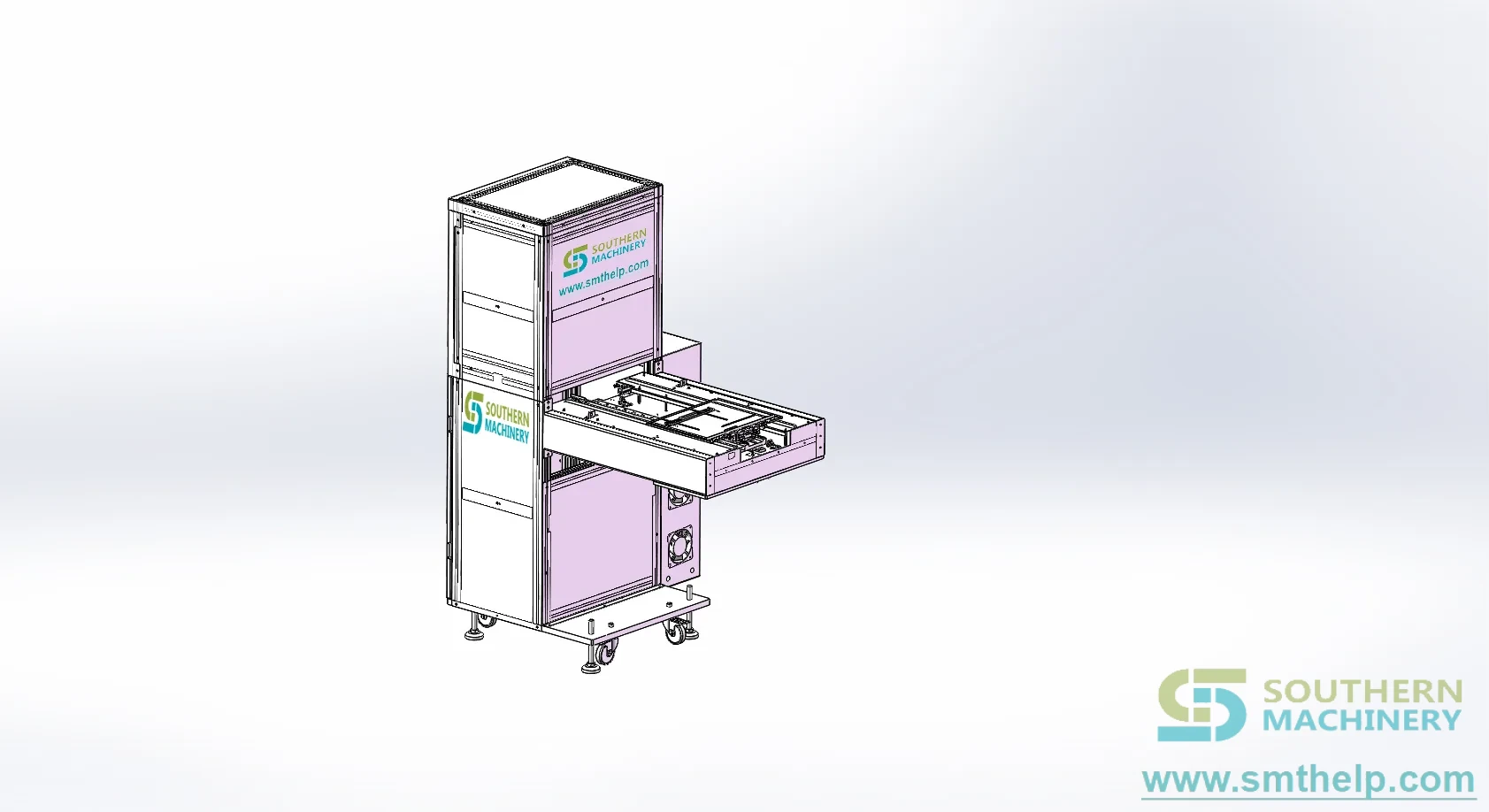
How does the STP1001 connect to a full PCB assembly line?
The feeder is a station in the through-hole and odd-form section, not a standalone island. Confirm the inward interfaces — feeder plate keyway, 220 V single-phase supply, 0.4–0.6 MPa air and the host IO or self-control handshake — and the outward face, where the host mounter picks and the empty trays return to the magazine.
Southern Machinery builds the surrounding line as well, so the feeder can be specified with the rest of the assembly section rather than retrofitted around it. Useful references:
- Machine feeder range on the official site: Southern Machinery feeder range
- Odd-form feeder design and manufacturing for EMS factories: odd-form feeder design and manufacturing
- Through-hole feeder category: THT feeder category
- Board handling and line transport: board handling and line transport
- STP1001 catalog PDF (V03): STP1001 tray feeder catalog V03 (PDF)
- Full machine catalogue: Southern Machinery machine catalogue
What is the ROI of an automated tray feeder?
The money case is a labour case, not a speed case. Tray-fed odd-form parts are usually placed by hand or by a low-throughput feeder an operator has to keep reloading; the feeder removes the reloading walk, the tray-swap stop and the index error that a hand-loaded tray produces. Use your own measured times, and keep the capital line honest:
- Handling hours released per month = (manual seconds per part − feeder seconds per part) × parts per board × boards per day × working days per month ÷ 3,600
- Labour saved per year = handling hours released per month × 12 × loaded hourly wage
- Payback period in months = installed feeder cost ÷ monthly labour saved
Worked example — the calculator's own default inputs, illustrative only, depends on configuration and subject to final technical confirmation:
- Inputs: 3 s feeder cycle, 12 tray-fed parts per board, 30 s manual handling per part, 300 boards per day, 26 working days per month, one operator freed, loaded wage USD 700 per operator-month, installed feeder cost USD 4,000.
- Machine time per board = 3 s × 12 parts = 36 s.
- Handling hours released per month = (30 − 3) s × 12 × 300 × 26 ÷ 3,600 = 702 hours.
- Labour released = 1 operator × USD 700 × 12 = USD 8,400 per year.
- Payback = USD 4,000 ÷ (USD 8,400 ÷ 12) = 5.7 months.
The manual handling time is the input that decides the answer, so measure it rather than assume it: a part that takes 30 seconds by hand loads very differently from one that takes 8.
Change any input to match your line; the shape of the result is what matters. Quality and throughput move with the same inputs — a 40-tray magazine keeps the host running without an operator visit, and the ±1 mm index removes the misplaced-component scrap a hand-loaded tray creates. These figures are not a quotation or a guarantee.
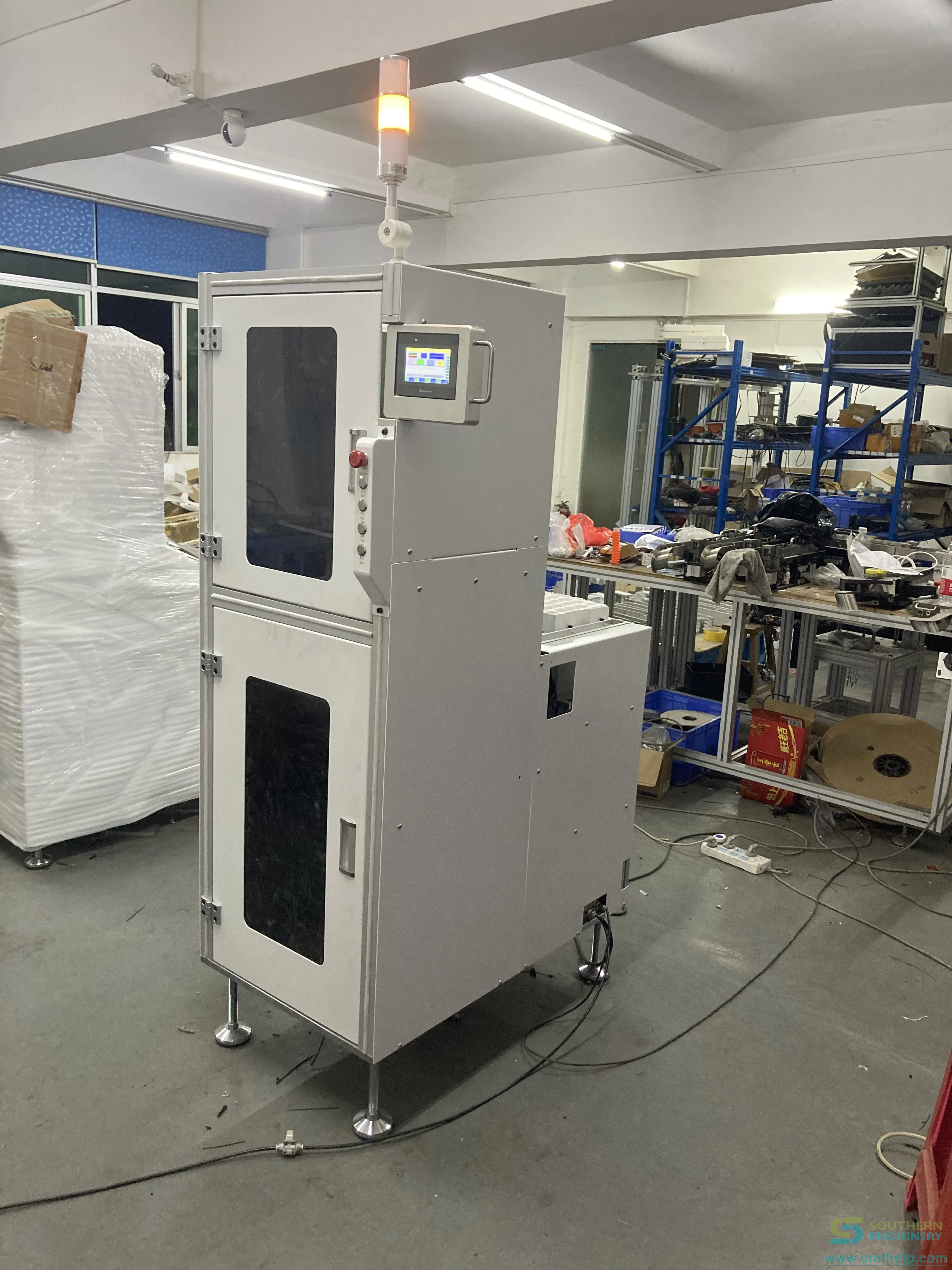
Frequently asked questions
What is the tray capacity of the STP1001? 40 trays for components under 10 mm tall, or 20 trays for components taller than 10 mm. The figure is taken from the V03 catalog page for the STP1001.
What is the difference between the STP1001 and a tube feeder? A tube feeder such as the STF1003 presents parts from a stick tube one at a time, while the STP1001 presents parts from a blister tray that holds many parts side by side. They cover different component families, so an EMS line typically uses both.
Can it run without connecting to the host mounter? Yes. The STP1001 supports IO communication and self-control without communication. In self-control mode the feeder cycles on its own and the host picks at its own pace.
What air pressure does the feeder need? 0.4–0.6 MPa, set on the regulator before the first tray goes on the stack. Below 0.4 MPa the magazine clamp will not hold; above 0.6 MPa the pneumatic seals start to leak.
What is the lead time for the STP1001? A standard unit ships within 30 days of order. A customized configuration — custom tray size, custom IO mapping or custom panel layout — is typically one month from order.
What service is included with an STP1001? 7 x 24 worldwide support by phone, WhatsApp or remote session; on-site installation and training for one operator and one host engineer; common spare parts from Shenzhen stock within one working day; customized solutions in about one month; and CE marking with ISO 9001 and ISO 14001 certification.
Next step
Send your component list — size, package and daily volume — and Southern Machinery will return a configuration with a payback estimate, normally within one working day. If the tray-fed parts are the ones holding up your odd-form section, start with a component trial on the STP1001 and confirm the fit on your own trays before the line is committed.
Southern Machinery has designed and manufactured SMT and THT equipment in Shenzhen since 2011, with SMT, THT, wave soldering, board handling, inspection, feeders and customized automation supporting EMS factories worldwide. Contact: info@smthelp.com, WhatsApp +86 13602562576, or browse the Southern Machinery feeder range.
Comments