
STP1001 Tray Feeder for Odd-Form PCB Assembly by Southern Machinery
Automate tray-fed odd-form parts with the STP1001: 40-tray magazine, 3 s feed, +/- 1 mm precision. Cut tray-swap labour and keep your mounter fed.
Oct 6, 2026 · Updated Oct 6, 2026 · Southern Machinery
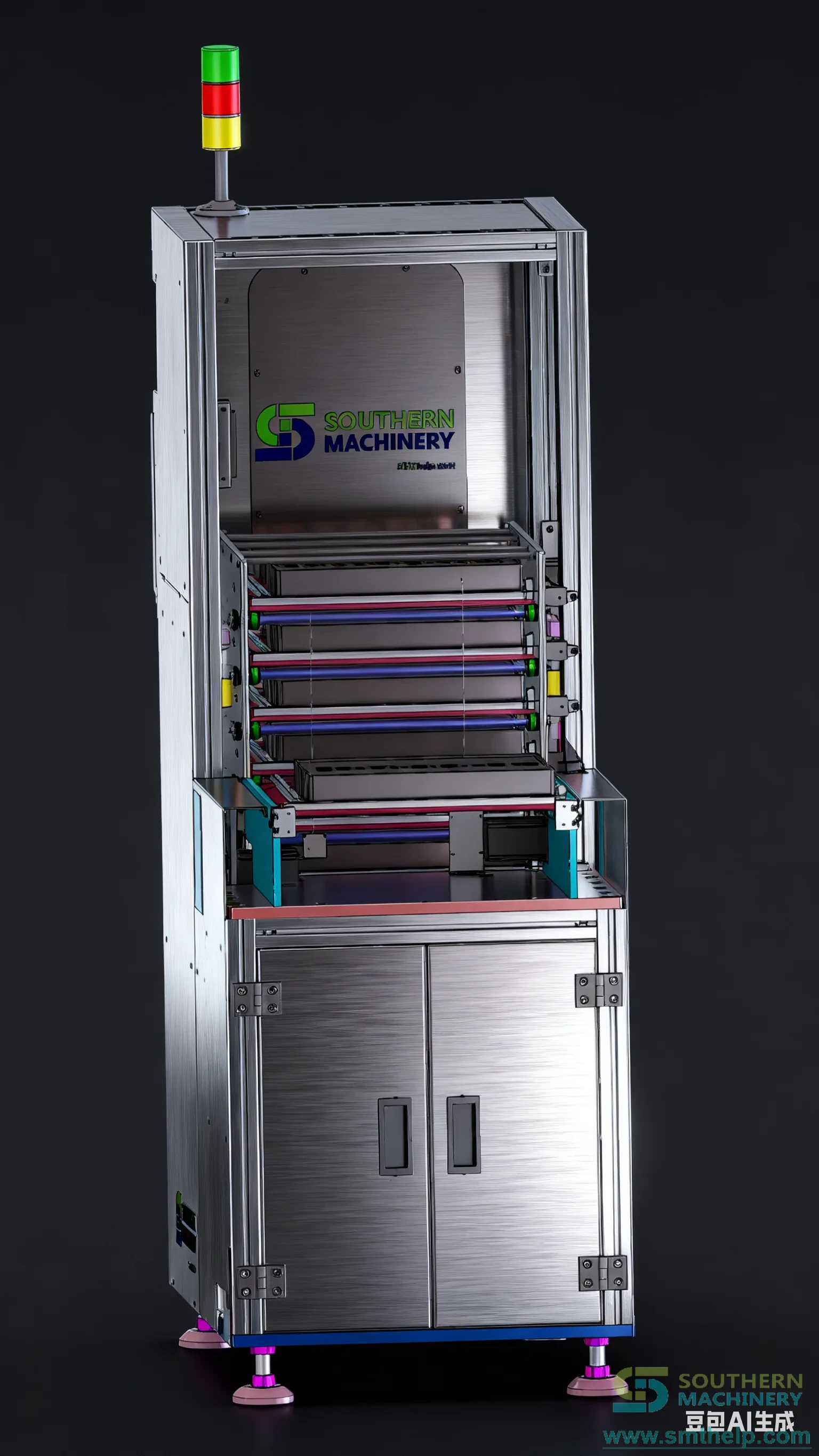
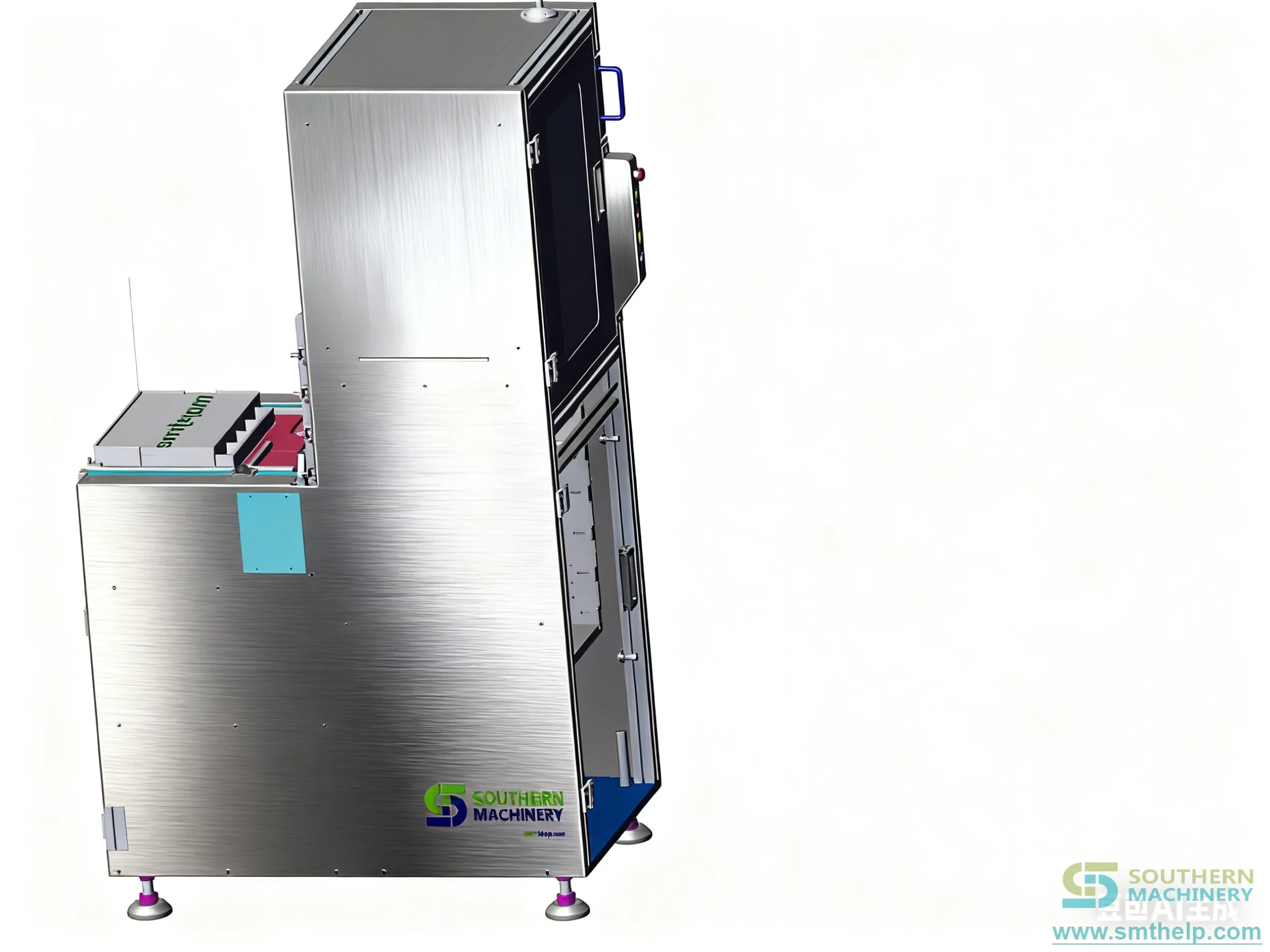
What is the STP1001 tray feeder used for? The STP1001 is an automated tray feeder that presents blister-tray odd-form components - transformers, relays, hardware parts, memory module sockets and large capacitors - to a host mounter, so the placement machine keeps running while the operator stays on quality instead of restocking trays. A 40-tray lifting magazine, a servo-driven screw rod and a conveyor belt replace the tray-swap walk, at a 3 s feed per component and +/- 1 mm positioning precision.
Tray-fed parts are the ones that cannot ride a tape reel: a transformer with a heavy magnetic core, a relay with thick pins, a memory module socket whose plastic body no nozzle can survive. They arrive in blister trays because that packaging protects the leads, and those trays are already on your receiving dock. The question is not how to re-package the part, but how to present the tray to the pick point without an operator.
What does an automated tray feeder do on an odd-form PCB assembly line?
An automated tray feeder turns a packaging format into a feeding format. It lifts one tray from a magazine, drives it on a belt until the correct pocket sits under the pick point, asserts component-in-position to the host, and returns the empty tray. The feeder never picks anything itself - the host keeps its nozzle, its vision and its cycle.
Package decides the feeder family: stick-tube parts want a tube feeder, loose parts want a bowl feeder, blister-tray parts want a tray feeder. The STP1001 covers a 3 x 3 x 3 mm to 50 x 50 x 50 mm band with a maximum 3 kg per tray; lead fragility, parts per board and whether your host exposes a feeder interface finish the check. The tray itself is not the problem - it is the part's natural packaging, already paid for - but it creates an operator who swaps trays, watches the pick point and walks back to the rack.
How does the STP1001 keep a host mounter fed without an operator?
Capacity is 40 trays of components under 10 mm tall, or 20 of taller components, held in a motor-driven lifting magazine. A 400 W lifting servo raises the stack until the top tray is level with the conveyor belt and a 100 W conveying servo positions the active tray; the empty tray is conveyed back to the lifting platform rather than set aside by hand.
The magazine, the screw rod and the belt
An operator loads the stack; the screw-rod lifter raises the top tray to belt level; the belt indexes the chosen pocket under the pick point; the host picks; the belt advances to the next pocket; the empty tray returns and the stack drops one level. Feeding speed is 3 s per material and precision is +/- 1 mm, which is what lets the head acquire a component on the first attempt.
IO handshake or self-control
An 8-core, 16 mm aviation plug carries the handshake to any mounter that exposes an IO feeder interface; where the host has no spare interface, the STP1001 runs in self-control mode and cycles on its own, with the same component-in-position signal. The control platform is a general-purpose PLC with touch-screen operation, and mounting uses a positioning key and clamping block on the existing feeder plate.
How does a tray feeder fit into a full PCB assembly line?
Printing and reflow fix the thermal process; the odd-form bay decides how much of the board still needs a human. Upstream, tape- and reel-fed content runs through the SMT line and board handling; the tray feeder then covers the heavy leaded content beside an odd-form insertion machine.
Tray plus bowl plus radial on one machine
Most odd-form boards are hybrids and no single feeder covers the mix: a tray feeder for heavy leaded parts, a bowl feeder for small loose parts and a radial tape feeder for through-hole parts can all run on one machine with the same IO handshake. Verified installations are listed on Panasonic CM602, JUKI, YAMAHA and Mirae machines. On the through-hole side, pair it with the S4000 axial inserter, the S7000 odd-form inserter and the wider THT line. A 3D layout model is on the Southern Machinery drawing board.
What should you check before you buy a tray feeder?
Every parameter below is quoted from the STP1001 catalogue page, spec sheet or FABE sales note.
- Magazine capacity: 40 trays under 10 mm tall, 20 trays over 10 mm - the number that drives hours between operator visits.
- Feed rate and precision: 3 s per material, +/- 1 mm - compare against your host mounter's pick cycle.
- Tray format: 150 x 150 mm to 200 x 300 mm PET blister trays, maximum 3 kg per tray.
- Host interface: 8-core, 16 mm aviation plug with IO communication, or self-control with none.
- Verification: 500 continuous feedings and 48 hours of aging, both reported without abnormality.
Tray feeder vs manual loading: cost and quality
Two effects matter and they are usually quoted as one: the operator time released from tray swaps, and availability - a line that stops feeding when a tray runs out has its OEE set by how fast somebody walks to the rack.
ROI formula
- Operator hours released per month = (tray swaps per hour x seconds per swap / 3600) x hours per day x days per month
- Labour released per month = operator hours released x loaded wage per operator hour
- Hours between operator visits = tray capacity / tray changes per hour
- Payback in months = installed cost / monthly value released
A worked example
The inputs are an example only, depend on your configuration, and are subject to final technical confirmation. Six tray changes per hour at 30 seconds each, 8 hours a day, 26 days a month: 6 x 30 / 3600 x 8 x 26 = 10.4 operator hours released per month, about USD 156 at USD 15 per loaded operator hour - which on wages alone does not carry a capital purchase. Availability is the stronger argument: at six tray changes an hour a 40-tray magazine runs roughly 6.7 hours between operator visits against about 40 minutes for a four-tray feeder. Installed cost is not stated in the source documents, so contact Southern Machinery to confirm it; on wages alone an illustrative USD 4,000 feeder against USD 156 a month would pay back in about 26 months, before throughput and rework value.
Quality follows the same logic: a tray one pocket off its taught position produces a mis-placed component, a rework or a scrap, and the +/- 1 mm indexing plus the component-in-position signal remove that defect class.
What does the STP1001 specification state?
Feeding method: tray feeding - the feeder presents, the host picks. Lifting and conveying: motor and screw rod lifting, two-direction conveyor belt. Drives: 400 W lifting servo, 100 W conveying servo, 3000 rpm maximum. Control: PLC-based, touch screen and buttons, 8-core 16 mm aviation plug to the host. Power and air: 220 V, 5 A average, 8 A peak, 0.4 - 0.6 MPa. Dimensions and weight: 1160 x 790 x 1530 mm, 75 kg. Lead time: standard units ship within 30 days; custom tray size, IO mapping or panel layout is typically one month.
Southern Machinery has built SMT and THT equipment in Shenzhen since 2011 and serves more than 237 customers worldwide, with 7 x 24 engineering support, free on-site installation and training for one operator and one host engineer, and common spare parts shipping from Shenzhen stock within one working day. The STP1001 is CE marked, ISO 9001 and ISO 14001.
Frequently asked questions
What is the tray capacity of the STP1001?
40 trays for components under 10 mm tall, or 20 trays for taller components.
How fast and how accurately does it feed?
3 s per material with +/- 1 mm precision, verified at 500 continuous feedings without abnormality.
Can it run without a handshake from the host?
Yes - IO communication through the 8-core aviation plug, or self-control mode where the feeder cycles on its own.
Which component families can it feed?
Transformers, relays, hardware parts, memory module sockets and large capacitors in the 3 x 3 x 3 mm to 50 x 50 x 50 mm band, on PET blister trays.
Tray feeder or tube feeder?
A tube feeder presents parts from a stick tube one at a time; the STP1001 presents many parts side by side in a blister tray, so a hybrid line uses both.
What running inputs should be budgeted?
220 V single-phase at 8 A peak and 0.4 - 0.6 MPa air, plus per-shift checks of the four feeder sensors.
Next step
Send Southern Machinery your component list - part size, package, trays per shift and daily volume - and we will return a tray feeder configuration with a payback estimate for your line. Request a component trial, or download the STP1001 tray feeder specification before you specify.
Comments