
Stencil Cleaning Wiper Roll Spec Guide by Southern Machinery
A stencil cleaning wiper paper roll is specified, not ordered by brand name. Six measured parameters decide whether the roll loads and tracks in your screen printer: core length, core inner diameter, notch type, roll outer diameter, material width and material length, plus the winding direction and tube material. Southern Machinery's roll is a dust-free 55% wood pulp / 45% polyester spunlace sheet at 56 gsm and 0.3 mm, quoted at a water absorption rate of 0.5 seconds or less, cut to your core and notch and packed 20 rolls per carton. This guide converts the product material into a measurement worksheet: how to read the roll already in the printer, how to decode the core end, what the wet, vacuum and dry strokes demand, and how one qualified specification can replace a different wipe for every printer brand on the floor.
Oct 15, 2026 · Updated Oct 15, 2026 · Southern Machinery
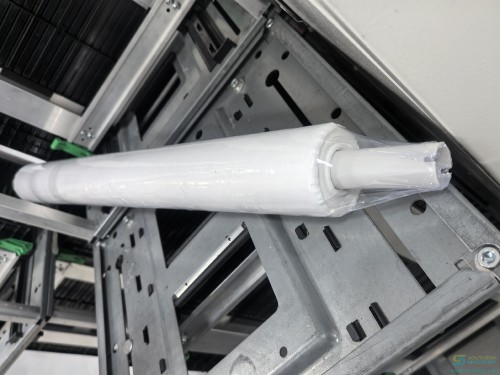
A stencil cleaning wiper paper roll is the consumable an automatic under-stencil cleaning unit pulls through a screen printer, and it is specified rather than simply re-ordered: six measured parameters decide whether the roll loads, tracks and cleans. Fit the wrong core and the roll slips or jams mid-cycle; fit the wrong sheet and solder paste stays in the apertures for the next board. This guide turns the Southern Machinery product material into the measurement worksheet behind that specification.
What is a stencil cleaning wiper roll, and when is it the wrong purchase?
Under-stencil cleaning is a fixed step in solder paste printing: the printer wipes the stencil underside between boards so apertures stay open and deposits stay repeatable. Because the roll is not a machine, it is easy to treat as a commodity and swap one wipe for another when the carton runs out. That is where print quality moves: the roll is keyed to one cleaning unit, and it works in three stressing strokes.
The material lists six failure modes: residual paste cutting transfer efficiency, losing roughly half the deposit at a 0.50 area ratio, its fine-pitch danger zone for 0402s and CSPs; underside smearing that reappears as solder balls and bridging; fibre shed on the dry stroke; sheets swelling and tearing under vacuum; a core jamming on the take-up shaft; and one wipe brand per machine multiplying SKUs and qualification work.
Which six parameters define a stencil cleaning wiper paper roll?
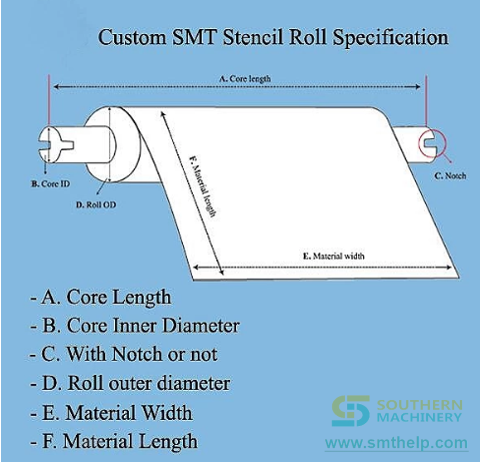
Custom rolls are cut from six parameters: core length, core inner diameter, notch type, roll outer diameter, material width and material length. Four of them are measurements. Two are choices.
The four numbers you measure
On the material's reference roll: core ID 20 mm, core length 410 mm, core wall 1.5 mm, core OD 23 mm, finished roll OD 50 mm, paper width 300 mm, paper length 10 m, hand-measured to about ±1 mm. Read that as one common configuration, not a universal one — your unit may need a different core ID, length, width or notch.
The two choices: core end and winding direction
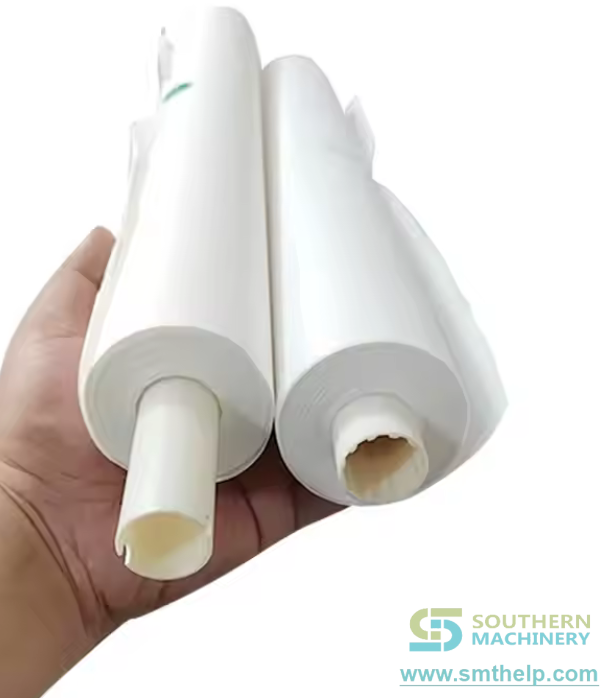
The core is not only a diameter. The material offers a PVC cross notch (+), a PVC one-word notch (−), a PVC 12-rib groove, smooth PVC without a notch, and a plain paper tube, because printer families key the roll differently: the notch or rib pattern transmits rotation instead of letting the roll spin free. Winding direction matters too — a roll wound the other way presents the wrong face to the stencil.
What the sheet has to deliver
The sheet is a spunlace double layer of 55% native wood pulp and 45% polyester at 56 gsm and 0.3 mm, with a water absorption rate quoted at ≤0.5 s. Wood pulp absorbs solvent and flux quickly; polyester keeps the sheet from swelling, weakening and linting while wet and under vacuum. The surface is dust-free and lint-free, with an even paper grain.
How do you measure the roll already in your printer?
You do not need a drawing of the cleaning unit. You need the roll already inside it.
Step 1 — identify the printer and its cleaning unit
Record the printer brand and model on each line, because one brand can ship several cleaning units. Reference dimensions in the material cover DEK, MPM, GKG, EKRA, JUKI, Fuji, Yamaha, Panasonic, KME, Hitachi, Sony, Minami and Desen units; an unlisted printer is built to the six parameters.
Step 2 — measure the four numbers
With the roll removed, measure core inner diameter and core length, then paper width and paper length on a full roll, in millimetres and metres. Those are the values a supplier quotes against and a buyer re-checks when the next carton arrives.
Step 3 — decode the core end
Match the core end against the five options: cross notch, one-word notch, 12-rib groove, smooth PVC, or paper tube. Photographing it beats describing it, and it removes the most expensive ambiguity in the order: a correct sheet on the wrong core cannot be made to run.
Step 4 — confirm winding direction and tube material
Confirm the unwind direction and whether the tube is PVC or paper, and keep both on the same record as the four measurements.
What must the sheet survive on the wet, vacuum and dry strokes?
Automatic cleaning runs a programmed sequence. On the wet stroke, solvent is applied and the sheet lifts paste and flux residue. On the vacuum stroke, particles are pulled out of the apertures into the sheet — the moment a weak sheet tears. On the dry stroke, a fresh section sweeps the stencil underside clean — the moment a shedding sheet deposits lint. When it works, apertures are clear and transfer efficiency is restored.
The 49% and 98% transfer-efficiency example
The material quotes transfer efficiency of 49% at a 0.50 area ratio when apertures are not cleaned properly, against 98% for a clean aperture at a 0.88 area ratio — example figures from the source, dependent on your paste and process and subject to final technical confirmation.
Can one stencil cleaning wiper roll spec cover DEK, MPM, JUKI and Yamaha printers?
Yes, in the sense the material intends: the roll is qualified per printer position and the specification is then held, so a mixed-brand floor is fed from one consumable file. Dimensions below use core ID × core length × paper width × paper length (mm × m), with tube type and core end shape per brand family.
- DEK: 20×530×250/300/350/400/450/490/500/510×10, hose, two-headed or one-word mouth
- MPM: 19.5×455×250/300/330/350/400×10, 12-rib inner tube
- GKG: 20×410×400×10, hose, two crosses
- EKRA: 13.5×400×300×10 and 13.5×400×400×10, hose, two-headed mouth
- JUKI: 38×270×260×15, 38×353×345×15, 38×408×400×8, 36×535×520×12, hose
- Fuji: 26×500×500×15, paper tube
- Yamaha: 25.5×360×350×10 and 25.5×420×400×10, paper tube
- Panasonic / Matsushita: 38×350×350×10, paper tube
- KME: 38×480×480×20, paper tube
- Hitachi: 30×360×300×10, paper tube
- Sony: 20×280×260×20, hose, two-headed mouth
- Minami / Desen: 8×290×270×10, 8×410×350×10, 20×410×300×10, hose, two-headed mouth
More sizes are available on request, and notch type plus winding direction are confirmed alongside the four measurements.
One supplier, one qualification file
The qualification path has five steps: printer review from the brand, model or current roll parameters; specification confirmation of core ID, core length, width, length, notch and tube material within 24 hours; a sample trial before bulk commitment; bulk production with rolls individually wrapped and labelled per printer position; and reorder support afterwards. Run it once per position and a consumable becomes a documented specification — the only thing that makes a second source comparable.
Reorder planning: 20 rolls per carton
Rolls ship individually wrapped, 20 per carton, sized to the roll format — a predictable stocking unit with one carton format per printer position and a reorder point set from your own consumption. Standard specifications are described as shipping from stock; custom sizes are confirmed within 24 hours, with about a one-month customisation window.
How does the roll sit inside a full SMT/THT PCB assembly line?
The roll belongs to the print module and touches every board. It sits in the printer's automatic cleaning unit, downstream of stencil setup and upstream of paste inspection and placement: if the stencil underside is not clean, the printer passes its own contamination to the placement machines as misprinted deposits, solder balls and bridging.
That is why the roll is evaluated with the other print-process assets. Southern Machinery publishes it on the stencil cleaning wiper paper roll product page, the DEK and GKG printer paper reference and the wider stencil cleaning category, which also covers the SME-800 electric stencil cleaning machine. The SP-1008 automatic screen printer and the stencil printing process specifications show where cleaning sits in the print programme; the rest of the line is at file.autoinsertion.com.
What does a documented wiper roll specification change in cost, quality and uptime?
Three effects are structural. Quality: the roll lifts paste and flux residue out of the apertures instead of smearing it across them, the mechanism behind the 49% / 98% example above. Uptime: a mid-stroke tear or jammed core stops the printer outright rather than degrading it slowly, so the cost is stopped minutes as much as wipe price. Procurement: one qualified specification per printer position replaces one supplier and one qualification file per brand.
No price, consumption rate or payback period is stated in the source material, so size the comparison with your own inputs:
Annual consumable cost = rolls used per year × unit roll cost
Annual print-quality cost = boards per year × print-defect rate × rework or scrap cost per board
Net annual effect = (baseline print-quality cost − wiper-roll print-quality cost) − annual consumable cost
Illustration only, depending on configuration and subject to final technical confirmation: a plant printing 200,000 boards a year whose defect rate moves by 0.1 percentage points at USD 3 of rework per board avoids 200 boards of rework, or USD 600 a year, before the roll's own cost. Those inputs are hypothetical, not Southern Machinery data.
Frequently asked questions about stencil cleaning wiper rolls
What is the wipe made of, and why a 55/45 blend?
It is 55% native wood pulp and 45% polyester in a spunlace double-layer sheet at 56 gsm and 0.3 mm, with a water absorption rate quoted at ≤0.5 s. The pulp draws solvent and flux quickly; the polyester stops the sheet swelling or shedding fibre.
Which screen printers does the roll fit?
Reference dimensions cover DEK, MPM, GKG, EKRA, JUKI, Fuji, Yamaha, Panasonic, KME, Hitachi, Sony, Minami and Desen units. For any other printer, send the six parameters plus notch type and winding direction and a size is produced to match.
How do I choose the right size and core?
Measure core inner diameter, core length, paper width and paper length on the roll you are replacing, then record the core end (cross "+", one-word "−", 12-rib groove, smooth PVC or paper tube) and the winding direction. The core end is the likeliest cause of a jam.
Does the roll work with IPA and water-soluble cleaning agents?
Yes. The sheet is specified for wet, vacuum and dry strokes with standard production cleaning agents, including IPA and water-soluble chemistry.
What is the packing, and how is a custom size handled?
Rolls are individually wrapped, 20 per carton, sized to the roll format. Standard specifications ship from stock; custom sizes are confirmed within 24 hours via the sample-first process.
Next step: send one printer model and get an exact specification
Send the printer brand and model for each line, or the six roll parameters plus notch type and winding direction, and Southern Machinery replies with the matched specification, quotation and packing plan. Start from the wiper paper roll product page.
Comments