
Stencil Cleaning Capacity: SME-750II by Southern Machinery
Stencil cleaning capacity planning for high-mix SMT: SME-750II cycle time, stencils per shift, line-balance maths and payback by Southern Machinery.
Oct 7, 2026 · Updated Oct 7, 2026 · Southern Machinery
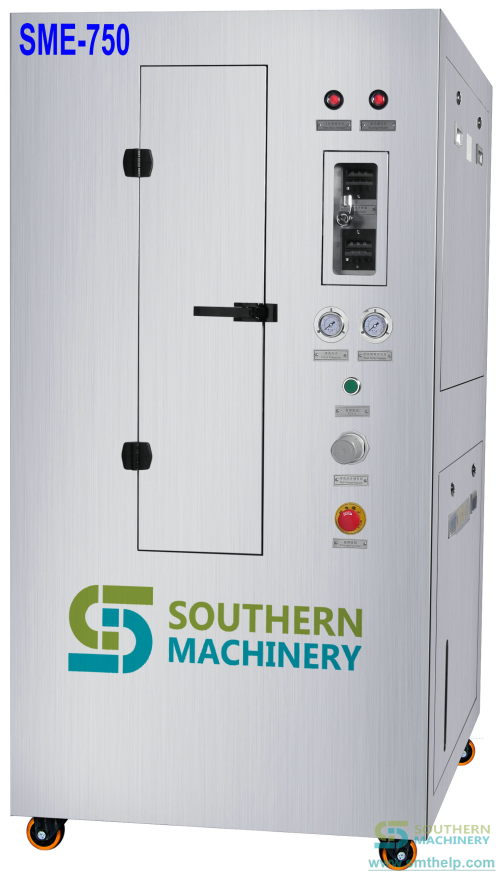
An SMT stencil cleaning machine strips solder paste and adhesive residue from stencil apertures without damaging mesh tension, but the reason plants stop scrubbing by hand is capacity. The Southern Machinery SME-750II is a full-pneumatic dual-stencil cleaner: two independent units, a published 3-5 minute clean and 3-5 minute dry for a solder paste stencil, and 3-level liquid filtration. Its published cycle time puts stencil cleaning capacity at roughly 12 to 20 stencils per hour, or about 82 to 136 across an eight-hour shift - derived, example only, subject to final technical confirmation.
How much stencil cleaning capacity does a print room actually need?
Capacity is a division, not a promise
Stencil cleaning capacity is cycle time turned upside down and multiplied by chamber count. Write the arithmetic before any vendor conversation, because a chamber cannot clean faster than it dries or dry faster than it reloads:
Stencils per hour = 60 / (clean time + dry time) x stencils per cycleThe SME-750II document supplies both inputs: 3-5 minutes cleaning and 3-5 minutes drying for a solder paste stencil, two stencils per cycle. One cycle therefore runs 6 to 10 minutes and returns two clean, dry stencils - an example derived from published cycle time, not a guaranteed rate.
A worked shift-capacity example
- Published cycle - 3-5 min clean plus 3-5 min dry, two stencils per cycle
- Stencils per hour - 12 to 20 (derived)
- Eight-hour shift at 85% availability - roughly 82 to 136 stencils (derived)
Treat 85% availability as an assumption. The document publishes clean and dry times and chamber count, and publishes no loading or unloading time, so anything that stops the chamber - carrying a stencil from the printer, checking filters, topping up tanks - sits outside the cycle and reduces the shift figure. The ceiling is rarely the spray: a clean stencil still has to be carried, checked and returned to the printer at walking speed, so plan the cleaner against changeover rate rather than cleaning power. Example / depends on configuration / subject to final technical confirmation.
Is stencil cleaning a line-balance problem rather than a cleaning problem?
Cleaning is work in progress between changeovers
On a high-mix line, stencils in flight are work in progress. Each product change needs the outgoing stencil cleaned and the incoming stencil verified before the printer makes a first good board, so if cleaning is a one-by-one bench task the queue grows faster than the printer consumes it - and the queue, not the printer, sets changeover time.
Matching cleaning capacity to the changeover rate
The comparison that matters is stencils needed per shift against stencils cleaned per shift. A plant running 40 product changes in a shift needs roughly 40 clean stencils plus whatever re-cleaning its paste and print quality demand; one dual-stencil cleaner covering 82 to 136 stencils per shift absorbs that with margin. Two single-chamber cleaners look comparable on price and are not comparable on capacity: they consume two load-unload events for the same two stencils.
Why chamber count is the only real buffer
Chamber count is the buffer you buy. A single unit holds one stencil per cycle; the SME-750II runs two independent units, each with its own 40 L tank and 360 degree rotary spray rods, so a late changeover can be covered by two stencils in flight at once, including different stencil types.
Manual stencil cleaning vs dual-stencil pneumatic cleaning: what changes on the floor?
Solvent, safety and the ignition question
Manual cleaning exposes an operator to solvent at arm's length and leaves quality in that operator's hands. The SME-750II runs entirely on compressed air with no electric power at all, and the document presents that as removing an ignition source from a cleaning area where flammable solvents are used. An inner-lock safety door and safety valve stop the machine immediately if the door is opened.
What the document quantifies, and what it does not
For a mid-size line moving off manual scrubbing, the document publishes three planning estimates:
- 2x throughput, from cleaning two stencils per cycle in independent units
- About 60% less solvent consumed with 3-level filtration and liquid recycling (reference estimate)
- One operator per shift freed from manual stencil scrubbing
It publishes no separate cycle for red glue or copper mask stencils and no litres-per-stencil solvent figure - confirm those with Southern Machinery against your stencil types and cleaning liquid.
Which specifications decide stencil cleaning capacity?
The selection list to take to your supplier
- Stencil envelope - up to L750 x W750 x H40 mm, two pieces maximum (reference)
- Cleaning units - 2 independent units, two stencils or two different types per cycle
- Cycle time - 3-5 min clean and 3-5 min dry for a solder paste stencil
- Liquid - 40 L x 2 tanks, solvent or cleaning liquid, recycled
- Wash and dry - 360 degree double-side rotary nozzles, spray wash then air blow dry
- Filtration per unit - 1 mm SUS304 net, 20 um bag, 1 um cotton filter
- Air supply - 0.5-0.7 MPa at 400-600 L/min, two sets
- Footprint, weight and structure - L1500 x W960 x H1700 mm, 480 kg net, SUS304 acid and alkali resistant, all liquid pipes SUS304, 15-year lifespan reference
- Control and parts - one-button automatic clean and dry, solvent auto add and discharge, Ingersoll Rand air pump, HENNGSTLER timer, KOGANEI indicator, modular maintenance design
Stencil type and facility limits belong in the same list
Those 3-5 minute times are stated for a solder paste stencil; red glue stencils and copper masks are supported without published cycles, so confirm the cycle first if most of your volume is adhesive or copper mask work. Air is the other limit - two sets at 0.5-0.7 MPa and 400-600 L/min each plus an exhaust vent - and an under-supplied station will not reach its published cycle time.
How does the SME-750II fit into a complete PCB assembly line?
The stencil cleaner is a print-room asset, not a conveyor module, so it integrates through stencil logistics: the printer pulls a stencil for the next product, the cleaner returns a dry, aperture-clean stencil, and boards continue through placement and soldering untouched.
- Print-room position - beside the printer, upstream of first-article verification
- Line partners - the same room's stencil storage and screening equipment
- Downstream continuity - keeps wave soldering and board handling stations fed without waiting for stencils
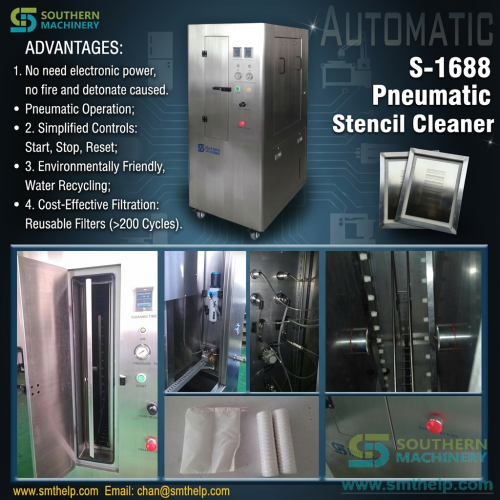
- Alternatives - the single-chamber S-1688 pneumatic cleaner where one stencil per cycle is enough, or the electric-drive SME800 where a DI rinse matters more than zero electric power
The SMT line carries the product while the PCB cleaning machine range carries process support, and a full PCB assembly line is configured as one system. Equipment families are listed in the machine catalogue at file.autoinsertion.com.
What is the payback on a dual-stencil stencil cleaner?
The payback formula
The document's reference estimate is under 12 months on a mid-size line, with the calculation redone on your numbers:
Annual labour saved = operators freed per shift x shifts per day
                      x loaded wage per hour x paid hours per year
Simple payback (years) = machine price / annual labour saved
A worked example
- Operators freed per shift - 1 (document reference estimate)
- Loaded wage per operator - $9/h (example input)
- Working pattern - 8 h/day, 22 days/month
- Annual freed labour - 1 x 9 x 8 x 22 x 12 = $19,008
- Machine price used for illustration - $25,000 (example, not a quotation)
- Simple payback - 25,000 / 19,008 = about 1.3 years
Solvent is a separate line: annual solvent saving = your current annual solvent spend x 0.60, from the document's reference estimate of about 60% lower consumption. Every figure above is example / depends on configuration / subject to final technical confirmation, and actual payback depends on stencil volume, solvent cost and quality targets. Simple payback also ignores boards never scrapped after a blocked aperture, changeovers that no longer wait for a stencil and the operator no longer inhaling solvent - treat it as a floor for the business case, not a forecast.
FAQ: stencil cleaning capacity questions
Can one dual-stencil cleaner keep up with a high-mix print room?
On the published cycle time, for most mid-size rooms: two stencils every 6-10 minutes, or roughly 82 to 136 per eight-hour shift at 85% availability. Compare that derived example against your own changeover count.
What stencil sizes does the SME-750II accept?
Up to L750 x W750 x H40 mm, two pieces maximum, and the two units can hold different stencil types at once.
Does a pneumatic stencil cleaner need an electrical supply?
No - it runs on compressed air at 0.5-0.7 MPa and 400-600 L/min on two sets, with no electric power at all, which is why the document presents it as the safe choice around flammable solvents.
How is the cleaning liquid managed?
Solvent and cleaning liquid are both supported, recycled through three filtration levels per unit with solvent added and discharged automatically. No litres-per-stencil figure is published; ask Southern Machinery to confirm it.
What support comes with the machine?
A technical consultation confirming model and cycle within 24 hours, free installation and training, 7 x 24 worldwide support and a one-day spare parts lead time.
Next step: size the cleaner to your changeover rate
Send stencil sizes, stencil types, cleaning liquid and daily volume to info@smthelp.com or WhatsApp +86 136 0256 2576. Southern Machinery confirms the model against those inputs - SME-750II dual-stencil, S-1688 single-chamber pneumatic or SME800 electric - and returns a configuration, quotation and delivery schedule, usually within one working day. Shenzhen Southern Machinery Sales and Service Co., Ltd. has built SMT and THT PCB assembly automation equipment since 2011 for 237+ customers worldwide, covering SMT lines, THT and odd-form insertion, wave soldering, board handling and inspection as complete line solutions.
Comments