
STE-800 Dual-Lane 8-Zone Lead-Free Reflow Oven | Southern Machinery
The STE-800 is a dual-lane, 16-zone (8 top / 8 bottom) lead-free reflow oven from Southern Machinery, built for EMS, ODM and OEM SMT lines that need tight thermal profiles, dual-rail throughput and PC-based process traceability. This guide explains what the STE-800 is used for, where it fits in a full PCB assembly line, the datasheet specifications that matter, and the selection parameters to confirm before you specify one.
Sep 10, 2026 · Updated Sep 10, 2026 · Southern Machinery
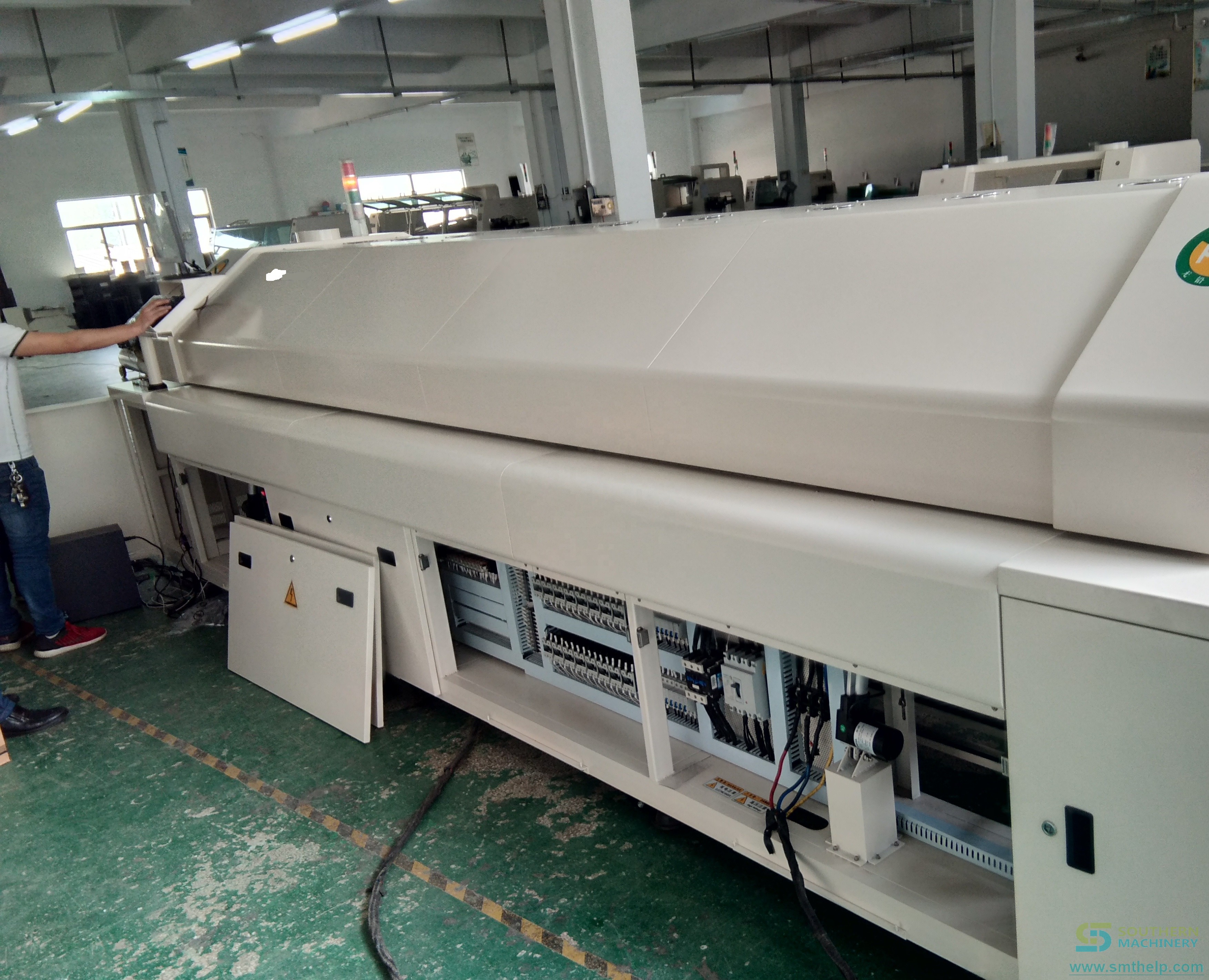
STE-800 Dual-Lane 8-Zone Lead-Free Reflow Oven: Selection and Line-Integration Guide
Reflow soldering is where an SMT line's thermal budget is either won or lost. Paste printing and placement get most of the attention, but the oven decides whether a profile is repeatable board after board, shift after shift. For EMS, ODM and OEM teams running mixed boards across automotive, medical and industrial-control programs, an oven that holds its setpoint under load is worth more than one that looks fast on a datasheet.
The STE-800 is a dual-lane, 8-zone-top / 8-zone-bottom lead-free reflow oven from Southern Machinery — a Shenzhen-based SMT and THT assembly-equipment manufacturer founded in 2011 and serving 237+ global customers. This guide explains what the STE-800 is used for, where it fits in a full PCB assembly line, and which parameters a buying team should confirm before it is specified.
What is the STE-800 reflow oven used for?
The STE-800 is used to reflow solder paste on SMT-assembled PCBs, forming the electrical and mechanical joints between components and the board. A PCB travels through the machine on a mesh-and-chain conveyor while 16 heating zones (8 top, 8 bottom) and 2 top cooling zones apply a controlled time–temperature profile — preheat, soak, reflow above the alloy's liquidus, then controlled cooling.
It is designed for factories that need:
- Double-sided and high-thermal-mass boards where top/bottom heating balance matters (top components up to 30 mm, bottom up to 25 mm).
- High-mix production, with profiles saved in the PC control and transferred in under 15 minutes.
- Traceable processes, because the control system logs daily zone profiles, production statistics and alarms.
- Dual-rail throughput, letting two narrower boards (up to 250 × 250 mm each) run side by side.
It is a lead-free–capable platform. Its 3,110 mm heating length and 16 total heating zones are dimensioned to reach peak lead-free profiles reliably within the machine's rated range.
STE-800 at a glance (datasheet specifications)
The following values are taken from the STE-800 lead-free reflow oven datasheet.
| Parameter | STE-800 |
|---|---|
| Model | STE-800 |
| Heating zones | 8 top / 8 bottom (16 total), 3,110 mm heating length |
| Cooling zones | 2 (top), external water chiller; PCB exit temp ≤70 °C |
| Temperature range | Room temperature to 300 °C |
| Temperature control | PID + SSR drive; industrial PC + PLC; accuracy ±1 °C (static state) |
| Documented PCB temperature deviation | Within ±1.5 °C |
| Load/no-load thermal compensation | ≤1.5 °C peak deviation (datasheet comparison) |
| Conveyor | 2-section rail, mesh + chain; 0–2 m/min; speed deviation within ±2% (closed-loop) |
| Conveying height | 900 ±20 mm |
| Max PCB width | 400 mm (optional 450 mm) |
| Dual-lane board size | Up to 250 × 250 mm per board |
| Component clearance | Top 30 mm / bottom 25 mm |
| Rail parallelism | ±0.3 mm |
| Control | Industrial PC; PLC + modular + PID; Windows-based UI (EN/CN) |
| Machine size (L×W×H) | 5,310 × 1,430 × 1,530 mm |
| Weight | Approx. 2,400 kg |
| Power supply | 3P 380 V / 220 V, 50/60 Hz |
| Total power / start-up / consumption | 67 kW / 32 kW / 10 kW |
| Exhaust capacity | 11 m³/min × 2 |
| Warm-up time | Approx. 30 minutes |
Notable build details from the datasheet include a Mitsubishi PLC with closed-loop PID temperature control, AB (Rockwell) inverters for conveyor, hot-air and cooling control, a Panasonic conveyor motor, inverter-driven hot-air motors, a rectifying plate machined from 10 mm imported aviation aluminium (hole position error within 0.02 mm), and an integrated flux/rosin recovery system with unified waste-gas extraction.
Typical application scenarios
Automotive electronics
Under-hood and body-control boards often mix large thermal-mass parts with fine-pitch SMDs. The STE-800's independent top/bottom zone control and documented low load/no-load temperature deviation (≤1.5 °C) help keep small parts from being over-cooked while large parts reach reflow.
Medical and instrumentation PCBs
Mixed-technology boards with strict process documentation benefit from the oven's per-zone profile logging, production database and alarm history.
Industrial control and power supply
Dense copper pours and heavy connectors make consistent soak and peak temperatures critical; the oven's PID + SSR control and temperature-patrol monitoring per zone support that goal.
EMS and ODM contract manufacturing
High-mix, quick-changeover lines value saved recipes, sub-15-minute profile transfer and dual-lane running to raise effective throughput without a second oven.
How the STE-800 integrates into a complete PCB assembly line
The STE-800 is one station in a longer flow. In a typical SMT line the sequence is:
- PCB loader (e.g. SLD-series magazine loader / destacker)
- Solder paste printer (e.g. SP-series stencil printer)
- Solder paste inspection (SPI) (e.g. SH8650 3D SPI)
- Pick and place (SMT placement)
- Reflow oven — STE-800
- AOI and post-reflow handling
- Unloader (magazine or NG/OK unloader)
For through-hole or mixed-technology products, the line continues into THT auto insertion, Wave Soldering or selective soldering, then cleaning and depaneling.
Southern Machinery supplies the whole line — SMT placement, THT/odd-form insertion, Wave Soldering, board handling, and inspection — so the STE-800 can be specified as a component of a single, SMEMA-compatible line rather than a standalone purchase. That matters for conveyor height (the STE-800 runs at 900 ±20 mm), direction (left-to-right or right-to-left), and load/unload handshaking.
Key selection parameters checklist
Before you specify a reflow oven — STE-800 or any equivalent — confirm these items with your process and manufacturing engineers:
- Board/panel envelope: maximum and minimum PCB dimensions, panel size, thickness and edge clearance.
- Lane configuration: single vs dual lane; if dual, the per-board size needed.
- Zone count vs profile complexity: number of heating/cooling zones required by your paste and component mix.
- Component height clearance: top and bottom clearance for connectors, shields and tall parts.
- Thermal mass & double-sided loading: whether the oven needs independent top/bottom control.
- Conveyor type & speed range: mesh + chain vs chain only, and the speed window your throughput needs.
- Line interface: SMEMA handshake, conveyor height, direction, and loader/unloader compatibility.
- Process control & traceability: saved recipes, per-zone profile logging, alarm history, and MES/data-export needs.
- Cooling method: external water chiller availability and required exit temperature.
- Utilities: power supply and total/consumption power, exhaust capacity, and utility requirements.
- Environment & footprint: installed size, weight, floor loading and access for maintenance.
- Alloy & atmosphere: lead-free profile requirements; whether flux recovery and (if applicable) nitrogen operation are needed.
Not every parameter can be answered by a datasheet. Line height, handshake behaviour and MES integration are best confirmed with the equipment supplier against your actual line layout.
ROI, quality and throughput angle
A reflow oven earns its keep in three ways.
Quality. Consistent profiles mean fewer cold joints, less tombstoning on small parts and fewer over-heated large components. The STE-800 datasheet documents tight temperature accuracy (±1 °C static), low PCB temperature deviation (within ±1.5 °C) and small load/no-load thermal-compensation deviation (≤1.5 °C) — the metrics that correlate with repeatable joints.
Throughput. Sixteen heating zones across a 3,110 mm heating length plus 0–2 m/min closed-loop conveyor speed let the line run to the profile rather than to the oven's limits. Dual-lane operation can effectively double boards processed per pass on suitable products.
Uptime and cost of ownership. PC-based recipe storage, automatic chain lubrication with selectable modes, a temperature patrol per zone and extensive alarm logging reduce unplanned stops and make faults easier to trace. Flux-recovery and waste-gas extraction reduce maintenance and keep flux out of the product and the furnace.
Because the STE-800 is sourced, integrated and serviced by Southern Machinery, ROI also depends on support: spare parts, repair, retrofit kits, training and overhaul services are available from the same supplier that builds the line.
FAQ
What is a dual-lane reflow oven used for?
A dual-lane reflow oven processes two PCB lanes in one tunnel, running the same profile on each. It is used to raise throughput on narrow boards, to run the same product in parallel, or to reduce changeover by dedicating a lane — up to 250 × 250 mm per board on the STE-800.
How many heating zones does the STE-800 have?
The STE-800 has 8 top and 8 bottom heating zones (16 total) over a 3,110 mm heating length, plus 2 top cooling zones.
What is the temperature range and accuracy of the STE-800?
The STE-800 controls from room temperature to 300 °C with PID + SSR control and a documented accuracy of ±1 °C in static state, on an industrial-PC + PLC platform.
Can the STE-800 run lead-free profiles?
Yes. The STE-800 is a lead-free reflow oven; its zone count, heating length and top/bottom control are configured to support lead-free reflow profiles.
What information does the STE-800 control system record?
The industrial-PC control logs daily zone temperature profiles, production statistics by product, and a full alarm list, and supports an on-line editing mode for recipes. Profile transfer time is under 15 minutes.
How do I know whether a reflow oven will fit my line?
Match board envelope, lane count, conveyor height and direction, SMEMA handshake and utility capacity to the line. Southern Machinery can advise on configuration based on your board data and line layout.
Get configuration advice from Southern Machinery
Southern Machinery has supplied SMT and THT PCB assembly automation equipment since 2011 and supports 237+ customers worldwide. If you are specifying a reflow oven or re-configuring an SMT line, the team can recommend a configuration based on your board sizes, component mix and throughput targets.
- Email: jasonwu@smthelp.com
- Phone / WhatsApp: +86 13602562576
- Website: https://www.smthelp.com
- Product catalogs and PDFs: https://file.autoinsertion.com
- Machine photos: https://ph.smthelp.com
Ask for the STE-800 datasheet and a line-integration review before you finalise your SMT line layout.
Comments