
Stacked Tube Feeder STF1003 by Southern Machinery
The STF1003 is a stacked tube feeder that takes stick-packaged THT and odd-form parts -- relays, terminals, transformers, square and round capacitors from 3 x 3 x 3 mm to 25 x 25 x 25 mm -- out of their tubes one at a time and presents each part at a pick position an SMT mounter or odd-form machine can reach. The magazine holds several tubes, so changeover happens inside the machine cycle instead of at an operator's hands. Published data covers 0.8 s per component, plus or minus 0.5 mm optical-fibre positioning, DC 24 V, an 8-core aviation plug with component-in-position on pin 4, a 1000-feed acceptance run and a 48-hour ageing run. It removes the standing reload-and-present job from stick-fed part families without changing the packaging that protects the leads.
Oct 6, 2026 · Updated Oct 6, 2026 · Southern Machinery
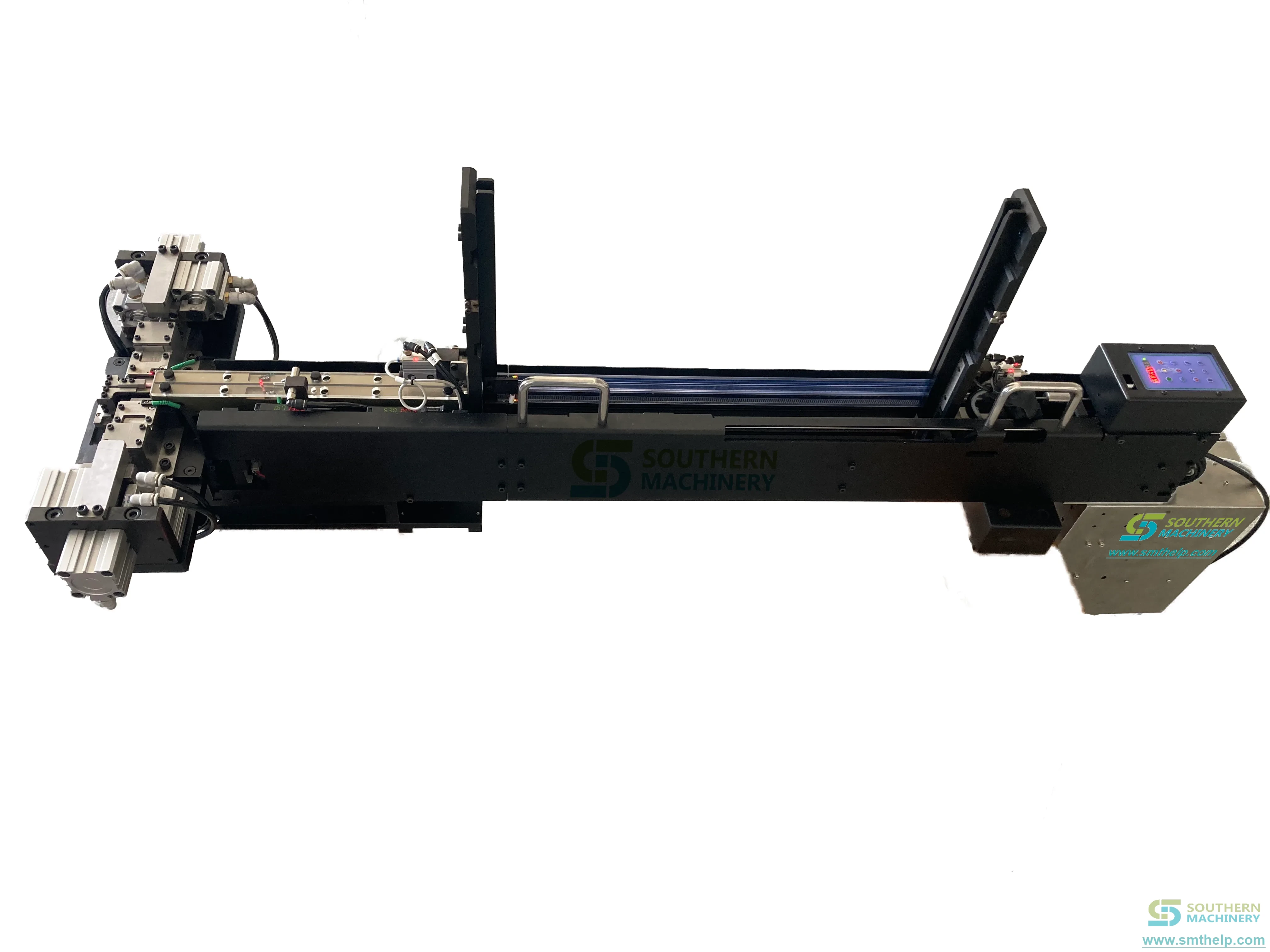
Direct answer. The STF1003 is a stacked tube feeder for SMT mounters and non-standard equipment. It takes tube-mounted — "stick" — components such as relays, terminals, transformers and capacitors and presents each part at a pick position the placement head can reach. The magazine holds several full tubes, so the machine keeps running while an operator tops the stack up.
Why tube-mounted components become a labour problem
The stick is packaging you already paid for. Relays, transformers and heavy terminals arrive in stick tubes because the tube protects the leads. That packaging is bought. What is not free is the person who stands at the machine shaking parts out of it, one stick at a time.
The labour is the cost, not the tube. Tube-mounted odd-form parts are usually placed by hand, or with a stick feeder an operator keeps reloading. Every stick that runs out is a machine stop, paid at the line rate.
A stacked magazine keeps the machine fed. The magazine holds several tubes. The operation manual documents a tube-change groove sensor, upper and lower tube sensors, and two air cylinders that seat the next tube and clear the empty one into a recovery box.
One feeder across several part families. The product sheet covers relays, terminals, transformers and capacitors from 3 x 3 x 3 mm to 25 x 25 x 25 mm, so a changeover is a tube and a track adjustment, not a second feeder.
How does a stacked tube feeder work?
The mechanism is a stack, a spring and a track: a cylinder releases one tube from the magazine, a second cylinder seats it against the track, and a motor-driven spring pushes the leading component out of the tube and along the track until a fibre sensor says it has arrived.
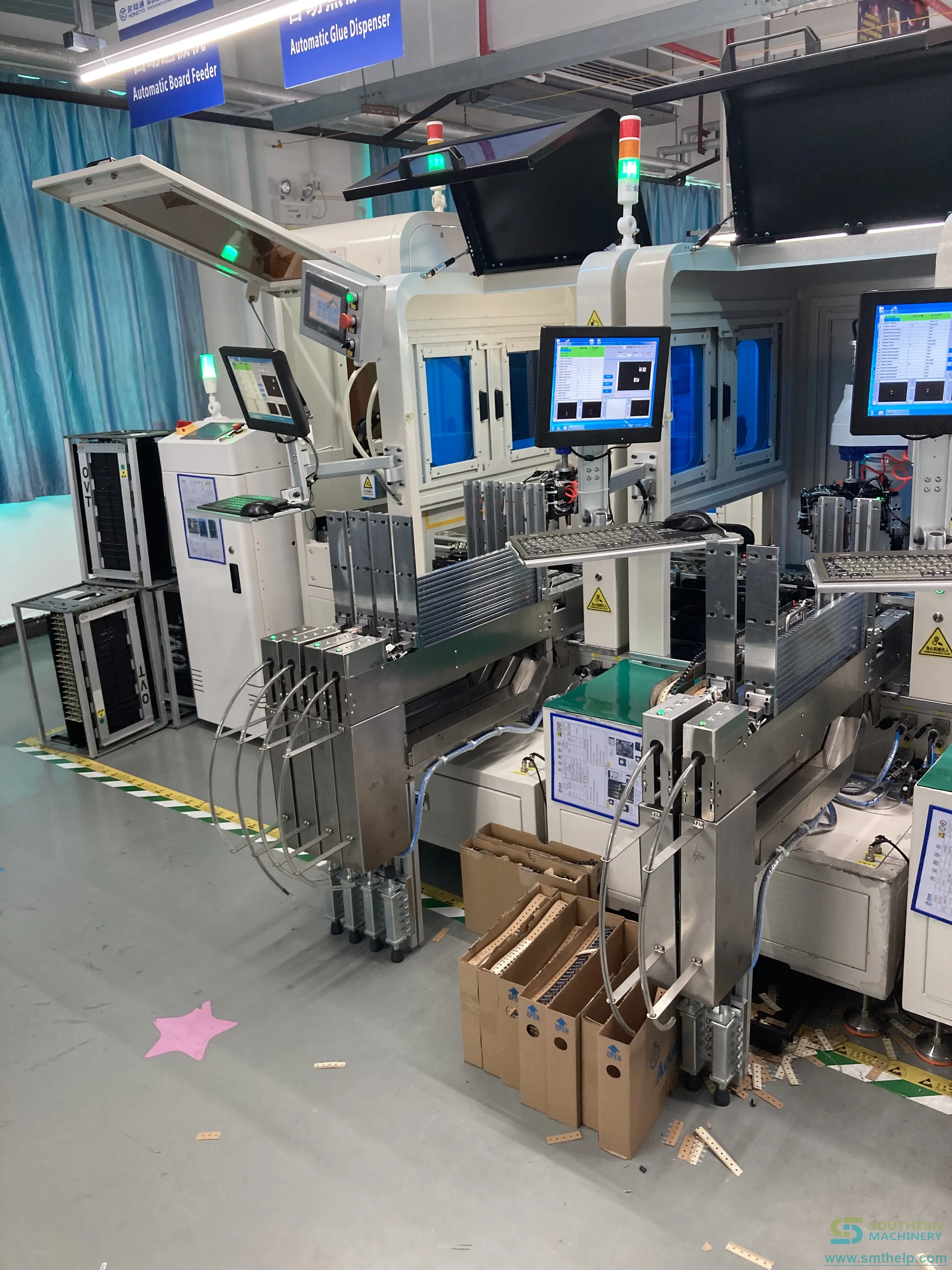
The feeding sequence, step by step
Load the stack — full tubes go into the magazine; orientation is set by the tube.
Release and seat a tube — a lower air cylinder drops one tube into the feed position and managed cylinders clamp it against the track.
Spring push and track transfer — the spring pushes the leading component out of the open end and along the track, positioned by optical fibre sensing plus software compensation.
Present at the pick point — the feeder holds the component at the front of the track and asserts component-in-position on pin 4.
Clear the empty tube — the tube is released and a cylinder swings clear so it drops into the recovery box.
Which components and tubes can the STF1003 handle?
Documented specification
Component families — relays, terminals, transformers, square capacitors and round capacitors (product sheet).
Component envelope — 3 x 3 x 3 mm to 25 x 25 x 25 mm.
Tube geometry — PVC or aluminium, wall 0.6 mm or more; length 200 to 650 mm on the product sheet and 300 to 600 mm in the manual; cross-section 6 x 10 mm to 30 x 30 mm.
Positioning and accuracy — optical fibre sensing with software compensation rather than a mechanical hard stop; published accuracy plus or minus 0.5 mm.
Published feeding speed — 0.8 s per component, single channel; dual-channel feeding is a listed customization for lines running two tube part numbers.
Drive and power — 57-type stepping motor, 600 rpm maximum, four-gear adjustable speed; DC 24 V at 4 A average and 6 A peak.
Air — product sheet 0.4 to 0.6 MPa; the manual asks for more than 0.6 MPa.
Host interface — 8-core 16 mm aviation plug with component-in-position on pin 4, or self-control with no communication at all.
Footprint and weight — 1350 x 92 x 115 mm, 25 kg, so it occupies a feeder slot rather than floor space.
Test record — 1000 consecutive feeds without abnormality, then 48 hours of continuous ageing; the spring is rated at 4 million bending cycles.
Will it fit your existing line?
The product sheet lists installations on Panasonic CM602, JUKI, YAMAHA and Mirae odd-form machines, in each case running alongside bowl feeders and radial tape feeders on the same platform, and states the feeder automates tube-mounted components for SMT machines, non-standard equipment and robotic arm integration.
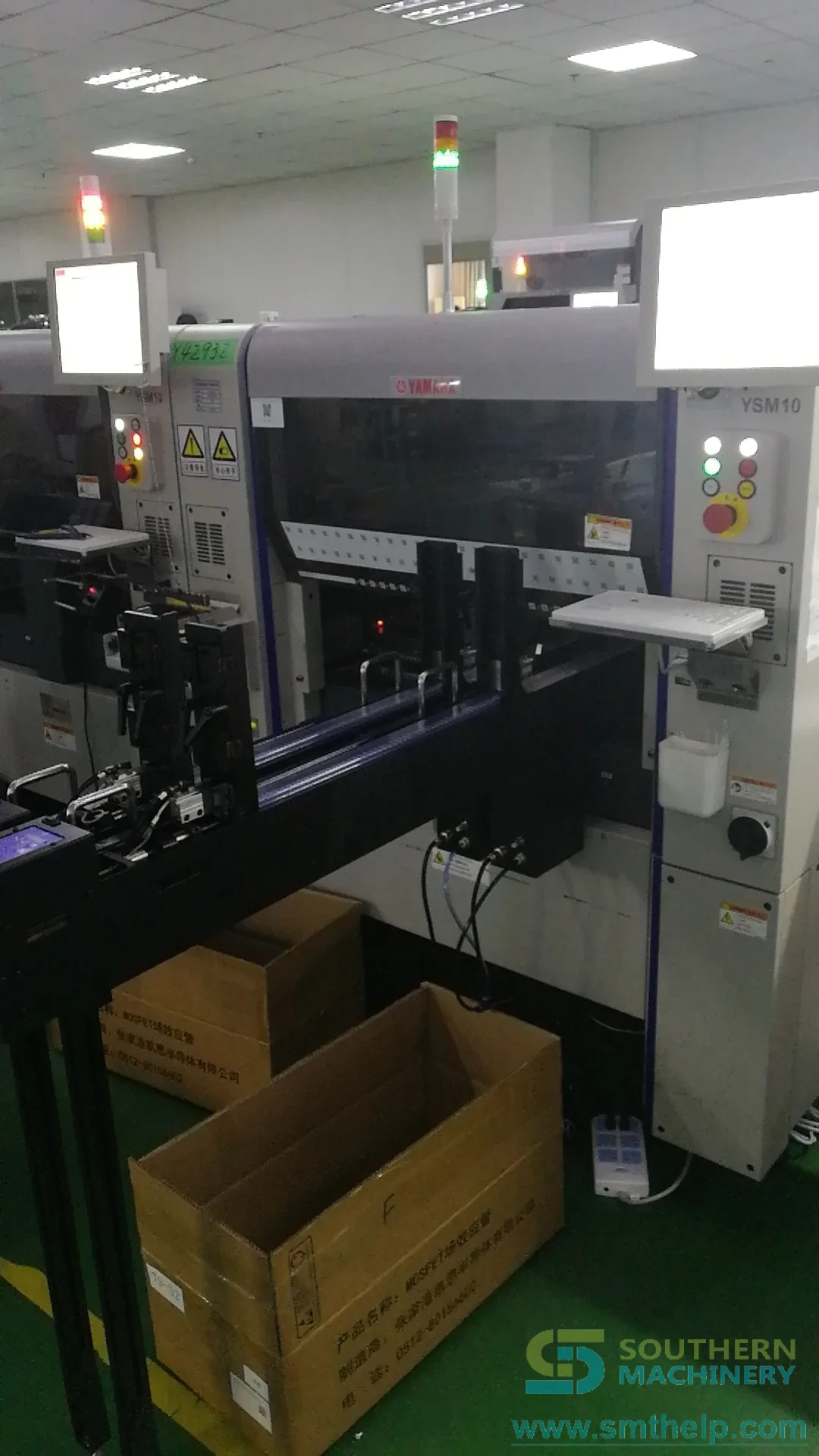
Mounting is by positioning key plus pressing block, with other fixing structures supported.
Compare it with the THT machine range, the feeder range and a complete PCB DIP assembly line; the one-stop PCB assembly solutions for EMS page covers the stages around it.
How many components per hour can it feed?
Single channel, so the upper bound is the published 0.8 s feeding speed.
Derived throughput at three availability levels
0.8 s per component — 4,500/h theoretical, 4,050 at 90 percent availability, 3,600 at 80 percent.
1.0 s per component — 3,600 / 3,240 / 2,880.
1.2 s per component — 3,000 / 2,700 / 2,400.
Derived arithmetic, not a measured production figure, and it counts components rather than finished boards.
What does tube feeding cost per board?
Work it from your own numbers, not a supplier's.
The handling-time formula
Handling seconds released per board = (tube-fed components per board x manual seconds per component) - (tube-fed components per board x 0.8 s).
Example inputs, marked illustrative, depending on configuration, and subject to final technical confirmation: 12 tube-fed components per board, 20 seconds manual handling per component, 300 boards per day, 26 days a month, one operator released at USD 700 per operator-month.
Machine feeder time — 12 x 0.8 s = 9.6 s per board.
Manual handling time — 12 x 20 s = 240 s per board.
Handling released — 230.4 s per board, about 7,800 boards and 499 handling hours a month.
Labour released — about USD 8,400 a year from the operator released.
Payback — machine investment divided by annual released labour; enter your own price, because this page does not quote one.
The model counts handling only, ignores tube and packaging cost, yield and utilisation, and assumes the magazine keeps the feeder loaded; releasing an hour is not the same as removing a cost.
Two parameters to confirm before you order
Working air pressure — the sheet gives 0.4 to 0.6 MPa; the manual asks for more than 0.6 MPa and states that below 0.6 MPa the component will not reach the correct position.
Tube length accepted — the sheet gives 200 to 650 mm; the manual gives 300 to 600 mm. A 250 mm or 640 mm stick is inside one range and outside the other.
Both are marked to be confirmed in the source — contact Southern Machinery to confirm them against your tube and drawing. Five other sheet-versus-manual differences come from the STF-1002 and SSTF01 being different machines; do not order against STF-1002's 1460 x 80 x 1148 mm footprint.
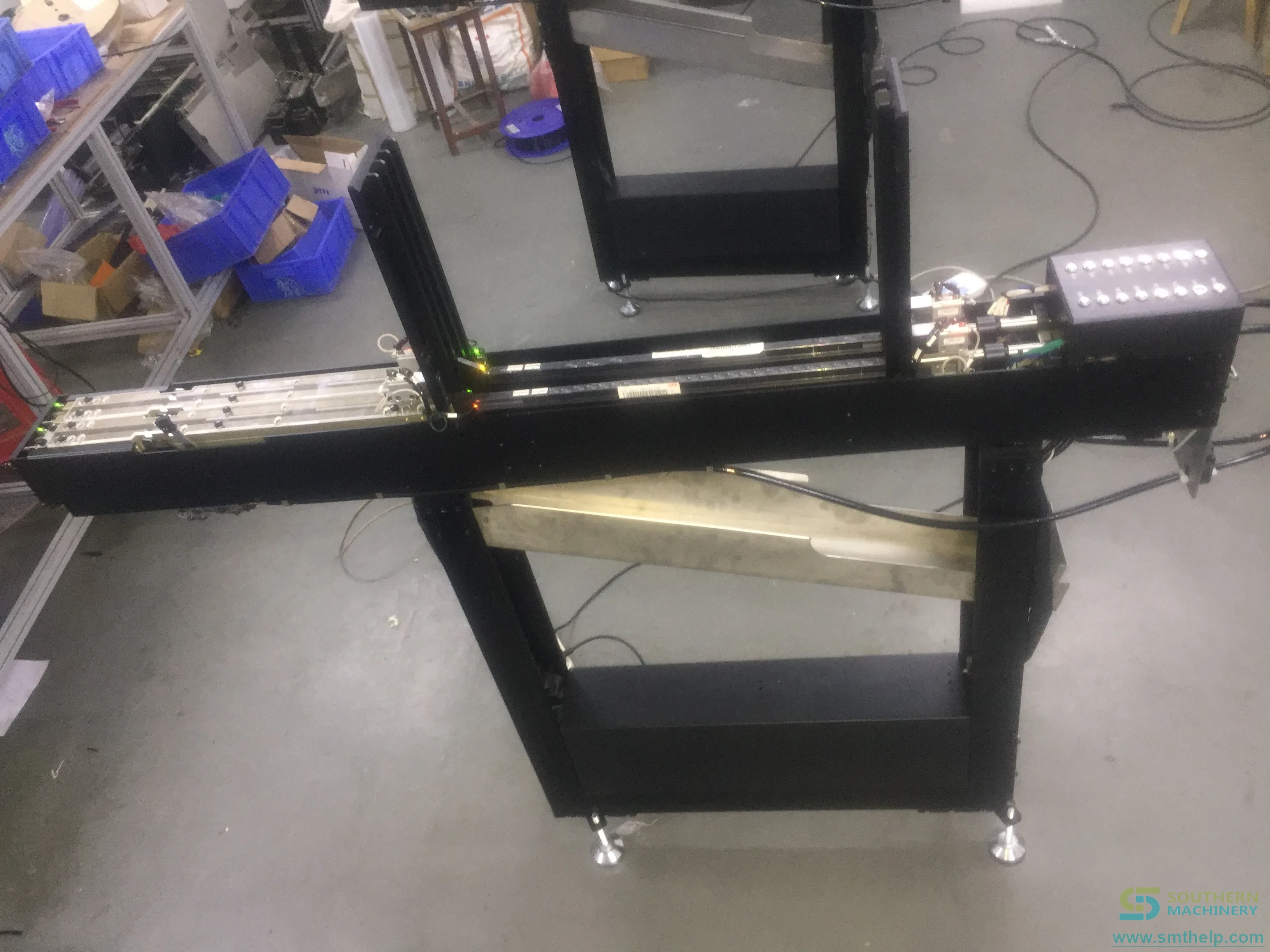
Commissioning, then keeping it running
Commissioning order
The manual describes commissioning as mount, air, power, load, adjust, prove. Bring air on at the higher figure until the drawing settles the open point. Power on at DC 24 V, connecting 24 V before the air supply and never shorting 24 V to 0 V. Load the stack and press start until the running light is green — never let the spring push air, or it will bend.
Then tune in order: fibre amplifier thresholds, cylinder positions, baffle width, tube-presence sensors. Prove it with the published acceptance run of 1000 consecutive feeds plus a 48-hour ageing run, repeated on your own component.
Daily sensor checks
The manual's fault chapter reads as a maintenance schedule: clean the fibre heads with alcohol, check the amplifier indicators, confirm the tube sensors respond at a known-empty and known-full position, and check the spring origin and limit switches.
FAQ
Which components can the STF1003 feed? The product sheet lists relays, terminals, transformers, square capacitors and round capacitors from 3 x 3 x 3 mm to 25 x 25 x 25 mm, and states it automates tube-mounted parts for SMT machines, non-standard equipment and robotic arm integration.
Which tube sizes does it accept? 200 to 650 mm with a wall of 0.6 mm or more in PVC or aluminium on the sheet; the manual narrows it to 300 to 600 mm and 6 x 10 mm to 30 x 30 mm. That difference is a listed, unconfirmed open point.
Will it fit my machine, and how fast is it? The sheet lists Panasonic CM602, JUKI, YAMAHA and Mirae odd-form machines; it connects through an 8-core 16 mm aviation plug or runs with no communication at all. Published speed is 0.8 s per component at plus or minus 0.5 mm.
How does tube changeover work? A lower air cylinder drops one tube into the feed position, an upper cylinder seats it, and after the tube empties a cylinder swings clear so it falls into the recovery box; a tube-change groove switch plus upper and lower tube sensors detect the swap.
Send the stick, not just the enquiry
The fastest answer is a sample stick and a photograph of the component. Send the part, the tube, the board and the monthly volume, and Southern Machinery will confirm whether it can be fed from a stack.
Shenzhen Southern Machinery has designed and manufactured SMT and THT equipment since 2011, covering odd-form insertion machines, feeders, board handling and turnkey lines. Request a component trial, or start from the machine catalogue and the SMT machine range.
Comments