
SRT7001 Closed-Loop Reel Terminal Feeder for SMT and Robotic Assembly by Southern Machinery
The SRT7001 Reel Terminal Feeder helps EMS factories automate reel-fed terminals and stamped odd-form parts that often slow down mixed SMT/THT assembly. Based on Southern Machinery source material, this guide explains ho
Jul 5, 2026 · Updated Jul 5, 2026 · Southern Machinery
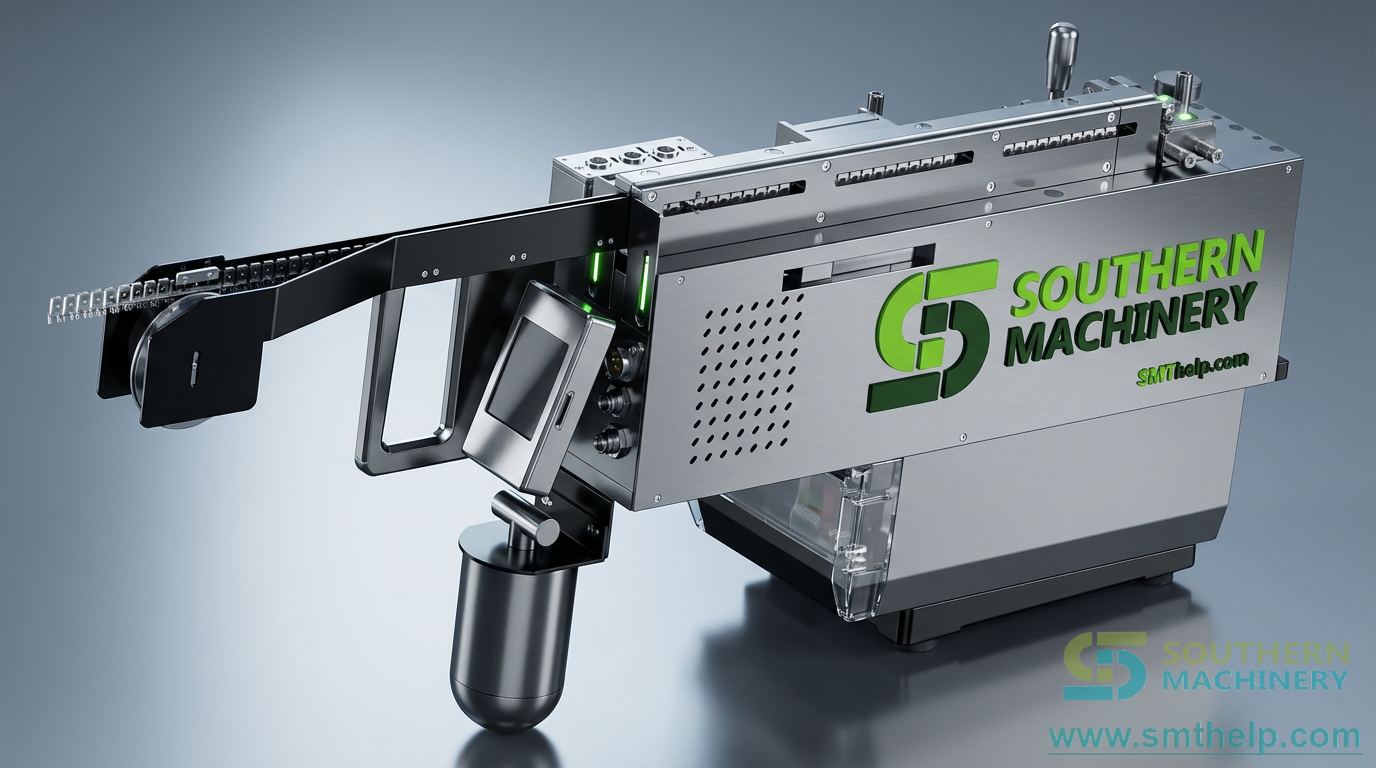
SRT7001 Closed-Loop Reel Terminal Feeder for SMT and Robotic Assembly by Southern Machinery
Reel-fed terminals and stamped odd-form parts often create a practical gap between fast SMT placement and slower manual or semi-manual THT assembly. The SRT7001 Reel Terminal Feeder is designed to help close that gap by presenting continuous strip terminals in a controlled, repeatable way for SMT mounters or robotic insertion cells.
Southern Machinery, founded in Shenzhen in 2011, builds cost-effective SMT and THT PCB assembly automation equipment for EMS factories worldwide. The SRT7001 fits into that wider line approach: feeder, placement or robotic handling, insertion, soldering, board handling, inspection, training, spare parts, and long-term support.
What is this machine used for?
The SRT7001 Reel Terminal Feeder is used to feed continuous strip terminals, FASTON-style terminals, stamped metal contacts, and similar reel-packaged odd-form components into an SMT placement machine or a robotic cell.
Instead of relying on manual pre-sorting or unstable pneumatic feeding, the feeder indexes the terminal strip, presents one part at the pickup position, and supports automated pickup by a nozzle, gripper, SCARA robot, or 6-axis robot, depending on the final line design.
The problem it solves in mixed SMT/THT production
Standard SMT chip shooters are excellent for resistors, capacitors, ICs, and other taped SMD components. The bottleneck appears when a board also needs larger connectors, terminals, clips, or odd-form through-hole parts.
Many factories handle these parts manually because conventional feeding is difficult. That creates several issues:
- Uneven takt time between SMT and THT processes.
- Higher missed-pick or wrong-part risk when operators handle small metal terminals by hand.
- More line stops when reel tension, waste paper, or strip pitch is not controlled.
- Extra engineering cost when each part requires a separate custom bowl feeder.
The SRT7001 is positioned as a more flexible feeder platform for this category of parts. According to the source document, its design uses electro-mechanical indexing, pilot-hole engagement, and controlled waste handling to improve repeatability compared with simpler pneumatic or friction-fed methods.
Key engineering ideas from the SRT7001 source document
Closed-loop stepper drive
The source document describes the SRT7001 as replacing pneumatic actuation with closed-loop stepper motor control. In practical terms, this means the feeder is intended to index the strip by controlled motion instead of a purely air-driven action.
For a manufacturing engineer, the value is not just speed. The value is better process control: the feeder can be configured to monitor feed readiness and reduce the chance of a robot or mounter moving before the part is correctly presented.
Pilot-hole indexing for terminal strips
The document highlights a sprocket-style drive interface that engages the pilot holes of the terminal strip. This is important because stamped terminals can be heavier and less forgiving than standard SMT tape parts.
Where friction feeding can slip, pilot-hole indexing gives a more positive mechanical reference. Final tolerance and repeatability must still be confirmed against the actual terminal drawing, strip pitch, material thickness, and pickup method.
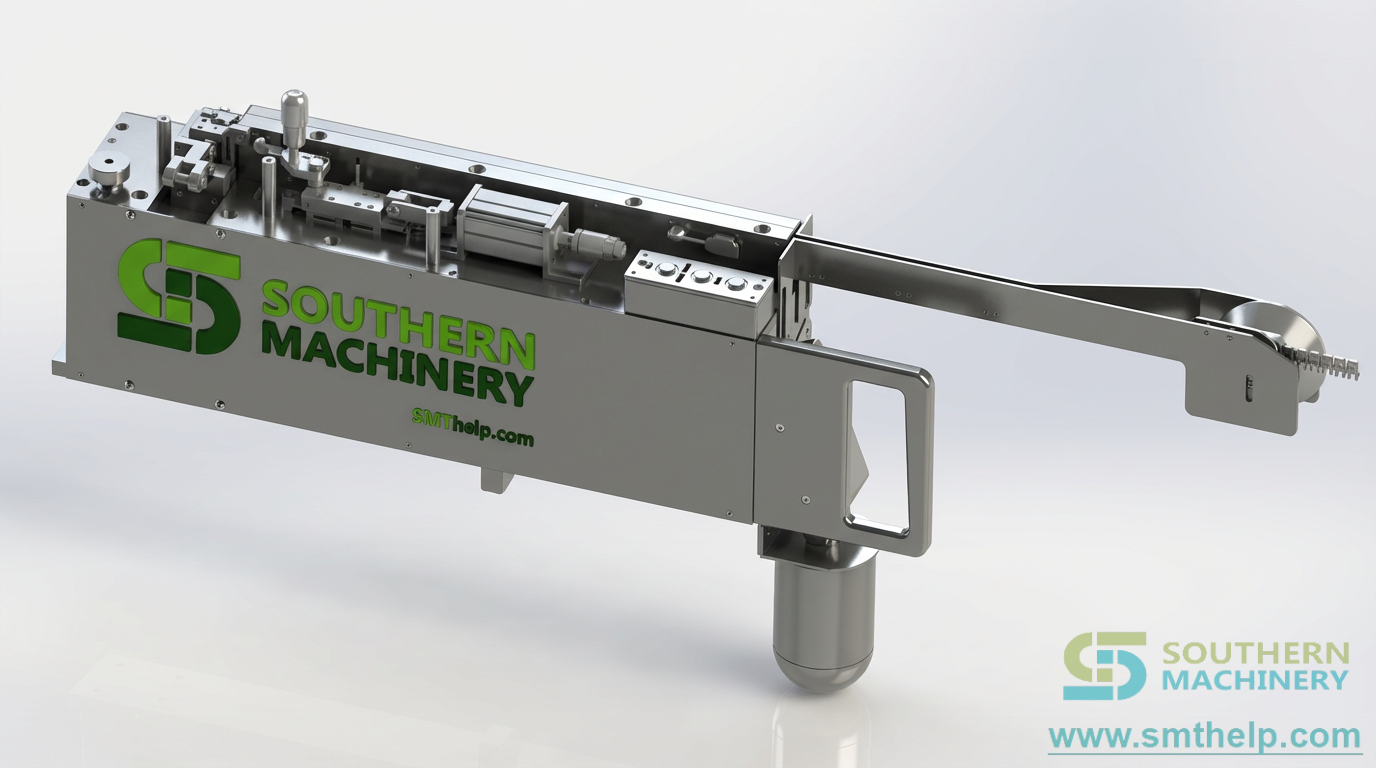
High-clearance pickup area
The source describes a pickup window designed for access by standard SMT nozzles or larger robot grippers. This matters because the feeder is not only for one machine style. It may be adapted for SMT placement platforms, offline automation cells, or custom robotic insertion stations.
For example, one factory may use the feeder on a Panasonic, Yamaha, or Juki style SMT process, while another may use a SCARA robot to pick and insert terminals into a power board. The exact mechanical interface must be confirmed during project engineering.
Motorized paper and waste management
Terminal reels may include interleaf paper or waste strip. If that material is not controlled, it can create jams, loose scraps, and maintenance problems near solder paste or automated handling equipment.
The SRT7001 source document describes active paper and waste management through a dedicated motorized spool. This supports a cleaner feeding area and reduces operator intervention, subject to final confirmation with the customer sample reel.
How it connects into a complete PCB assembly line
The SRT7001 is most useful when it is treated as part of a full assembly process, not as an isolated accessory.
A typical Southern Machinery line concept can look like this:
- SMT loading and board handling: magazine loader, conveyor, barcode scan if needed.
- Solder paste printing: automatic stencil printer, with SPI when quality requirements justify it.
- SMT placement: chip placement and multifunction placement for SMD parts.
- Reflow soldering: configured by board size, thermal mass, and lead-free profile needs.
- Terminal or odd-form feeding: SRT7001 presents reel-fed terminals to an SMT mounter or robot cell.
- THT insertion or robotic handling: terminal pickup, insertion, or transfer into the next process.
- Wave or selective soldering: selected based on board design, thermal mass, and soldering accessibility.
- Inspection and test: AOI, visual inspection, ICT/FCT, and traceability as required.
For high-mix factories, the main advantage is flexibility. One feeder concept can support multiple terminal SKUs if the strip format, pitch range, pickup geometry, and interface are engineered correctly.
Selection checklist for buyers and process engineers
Before Southern Machinery finalizes the SRT7001 configuration, the engineering team should confirm these points:
- Terminal type: FASTON terminal, stamped contact, clip, connector pin, or another reel-fed metal part.
- Packaging format: reel diameter, carrier strip width, pilot-hole design, interleaf paper, and waste strip format.
- Pitch requirements: the source document mentions digital pitch adjustment from 4 mm to 32 mm, but the final range must be confirmed against the part sample and feeder configuration.
- Pickup method: SMT nozzle, custom gripper, SCARA robot, 6-axis robot, or dedicated insertion head.
- Machine interface: SMT feeder slot, trolley, 24V I/O handshaking, PLC control, or custom automation interface.
- Process target: feeding only, feeding plus robotic insertion, or full line integration with board handling and soldering.
- Quality requirement: whether secondary vision, presence sensing, barcode traceability, or MES data connection is required.
- Changeover needs: number of terminal types, daily product mix, and expected operator skill level.

ROI, quality, and capacity value
The business case for the SRT7001 usually comes from labor reduction, more stable feeding, and fewer interruptions around odd-form parts.
In a manual process, operators may pick terminals from trays or loose containers, orient them, place them into the board, and then move the board to wave or selective soldering. That can work for low volume. But once the same terminal appears across many boards or shifts, the manual step becomes a bottleneck.
A configured reel terminal feeder can help by:
- Reducing repetitive manual feeding and orientation work.
- Making odd-form terminal presentation more consistent.
- Supporting robotic pickup with a defined ready-to-pick signal.
- Improving line balance between SMT, THT insertion, and soldering.
- Reducing dependence on one-off bowl feeder projects for every terminal shape.
Any ROI estimate should be calculated from the customer’s real labor cost, monthly volume, terminal count per board, current defect/rework level, and required automation scope. Southern Machinery can support this calculation after reviewing samples and production targets.
Where this feeder fits best
The SRT7001 is a strong fit for factories assembling:
- Power supplies and LED drivers with reel-fed terminals.
- Automotive electronics with metal contacts or clips.
- Industrial control boards with terminal hardware.
- Home appliance PCBA with high-volume connector or terminal insertion.
- EMS lines that need one automation platform for multiple odd-form terminal projects.
It is less likely to be the first choice for very low-volume prototype work where manual insertion is still acceptable, or for parts with packaging that cannot be stabilized in reel or strip format without custom tooling.
Why work with Southern Machinery
Southern Machinery focuses on complete SMT and THT PCB assembly automation, not only single machines. Since 2011, the Shenzhen-based team has served 237+ global customers with equipment and support covering SMT lines, THT insertion, wave soldering, selective soldering, board handling, inspection, feeders, nozzles, grippers, and custom automation.
For a reel terminal feeding project, that matters. The feeder must match the component, the placement method, the PCB, the soldering process, and the production target. Southern Machinery can help review the terminal sample, propose the feeder and gripper/nozzle approach, and integrate the solution into a practical line plan.
FAQ
Can the SRT7001 be used with both SMT machines and robots?
Yes, that is the intended positioning in the source document. It can be engineered for SMT mounter integration or robotic cells, depending on mechanical fit, signal interface, pickup method, and customer process requirements.
Does it replace a vibratory bowl feeder?
For reel-packaged terminals, it may be a more compact and controlled alternative. But if the component is supplied loose in bulk and cannot be converted to tape or reel format, a bowl feeder or another custom feeding method may still be needed.
Can one feeder support different terminal pitches?
The source document mentions digital pitch adjustment from 4 mm to 32 mm. Treat this as a source example and confirm the final working range with Southern Machinery using your actual terminal drawing and sample reel.
Do I still need vision inspection?
It depends on the terminal geometry, insertion tolerance, board value, and quality target. A controlled feeder may reduce the need for complex compensation, but critical automotive, medical, or high-value boards may still require vision or presence verification.
What information should I send for a quotation?
Send terminal drawings, reel photos, strip pitch, PCB photos, target output per shift, current insertion method, required machine interface, and whether you need a feeder only or a full line including insertion, soldering, and board handling.
Can Southern Machinery provide the full line, not just the feeder?
Yes. Southern Machinery can configure SMT, THT insertion, wave or selective soldering, board handling, inspection, and traceability around the feeding requirement, with global service, spare parts support, and professional training.
Next step
If reel-fed terminals are slowing your SMT or THT process, send Southern Machinery the terminal drawing, sample reel photos, PCB size, target output, and current production method. The engineering team can match the closest feeder configuration, confirm whether a nozzle or gripper is needed, and suggest how to connect the SRT7001 into your PCB assembly line.
Comments