
SRF1001 Radial Tape Feeder for THT Automation by Southern Machinery
The SRF1001 Radial Tape Feeder helps EMS and PCB assembly teams reduce manual through-hole insertion work by feeding radial taped components into compatible SMT platforms or automated insertion workflows. For factories handling LEDs, MOVs, electrolytic capacitors, and other radial parts, it supports a more stable, lower-labor process than purely manual insertion. The article explains line integration, buyer selection points, ROI assumptions, and how Southern Machinery can support complete SMT/THT automation with board handling, soldering, service, and spare parts for global factories.
Jul 2, 2026 · Updated Jul 2, 2026 · Southern Machinery
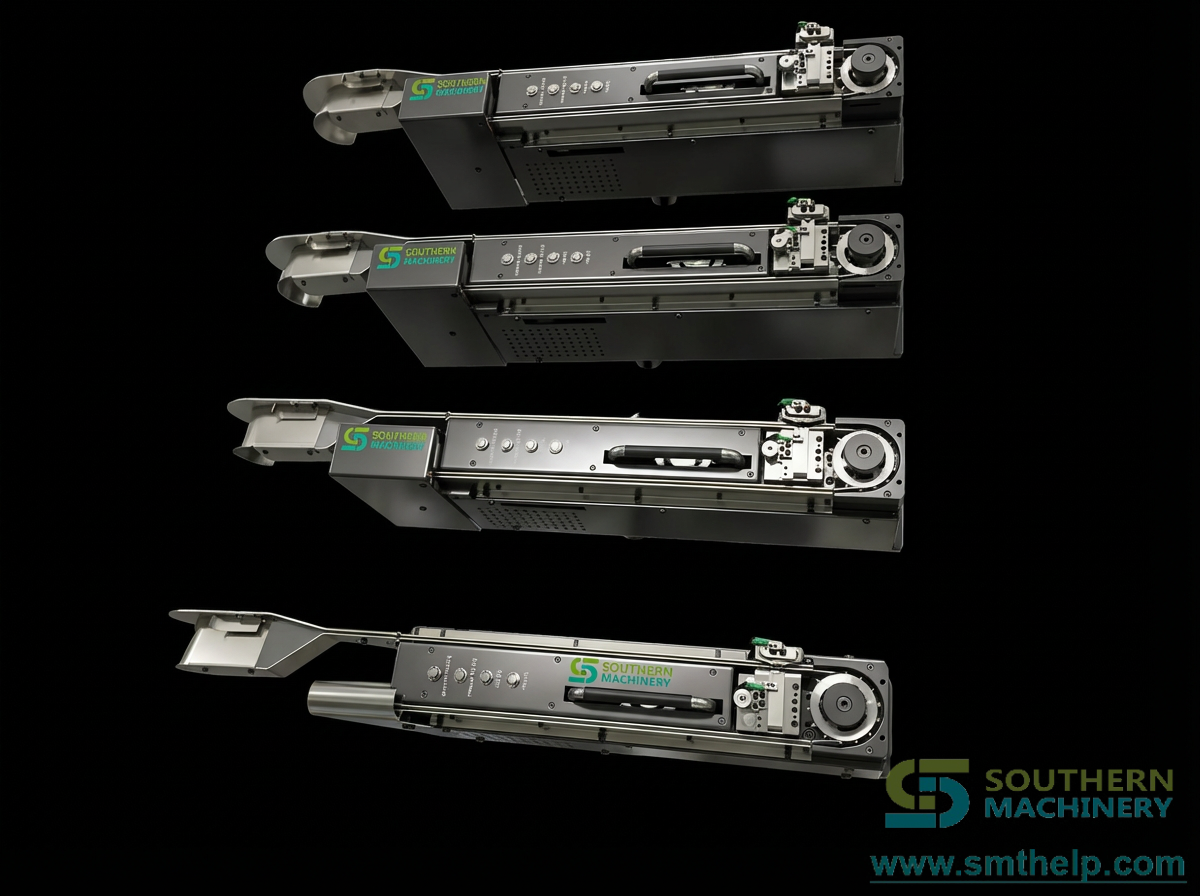
SRF1001 Radial Tape Feeder for THT Automation by Southern Machinery
Manual radial component insertion is still one of the most painful labor points in many EMS factories. Operators can place parts carefully, but output is limited by fatigue, training quality, and the number of people available on each shift.
The SRF1001 Radial Tape Feeder by Southern Machinery is designed to help factories automate radial taped component feeding for THT and mixed SMT/THT assembly. In practical terms, it gives production engineers a path to move repetitive radial insertion work away from manual benches and into a more controlled automated process.
Southern Machinery was founded in Shenzhen, China in 2011 and serves 237+ global customers with SMT/THT PCB assembly automation equipment. Our team focuses on complete line solutions, including SMT lines, THT insertion, wave soldering, board handling, inspection, global service, spare parts support, and professional training.
Radial taped feeder modules found through Southern Machinery's ph.smthelp.com image gallery search for radial inserter / radial feeder keywords.
What is this machine used for?
The SRF1001 Radial Tape Feeder is used to feed radial taped through-hole components into an automated PCB assembly process, helping reduce manual insertion labor and improve repeatability.
Typical target components include radial components such as:
- Electrolytic capacitors
- MOVs
- LEDs
- Similar radial taped parts that require stable feeding, lead cutting, or forming before insertion
For buyers, the main value is not only "faster feeding." The real value is building a more controlled THT process: fewer manual touch points, more repeatable component presentation, easier integration with existing production flow, and better scalability when order volume grows.
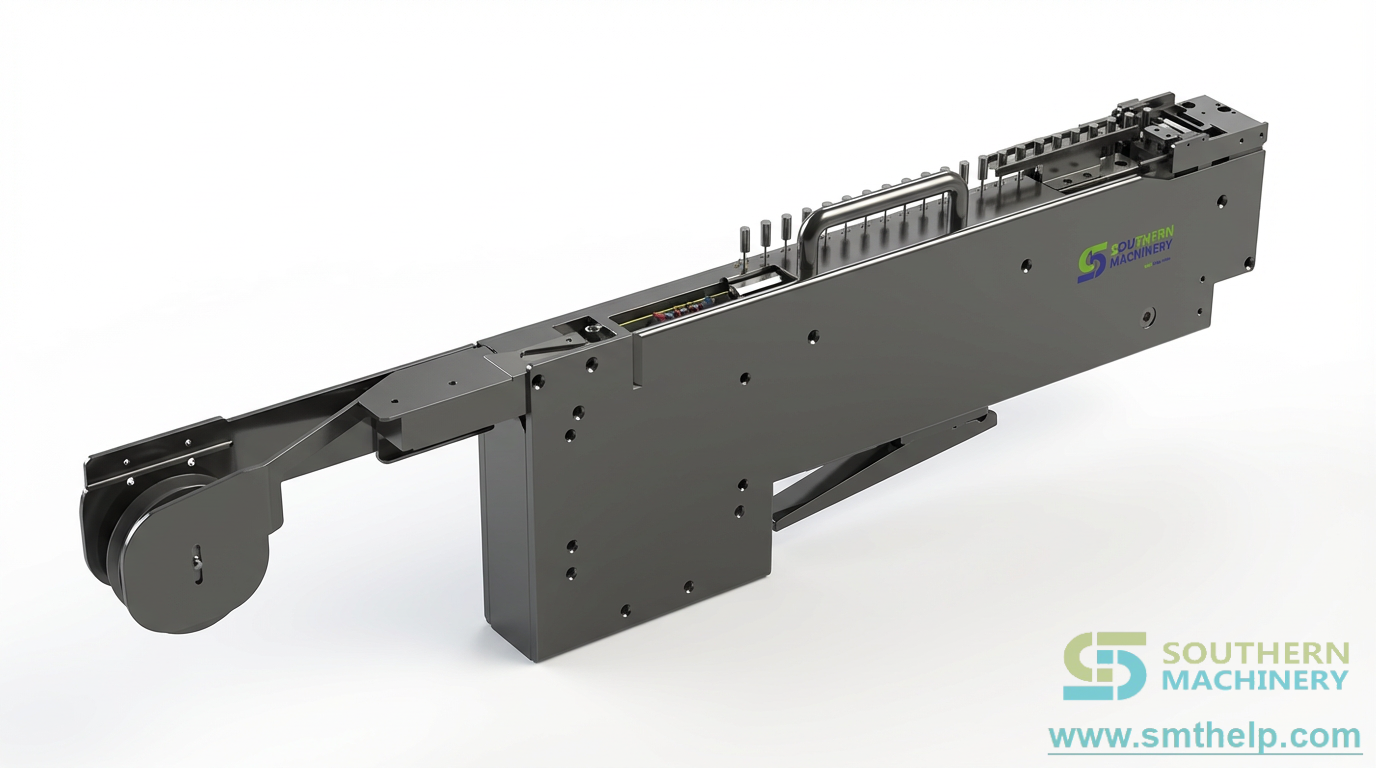
Single radial taped feeder module for controlled feeding, cutting, and component presentation.
Why EMS factories look at radial feeder automation
Manual insertion can work for low volume or high variation products. But when the same radial components appear on hundreds or thousands of boards per day, manual work becomes expensive and unstable.
The source material for this product frames the problem clearly: manual insertion carries human error risk, rework cost, and quality variation from operator fatigue. The SRF1001 concept is built around reducing that dependency by feeding components through a controlled automated mechanism.
For a factory producing power supplies, LED drivers, industrial control boards, or mixed-technology assemblies, this can be especially useful when radial components are repeated across many SKUs.
How the SRF1001 fits into a PCB assembly line
The SRF1001 should be considered as part of a full SMT/THT workflow, not as an isolated accessory.
Example line position
- SMT section: loader, printer, pick-and-place, reflow oven, AOI if required.
- THT preparation: radial components supplied by the SRF1001 feeder.
- Insertion process: automated or semi-automated insertion depending on the host machine and fixture design.
- Soldering: wave soldering or selective soldering, depending on product design and mix.
- Inspection and test: visual inspection, AOI, ICT, FCT, or traceability as needed.
Southern Machinery can support the surrounding equipment as well, including board handling conveyors, buffers, wave soldering machines, inspection options, and line integration support. That matters because a feeder only creates full value when the upstream and downstream process can keep pace.
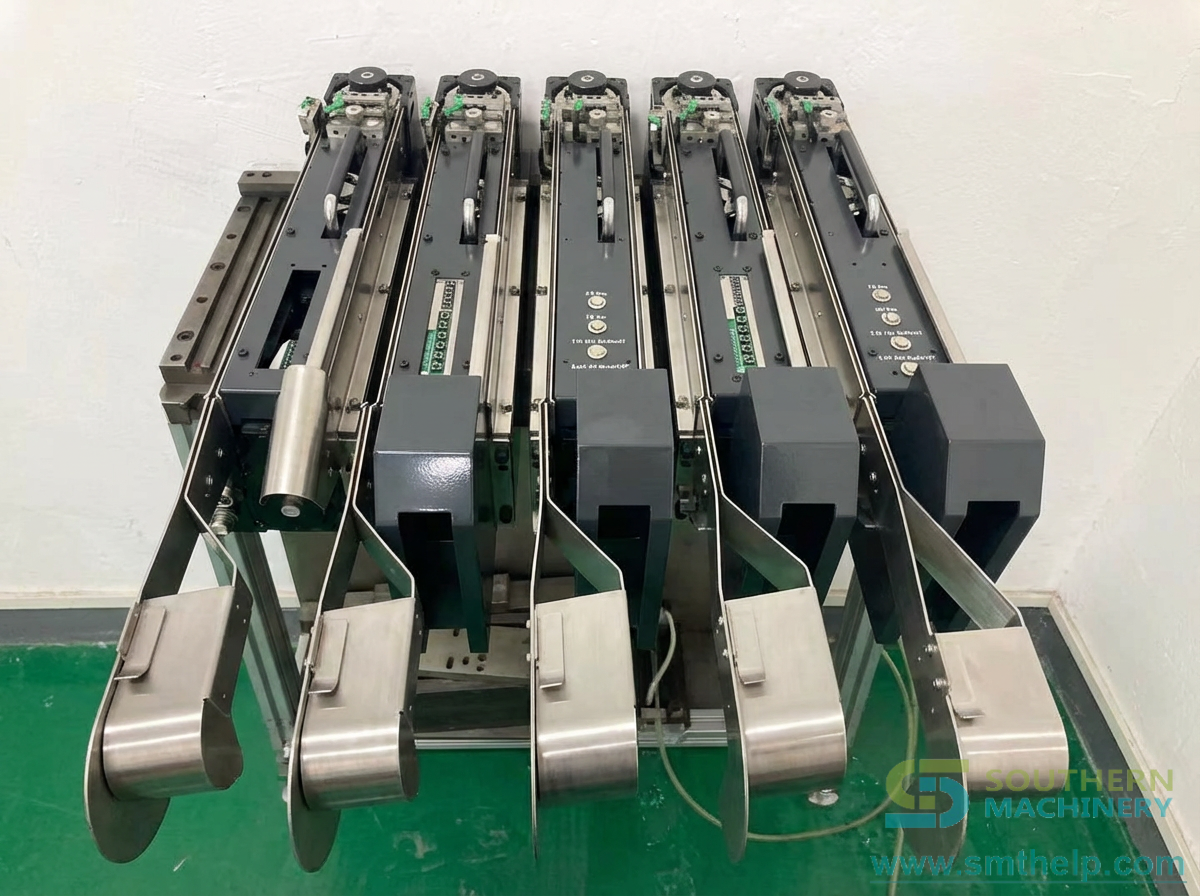
Multiple radial taped feeder modules can be configured according to component mix and production requirements.
Key buying parameters to confirm
The SRF1001 source material highlights several selection points that buyers should verify before final configuration.
Component and tape details
- Radial component type, such as capacitor, MOV, LED, or similar part.
- Tape packaging format and pitch.
- Lead diameter, lead span, and required cut length.
- Whether the component needs lead cutting, bending, or forming.
Host machine and integration
- Which SMT platform or insertion machine the feeder will connect to.
- Mechanical mounting space and feeder interface.
- Standard I/O communication requirements.
- Whether a customized mount or tooling is required.
The source material specifically mentions compatibility with JUKI applications through standard I/O communication and customizable mechanical mounts. Final compatibility should still be confirmed with your machine model, feeder interface, and component sample.
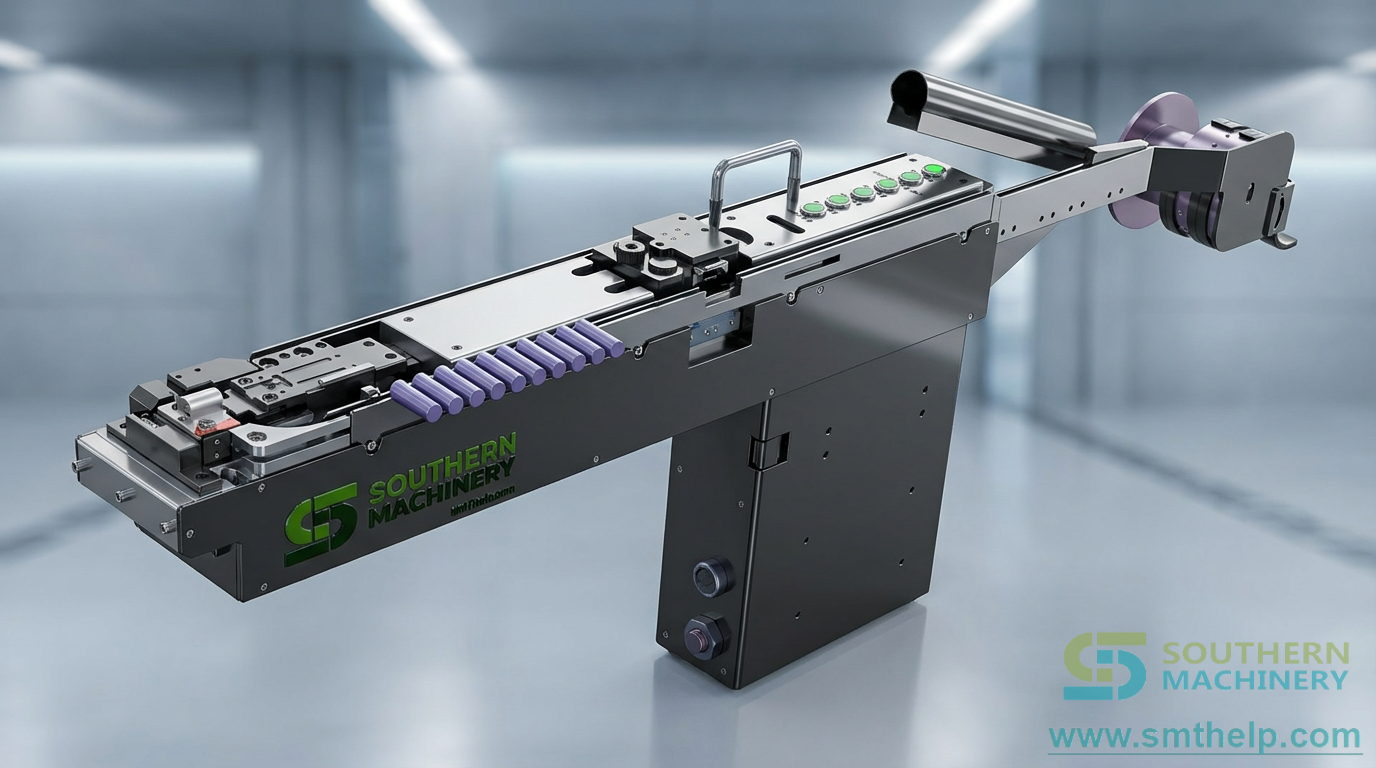
Radial taped feeder detail view showing component presentation and feeder mechanism layout.
Process and quality requirements
- Target daily board output.
- Number of radial components per PCB.
- Required insertion repeatability and quality target.
- Whether the line needs traceability, barcode scanning, or MES connection.
- Spare parts and cutter maintenance expectations.
The source material also mentions a Mitsubishi PLC and ARM control concept, a hardened steel cutter, and a cutter life reference of about 5,000,000 operations. These points should be confirmed against the final selected configuration and sample testing plan.
ROI and capacity value
The business case for radial feeder automation usually comes from three areas:
- Labor reduction: fewer operators are needed for repetitive radial insertion work.
- Quality stability: automated feeding reduces variation caused by manual fatigue.
- Scalability: output can grow without hiring the same number of additional insertion operators.
In the original ROI calculator concept, the example assumptions were:
- Monthly labor cost per worker: USD 3,000
- Daily THT board output: 400 boards
- Radial components per board: 8
- Manual insertion reference: 500 components per hour per person
- Machine feeding reference: 5,000 components per hour
- Working days per month: 22
These numbers should be treated as an example model, not a guaranteed result. Your real payback depends on local labor cost, board design, component type, host machine speed, changeover frequency, and soldering capacity.
As a practical rule, if one product family repeatedly uses the same radial taped components, automation becomes much easier to justify. If every batch uses different components, manual or semi-automatic insertion may still be more flexible.
Manual insertion vs. used equipment vs. SRF1001 automation
Many factories compare three paths:
Manual insertion
Manual work is flexible and low cost at the beginning, but it becomes harder to control as volume rises. It also creates hidden cost: training, checking, rework, fatigue, and production planning pressure.
Used legacy insertion equipment
Used equipment can look attractive because the purchase price is lower than a full new line. The risk is spare parts, downtime, floor space, and difficulty adapting to new components or product changes.
SRF1001 feeder-based automation
The SRF1001 approach is more modular. It is intended to help an existing automated workflow handle radial taped components with less manual dependence. For many EMS buyers, that makes it a practical middle path between pure manual insertion and a much larger dedicated insertion investment.
Typical applications
The SRF1001 is best suited for manufacturers that assemble PCBs with repeated radial taped components.
Common use cases include:
- LED driver production
- Power supply assembly
- Industrial control boards
- Consumer electronics with radial THT parts
- EMS lines handling mixed SMT and THT products
For automotive electronics, medical electronics, or other high-reliability applications, the main question is not only feeder speed. Buyers should confirm repeatability, inspection strategy, soldering profile, traceability, and validation requirements before finalizing the line design.
Why choose Southern Machinery
Southern Machinery is a Shenzhen-based manufacturer founded in 2011. We focus on high-efficiency, cost-effective SMT/THT PCB assembly automation equipment for global EMS and electronics manufacturing customers.
Our advantage is full-line thinking. Instead of only supplying one machine, we can help match the feeder with:
- SMT lines
- THT insertion solutions
- Wave soldering or selective soldering
- Board handling conveyors and buffers
- Inspection and traceability options
- Operator training, spare parts, and remote service support
For buyers, this reduces integration risk. A feeder, insertion process, soldering machine, and board handling system must work together. Southern Machinery can help review your PCB, components, output target, and current equipment before recommending the final configuration.
FAQ
Is the SRF1001 only for one brand of SMT machine?
No. The source material describes standard I/O communication and customizable mechanical mounting for integration with compatible SMT platforms. Final compatibility must be checked against your exact machine model, feeder interface, and component sample.
Can it replace all manual THT insertion?
Not always. It is strongest for repeated radial taped components. Large connectors, transformers, heatsinks, or irregular odd-form parts may require other THT automation methods, custom tooling, or manual assist.
What information should I send before asking for a quote?
Send your component drawing, tape packaging details, lead span, required cut length, PCB sample or drawing, daily output target, and the model of the host machine. This allows Southern Machinery to check whether standard feeding is enough or customization is needed.
Does it support lead cutting or forming?
The source material mentions lead cutting and bending angle customization for specific component needs. The exact design should be confirmed using your sample components and insertion requirement.
What spare parts should buyers consider?
The cutter is the key wear part mentioned in the source material. Buyers should confirm cutter life, spare cutter availability, maintenance steps, and recommended spare parts package before final purchase.
Can Southern Machinery help with the full line, not just the feeder?
Yes. Southern Machinery supplies SMT/THT automation equipment and complete PCB assembly line solutions, including board handling, wave soldering, inspection options, spare parts support, and training.
Next step
If you are currently using operators to insert radial capacitors, MOVs, LEDs, or similar components, the fastest way to evaluate SRF1001 feasibility is to share:
- Product type and monthly volume
- PCB size and panelization
- Radial component drawing and tape details
- Current machine brand and model
- Required output per shift
Visit www.SMThelp.com to contact Southern Machinery, browse machine catalog resources at file.autoinsertion.com, or view product images through ph.smthelp.com.
Comments