
SQX350 PCB Router Separator: Low-Stress Depaneling for High-Density PCBA | Southern Machinery
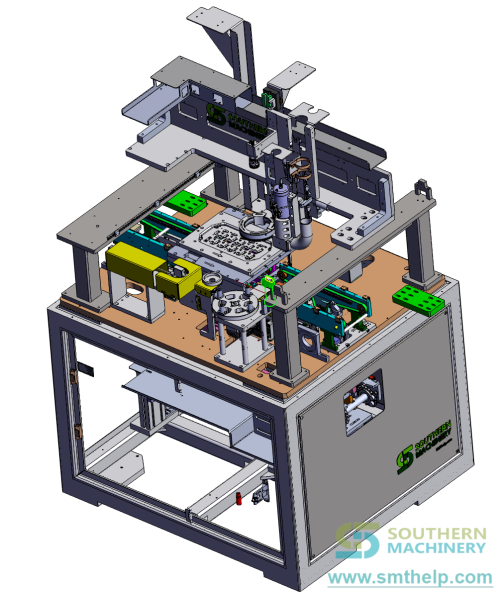
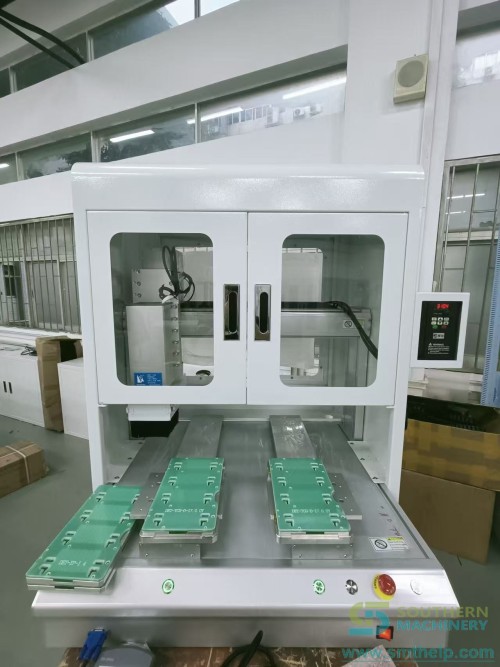
The SQX350 is a full-visual, dual-station PCB Router Separator from Southern Machinery for low-stress curved and high-density PCBA depaneling.
Sep 12, 2026 · Updated Sep 12, 2026 · Southern Machinery
SQX350 PCB Router Separator: Low-Stress Depaneling for High-Density PCBA | Southern Machinery
Depaneling is the last process step before a board ships — and it is still one of the most under-engineered stages on many SMT and THT lines. A poorly controlled router, a slow programming method or a single-station worktable can quietly add labour, scrap and hidden stress to every panel. The SQX350 PCB Router Separator from Southern Machinery was built to close that gap: a full-visual, dual-station routing system for curved, high-density and mixed-technology PCBA.
What is the SQX350 PCB Router Separator used for?
The SQX350 is a full-visual intelligent curve PCB separator. It uses a high-speed router spindle to cut a populated PCB panel — published as a V-groove or a perforated/tab-routed design — into individual boards, without the mechanical shock of snapping or the blade limitations of a straight V-cut machine.
In practice it is used for three jobs on a modern assembly line:
- Depaneling of high-density assemblies where components sit close to the board edge and mechanical stress must be kept low.
- Cutting non-straight outlines — the SQX350 supports linear, circular, arc, L-curve and U-curve cut paths, so round sensors, curvy wearables and shaped modules are handled by the same machine.
- Unattended, high-mix production where changeover speed and traceability matter as much as raw speed.
Put simply: if your product mix includes curved outlines, edge-mounted parts or panels that cannot tolerate hand-snapping stress, a router-style separator is the correct tool — and the SQX350 is Southern Machinery's answer for that segment.
Why depaneling is the hidden yield risk in SMT and THT assembly
Most quality investment goes into printing, placement, reflow, AOI and in-circuit test. Depaneling sits downstream and receives far less attention — yet it is applied to a board that is already fully populated and expensive. At that point a stress crack in a solder joint, a lifted pad or a micro-fracture under an IC is no longer a rework opportunity; it is scrap.
The key engineering principle is low-stress separation. Routing with a controlled spindle, correct feed rate and proper fixture support keeps mechanical strain on the panel within a narrow, repeatable window instead of concentrating it along a snapped V-groove. The SQX350's datasheet describes the machine as engineered for low-stress routing and low-strain measurement — deliberately designed to protect sensitive components and maintain long-term joint reliability.
Key specifications of the SQX350
The table below is taken directly from the official Southern Machinery SQX350 datasheet. Nothing here is estimated.
| Parameter | SQX350 (published specification) |
|---|---|
| Model | Southern Machinery SQX350 |
| Machine type | Full-Visual Intelligent Curve PCB Separator |
| Effective cutting area | X300 × Y350 mm (dual station) |
| Cutting functions | Linear, circular, arc, L-curve, U-curve |
| Cutting accuracy | ±0.02 mm |
| Machine repeatability | ±0.01 mm |
| Max movement speed | X, Y axes 800–1000 mm/s; Z axis 350–800 mm/s |
| Max travel stroke | X 735 mm, Y 400 mm, Z 90 mm |
| Spindle speed | Max 60,000 rpm (adjustable) |
| Spindle cooling | Air cooling |
| Cutting speed | 0–100 mm/s (adjustable) |
| PCB thickness | 0.3–3.0 mm |
| Router bit diameter | 0.8–3.0 mm |
| Programming method | Full-board photography, image-based teaching |
| Control system | PC precision 4-axis control, Windows 7 / 10 |
| Power requirements | AC220V / AC380V, 50/60 Hz, three-phase |
| Machine dimensions | Approx. L1200 × W1050 × H1700 mm |
| Machine weight | Approx. 800–1000 kg |
| Dust collector power | 2.2 kW (3 HP) |
| Safety features | Safety light curtain, security door |
| Data interface | MES/ERP connection ports, barcode scanner |
| Drive system | Panasonic A6 / Huichuan servo, ground ball screws |
How the SQX350 works
Full-visual programming instead of manual teach
Traditional router programming requires an operator to jog the X, Y and Z axes to teach every point of the cutting path. It is slow, depends on operator skill, and is a frequent source of error.
The SQX350 replaces that with a full-board photography approach: a camera captures a panoramic, high-resolution image of the entire panel, and the cutting path is defined as an image-based teaching operation. The practical result is a shorter programming cycle and a path that is far easier to verify before the first cut.
Dual-station, non-stop workflow
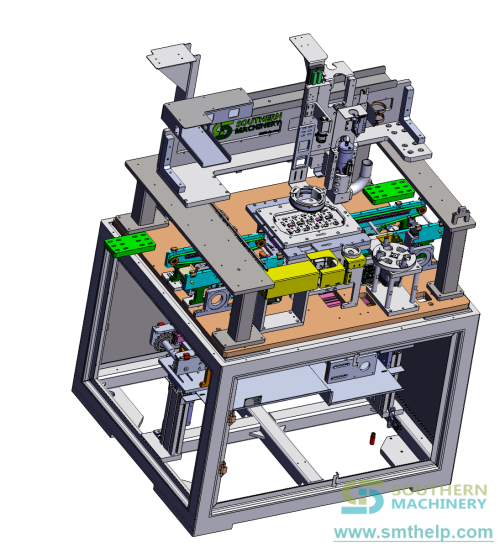
The SQX350 uses a dual-station frame. While one station is being cut, the other can be loaded or unloaded, so the spindle does not sit idle waiting for the operator. This is what turns depaneling from a production bottleneck into a continuous process — a meaningful difference for any line running more than one shift.
Dust control and static elimination
High-speed routing generates two enemies of yield: dust and static electricity. Both are addressed directly in the SQX350 design:
- A 2.2 kW (3 HP) dust collector with flexible extraction modes, matched to the cutting task.
- A static eliminator using high-frequency ion nozzles that neutralises the charge generated by the high-speed spindle, preventing static-related component damage and dust attraction.
Traceability and factory integration
The SQX350 publishes MES/ERP connection ports and supports a barcode scanner. For plants moving toward a smart factory model, that means depaneling data can be part of the same production record as placement and inspection — not a standalone island.
Typical application scenarios
Because the SQX350 is a general-purpose, curve-capable router, it appears across several buyer profiles:
- EMS and ODM high-mix lines — many different panel outlines per week, where fast programming and dual-station throughput matter more than a single high-volume part.
- Automotive electronics — sensor, control and power modules with edge connectors and tight keep-out zones, where joint stress directly affects field reliability.
- Medical electronics — monitoring, imaging and diagnostic boards where a cracked joint discovered after shipment is unacceptable.
- Industrial control and power supply — controllers, drives and power boards with mixed SMT and THT content and irregular panel layouts.
- LED and lighting modules — shaped and strip-based assemblies that do not fit a straight V-cut path.
- Communication and computing boards — dense routing where components sit close to the separation line.
How the SQX350 fits into a complete PCB assembly line
The SQX350 is a downstream machine: it receives fully populated and soldered panels and delivers singulated boards. A typical Southern Machinery line flow looks like this:
- Board handling — magazine loader feeds bare boards into the line.
- Solder paste printing — automatic stencil printer.
- SPI — 3D solder paste inspection.
- SMT placement — Pick and Place.
- Reflow Oven — reflow soldering.
- AOI — optical inspection of the SMT side.
- THT insertion — Southern Machinery radial, axial and odd-form auto-insertion machines handle the through-hole content.
- Wave Soldering or selective soldering for the THT joints.
- Lead cutting and cleaning — post-solder lead trimming and PCBA cleaning.
- Depaneling — the SQX350 separates the panel into individual boards.
- Final inspection and handling — X-ray, AOI and magazine unloader.
Because depaneling is a SMEMA-era line element, working with a supplier who also provides board handling, insertion, soldering and inspection means one partner can size the interfaces — conveyor heights, board transfer direction and panel flow — instead of reconciling three vendors after the fact. Southern Machinery supplies that full scope: SMT, THT, Wave Soldering, board handling and inspection equipment, all from one source since 2011.
SQX350 vs other depaneling methods
Depaneling is not one process — it is a family of methods, and the right choice depends on the panel and the product risk profile.
| Method | Best suited to | Main trade-off |
|---|---|---|
| Manual snap-off | Non-critical, low-value boards | Highest stress variance and operator dependence |
| V-cut / blade separator | Straight-line cuts on rigid FR-4 | Cannot follow curves or tight component keep-outs |
| Laser / punch | Specific materials and volumes | Higher capital cost and material limitations |
| Router separator (SQX350 class) | Curved outlines, high-density PCBA, mixed panels | Requires correct bit selection and dust management |
The SQX350 sits in the router category, which is why it handles the widest range of shapes: linear, circular, arc, L-curve and U-curve cuts from a single machine.
Key selection parameters: a buyer's checklist
Use this checklist before requesting a configuration. Every item below is a published SQX350 capability — confirm your own product data against it.
- Maximum panel outline — the SQX350's effective cutting area is X300 × Y350 mm across a dual station. Confirm your largest panel fits.
- PCB thickness — published range 0.3–3.0 mm.
- Cut profile complexity — confirm which of linear, circular, arc, L-curve or U-curve your product requires.
- Component keep-out and height clearance — share your tallest components and the minimum distance from the cut path.
- Router bit diameter — the machine supports 0.8–3.0 mm bits; bit choice drives cut quality and tool life.
- Accuracy requirement — SQX350 publishes ±0.02 mm cutting accuracy and ±0.01 mm repeatability. Match this to your tolerance stack.
- Spindle and feed strategy — up to 60,000 rpm, air-cooled, with cutting speed adjustable between 0 and 100 mm/s.
- Programming method — full-board photography and image-based teaching. Confirm your CAD/Gerber data can support the teaching workflow.
- Traceability need — if you need panel-level records, confirm the MES/ERP and barcode-scanner interface against your factory systems.
- Facility requirements — AC220V/AC380V three-phase, machine footprint approx. 1200 × 1050 × 1700 mm, weight approx. 800–1000 kg, plus the 2.2 kW dust collector.
- Safety and enclosure — safety light curtain and security door are standard; confirm against your local site rules.
- Consumables and support — confirm router bit supply, dust-filter maintenance interval and operator training as part of the quotation.
ROI, quality and throughput
Depaneling ROI rarely shows up as a single headline number. It shows up in four places:
Labour. A dual-station router keeps cutting while the operator loads and unloads, so one person can run the cell without standing idle. Compared with manual snapping or a single-station machine, the labour content per board drops — and it becomes predictable.
Quality and scrap. Every panel that reaches depaneling is a fully populated, fully reflowed board. A low-stress routing process protects that accumulated value. Reducing stress-induced joint cracks and component damage directly reduces scrap at the most expensive possible moment.
Throughput and changeover. Programme changeover is often the real bottleneck in high-mix production, not cutting speed. Image-based teaching shortens the path from new product to first good board, and the dual station keeps output flowing while that happens.
Traceability and integration. MES/ERP ports and barcode scanning let depaneling become part of the plant's data record. For buyers preparing audits or defending field reliability, that integrability is a long-term benefit that outlasts the machine's purchase price.
FAQ
What is the SQX350 PCB Router Separator used for? It separates populated PCB panels into individual boards using a high-speed routing spindle. It is a full-visual intelligent curve separator designed for low-stress depaneling of high-density and non-straight PCBA.
What makes the SQX350 different from a V-cut separator? A V-cut machine cuts a straight line only. The SQX350 supports linear, circular, arc, L-curve and U-curve cutting, so it handles curved and irregular outlines that a blade system cannot follow.
What board sizes and thicknesses does it support? The published effective cutting area is X300 × Y350 mm on a dual station, with a PCB thickness range of 0.3–3.0 mm and router bits from 0.8–3.0 mm.
How accurate is the SQX350? The datasheet publishes ±0.02 mm cutting accuracy and ±0.01 mm machine repeatability, with a spindle speed of up to 60,000 rpm.
Can it connect to MES and work in a full SMT/THT line? Yes. The SQX350 publishes MES/ERP connection ports and barcode-scanner support, and as a downstream depaneling cell it integrates with loaders, insertion machines, Wave Soldering, cleaning and inspection equipment.
How is the SQX350 programmed? Using full-board photography and image-based teaching. The camera captures the whole panel and the cutting path is defined on that image, which is faster and less error-prone than manual axis teaching.
Contact Southern Machinery for a configuration review
Shenzhen Southern Machinery Sales And Service Co., Ltd has supplied SMT and THT PCB assembly automation equipment since 2011, serving 237+ global customers with complete line solutions across SMT, THT, Wave Soldering, board handling and inspection.
If you are specifying a depaneling cell, send us your panel outline, thickness, cut-path type and component keep-outs, and we will help you confirm whether the SQX350 is the right fit — or recommend the correct machine for your product.
- Review the product catalogue: https://file.autoinsertion.com
- See machine photos: https://ph.smthelp.com
- Talk to a sales and service engineer: Jason Wu — jasonwu@smthelp.com — +86 13602562576
- Website: https://www.smthelp.com
Tell us your panel data and target volume, and we will map the SQX350 against your line.
Comments