
Speaker PCB Auto Insertion: THT Assembly Automation for Audio Electronics
Speaker PCB auto insertion from Southern Machinery automates through-hole audio assembly, cutting manual labor and rework on jacks, capacitors and connectors.
Sep 7, 2026 · Updated Sep 7, 2026 · Southern Machinery
Speaker PCB Auto Insertion: THT Assembly Automation for Audio Electronics
Speaker PCBs do not get the same attention as smartphone motherboards, yet they are everywhere: Bluetooth speakers, sound bars, home-theater amplifiers, PA systems, automotive audio, and smart assistants. What most buyers discover is that these boards are stubbornly mixed-technology — a small SMD section for control logic, and a large through-hole section full of audio jacks, terminal blocks, big electrolytic capacitors, inductors, relays, and heat-sink-mounted transistors. That through-hole content is exactly where Southern Machinery's speaker PCB auto insertion equipment removes manual labor, rework, and quality variance.
This article explains what speaker PCB auto insertion is, which audio boards benefit most, how insertion machines integrate with the rest of an SMT/THT line, and what to confirm when you size a machine for your own audio PCBA.
What Is Speaker PCB Auto Insertion?
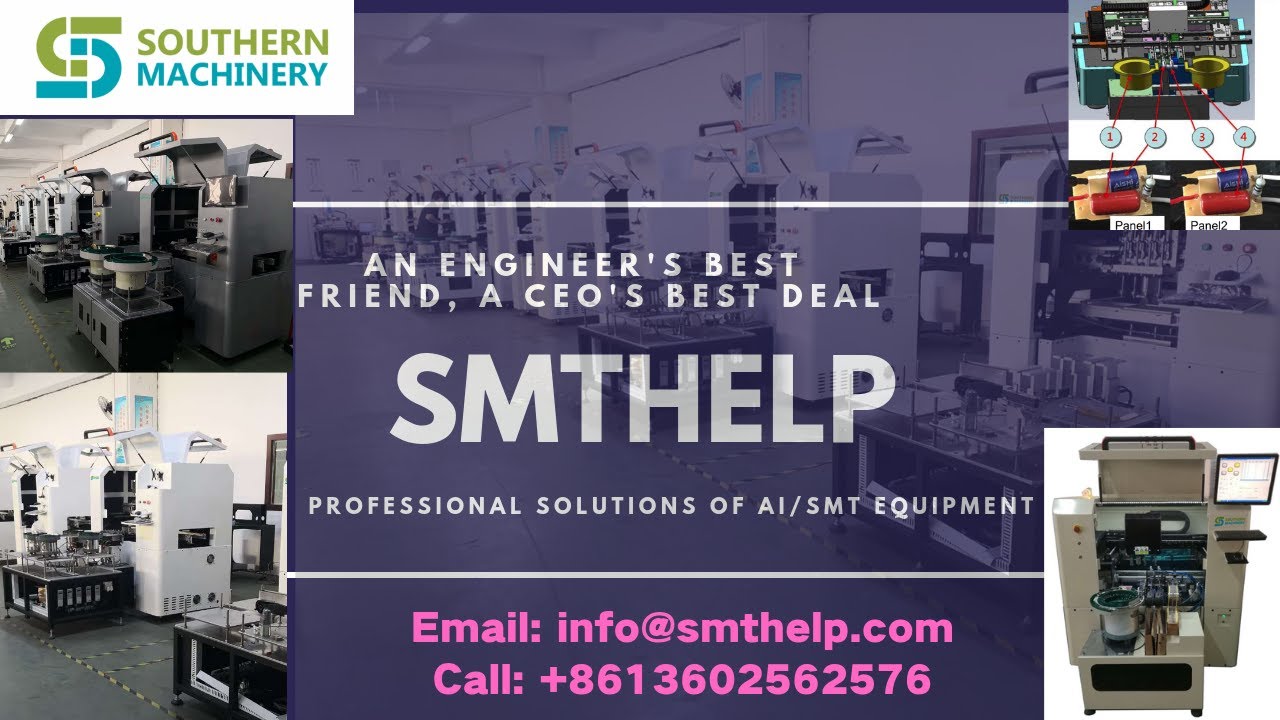
Speaker PCB auto insertion is the use of automatic THT (through-hole) insertion machines to place and clinch leaded components on audio PCBs — instead of an operator inserting each part by hand. The demo video on Southern Machinery's official channel ("speaker PCB auto insertion assembly") shows this in practice: the machine feeds components from reels or vibratory bowls, positions each board, inserts the leads into the plated through-holes, and clinches them so boards can move directly into wave soldering without a separate lead-trimming step.
Southern Machinery, a Shenzhen-based SMT/THT PCB assembly automation company founded in 2011, designs and manufactures the machine families used for this class of work: axial insertion machines, radial insertion machines, odd-form insertion machines, and terminal/pin insertion machines, together with the conveyors, wave soldering and board handling equipment that turn them into a complete DIP assembly line. The company has served 237+ customers worldwide, many of them EMS and ODM factories building appliances, lighting, power supplies and audio products.
Typical Application Scenarios
Audio PCBA covers a wide range of board types, and not all of them need the same insertion solution:
- Bluetooth and smart speaker mainboards — control sections are SMT, but power connectors, battery terminals, buttons, and audio jacks are through-hole odd-form parts.
- Amplifier and receiver boards — large electrolytic capacitors, film capacitors, relay sockets, and connectors dominate the component count; radial taped capacitors are a natural fit for radial insertion machines.
- Crossover and passive networks — inductors, resistors, and capacitors with widely spaced leads; odd-form or radial insertion with lead clinching keeps parts flat and stable.
- Sound bar and TV audio boards — mixed SMD/THT boards with connector-heavy layouts that run in high volume and reward automation.
- Automotive audio and PA amplifiers — reliability-sensitive boards where consistent solder joints and repeatable lead forming matter more than raw speed.
Audio boards are classic EMS work: high mix, medium volume, and frequent changes between board types. That is why the insertion machines Southern supplies are selected for fast changeover (feeder and nozzle setups) as well as throughput.
How It Integrates into a Complete SMT/THT PCB Assembly Line
Speaker PCBA usually flows through both SMT and THT processes. A typical line arrangement is:
- SMT section — solder paste printing, pick-and-place, reflow oven for the small-signal side of the board.
- THT insertion section — axial, radial, and odd-form auto insertion machines place the through-hole components and clinch the leads. Manual insertion stations may still be used for the few parts that are not economical to automate.
- Wave soldering — boards pass over the solder wave to form all THT joints in one pass.
- Post-wave processes — inline lead cutting (if leads were not pre-clinched), cleaning, AOI inspection, and functional test.
Southern Machinery provides equipment for every station in that THT flow — insertion machines, wave soldering machines, board handling conveyors, lead cutters, cleaning machines and inspection — and its PCB DIP assembly line solutions include DFM review, NPI process guidance, equipment installation, THT operator training, and machine troubleshooting, upgrade and overhaul support. For an EMS factory adding audio PCBA, that means one supplier can configure and support the whole through-hole line rather than stitching together separate vendors.
Key Selection Parameters
Every audio board is different, so treat the list below as the parameters to confirm with Southern Machinery when you request a configuration — not as fixed specifications:
- Component mix and lead form — which parts are axial (two straight leads), radial (two parallel leads from one side), or odd-form (jacks, connectors, relays, transformers). This decides whether you need a radial, axial, or odd-form machine, or a combination on one line.
- Board dimensions and panelization — the maximum board size the machine table and conveyor can carry, and whether boards arrive as single boards or panels.
- Feeders and material format — taped reels, tubes, trays, or bulk components in vibratory bowls; each requires different feeding hardware.
- Clinching requirement — whether leads must be clinched (bent) on the solder side for wave soldering stability and to eliminate a downstream lead-cutting step.
- Changeover frequency — for high-mix audio production, look at how quickly programs, feeders, and nozzles can be swapped between board types.
- Line integration — SMEMA or equivalent conveyor interface, board loading/unloading, and how the insertion machines connect to your wave soldering machine.
ROI, Quality & Throughput Perspective
The economic case for automating speaker PCB insertion is usually built on three measurable items:
- Labor replacement — one automatic insertion machine typically replaces several manual insertion operators on a connector- and capacitor-heavy board, and it does not fatigue or lose concentration during long runs.
- Defect reduction — consistent lead insertion depth, correct polarity orientation, and uniform clinching reduce the mis-inserted, reversed, and floating components that manual assembly produces. Fewer defects means less rework, less wave-soldering touch-up, and fewer field failures on audio products.
- Line balance — when the through-hole content is the bottleneck, moving insertion from manual stations to machines raises the whole line's output and shortens delivery time for customer orders.
Because Southern Machinery also supplies the surrounding THT line equipment, an audio EMS factory can plan the automation step by step: start with the highest-labor board, prove the ROI, then extend insertion to more models and add wave soldering or board handling as volumes grow.
FAQ
Q: What types of components can speaker PCB auto insertion machines handle?
A: Through-hole components in taped, tubed, tray or bulk format — typically axial and radial capacitors and resistors, plus odd-form parts such as audio jacks, connectors, terminal blocks, relays, and transformers. Confirm your exact component list with Southern Machinery for feeder planning.
Q: Does the insertion machine integrate with an existing SMT line?
A: Yes. Southern Machinery insertion machines are designed for PCB assembly lines with standard conveyor interfacing (SMEMA-type signaling), so they can be placed between reflow and wave soldering or operated as standalone machines feeding from a magazine loader.
Q: What support does Southern Machinery provide after installation?
A: Southern Machinery offers training, spare parts, and global service from its Shenzhen base, plus retrofit and upgrade support for existing THT lines. The DIP assembly line service covers DFM guidance, NPI process support, installation, and troubleshooting.
Q: Which industries use speaker PCB auto insertion?
A: Consumer audio brands and their EMS/ODM partners — Bluetooth speakers, sound bars, home and car audio amplifiers, PA systems — as well as appliance makers whose control boards carry the same capacitor-and-connector THT content.
Q: How does automation improve quality versus manual assembly?
A: Automatic insertion applies the same insertion depth, orientation, and clinch on every cycle, removing the operator-dependent errors (reversed polarity, tilted parts, missed components) that drive rework on audio boards.
Q: Can I see the machine in operation?
A: Yes — the official Southern Machinery YouTube channel shows a speaker PCB auto insertion assembly demo, and you can request a live machine video or factory visit for your own board.
Contact Southern Machinery for Configuration Advice
Every audio board is different, and the right line configuration depends on your component mix, volumes, and existing equipment. Contact Jason Wu at jasonwu@smthelp.com (WeChat/WhatsApp: +86 13602562576) for a configuration review.
- Browse product catalogs: file.autoinsertion.com
- See machine photos: ph.smthelp.com
- Product pages and company information: www.smthelp.com
- Audio PCBA assembly solutions: https://www.smthelp.com/audio-pcba
Comments