
Wave Soldering Machine SW-350 for High-Efficiency THT PCB Assembly
The SW-350 wave soldering machine delivers consistent, high-quality THT solder joints for power supplies, LED drivers, and consumer electronics — backed by Southern Machinery's global support.
Aug 13, 2026 · Updated Aug 13, 2026 · Southern Machinery
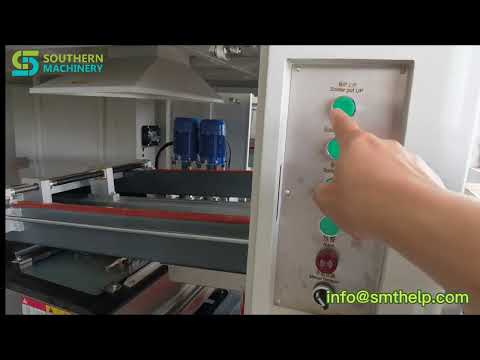
What Is the SW-350 Wave Soldering Machine?
The SW-350 is a wave soldering machine designed for Through-Hole Technology (THT) PCB assembly. It creates a controlled, flowing wave of molten solder that contacts the underside of a PCB, forming reliable solder joints on component leads passing through plated holes.
Wave soldering is a core THT process step — it replaces manual soldering for high-volume production of power supplies, LED drivers, motor controls, and consumer appliances where through-hole components deliver the mechanical robustness required.
---
Typical Application Scenarios
The SW-350 is suited for electronics manufacturers running medium-to-high volume THT production:
- Power supplies — DC converters, vehicle power supplies, and ballast PCBs with axial and radial leads
- LED lighting drivers — aluminum base MCPCBs requiring consistent solder fill around leads
- Home appliances — PCBs for air conditioners, washing machines, and kitchen equipment
- Industrial controls — relay boards, timer circuits, and protection modules
- Automotive electronics — car audio and vehicle control modules with connector headers
The SW-350 handles both standard tin-lead and lead-free (RoHS-compliant) solder alloys by adjusting the solder pot temperature and flux application parameters.
---
Integrating the SW-350 into a PCB Assembly Line
A typical THT line sequence with wave soldering follows this flow:
- Wave solder fluxer — applies controlled flux to PCB bottom-side leads and holes
- Preheater zone — raises PCB temperature gradually to minimize thermal shock
- Wave solder contact — molten solder flows across the board bottom; leads pass through the wave
- Cooling zone — solder solidifies; board exits at a controlled cooling rate
Conveyor speed, wave height, and solder pot temperature are the three primary variables operators tune for a given board profile. Southern Machinery's SW-350 features a titanium wave finger designed for durability in lead-free operation, reducing maintenance intervals on high-wear contact surfaces.
For boards with heat-sensitive SMD components on the top side, bottom-sideonly wave soldering is a standard configuration — no topside reflow occurs because only the PCB bottom contacts the wave.
---
Key Selection Criteria for Wave Soldering Equipment
When evaluating a wave soldering machine, focus on these operational parameters:
Solder pot capacity and temperature range
Lead-free operation requires solder pot temperatures typically 20–30°C higher than tin-lead (≈260–280°C). Confirm the SW-350's pot can maintain stable temperature across the full conveyor working width.
Wave type — standard vs. double-wave
A single wave is sufficient for boards with all leads oriented perpendicular to the travel direction. A dual-wave (laminar + turbulent) improves hole fill for boards with mixed orientation, fine-pitch components, or when lead-free alloys with higher surface tension are used. The SW-350 dual-wave configuration is suited for boards with mixed THT components.
Conveyor system compatibility
Verify conveyor width and clearance height accommodate your largest production board. Southern Machinery's SW-350 supports a range of PCB widths common in industrial and consumer electronics production.
Nitrogen inerting option
Lead-free solders oxidize more readily. Some wave solder systems offer nitrogen inerting to reduce dross formation and improve wetting. Evaluate whether your production volume justifies this add-on.
Maintenance access — wave fingers and flux containment
Titanium wave fingers (as featured on the SW-350) resist erosion from continuous lead-free operation. Easy-access solder pots reduce changeover and cleaning time between alloy types.
---
Why Electronics Manufacturers Choose Southern Machinery Wave Soldering
Southern Machinery (Shenzhen, founded 2011) specializes in SMT and THT PCB assembly automation. The SW-350 is one component of a broader portfolio covering radial and axial insertion, odd-form insertion, selective soldering, and board handling — enabling a single supplier relationship for full THT line builds.
Key differentiators:
- 237+ global clients across power supply, LED, automotive, and consumer electronics sectors
- Spare parts and training included as standard after-sales support
- Full-line capability — from stencil printing through wave soldering to board handling and cleaning
- Equipment configured for RoHS/lead-free compliance as standard
---
ROI and Quality Angle
Wave soldering delivers consistent, repeatable solder joints across high-volume runs — reducing the defect rates associated with manual THT soldering: cold joints, insufficient fill, and solder bridges.
For a production line running 500+ THT boards per shift, the transition from manual soldering to automated wave typically pays back within 6–18 months through:
- Reduced labor cost per joint
- Lower rework and repair rates
- Consistent first-pass yield
- Reduced operator skill dependency
---
Frequently Asked Questions
What is wave soldering used for?
Wave soldering is used to solder through-hole component leads to PCBs in a high-volume, automated process. The PCB passes over a controlled wave of molten solder that fills holes and contacts lead surfaces.
What is the difference between wave soldering and reflow soldering?
Wave soldering solders THT (through-hole) components from the PCB bottom side. Reflow soldering solders surface-mount (SMD) components by melting solder paste applied to pads. Most mixed-technology boards use both processes.
Can wave soldering handle lead-free solders?
Yes — modern wave soldering equipment like the SW-350 operates at temperatures suitable for lead-free alloys (SAC305, SAC387, etc.) and uses materials (titanium wave fingers, high-temp flux) compatible with RoHS requirements.
What boards can the SW-350 handle?
The SW-350 is designed for industrial and consumer electronics PCBs including power supplies, LED drivers, appliance controls, and automotive modules. Board size and weight depend on conveyor spec — consult Southern Machinery for specific production requirements.
Does wave soldering damage temperature-sensitive components?
Only the PCB bottom side contacts the wave. Heat-sensitive SMDs on the topside are generally unaffected, especially with preheater zone profiling. Boards with extreme topside thermal sensitivity may require selective soldering for those areas.
How does Southern Machinery support wave soldering customers?
Southern Machinery provides spare parts, commissioning support, and operator training. The company maintains a global parts network for common wear items including wave fingers, pumps, and flux applicators.
---
Ready to Upgrade Your THT Soldering?
Southern Machinery's SW-350 wave soldering machine is available as a standalone unit or as part of a complete THT assembly line configuration. Contact Kevin Yang at kevin@smthelp.com or +86 13602562576 to discuss your production requirements.
Explore the full product video: SW-350 Wave Soldering Machine on YouTube
---
Southern Machinery — SMT/THT PCB Assembly Automation Specialist. Shenzhen, China. www.smthelp.com
Comments