
Southern Machinery S7020T Terminal Insertion Machine
Discover how the S7020T dual-head terminal inserter reduces manual labor, improves throughput, and delivers measurable ROI in THT PCB assembly lines.
Sep 27, 2026 · Updated Sep 27, 2026 · Southern Machinery
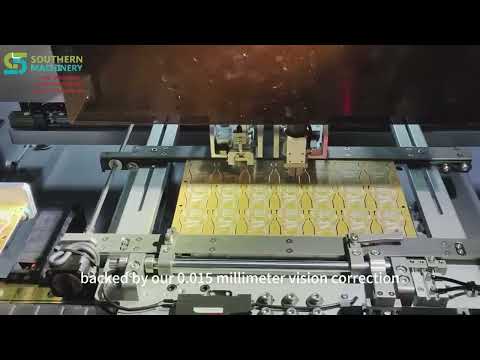
What Is the S7020T Dual-Head Terminal Inserter?
The S7020T is a dual-head terminal insertion machine from Southern Machinery, purpose-built for through-hole technology (THT) assembly lines handling power tools, home appliances, and industrial control PCBs. It automates the insertion of terminal pins and rivets into circuit boards, replacing manual placement operations that introduce inconsistency and ergonomic risk.
Typical manual terminal insertion rates hover around 300–500 placements per hour per operator, with defect rates that scale inversely with operator experience. The S7020T targets high-mix, high-volume production environments where consistent lead alignment and cycle time directly affect cost per board.
Key Application Scenarios
Power tool control boards — Dense component populations with multiple terminal types (spade, ring, fork) are common in power tool PCBs. The dual-head configuration allows two different terminal types to be inserted in a single machine cycle, reducing changeover time.
Home appliance THT assembly — Washing machines, air conditioners, and induction cooktops require robust through-hole connections for power delivery and grounding. The S7020T handles the varied board sizes and thicknesses common in this segment.
Industrial motor controllers — High-current applications demand secure, gas-tight connections that only a properly inserted terminal can provide. Automation ensures each lead is seated to consistent insertion-force specifications.
Integrating the S7020T into an Existing PCB Assembly Line
The S7020T is designed for inline integration with wave soldering and selective soldering processes. Key integration considerations:
- Board format: Supports standard SMT-compatible board sizes; fixtures can be customized for non-standard panel dimensions
- Feed system: Dual bowl feeders or tube feeders supply terminals to each head independently, enabling mixed-product runs without tooling changes on one head
- Cycle time: Insertion rate is a function of component lead diameter and board thickness; the machine includes programmable insertion force control to protect sensitive PCB substrates
- Connection: Standard SMEMA-compliant conveyor interface allows drop-in placement between print, placement, and soldering stations
Selecting the Right Terminal Inserter: What to Evaluate
When evaluating any dual-head terminal insertion system, procurement and engineering teams should assess:
- Component compatibility — Maximum and minimum lead diameter, lead length range, and terminal body diameter. Verify against the terminal types used in your products.
- Board size envelope — Minimum and maximum PCB dimensions the machine can handle. Some boards require custom fixtures outside the standard envelope.
- Insertion force range — Too low and leads fail to seat; too high and PCB trace damage occurs. Programmable force control is essential for mixed-board production.
- Changeover time — Dual-head machines can run two different terminals simultaneously. Evaluate feeder changeover time when product mix changes.
- Solder compatibility — The machine is optimized for THT insertion upstream of wave or selective soldering. Confirm your soldering process is sequenced correctly.
- Service and spare parts — Southern Machinery provides spare parts, training, and technical support from its Shenzhen headquarters with global distribution.
ROI and Quality Angle
The financial case for terminal insertion automation rests on three variables: labor displacement, defect reduction, and throughput gain.
Labor: A single dual-head machine can replace 2–4 manual insertion operators, depending on board complexity and shift count. At typical labor rates in electronics manufacturing regions, payback periods of 12–24 months are commonly achievable.
Defect: Misaligned or insufficiently inserted terminals cause field failures and costly rework. Automated insertion with force monitoring reduces position and seating defects compared to manual operations.
Throughput: Dual-head simultaneous insertion effectively doubles the per-cycle output of a single-head machine. For high-volume SKUs, line balancing against downstream soldering capacity is the primary constraint.
Frequently Asked Questions
What board thicknesses can the S7020T handle?
The machine accommodates standard PCB thicknesses from 0.8 mm to 3.2 mm. Thick boards may require fixture customization.
Does it support both radial and axial terminals?
The S7020T is primarily designed for terminal and rivet insertion (through-hole). Radial component insertion (e.g., resistors, capacitors) is handled by separate radial insertion equipment such as the Southern Machinery S-3010B series.
What is the typical changeover time between terminal types?
Feeder changeover depends on the feeder type. Tube feeder changeover is typically under 15 minutes; bowl feeder changeover may take longer depending on terminal geometry.
Is programming new board variants difficult?
The machine interface allows board-specific program storage. For production facilities running high-mix volumes, keeping a library of board programs reduces changeover time significantly.
What after-sales support does Southern Machinery offer?
Southern Machinery provides spare parts, remote technical support, on-site training, and machine overhaul services. The company has served 237+ clients globally since its founding in Shenzhen in 2011.
---
Southern Machinery is a Shenzhen-based SMT/THT PCB assembly automation specialist offering insertion machines, wave soldering systems, board handlers, and cleaning equipment for electronics manufacturers worldwide.
Comments