
Southern Machinery S7020T Dual-Head Terminal Insertion Machine
The S7020T dual-head terminal insertion system brings high-throughput automation to power tool PCB assembly. Here are the key selection criteria and ROI factors to consider.
Sep 26, 2026 · Updated Sep 26, 2026 · Southern Machinery
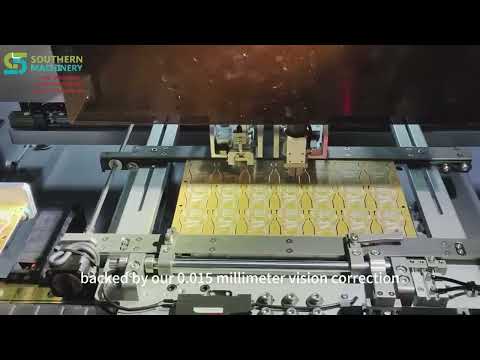
What Is the S7020T Dual-Head Terminal Insertion Machine?
The S7020T is a dedicated terminal insertion system built for automated PCB assembly in power tool manufacturing. Its dual-head design places two terminal leads at once, effectively doubling throughput on two-pin components compared with single-head machines.
In power tool PCB production, terminal insertion is a critical step: conductive leads — often flag-type or quick-connect terminals — must be positioned accurately and locked into the board before wave soldering. Manual insertion is labor-intensive, error-prone, and quickly becomes a bottleneck on high-volume lines.
The S7020T solves this by mounting two independent insertion heads on a single platform, both driven by a shared vision-alignment system. That layout is especially effective for power tool control boards that carry several discrete terminals per board, such as motor driver circuits, switch-mode power supplies, and safety interlock modules.
---
Typical Application Scenarios
Power tool motor control boards — Drills, grinders, and saws need rugged PCB assemblies that withstand high current and thermal stress. The S7020T handles the multiple input/output terminal leads that connect power semiconductors, relays, and capacitors to the board.
Appliance control modules — Induction cookers, air conditioners, and microwave ovens use terminal-plugged PCBs for power routing. The dual-head approach cuts cycle time per board.
LED driver circuits — High-power LED lighting (street lamps, floodlights, industrial high-bay fixtures) frequently relies on terminal-inserted driver boards for dependable connections under high current.
Automotive accessory boards — Car audio, vehicle power supplies, and other in-vehicle electronics benefit from consistent insertion quality that manual processes struggle to sustain at scale.
---
Integrating into a PCB Assembly Line
Terminal insertion typically comes after SMT placement and before wave soldering in a THT (Through-Hole Technology) flow:
- SMT placement — Surface-mount components are placed and reflow-soldered first.
- THT insertion — Through-hole components, including terminals, are inserted by the S7020T.
- Wave soldering — The board passes through the wave solder bath to secure the THT leads.
- Cleaning and inspection — Residual flux is removed and visual/AOI checks confirm joint quality.
On lines without SMT, the S7020T can run as a standalone offline insertion station: boards are loaded manually and passed on to a downstream wave solder machine.
Key integration considerations:
- Board size compatibility — Confirm that maximum PCB dimensions and mounting-hole pitch fall within the machine's tolerance.
- Terminal lead diameter — The insertion heads must match your lead gauge range; consult Southern Machinery specs for your diameter.
- Feeder configuration — Terminals are usually supplied on strips or in trays, so specify the correct feeder type.
- With or without insertion force detection — Southern Machinery offers insertion force monitoring as a configurable option, which helps cut defects caused by bent leads or misaligned holes.
---
Key Selection Criteria
When evaluating a dual-head terminal insertion machine for power tool production, weigh the following:
| Criterion | What to Assess |
|---|---|
| Throughput | A dual-head setup effectively doubles the insertion rate for two-lead components versus a single head. Evaluate per-head cycle time. |
| Placement accuracy | Misalignment causes tombstoning or incomplete insertion. Look for vision-based alignment. |
| Component range | Check the minimum and maximum lead diameter and body size the machine can handle. |
| Lead cutting | Some terminals require in-situ lead cutting after insertion — confirm whether the S7020T supports this or needs a separate downstream operation. |
| Changeover time | For mixed-product runs, tool-free or minimal-tool changeover reduces downtime between board types. |
| Force monitoring | Insertion force detection keeps damaged boards from progressing to soldering — a key quality control feature. |
| Service and spare parts | Evaluate lead time for replacement heads, feeders, and wear parts. Southern Machinery supplies spare parts worldwide. |
Note: This article focuses on selection criteria and process integration for the S7020T category. Specific throughput figures (CPH), pricing, and certification details vary by configuration and region — contact Southern Machinery directly for a tailored quotation.
---
ROI and Quality Angle
Labor cost reduction — A dual-head insertion system can replace two or more manual insertion operators per shift, holding consistent quality that does not degrade over hours of repetitive work.
Defect reduction — Bent leads, misaligned insertion, and tombstoning are common manual errors. Automated insertion with vision alignment and force monitoring significantly lowers rework rates.
Throughput consistency — Manual insertion rates vary with operator skill and fatigue. Automated dual-head insertion holds a steady cycle regardless of shift length.
Scalability — As volumes grow, adding a second automated insertion head is more cost-effective than hiring additional operators, and quality stays constant.
For a power tool manufacturer running a mid-volume line (say, 500–2000 boards per shift), the payback period on an automated terminal insertion system is typically measured in months, not years — especially once reduced rework and scrap costs are factored in.
---
Frequently Asked Questions
What types of terminals can the S7020T handle?
The S7020T supports flag-type terminals, quick-connect terminals, and other standard through-hole lead configurations used in power electronics. Confirm specific lead diameter and pitch ranges with Southern Machinery against your component datasheet.
Can this machine be integrated into an existing SMT line?
Yes. The S7020T is typically positioned after SMT placement and before wave soldering. It can be configured as an inline or offline station depending on your line layout.
Does it support insertion force monitoring?
Yes. Southern Machinery offers insertion force detection as an option on this machine type, helping identify bent leads or misaligned board holes before they reach the soldering stage.
What is the changeover time for different board types?
Changeover time depends on board geometry and component feeder configuration. Southern Machinery provides guidance on tooling requirements during commissioning.
Is training available?
Southern Machinery offers operator and maintenance training, spare parts support, and technical documentation. Contact Kevin Yang at kevin@smthelp.com for training schedules.
What after-sales support is available?
Southern Machinery provides global spare parts, remote technical support, and on-site training. The company has served 237+ clients worldwide since its founding in 2011.
---
Get a Quote for Your Power Tool PCB Line
Southern Machinery has been a trusted SMT/THT automation partner for electronics manufacturers since 2011, with 237+ global clients across the power tool, LED lighting, automotive, and appliance sectors.
To discuss how the S7020T dual-head terminal insertion system can fit into your production line, contact:
Kevin Yang
Shenzhen Southern Machinery Sales And Service Co., Ltd
Email: kevin@smthelp.com
Phone: +86 13602562576
Website: https://www.smthelp.com
Comments