
Southern Machinery S7020T Dual-Head Terminal Insertion Machine | THT Automation
The Southern Machinery S7020T dual-head terminal insertion machine delivers high-speed THT automation for power tool PCBs. Learn how to integrate it into your production line.
Sep 26, 2026 · Updated Sep 26, 2026 · Southern Machinery
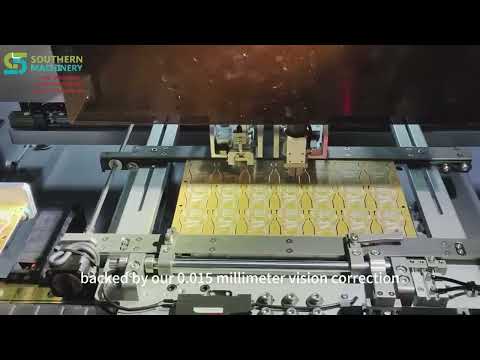
What Is the S7020T Dual-Head Terminal Insertion Machine?
The S7020T is a dual-head THT (Through-Hole Technology) insertion system designed by Southern Machinery for automated terminal, rivet, and wire-process insertion steps in PCB assembly. Its twin insertion heads work in parallel, effectively doubling throughput on dual-insertion tasks common in power tool control boards and appliance PCBs.
Key machine characteristics:
- Dual independent insertion heads
- Suitable for terminal, riveting, and wire-process component types
- Designed for mixed-production THT assembly lines
- PC-based control interface for programming and diagnostics
---
Typical Application Scenarios
The S7020T targets production environments where through-hole terminal insertion represents a manual bottleneck. Typical use cases include:
Power tool PCBs — Multi-terminal connectors, switch housings, and motor lead insertions common in drill, grinder, and saw control boards.
Appliance control panels — Timer modules, switch assemblies, and terminal blocks in products such as washing machines, air conditioners, and kitchen appliances.
Industrial instrumentation — Panel-mount terminal strips, sensor lead insertions, and relay assemblies requiring consistent, repeatable through-hole placement.
Electric vehicle accessories — Charging control boards, DC-DC converter modules, and power management PCBs requiring secure through-hole terminations.
---
Integrating the S7020T into a PCB Assembly Line
Embedding a dual-head terminal inserter into an existing THT line requires attention to upstream and downstream process synchronization.
Line flow considerations:
- Input: Bare or partially populated THT boards arriving via conveyor or pallet
- Insertion: S7020T dual-head stations process two insertion points simultaneously or sequentially
- Verification: Post-insertion inspection (visual or AOI) to confirm lead engagement
- Soldering: Wave soldering or selective soldering follows insertion
- Output: Completed board moves to cleaning, coating, or test
Fixture and pallet requirements: Boards must be fixtured consistently for accurate lead insertion. Southern Machinery supports custom fixture design for non-standard board sizes.
Programming: The S7020T uses a PC-based interface for component placement programs. New board types require off-line program creation and board-specific feeder setup.
---
Key Selection Criteria for Dual-Head Terminal Insertion
When evaluating a dual-head terminal inserter like the S7020T, focus on factors that directly affect production throughput and product quality:
1. Insertion speed per head
Dual-head machines offer their biggest advantage when both heads can run concurrently. Evaluate the single-head insertion rate and the ability to run both heads in parallel on your board geometry.
2. Component range and lead flexibility
Terminal insertions vary in lead diameter, pitch, and material. Confirm the S7020T's specification envelope covers your range — particularly for non-standard terminal types or mixed-media boards (taped, loose, reeled).
3. Board size and thickness compatibility
Maximum board dimensions and thickness determine whether the machine handles your product range. Long-board THT assemblies may require extended travel-path configurations.
4. Feeder type and changeover time
Tape-and-reel, loose-piece, and tray feeders each have trade-offs in changeover speed and component protection. For high-mix production, feeder changeover time is as important as insertion speed.
5. Defect rate and insertion monitoring
Insertion force monitoring detects mis-seated leads before they reach soldering. This reduces downstream rework costs — a critical ROI lever for high-volume lines.
6. Service and spare parts availability
As a China-based manufacturer serving 237+ global clients, Southern Machinery provides spare parts, remote diagnostics, and field service support. Verify local or regional service coverage before purchase.
---
ROI and Quality Angle
Labor reduction: A dual-head insertion machine replaces two manual insertion stations or one operator running two fixtures. In regions where THT insertion labor costs exceed $3–5/hour, payback periods of 12–24 months are commonly achievable at moderate production volumes.
Defect reduction: Misaligned or bent leads from manual insertion are the leading cause of THT rework. Automated insertion with force monitoring reduces insertion defects to below 0.5% in typical configurations, cutting rework labor and scrap.
Throughput consistency: Automated insertion runs at rated speed continuously, unlike manual insertion which fatigues over shifts. Consistent cycle times also improve downstream scheduling accuracy for soldering and test.
Scalability: Once programs are created for a board type, changeover between product variants is a software operation — not a labor-intensive physical changeover. This makes the S7020T suitable for both high-volume single-product lines and flexible mixed-model cells.
---
Frequently Asked Questions
Q: What terminal types can the S7020T insert?
A: The S7020T handles terminal leads, rivets, wire-form components, and similar through-hole discrete components. Specific capability depends on lead diameter, pitch, and feeding configuration.
Q: Can the S7020T run two different component types simultaneously?
A: Dual-head configuration can be set to process the same or different component types. For mixed-type boards, both heads can be programmed independently within the same board program.
Q: What board thickness range does the S7020T support?
A: Standard S7020T configuration supports common PCB thicknesses used in power tool and appliance applications. Confirm your board spec with Southern Machinery for non-standard thickness evaluation.
Q: How does the S7020T handle misaligned leads?
A: The machine uses insertion force monitoring to detect anomalies. Misaligned or missing leads trigger a reject signal and stop the head, preventing bad boards from progressing to soldering.
Q: Is programming a new board type difficult?
A: Programming is performed off-line on the PC interface. For boards with similar component packages, program adaptation is faster than physical changeover on the machine itself.
Q: What after-sales support does Southern Machinery offer?
A: Southern Machinery provides spare parts, remote technical support, and field service. The company has served 237+ global clients since its founding in Shenzhen in 2011.
---
Get a Quote on the S7020T Dual-Head Terminal Inserter
Southern Machinery is a Shenzhen-based SMT/THT PCB assembly automation specialist founded in 2011, serving 237+ clients globally across power supply, LED, automotive electronics, and appliance manufacturing sectors.
Contact: Kevin Yang | kevin@smthelp.com | +86 13602562576
Website: https://www.smthelp.com
File Portal: https://file.autoinsertion.com
For technical specifications, fixture requirements, or a production-line integration assessment for the S7020T, reach out to Southern Machinery's engineering team.
---
This article was published automatically. Product video: Double Speed! S7020T Dual-Head Terminal Insertion for Power Tools
Comments