
SO-300 Offline Selective Soldering Machine: Precision THT Soldering for High-Mix EMS Lines
The SO-300 offline selective soldering machine from Southern Machinery delivers ±0.1 mm accuracy and a 300×300 mm soldering area, with PC-based recipe control for high-mix THT soldering and PCB rework.
Aug 20, 2026 · Updated Aug 20, 2026 · Southern Machinery
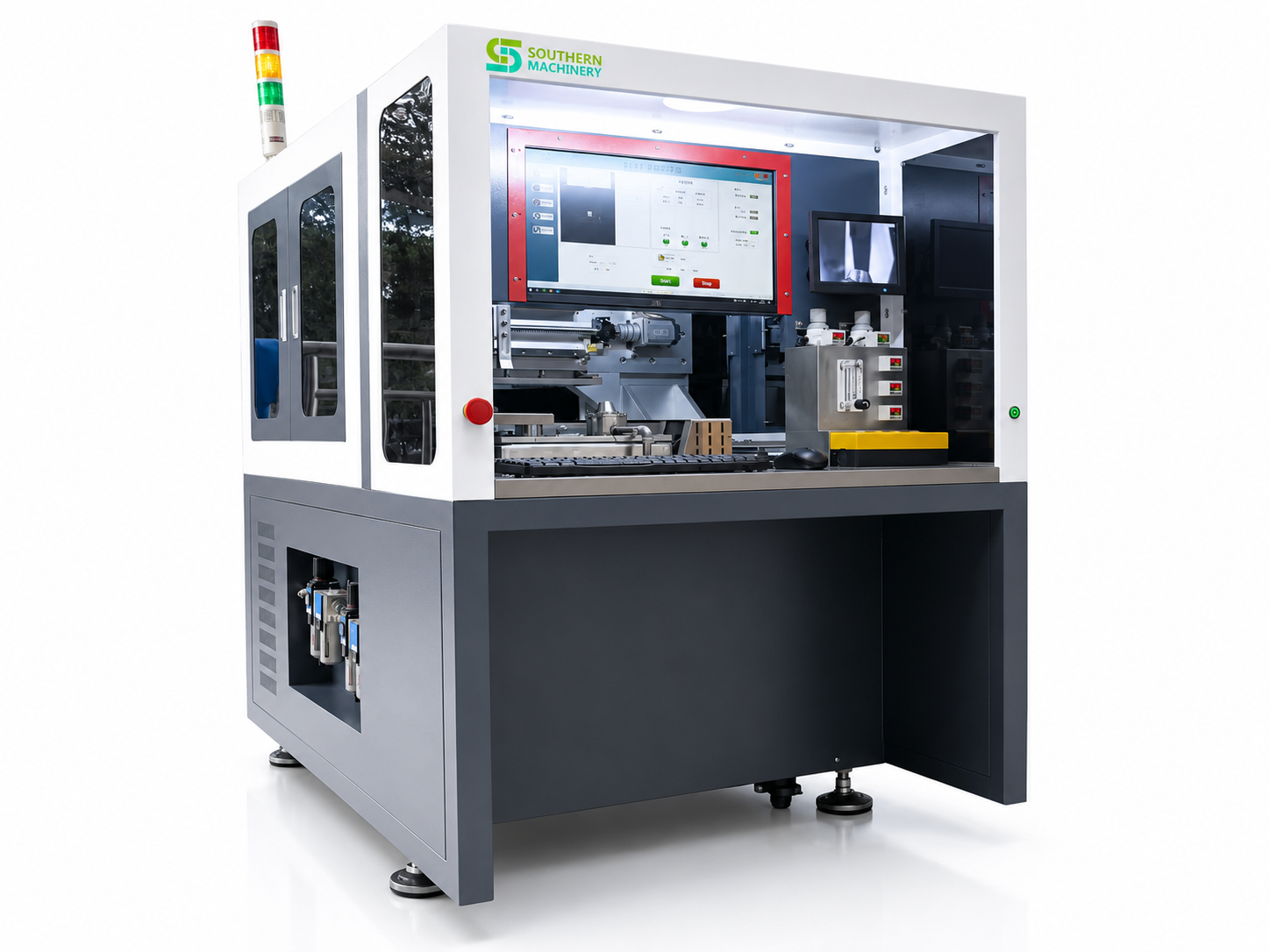
SO-300 Offline Selective Soldering Machine: Precision THT Soldering for High-Mix EMS Lines
Selective soldering is the answer when full wave soldering is overkill—and hand soldering is too slow. The SO-300 High-Speed Offline Selective Soldering Machine from Southern Machinery (Shenzhen, China, founded 2011) brings fluxing, bottom infrared preheating, and selective soldering into one compact offline station, with ±0.1 mm positioning accuracy and PC-based recipe control. For EMS, ODM, power supply, automotive electronics, and industrial control manufacturers, the SO-300 is a practical, verifiable choice for through-hole soldering, PCB rework, and high-mix, low-volume THT production.
What Is This Machine Used For?
Q: What is the SO-300 selective soldering machine used for?
A: The SO-300 is an offline, single-head selective soldering machine used to solder through-hole (THT) components on selected areas of a PCB—without exposing the whole board to a solder wave. It integrates three process steps into one machine: selective fluxing (jet valve), bottom infrared preheating (3 kW, 25–240 °C), and selective soldering on a servo-controlled XYZ motion table. The PCB moves above fixed fluxing, preheating, and soldering modules along a programmed path, so only the target joints are soldered.
Typical uses:
- Soldering THT connectors, relays, transformers, electrolytic capacitors, and power devices
- PCB rework and repair soldering on assembled boards
- Low-volume, high-mix THT production where a full wave soldering line isn't justified
- Prototype and engineering builds
- Line-side soldering stations alongside SMT or THT lines
Why Choose Selective Soldering Instead of Full Wave Soldering?
Full wave soldering is efficient for large batches of boards with many THT joints, but it has limits:
| Consideration | Full Wave Soldering | Selective Soldering (SO-300) |
|---|---|---|
| Batch size | Best for high volume | Suited to high-mix, low/medium volume |
| Board exposure | Whole board passes over molten solder | Only programmed joints are soldered |
| Fixtures/pallets | Usually required | Simplified handling, offline operation |
| Changeover | Time-consuming | PC recipe per PCB, faster changeover |
| Rework | Not designed for rework | Rework and repair are core use cases |
For EMS factories running mixed products, the SO-300 lets you program a soldering path per board, save it as a recipe, and recall it on demand—a practical fit for the high-mix, low-volume (HMLV) reality of modern electronics manufacturing.
SO-300 Key Specifications (Verified)
The following specifications are published on the official Southern Machinery product page (smthelp.com):
| Parameter | SO-300 |
|---|---|
| Machine type | Offline single-head selective soldering machine |
| Maximum soldering area | 300 × 300 mm (customizable) |
| PCB thickness | 0.2–6 mm |
| PCB edge requirement | > 3 mm |
| Loading / unloading | Manual |
| Motion axes | X, Y, Z (servo control) |
| Positioning accuracy | ±0.1 mm |
| Fluxing system | Selective jet valve, 1 L flux tank |
| Preheating | Bottom infrared, 3 kW, 25–240 °C |
| Solder pot capacity | 15 kg |
| Solder temperature control | PID, max 350 °C |
| Solder melting time | 60–90 minutes |
| Standard nozzles | 5 pcs (ID 4 mm × 3, 5 mm, 6 mm) |
| N2 temperature range | 0–350 °C |
| N2 consumption | 1–2 m³/h per nozzle |
| Power supply | Single-phase 220 V, 50 Hz |
| General power / operating power | 5 kW / 1–3 kW |
| Machine dimensions | 1220 × 1000 × 1450 mm (without base) |
| Net weight | ~380 kg |
| Required air pressure | 3–5 bar |
| Required N2 pressure / purity | 3–4 bar / >99.998% |
| Required exhausting | 500–800 m³/h |
Process control highlights (per official page): Windows-based industrial PC control, PCB image background for soldering path programming, programmable speed/dwell/Z height/wave height, recipe saving, live soldering process camera display, and monitoring of temperature, speed, and pressure.
Typical Applications
Southern Machinery supplies SMT/THT automation to 237+ global customers across industries including power supply, LED lighting, appliances, automotive electronics, and industrial control. The SO-300 fits where THT joints must be soldered selectively:
- Power supply and adapter boards — soldering THT capacitors, transformers, and connectors after SMT reflow
- Automotive electronics — vehicle power supply and control boards with mixed SMT/THT content
- Industrial control and instrumentation — lower-volume boards where wave soldering setup isn't economical
- PCB rework stations — repair of solder defects without thermal damage to adjacent SMD components
- New product introduction (NPI) and engineering — fast prototyping without waiting for a full line
How the SO-300 Fits Into a Complete PCB Assembly Line
The SO-300 is an offline machine, which makes line integration flexible:
- SMT section — solder paste printing, pick and place, reflow oven
- THT insertion — auto insertion machines (radial, axial, odd-form) place through-hole components
- Soldering — the SO-300 runs as a line-side or standalone soldering station for selective THT joints; for full-board THT, Southern Machinery also offers wave soldering machines (e.g., S-WS350B, S-WS450)
- Post-soldering — lead cutting, PCBA cleaning, AOI inspection
- Depaneling and final assembly
Because the SO-300 uses PC recipes, changing from one PCB to another means recalling a program rather than rebuilding a line—exactly what high-mix EMS production needs. Southern Machinery can supply the surrounding THT equipment (insertion, wave soldering, board handling, inspection) as a complete-line solution from a single supplier.
Key Selection Parameters Checklist
Before specifying a selective soldering machine, buyers should confirm these parameters with the supplier:
- PCB size range — maximum board dimensions and required soldering area (SO-300: 300 × 300 mm, customizable)
- PCB thickness and edge clearance — 0.2–6 mm, > 3 mm edge requirement on SO-300
- Component mix — THT joint count, lead pitch, component height above and below board
- Nozzle size and shape — match nozzle ID to pad/lead geometry (SO-300 ships with 5 standard nozzles)
- Flux type — no-clean, water-soluble, or rosin-based; flux tank capacity (1 L)
- Preheat profile — required top-side temperature and ramp rate (SO-300: bottom IR, 25–240 °C)
- Solder alloy — leaded or lead-free; pot temperature range (max 350 °C on SO-300)
- Nitrogen availability — purity >99.998% and flow 1–2 m³/h per nozzle if N2-assisted soldering is planned
- Utilities — power supply, air pressure (3–5 bar), exhausting (500–800 m³/h)
- Production volume and changeover frequency — decides offline vs. online selective soldering
Configuration details such as PCB dimensions, nozzle shape, soldering paths, process temperatures, nitrogen settings, and fixture requirements must be confirmed against your application before final quotation.
ROI, Quality, and Throughput Perspective
Quality: Selective soldering applies heat only where needed, reducing thermal stress on SMD components and sensitive areas. The ±0.1 mm positioning accuracy and PC recipe control support repeatable, documented process settings—a real advantage for IPC-aligned quality systems and customer audits.
Throughput: For high-mix lines, the SO-300 eliminates the two bottlenecks of manual soldering: inconsistent operator quality and slow per-board cycle times. A programmable soldering path with controlled dwell time runs the same program board after board, with fewer defects and less rework.
ROI: The payback case is strongest where you currently hand-solder THT joints on mixed products, or where full wave soldering is overkill. Manual soldering labor cost, defect rate, and rework are typically the first items to quantify; the SO-300 converts that variable labor into a fixed, repeatable process.
FAQ
1. Is the SO-300 suitable for lead-free soldering?
The SO-300 supports solder temperatures up to 350 °C with PID control and optional N2 heating, which covers the temperature range required for common lead-free THT soldering. Confirm your alloy and profile with Southern Machinery during configuration.
2. Does the SO-300 need a fixture or pallet?
The machine is designed for offline, manually loaded operation; fixture requirements depend on your PCB and must be confirmed with the supplier for your specific board.
3. Can the SO-300 be used for PCB rework?
Yes. PCB rework and repair soldering is one of its stated use cases, alongside low-volume high-mix THT production and prototype builds.
4. What is the maximum PCB size the SO-300 can process?
The maximum soldering area is 300 × 300 mm, customizable, with PCB thickness support of 0.2–6 mm and an edge requirement of > 3 mm.
5. How does recipe-based programming work?
A Windows-based industrial PC interface displays a PCB image background; the operator programs the soldering path, speed, dwell time, Z height, wave height, and temperatures, then saves it as a recipe for repeatable production.
6. Where can I see the SO-300 and other Southern Machinery selective soldering machines?
Southern Machinery publishes product videos and demos, including desktop selective soldering demonstrations, on its YouTube channel. Product catalogs and manuals are available at file.autoinsertion.com, and machine photos are on ph.smthelp.com.
Contact Southern Machinery
Since 2011, Shenzhen-based Southern Machinery has served 237+ global customers with cost-effective SMT/THT PCB assembly automation—including selective soldering, wave soldering, auto insertion, board handling, and inspection, as a complete-line solution.
- Get a configuration recommendation: email Jason Wu at jasonwu@smthelp.com or call/WhatsApp +86 13602562576
- Browse catalogs and manuals: https://file.autoinsertion.com
- See machine photos: https://ph.smthelp.com
- Official site: https://www.smthelp.com
All specifications above are taken from the official Southern Machinery SO-300 product page. Confirm final configuration, soldering paths, nozzles, and process settings with the supplier for your specific application.
Comments