
SMTFV3 High-Speed Tray Feeder for PCB Assembly | Southern Machinery
The SMTFV3 High-Speed Tray Feeder automates JEDEC tray presentation to SMT mounters and THT inserters, so precision parts keep flowing as EMS output scales.
Sep 19, 2026 · Updated Sep 19, 2026 · Southern Machinery
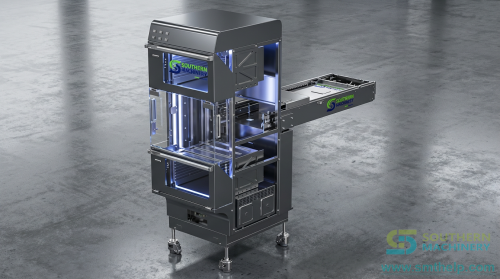
SMTFV3 High-Speed Tray Feeder for PCB Assembly | Southern Machinery
<iframe width="560" height="315" src="https://www.youtube-nocookie.com/embed/3vnFUuuOwG0?rel=0" title="Revolutionize Your EMS Production | SMTFV3 High-Speed Tray Feeder for Precision & Scalability" frameborder="0" allow="accelerometer; autoplay; clipboard-write; encrypted-media; gyroscope; picture-in-picture" allowfullscreen></iframe>
What is this machine used for?
A tray feeder is the material-supply module that stands between your component warehouse and your placement head. The SMTFV3 High-Speed Tray Feeder from Southern Machinery stores JEDEC-style component trays, advances them on demand, and presents each pocket at a repeatable pick position — so an SMT chip mounter, a THT odd-form inserter, or a robotic placement cell can take the part automatically, cycle after cycle.
That matters because tray-fed parts are usually your expensive parts. QFP, BGA, LGA and CSP packages, plus odd-form through-hole components such as connectors, relays and transformers, do not ship on carrier tape. They ship in rigid anti-static trays. On many lines those trays are still handled by hand: an operator walks up, lifts a tray in, waits, then swaps it out. Every manual swap is a window where the placement head has nothing to pick — and where a fine-pitch part can be reoriented, ESD-exposed or physically damaged.
In practical, buyer-oriented terms, the SMTFV3 is used to:
- Keep precision SMT packages flowing to a chip mounter without an operator standing at the machine to feed trays.
- Supply odd-form THT components to an insertion machine, replacing a manual DIP insertion bench for parts that tape feeders cannot present.
- Deliver components to robotic placement cells, where the robot must pick from a defined, repeatable position.
- Hold several tray SKUs online at once, so a high-mix line does not stop for a tray change every time the product changes.
- Stabilise effective line output, so the mounter or inserter — not the operator's tray rotation — sets the pace of the line.
If you are evaluating this class of equipment, the most useful question is not "how fast is the feeder?" but "how many minutes per shift is my placement head not placing because somebody is handling trays?" That number is the business case.
Typical applications
1. High-mix EMS lines running multiple tray-fed product families. When a line changes over between several assemblies that all use QFP, BGA or LGA parts, the feeder has to keep enough tray capacity online to survive the run. Southern Machinery's tray feeder range includes multi-layer tray stack configurations — up to 24 layers — which keeps several tray SKUs staged at once and cuts changeover frequency on high-mix work.
2. Automotive electronics and power supply assembly. Vehicle power supplies, ballast and control boards use relay, connector and transformer components that arrive in trays or bulk packs. Presented on trays to an odd-form inserter, they can be placed automatically instead of at a hand-insertion bench, which is where orientation errors and lead damage most often originate.
3. LED lighting, display and luminous-character manufacturing. These boards mix a small number of high-value placement-critical parts with long, repetitive runs. Automated tray presentation keeps the pick position identical from the first board to the last, which is exactly what LED and lens placement needs to hold its yield.
4. Robotic assembly cells and automation islands. With a pickup-head variant, the feeder hands components directly to a robot or insertion head. The robot then spends its cycle placing instead of hunting for parts, which is how robot cells actually reach their quoted throughput.
5. NPI, prototype and low-volume SMT builds. Trial runs and short production batches rarely justify dedicated hard tooling, but they still use tray-packaged fine-pitch parts. Tray feeding gives these builds the same repeatable pick position that high-volume lines take for granted.
How it fits into a complete PCB assembly line
A tray feeder is one layer of the material-supply system that keeps an entire SMT/THT line running. Southern Machinery supplies the surrounding equipment, which is why the SMTFV3 is normally specified as part of a full line rather than as a standalone box:
- SMT side: solder paste printing → SPI → pick and place (fed by tape, stick, tube and tray feeders) → reflow → AOI. The SMTFV3 sits alongside the chip mounter, presenting JEDEC-tray components so the placement head keeps its CPH instead of waiting on material. Southern Machinery builds the pick-and-place, printer, reflow and inspection equipment on either side of it.
- THT side: radial inserters, odd-form inserters and pin/eyelet terminal insertion machines place through-hole parts; wave soldering — lead-free dual wave or standard wave — then solders them. Tray feeding supplies the odd-form machines with the connectors, relays and transformers that will not run on tape.
- Material logistics: tray feeding plugs into the wider smart-EMS material flow — reel storage systems, kitting, and MES-tracked material presentation. Every component presented automatically is one fewer manual handling step between the warehouse and the board.
- Board handling: SMEMA-compatible loaders, conveyors, buffers and unloaders move PCBs between these stations. Material supply and board flow have to be designed together; automating one without the other just relocates the bottleneck.
In a smart EMS factory layout, this is the point of the feeder family — tape, tube, stick, tray and terminal reel — working with board handling, AOI/SPI and cleaning equipment so that both the board and the components keep moving.
Key selection parameters
Tray feeders are configured around the component mix, so confirm each of these against a datasheet or a written configuration proposal for your application. Do not accept a quotation that leaves them unstated:
- Tray format and pocket layout — the JEDEC tray dimensions and cavity geometry of the components you actually feed, and how many distinct tray SKUs must be online simultaneously.
- Tray stack capacity — how many trays the feeder stores and indexes before a reload is required. Southern Machinery's tray feeder range includes configurations up to 24 layers.
- Presentation method — tray-to-tray indexing, pickup-head delivery, or handoff to a robotic gripper. Choose it based on whether the consumer is an SMT mounter, an odd-form inserter or a robot.
- Changeover time — how quickly the feeder can be reloaded or reconfigured between product runs. This is the parameter that decides whether the feeder helps or hurts on a high-mix line.
- Component compatibility — anti-static handling, orientation control, and protection for fragile, fine-pitch or moisture-sensitive packages.
- Integration — communication with the host placement/insertion machine, MES connectivity, and physical fit within the existing line layout.
- Build quality and service — feeder construction, spare-parts availability, and whether the supplier can customise the feeder around your trays rather than forcing your BOM to fit a standard machine.
ROI and quality perspective
From a buyer's perspective, the tray feeder business case rests on three levers, and each one is measurable before you buy:
Throughput. A placement or insertion head that waits for a manual tray change is losing CPH every time it happens. Multiply the number of tray changes per shift by the stoppage time and you have the recoverable capacity. Automated tray feeding keeps the head working, which raises the effective output of the whole line — not just of the feeder.
Quality. Manual tray handling is a documented source of orientation errors, ESD exposure and bent leads on fine-pitch QFP and BGA parts. A feeder that presents every component at a defined pick position takes that variability out of the process. For high-reliability work — automotive, power, medical — that reduction in handling variability is often worth more than the throughput gain.
Labour. Removing the operator task of tray swapping and machine-side kitting frees headcount for value-added work. This is the direct labour-cost reduction that makes automation projects in EMS factories pay back, and it is the easiest of the three levers to quantify from your own shift data.
Because Southern Machinery designs and manufactures feeders around the customer's trays and component set, the equipment matches the real bill of materials. That is the difference between a tray feeder that pays back and one that becomes another changeover step.
FAQ
What is a high-speed tray feeder used for?
A high-speed tray feeder stores component trays and indexes them automatically to a fixed pick position so an SMT chip mounter, THT odd-form inserter or robotic cell can take parts without manual tray handling. It is used for components supplied in JEDEC-style trays — typically QFP, BGA, LGA and CSP packages, and odd-form through-hole parts such as connectors, relays and transformers.
What components can the SMTFV3 High-Speed Tray Feeder handle?
It handles components that ship in rigid anti-static trays: fine-pitch SMD packages (QFP, BGA, LGA, CSP) and odd-form through-hole parts (connectors, relays, transformers, terminal blocks) that cannot be presented on tape or tube feeders.
How does a tray feeder improve EMS line productivity?
By presenting components automatically at a repeatable pick position, it prevents the placement or insertion head from starving, reduces changeover frequency on high-mix lines (multi-layer tray stacks keep several tray SKUs online), removes manual handling errors, and cuts direct labour at the machine.
What is the difference between tape, tube, stick and tray feeders?
Tape feeders present components from carrier tape; tube and stick feeders present components from rigid tubes; tray feeders present components from flat JEDEC-style trays. Tray feeders are chosen when components are too large, fragile or irregular for tape or tube presentation.
Can a tray feeder work on both SMT and THT lines?
Yes. On the SMT side it feeds precision packages to a chip mounter; on the THT side it supplies odd-form parts to an insertion machine. With a pickup-head variant it can also hand components to robotic assembly cells, making it a flexible part of a mixed SMT/THT smart factory layout.
Does Southern Machinery customise tray feeders?
Yes. Southern Machinery designs and manufactures custom SMT/THT tray feeders around the customer's tray formats and component mix, including multi-layer tray stack configurations and pickup-head variants for robotic cells. Send your tray sizes and bill of materials for a configuration recommendation.
Contact Southern Machinery
Southern Machinery (Shenzhen, China) has designed and manufactured SMT, THT and PCB assembly automation for 237+ global customers since 2011. For SMTFV3 High-Speed Tray Feeder configuration, custom feeder design, and the full feeders, nozzles and material-supply range:
- Email: [jasonwu@smthelp.com](mailto:jasonwu@smthelp.com)
- Website: www.smthelp.com
- Machine catalogs & documents: file.autoinsertion.com
- Product photos: ph.smthelp.com
Tell us your tray formats, component mix and current changeover frequency, and we will propose a configuration sized to your line.
Comments