
SMT Warehouse Traceability: Intelligent Reel Storage Rack by Southern Machinery
SMT warehouse traceability with reel storage automation: LED pick-to-light, real-time inventory, MES/ERP links, selection checklist and ROI steps.
Oct 9, 2026 · Updated Oct 9, 2026 · Southern Machinery
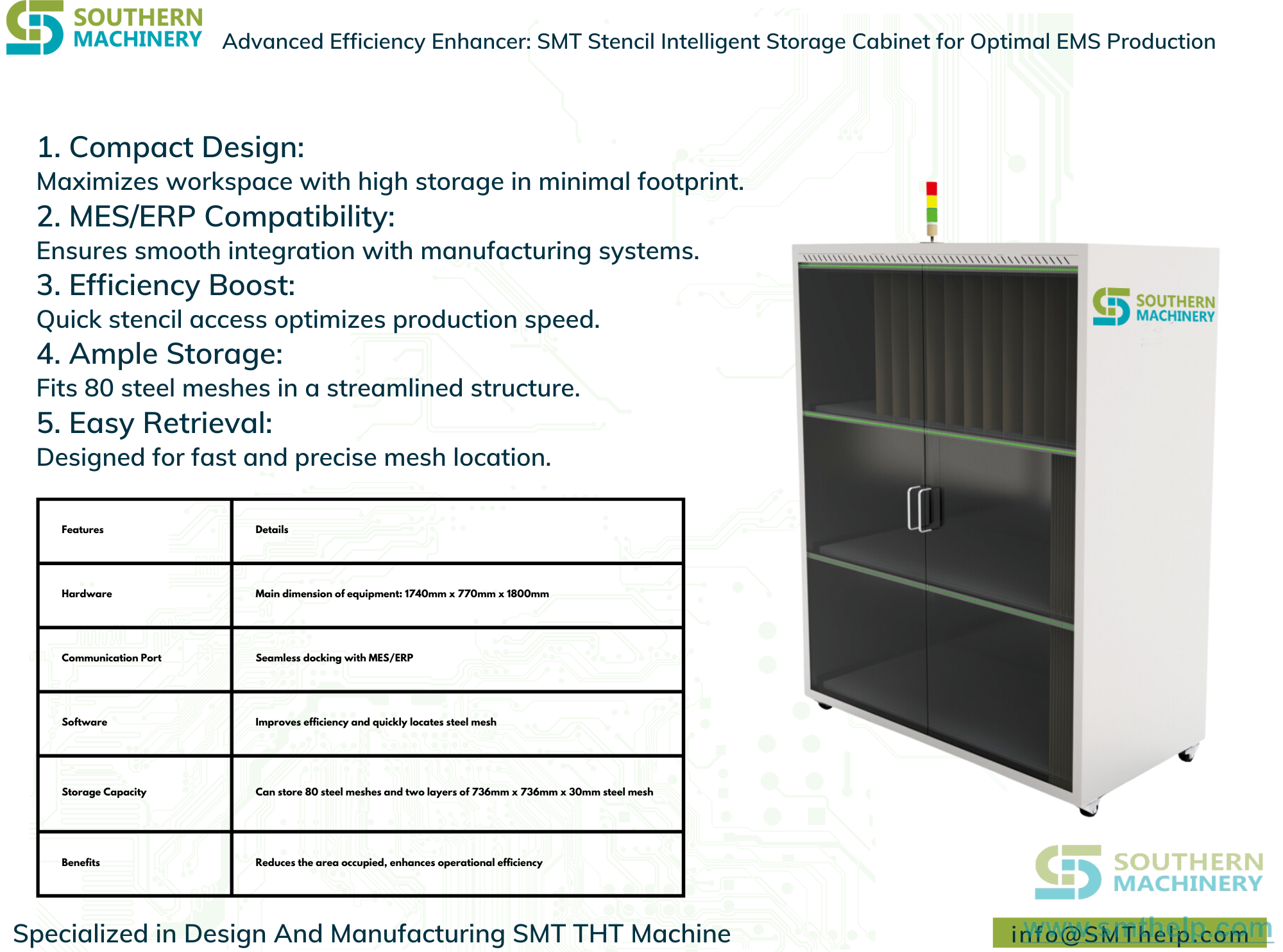
SMT warehouse traceability means every component reel carries a unique ID and is tracked by sensors from goods-in through to line-side placement — so the stock figure on the screen is the stock figure on the shelf. Southern Machinery's Intelligent Reel Storage Rack is built for that job: LED pick-to-light guidance shows the operator which reel to take, sensor shelves keep the count current, and the software layer pushes that data into your MES and ERP. The source document for this guide states the result as 100% real-time accuracy and full traceability of every reel movement.

What does an SMT warehouse traceability system actually track?
Traceability is often a badge on a brochure. In practice it is three separate data problems, and a rack only solves them if it handles all three: identity, position, and history.
Identity: one reel, one ID
Every reel is assigned a unique ID when it is received. That ID is what makes a stock figure auditable instead of estimated — a barcode or RFID scan at goods-in binds the physical reel to a record your ERP can query. Without this step, "warehouse management" is a list of part numbers with guessed quantities.
Position and movement: sensors instead of stock-takes
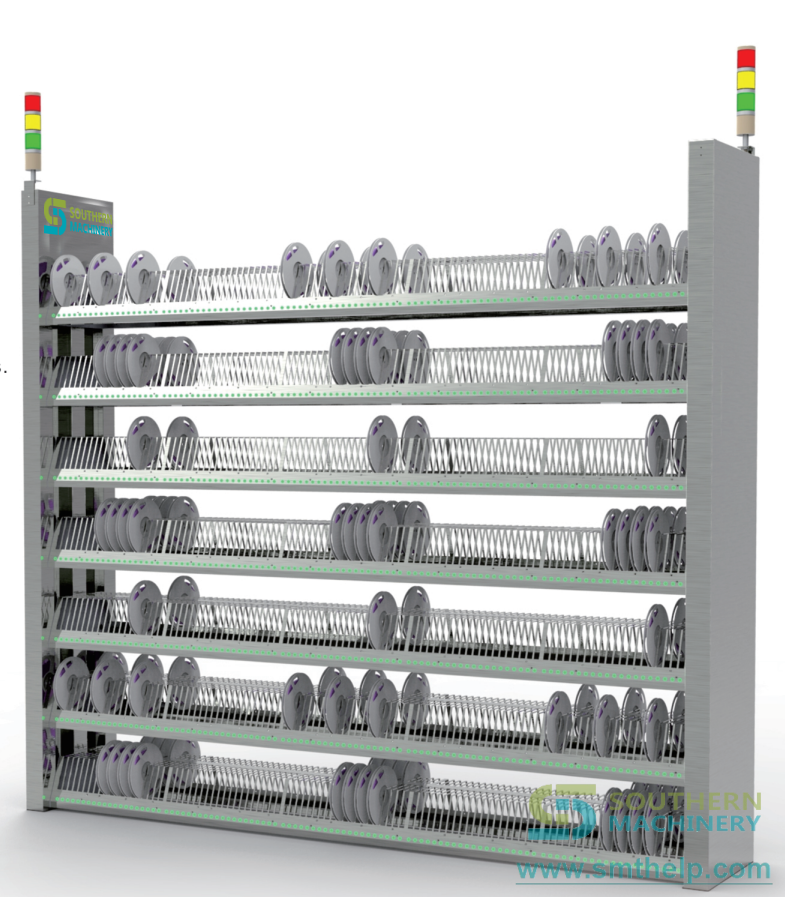
On the Intelligent Reel Storage Rack, shelf sensors register storage and retrieval events as they happen, rather than waiting for an operator to write them down or a monthly count to discover the drift. The document lists storage in about 5 seconds and retrieval times as low as 3 seconds — which matters, because a traceability system that slows the operator down gets bypassed within a week.
History: rotation and material shelf life
The third layer is time. The document specifies FIFO and FEFO rotation support so the oldest qualified material leaves first, plus optional humidity control for moisture-sensitive devices. For an EMS factory building to automotive or medical requirements, that history — reel ID, storage events, rotation order — is the raw material of a traceability report.
Why does manual reel tracking keep failing in EMS warehouses?
The source document names three symptoms that EMS factories report as daily problems, and they are worth reading as one system rather than three complaints.
Inaccurate inventory creates unplanned line-downs
False stock data produces the worst sequence: the pick list says the reel is available, the line stops, and the factory pays for an emergency order. The document's stated remedy is 100% real-time accuracy — the figure is refreshed by the same movement that changed it.
Kitting consumes hours that production never sees
Manual picking is described in the document as a bottleneck, with kitting measured in hours. LED-guided picking is quoted as cutting that to minutes, or even seconds per reel. The saving is not only labour; it is the time a machine waits between jobs.
Wrong parts and expired parts reach the line
Human error and MSD misuse end in the same place: scrap, rework, and traceability gaps that surface months later in a customer audit. Multi-colour LEDs that illuminate the exact reel location are, in the document's words, what makes mispicks "virtually impossible".
Where the two approaches differ, using the document's own terms:
- Stock accuracy — periodic counts that drift, versus sensor-tracked records updated at each movement.
- Pick guidance — an operator reading a pick list and searching, versus LED pick-to-light pointing at the reel.
- Kitting time — measured in hours, versus minutes to seconds per reel.
- Rotation discipline — the operator's judgement, versus FIFO/FEFO support in the system.
- Traceability report — reconstructed by hand after the event, versus reel ID and storage history, query-ready.
Where a parameter is not stated in the document, treat it as unconfirmed and ask Southern Machinery for the specification on your configuration.
Pick-to-light or paper pick lists: which actually removes mispicks?
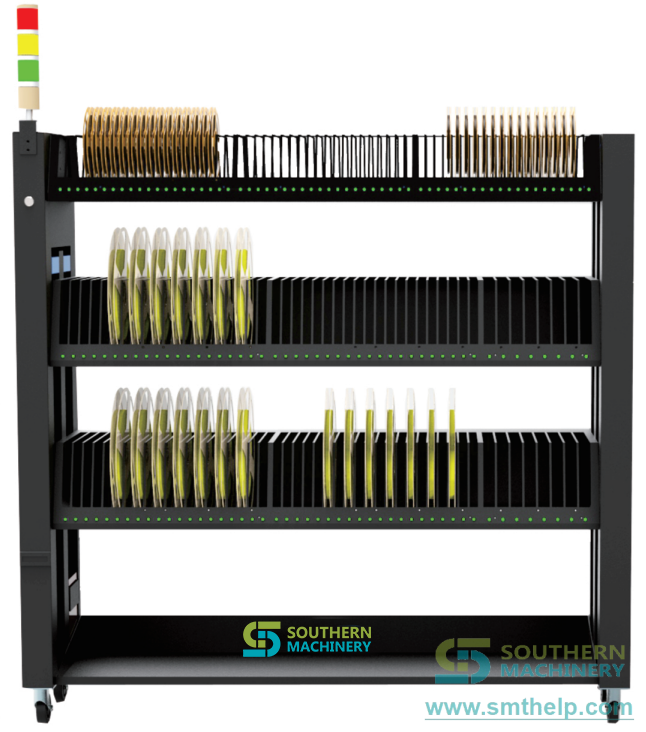
A paper pick list asks an operator to convert a printed part number into a physical reel, in a warehouse of similar-looking reels, under production pressure. Pick-to-light inverts the task: the system has already made the decision, and the operator confirms the illuminated location instead of searching for it.
That inversion is what makes the document's "virtually impossible" mispick claim plausible rather than promotional, and it turns kitting into a guided activity. It is also why multi-kitting — several jobs picked in one pass — becomes practical, with guidance that stays readable while more than one kit is being picked.
How does the rack connect to your MES, ERP and the rest of the SMT line?
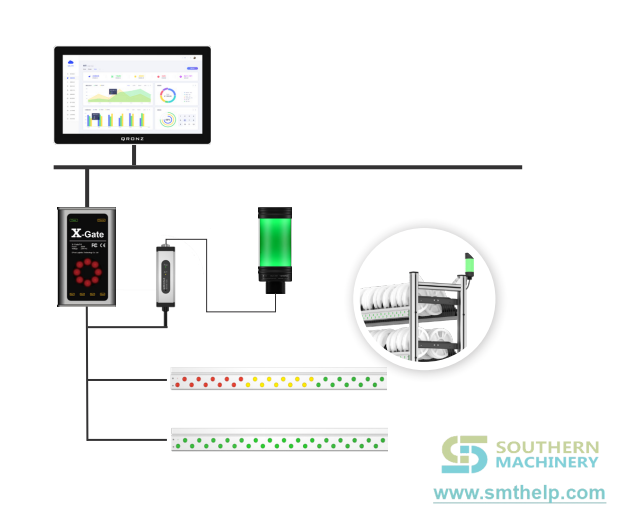
Material handling is an interface problem. A rack that is accurate on its own but invisible to the rest of the factory still leaves planners working from yesterday's numbers, so the document specifies integration with existing MES, ERP and Pick & Place software, plus automated replenishment alerts. In a working layout it sits upstream of the machines it feeds:
- Goods-in and inspection — the reel is scanned and receives its ID.
- Intelligent Reel Storage Rack — sensor shelves hold the stock, LEDs guide every pick and put-away, and the software exposes quantity, location and history.
- Kitting and staging — trolleys move prepared kits to the line with contents already recorded against the job.
- SMT production — loaders, printers, mounters, reflow and inspection consume material traceable from reel to panel.
- Return and re-use — partial reels come back with their history intact.
For the wider line context see Southern Machinery's SMT machine range, the board handling systems that move panels between stations, and the one-stop PCB assembly solutions overview. Southern Machinery has supplied PCB assembly automation equipment from Shenzhen since 2011, covering SMT, THT, wave soldering, board handling and inspection in a single line scope.
Which selection parameters should you confirm before requesting a quote?
Use this as the agenda for the technical discussion:
- Reel diameter and width range — sets shelf pitch, sensor type and how many reels fit.
- Peak reel count and growth plan — racks are modular and expandable, but the first layout should not block growth.
- Reel throughput per shift — kitting and put-away volume determines shelf and station count.
- Retrieval and storage expectations — the document quotes retrieval as low as 3 seconds, storage about 5 seconds.
- MES / ERP / Pick & Place interfaces — integration is a prerequisite, not an accessory.
- Rotation rules (FIFO / FEFO) — required for shelf-life control and audit compliance.
- Environment control — optional humidity control is listed for MSD protection; confirm the applicable option.
- Footprint and aisle layout — compact modular design is claimed; usable area is site-specific.
- ESD and housekeeping — storage is part of the ESD chain.
- Reporting format — agree the traceability report your customers will ask for.
- Open items — price, delivery and final configuration are confirmed only after the technical review.
How do you calculate the payback on reel storage automation?
Model it on the customer's own numbers and treat every input as an assumption to confirm at the technical review. The document states that clients typically see full return on investment in 3 to 12 months; that is a customer-reported range, not a guarantee.
Annual benefit = (labour hours saved x loaded hourly cost)
               + (line-down events avoided x average cost per event)
               + (material written off to expiry or mispick x unit cost)

Payback (months) = (equipment and integration cost) / (Annual benefit / 12)
Worked example — illustrative, depends on configuration, subject to final technical confirmation. An example factory spends 2,000 warehouse hours a year picking, counting and searching at a loaded cost of 20 per hour, records 12 material-related line stops at 500 each, and writes off 3,000 of expired or mispicked material. Annual benefit is 40,000 + 6,000 + 3,000 = 49,000, or roughly 4,083 per month, divided into the quoted equipment and integration cost. Every input is an example for the arithmetic only and must be replaced with the customer's own measured figures.
FAQ
What is SMT warehouse traceability?
It is the ability to identify every component reel by a unique ID and reconstruct where it has been stored, when it moved, and whether it is still within its qualified life — from receiving through kitting to line-side placement. The Intelligent Reel Storage Rack implements this with ID assignment, sensor-tracked shelf positions and MES/ERP integration.
How accurate is the inventory on an intelligent reel storage rack?
The product document states 100% real-time accuracy, because stock levels are updated by the storage and retrieval events themselves rather than by periodic counts. Confirm the reporting granularity you need during the technical review.
How long does it take to store or retrieve a reel?
The document lists retrieval times as low as 3 seconds and storage in about 5 seconds, with LED pick-to-light guidance. Actual times depend on rack size and reel mix.
Does it replace our MES or ERP?
No. The rack is the physical layer that generates accurate material data; the document specifies integration with existing MES, ERP and Pick & Place software so the data lands where planning happens.
Can it protect moisture-sensitive devices?
The document lists optional humidity control for MSD and material protection. Whether it is required depends on your components and floor-life rules; confirm it in the technical review.
What return on investment is typical?
The document states that clients typically achieve full ROI in 3 to 12 months. Treat that as customer-reported experience rather than a guarantee, and model payback on your own labour, downtime and material-loss figures.
Next step
Send Southern Machinery your reel mix, peak reel count and the interfaces you need, and the team will confirm the rack configuration against your floor plan. Product and spare parts documentation is in the Southern Machinery file library, quotations start from the quote request page, and the FAQ and contact page cover the rest.
Comments