
Southern Machinery Odd-Form Insertion Machines: Design & Manufacturing for Smart EMS Factories
Transformers, relays, connectors, fuse holders, and terminal blocks are the hardest THT parts to insert by hand — and the ones that keep DIP lines slow, inconsistent, and expensive. Southern Machinery designs and manufac
Aug 22, 2026 · Updated Aug 22, 2026 · Southern Machinery
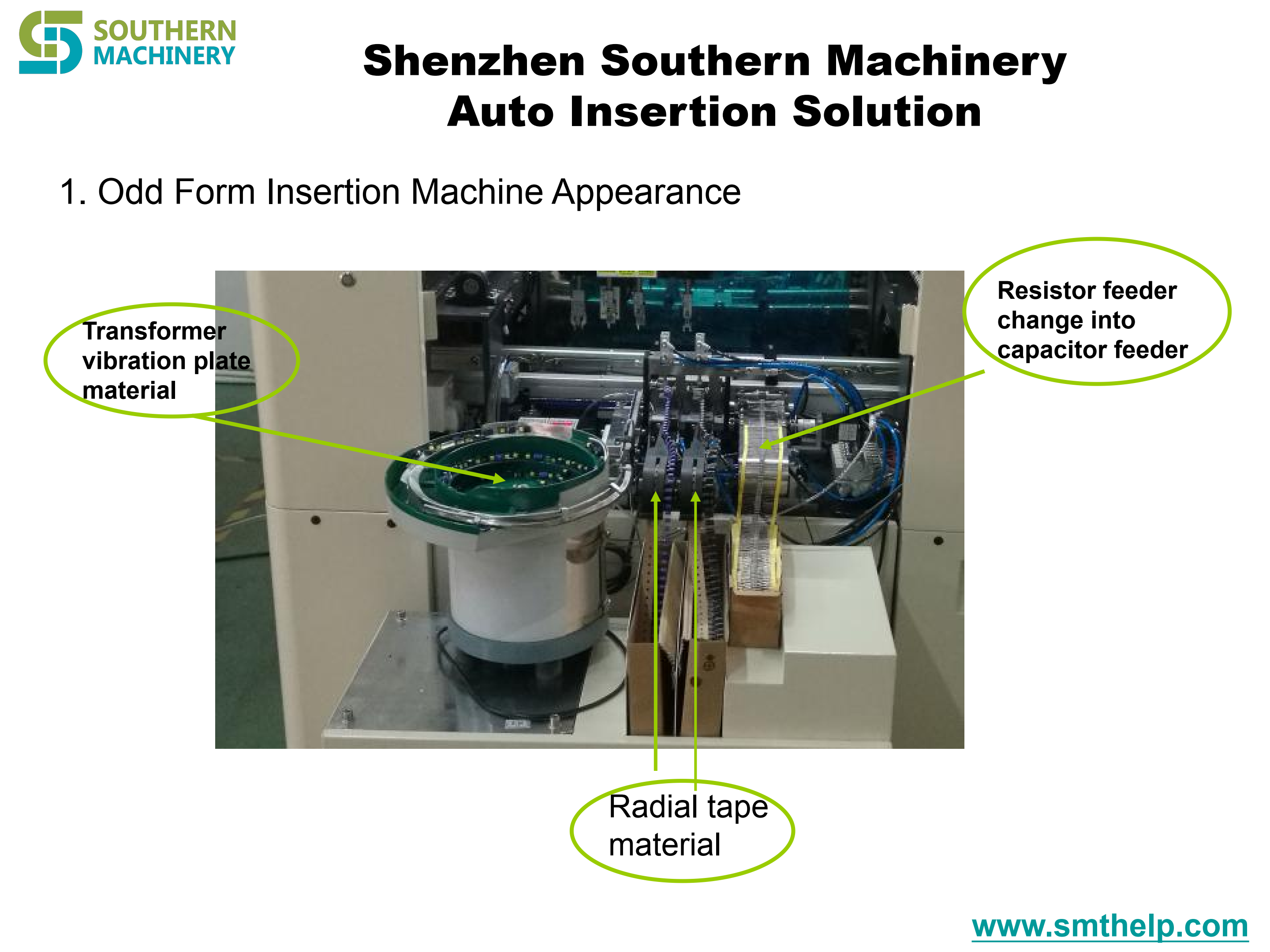
Transformers, relays, connectors, fuse holders, terminal blocks, large electrolytic capacitors — these are the components that never fit into standard radial or axial tape. They arrive in trays, tubes, or loose bags, their lead pitches vary, and their bodies are asymmetric. For years they kept THT DIP lines dependent on manual insertion — until vision-guided odd-form insertion machines changed the equation. This article looks at how Southern Machinery designs and manufactures this class of machine for smart EMS factory PCB assembly, and what it means for your DIP line.
<iframe width="560" height="315" src="https://www.youtube-nocookie.com/embed/xQ0d-dM00RQ?rel=0" title="SMT THT Odd Form Insertion machine - Design and manufacturing for Smart EMS factory PCB assembly" frameborder="0" allow="accelerometer; autoplay; clipboard-write; encrypted-media; gyroscope; picture-in-picture; web-share" referrerpolicy="strict-origin-when-cross-origin" allowfullscreen></iframe>
Watch the demo: SMT THT Odd Form Insertion machine — Design and manufacturing for Smart EMS factory PCB assembly
What is this machine used for?
An odd-form insertion machine is a THT (through-hole) auto-insertion station built for non-standard components. "Odd form" is the industry term for parts that are not radial, not axial, and not SMD: they come in trays, tubes, or loose packaging, their lead pitches vary, and their bodies are asymmetric. In most factories, these parts are still hand-inserted — which is exactly where throughput and quality problems start.
The machine replaces that manual step with a programmable, vision-guided process:
- Vision guidance locates each part and recognizes its lead geometry, so the machine can handle tray, tube, or vibration-bowl presentation without mechanical re-tooling.
- Polarity checking before placement catches 180°-rotated parts, eliminating reverse insertion of polarity-sensitive components.
- Consistent insertion force seats every lead to a programmed depth, eliminating "floating high" components that pass wave soldering but fail in the field.
- Programmable orientations make changeover between PCB variants a software task rather than a mechanical one.
Southern Machinery designs and manufactures its own insertion machines in Shenzhen, China — the mechanical design of the insertion heads, the tape and vibration-plate feeder systems, the vision integration, and the industrial-computer control are all built in-house. That means EMS factories get a machine matched to their actual component portfolio instead of a generic import. The S-70LD odd-form insertion machine is the reference model in this category: 4 insertion heads, 4 adjustable feeders (tape or vibration plate), industrial-computer control with vision guidance, and an inline design that accepts boards via SMEMA handshake on the conveyor upstream of wave soldering. It handles component bodies from 3×3 mm up to 30×30 mm and up to 50 mm high, on PCBs from 50×50 mm to 300×300 mm. Southern Machinery has been designing and manufacturing this class of equipment since 2011 and serves 237+ global customers.
Typical applications
Odd-form inserters earn their keep wherever a product family repeatedly uses the same awkward components:
- Power supplies — transformers, inductors, and radial electrolytic capacitors (E-CAP) inserted from tape or vibration feeders.
- Appliance control boards — relays, fuse holders, and terminal blocks for air conditioners, induction cookers, microwaves, and electric kettles.
- LED lighting and drivers — electrolytic capacitors, optoelectronic components, and lamp-related THT parts with polarity-critical orientation.
- Automotive electronics — connectors and relays for car audio and vehicle power supplies, where reverse insertion is a field-failure risk.
- Industrial controls and instrumentation — terminal blocks and connectors shared across multiple PCB variants, so program changeover cost per SKU stays low.
The common thread: medium-to-high volume per SKU (roughly 500+ boards per run), standard odd-form component families shared across several PCB variants, and a line where quality consistency matters more than operator flexibility.
How it fits into a complete PCB assembly line
An odd-form inserter is one station in a complete mixed-technology line:
SMT line (solder paste → SPI → pick and place → reflow → AOI) → THT insertion (radial + odd form) → wave soldering → cleaning → final inspection
The machine is designed as an inline station: it connects to the existing conveyor system upstream of wave soldering, accepts boards via SMEMA handshake, and returns them to the same line. No additional board handling is introduced, and existing wave soldering, cleaning, and conveyor infrastructure stays in place.
Southern Machinery covers the rest of the DIP line with complementary equipment:
- S-3010B radial insertion machine for standard radial components on the same line
- S-WS450 and S-WS350B lead-free wave soldering machines downstream of insertion
- Board handling systems for safe, ESD-aware PCB transfer between stations
- S-680A reel scrap tape cutting machine to process tape waste from tape-fed insertion
- SMT nozzles, feeders, and spare parts to keep the line running
For an EMS factory, this means the odd-form inserter is not a standalone gadget — it is a drop-in automation upgrade for the most labor-dependent part of an otherwise automated line.
Key selection parameters
When evaluating an odd-form insertion machine for your line, compare these parameters rather than a single headline number:
- Component envelope — maximum body size and height your product mix actually contains.
- Feeder flexibility — how many feeders, and which presentation formats: tape, vibration plate, tube, or tray.
- Vision capability — lead-geometry recognition and polarity checking before placement.
- Speed vs. accuracy — rated CPH is meaningless if the accuracy budget for your lead pitches is not met.
- PCB size range — board dimensions and thickness your current and future products cover.
- Line integration — SMEMA-compatible conveyor handshake and upstream/downstream compatibility.
- Changeover and programming — how quickly a new SKU or a new component is taught.
- Facility requirements — footprint, power supply, and compressed air demand.
- After-sales support — spare parts availability, training, and service response time.
Southern Machinery publishes detailed spec sheets per model — contact the team at jasonwu@smthelp.com or download the catalog from file.autoinsertion.com to compare against your board portfolio.
ROI and quality perspective
From a buyer's perspective, the business case for odd-form automation is rarely about replacing one wage — it is about the costs that manual insertion hides:
- Throughput variability. A hand-inserted connector can take 4 to 10 seconds depending on operator familiarity and part presentation. On a 5,000-board run with four odd-form parts per board, that variability adds hours of unplanned labor per shift.
- Defect costs. Manual insertion produces floating-high, misinsertion, and reverse insertion defects that are only caught at AOI or functional test — after wave soldering and cleaning. Rework means desoldering, clearing the through-holes, reinserting, and re-soldering: several minutes per board, often damaging adjacent components.
- Field-failure risk. A transformer with 6 to 10 pins needs every pin seated; a single non-seated pin can cause a field failure that costs many times the board's assembly value to repair.
Automation converts these variable costs into a predictable one. Vision-guided insertion checks polarity before placement, seats every lead to the same depth, and runs the same cycle time on every shift. Line balancing becomes predictable, quality is consistent, and production scale no longer depends on recruiting and retaining skilled hand-insertion operators — which is why 237+ global customers in appliance, power supply, LED, and automotive electronics use Southern Machinery THT automation.
FAQ
What are odd-form components in PCB assembly?
Odd-form components are through-hole parts that do not fit standard radial or axial tape formats — for example transformers, relays, connectors, fuse holders, terminal blocks, and large electrolytic capacitors. They typically arrive in trays, tubes, or loose packaging, have varying lead pitches, and asymmetric bodies, which makes them difficult to automate with conventional inserters.
How does an odd-form insertion machine work?
The machine uses industrial-computer control with vision guidance to locate each part, recognize its lead geometry, and place it onto the PCB. The vision system checks polarity before placement, seats every lead to a programmed depth with consistent insertion force, and can handle tray, tube, or vibration-bowl presentation without mechanical re-tooling.
Which machine does Southern Machinery offer for odd-form insertion?
Southern Machinery's reference model is the S-70LD odd-form insertion machine — a vision-guided, inline THT inserter with 4 heads, 4 adjustable feeders (tape or vibration plate), and industrial-computer control. The company designs and manufactures the machines in Shenzhen, China and also offers the S7000-series odd-form/pin insertion family.
Can an odd-form inserter connect to an existing wave soldering line?
Yes. The S-70LD is designed as an inline station: it accepts boards via SMEMA handshake, connects to the existing conveyor upstream of wave soldering, and returns boards to the same line — so existing wave soldering, cleaning, and conveyor infrastructure remains unchanged.
How does vision guidance prevent reverse insertion?
The machine's vision system recognizes each part's lead geometry and checks polarity before placement. A part rotated 180° is detected and corrected or rejected, so polarity-sensitive components such as electrolytic capacitors, diodes, and transformers are inserted in the correct orientation every cycle.
How do I get pricing or a catalog for Southern Machinery odd-form insertion machines?
Contact Jason Wu at jasonwu@smthelp.com for pricing and a technical proposal, download the product catalog from file.autoinsertion.com, and browse product images at ph.smthelp.com.
---
About Southern Machinery
Shenzhen Southern Machinery Sales And Service Co., Ltd is a precision SMT and PCB assembly equipment manufacturer based in Shenzhen, China. Founded in 2011, the company has served 237+ global customers across appliance, power supply, LED, automotive, and general electronics manufacturing with THT auto insertion, SMT, wave soldering, and board handling automation for smart EMS factories.
Contact
- Email: jasonwu@smthelp.com
- Website: https://www.smthelp.com
- Catalog: https://file.autoinsertion.com
- Product images: https://ph.smthelp.com
Comments