
SMT Solder Paste Printer A9 & SP-1200 by Southern Machinery
Compare A9 automatic and SP-1200 semi-automatic SMT solder paste printers: accuracy, changeover, line integration and a payback model for PCB assembly lines.
Oct 6, 2026 · Updated Oct 6, 2026 · Southern Machinery
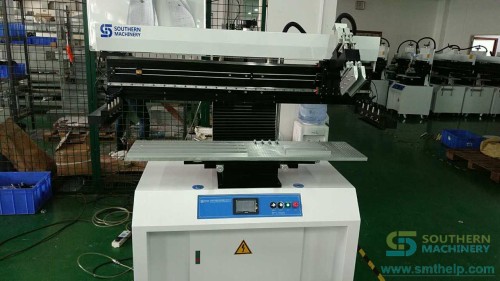
An SMT solder paste screen printer deposits solder paste through a stencil onto PCB pads before any component is placed. Paste volume is set in the seconds the squeegee crosses the stencil, and nothing downstream repairs it: the mounter places onto whatever you printed, and the reflow oven bakes that decision in. Southern Machinery builds both answers - the A9 fully automatic vision printer, and the SP-1200 and SP-300 semi-automatic printers for NPI and boards up to 1200 mm long.
What does an SMT solder paste screen printer decide for your line?
Yield problems are usually chased at AOI or at rework, by which time the paste volume is wrong and the only lever left is a soldering iron. Fixing the deposit instead costs a stencil and a setup. Typical applications split the same way: long LED lighting, power-supply and instrument boards that will not fit an in-line printer are what the SP-1200 was built for, while a fine-pitch QFN or 0402 array is where the accuracy figure stops being a datasheet number.
A9 or SP-1200: which SMT solder paste printer fits your production?
A fully automatic in-line printer and a semi-automatic bench printer solve different problems.
A9 - fully automatic in-line vision printer
PC control, a CCD camera with geometry pattern matching, programmable dry, wet and vacuum cleaning, two motorised print heads and board transport to 1500 mm/s. Fiducials - square, round, triangle, cross or pad hole - are corrected in X, Y and theta, and 2D solder paste inspection is standard. Arithmetic on cycle time, not a measured claim: 12 s gives 165 boards/h with one operator, 300 in-line.
SP-1200 and SP-300 - semi-automatic printers
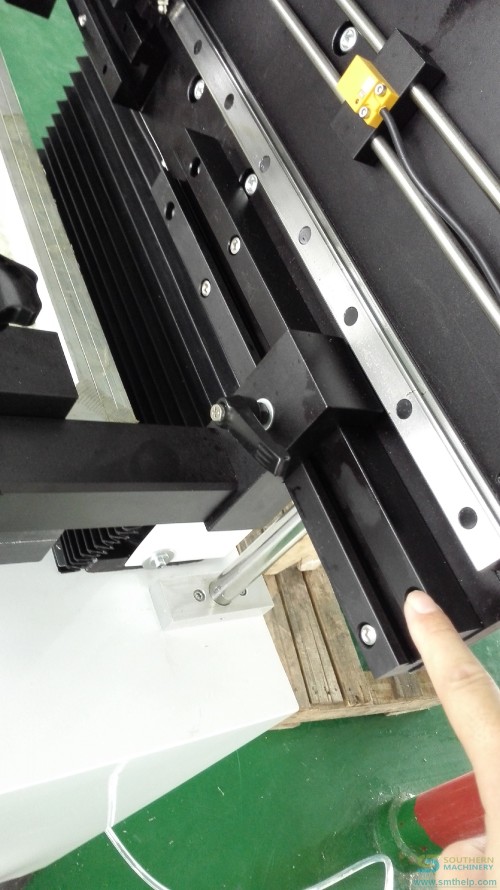
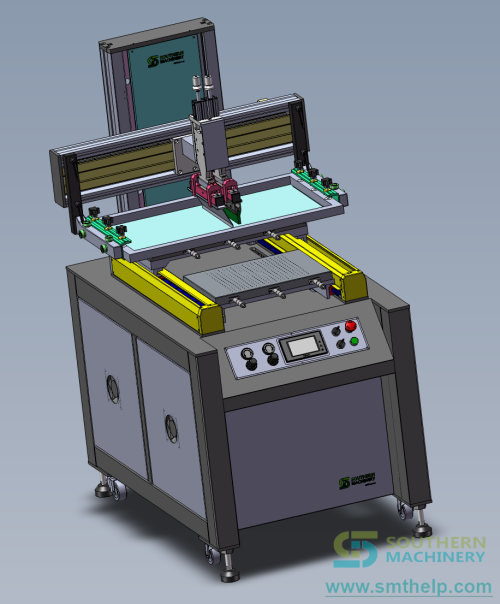
The SP-1200 is quoted for boards up to 1200 mm, covering LED lighting and long power-supply boards that will not fit an in-line printer; the operator loads and aligns each board. The SP-300 uses the same print head concept - an SMC rail and speed-control motor driving a steel squeegee base that lifts 45 degrees for cleaning - in a 250 kg machine.
What the source documents disagree on
Three Southern Machinery documents cover this family and disagree on several rows, disclosed rather than averaged: PCB size (300 x 1200 versus 350 x 1200 mm), printing area (320 x 1250 versus 320 x 1270 mm), frame size (420 x 1500 versus 370 x 1320 mm), printing accuracy (+/- 0.02 versus +/- 0.05 mm) and weight (550 versus 250 kg).
What are the key selection parameters for a stencil printer?
A9 parameters, as quoted
- Screen frame - 470 x 370 mm to 737 x 737 mm, 25-40 mm thick
- PCB - 50 x 50 mm to 510 x 340 mm and 0.4-6 mm thick; board warpage not specified in source - contact Southern Machinery to confirm
- Accuracy - +/- 0.015 mm at CPK > 2.0 and 03015 capable; repeat accuracy +/- 0.007 mm
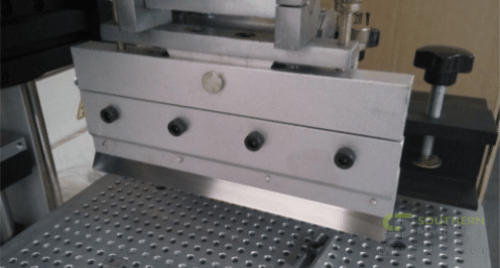
- Squeegee - steel or plastic blade; 6-200 mm/s; 0-15 kg; 60, 55 or 45 degrees
- Separation and cleaning - 0.1-20 mm/s; dry, wet and vacuum programmable
- Transport and utilities - 900 +/- 40 mm height; 220 V, single phase, 3 kW; about 1000 kg
SP-1200 and SP-300 parameters, as quoted
- SP-1200 - PCB 300 x 1200 mm; print area 320 x 1250 mm; frame 420 x 1500 mm; squeegee 0-100 mm/s; accuracy +/- 0.02 mm; minimum distance 0.35 mm; about 550 kg
- SP-300 - PCB 350 x 1200 mm; print area 320 x 1270 mm; frame 370 x 470 mm and 550 x 650 mm; speed-control motor drive; accuracy +/- 0.05 mm; 250 kg
The two numbers to check first
The smallest gap between adjacent paste apertures decides whether your densest board can be printed at all. The semi-automatic series quotes 0.35 mm, and on a fine-pitch QFN that is the difference between a clean release and paste that bridges through reflow. Measure aperture to aperture, and check the board you will build in two years, not only today's. The second number is changeover - last good board of one product to the first good board of the next.
How does the printer fit into a complete PCB assembly line?
What sits either side of the printer
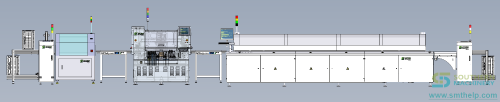
Upstream is a board loader and any handling conveyors; set transport height to 900 +/- 40 mm to match the conveyor either side. Downstream is the mounter, then reflow, then inspection. Southern Machinery supplies the whole sequence - loaders, printers, mounters, reflow ovens, AOI and SPI, stencil cleaning and storage, and the handling between them - so the printer is quoted against the line it joins. See the SMT machine range, board handling systems and the SP-1200 product page.
Utilities, floor and options
The A9 needs single-phase 220 V at 3 kW and 4.5-6 kg/cm2 of clean dry air and occupies 1216 x 1381 mm at about 1000 kg; leave access to both sides, because the squeegee head, stencil frame and cleaning system are reached daily. Options that remove a manual task include a stencil inspection system, automatic paste addition, an automatic dispensing system for mixed-technology panels, in-line 3D SPI and an Industry 4.0 interface. Specify consumables with the machine: squeegee blades and PCB locating pins.
Cost efficiency: how do you calculate SMT printer payback?
Operator hours released per month = Operators released x Production hours per day x Production days per month
Monthly value released            = Operator hours released per month x Loaded hourly cost
Payback (months)                  = Printer investment / Monthly value released
Example calculation - example figures only
With one operator released, 20 production hours a day and 22 days a month, released hours are 440 a month. At an example loaded cost of USD 3.50 per hour that is USD 1,540 a month against an example investment of USD 25,000 - a payback of about 16 months. Every figure is an illustration, depends on configuration and is subject to final technical confirmation. The model ignores paste, stencil, consumable, floor-space and financing costs. The trigger to stop adding operators is measurable: when printing and reprint exceed two operator positions per shift, or changeover exceeds 15 minutes, the manual approach has become structural rather than cheap. Re-check that trigger every year in both directions, because a line that shifts from high volume to high mix may be better served by a semi-automatic machine.
Lifecycle: what keeps an SMT solder paste printer accurate in year three?
Fix the blade angle first and leave it alone; it is a mechanical setup, not a running parameter, and the A9 offers 60, 55 and 45 degrees. Set speed from the paste manufacturer's data, and set pressure last and as low as the board allows. Write down what you set, and require anyone who changes it to do the same.
A stencil that is not cleaned does not stop printing - it prints slightly worse until an aperture blocks and a pad goes down with no paste at all, by which time a few hundred boards have been produced in the degraded window. Put cleaning on a schedule tied to boards or elapsed time, and test it by holding the stencil to a light source. The A9 cleans programmable in dry, wet and vacuum modes.
Southern Machinery has built SMT and THT equipment since 2011 and has shipped to Brazil, India, Malaysia, Indonesia, Thailand, Turkey, Saudi Arabia and across Latin America. Support starts remote and goes on-site when remote is not enough, and operators are trained on setup, alignment, cleaning and the parameters they may adjust.
SMT solder paste printer FAQ
What is the difference between the A9 and the SP-1200?
The A9 loads, aligns, prints, cleans and inspects without an operator and changes product in under 5 minutes; the SP-1200 is semi-automatic, with the operator loading and aligning each board.
Can the SP-1200 really print a 1200 mm board?
1200 mm is what its specification sheet quotes, but the source documents disagree on the exact PCB size - 300 x 1200 mm on one sheet, 350 x 1200 mm on another. Confirm against the current drawing.
What printing accuracy should I expect?
The A9 sheet quotes +/- 0.015 mm at CPK > 2.0 and +/- 0.007 mm repeat accuracy, and states 03015 capability. The semi-automatic series is quoted at +/- 0.02 mm to +/- 0.05 mm. Accuracy is only meaningful next to a CPK value.
What paste should I use?
That decision belongs with your process engineer and paste supplier, because it depends on your alloy, profile and reliability requirements. The printer's job is to hold the parameters your paste needs.
Send us your board and we will tell you which printer fits
Send your board dimensions, monthly volume and a photo of your current setup, and you will get a straight answer on whether you need the A9, the SP-1200, the SP-300 or neither. Southern Machinery supplies SMT lines, THT automation, wave soldering, board handling and inspection to more than 237 global customers, with global service and spare parts support. Open the originals if a number matters: the A9 specification sheet, SP-1200 specification and manual, SP-300 specification sheet and A9 installation manual. Email info@smthelp.com.
Comments