
SMT Intelligent Reel Storage Rack for Manual Material Handling by Southern Machinery
Manual reel handling can quietly become one of the most expensive constraints in an SMT factory: operators lose time searching for reels, picking errors interrupt changeovers, and storage space expands faster than production output. Southern Machinery’s SMT Intelligent Reel Storage Rack is positioned as a smart material-control solution for EMS and PCB assembly teams that need faster reel retrieval, guided picking, and more disciplined line-side replenishment. Based on the source material, the system targets under-4-second reel retrieval, Pick-to-Light guidance, 99.9% inventory accuracy, up to 75% storage-area savings, and ROI that must be confirmed against each factory’s labor cost, SKU count, and production schedule.
Jul 28, 2026 · Updated Jul 28, 2026 · Southern Machinery
SMT Intelligent Reel Storage Rack for Manual Material Handling by Southern Machinery
Manual SMT material handling often looks like a storage problem, but the real factory impact is broader: operators spend time searching for reels, changeover teams wait for the right material, and inventory errors can stop a line that is otherwise ready to run. For EMS, ODM, automotive electronics, medical electronics, and industrial control manufacturers, these small delays can accumulate into measurable OEE loss.
Southern Machinery's SMT Intelligent Reel Storage Rack is designed for factories that want to move reel storage from manual searching to guided, traceable, line-supporting material control. The source document positions the system around speed, accuracy, space utilization, and practical ROI rather than storage furniture alone.
What is this machine used for?
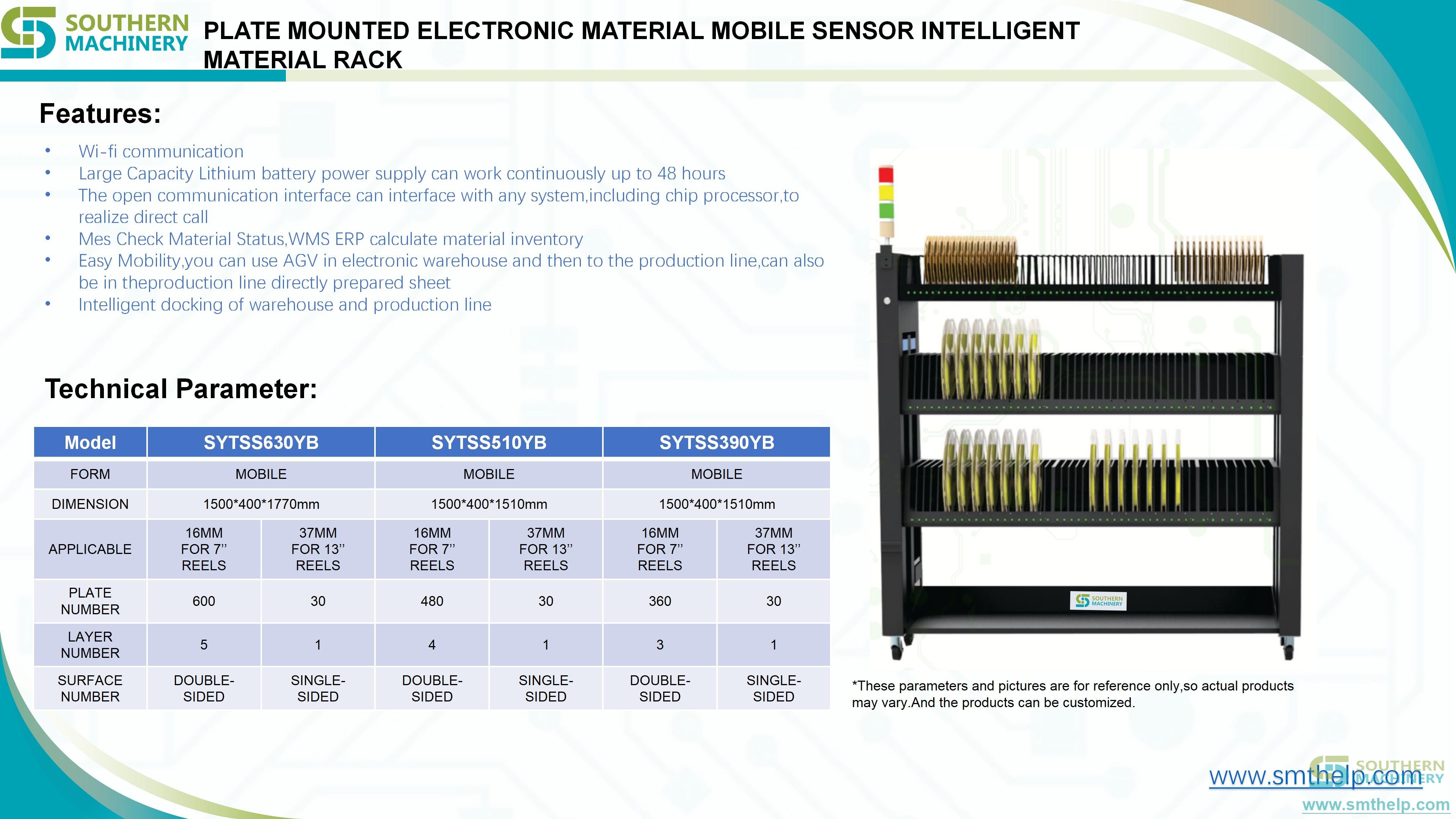
The SMT Intelligent Reel Storage Rack is used to store, locate, and retrieve SMD component reels more efficiently inside an SMT production environment. Instead of depending on operators to manually search shelves or cabinets, the rack supports guided reel retrieval and material organization for faster preparation before production and changeover.
In practical PCB assembly operations, the machine is used for:
- Line-side or warehouse reel storage for SMT components.
- Faster material preparation before production runs.
- Reducing operator search time during changeover.
- Supporting Pick-to-Light guided picking to reduce reel selection errors.
- Improving storage density through a vertical rack structure.
- Creating a more controlled foundation for SMT material traceability workflows.
Why manual reel handling becomes a production bottleneck
The source document states the core problem directly: in a competitive electronics market, every second on the production line counts, and manual material handling can become a critical liability. That is a useful first-principles way to view SMT storage.
An SMT line does not only need reels to exist in inventory. The line needs the correct reels to be found, verified, delivered, staged, and returned without delay. If any one of those steps depends heavily on manual searching, the factory pays for it through:
- Longer changeover windows.
- More operator walking and searching time.
- Higher risk of wrong-reel picking.
- More floor space tied up in low-density storage.
- Slower response when urgent production priorities change.
Key value points from the source document
The selected local source presents four main performance claims. These should be treated as project targets or source-stated benefits, with final confirmation depending on the selected configuration, factory workflow, and material database integration.
Faster reel retrieval
The source document states that the rack can help teams retrieve any reel in under 4 seconds. In a high-mix SMT factory, this matters because the same storage system may support many SKUs, frequent job changes, and urgent replenishment requests.
Guided picking accuracy
The source document states 99.9% inventory accuracy with Pick-to-Light guidance. The engineering value is not only the accuracy number itself, but the workflow principle behind it: the system should guide the operator to the right reel instead of relying only on memory, labels, or manual shelf searching.
Better use of floor space
The source document states that the vertical design can help reclaim up to 75% of storage area. For factories where material storage competes with production space, incoming inspection, kitting, or WIP staging, storage density can directly affect layout flexibility.
ROI potential
The source document mentions a possible 3-6 month ROI. This should be evaluated as an example or target case, not a universal guarantee. A realistic ROI check should include labor cost, reel SKU count, number of changeovers per shift, line downtime cost, inventory error rate, available floor space, and the level of software or traceability integration required.
Typical application scenarios
The SMT Intelligent Reel Storage Rack is most relevant when the factory has a clear material-flow problem, not just a desire for a cleaner warehouse. Typical scenarios include:
- High-mix, medium-volume SMT production with frequent changeovers.
- EMS factories managing many customer BOMs and component reels.
- Automotive or industrial control production where material traceability discipline is important.
- SMT lines where operators spend too much time locating reels before setup.
- Factories expanding output but constrained by storage floor space.
- Production teams preparing to connect storage, kitting, scanning, and line-side replenishment.
How it fits into a complete PCB assembly line
Southern Machinery, founded in Shenzhen, China in 2011, focuses on SMT/THT PCB assembly automation equipment and has served 237+ global customers. The SMT Intelligent Reel Storage Rack can be considered as part of a broader factory automation plan rather than a standalone warehouse accessory.
A practical line integration can look like this:
- Incoming material is received, labeled, and registered.
- Reels are stored in the intelligent rack using controlled locations.
- Operators retrieve reels using guided picking before SMT setup.
- Reels are staged for the printer, pick-and-place machine, reflow oven, and inspection process.
- Unused reels are returned to controlled storage after production.
- The same factory can later extend automation into board handling, SPI/AOI, THT insertion, wave soldering, selective soldering, and traceability systems.
For a full PCB assembly project, Southern Machinery can support SMT, THT, wave soldering, board handling, inspection, spare parts support, professional training, and cost-effective automation planning.
Key selection parameters for buyers
Before selecting an intelligent reel storage rack, procurement and manufacturing engineering teams should confirm these points:
- Number of active reel SKUs and expected future growth.
- Daily or shift-level changeover frequency.
- Required storage capacity and reel sizes.
- Current time spent searching, picking, staging, and returning reels.
- Whether Pick-to-Light guidance is required.
- Whether barcode, MES, ERP, or traceability integration is needed.
- Available floor area and ceiling or rack-height constraints.
- ESD requirements and material handling rules.
- Operator workflow from warehouse to SMT line-side staging.
- Required training, spare parts, and after-sales support plan.
ROI, quality, and production value
The business case for intelligent reel storage is strongest when manual searching and material errors create hidden cost. The value is usually built from several small improvements, not one isolated feature.
A more disciplined storage workflow can help reduce waiting time before production, reduce wrong-reel selection risk, recover floor space, and make material preparation more predictable. For factories running multiple shifts or high-mix customer orders, that predictability can be more valuable than the rack hardware alone.
However, ROI should be calculated against the real factory baseline. The source document's 3-6 month ROI statement should be treated as configuration- and workflow-dependent. Final payback should be confirmed after reviewing reel quantity, labor cost, changeover pattern, software needs, and production downtime cost.
FAQ
Is this only a storage rack?
No. The source document positions it as an intelligent material handling tool for speed, accuracy, and efficiency. The practical value comes from guided retrieval, controlled storage locations, and better SMT material workflow.
Does it replace all manual material handling?
Not by itself. It reduces manual searching and improves guided picking, but the final workflow still depends on receiving, labeling, kitting, line-side staging, and return-material control.
Can it connect with a complete SMT line project?
Yes. It can be planned together with SMT printing, pick-and-place, reflow, AOI/SPI, board handling, THT automation, wave soldering, and traceability requirements. The exact integration scope needs technical confirmation.
Are the speed, accuracy, storage saving, and ROI numbers guaranteed?
No. The source document provides targets and claimed benefits such as under-4-second retrieval, 99.9% inventory accuracy, up to 75% storage-area savings, and 3-6 month ROI. Actual performance depends on configuration, factory layout, SKU count, operator process, and integration level.
What information is needed for a quotation?
A useful RFQ should include reel SKU count, required capacity, reel sizes, current storage method, changeover frequency, available floor space, barcode or MES requirements, and whether the rack will support one SMT line or a larger factory material warehouse.
Who should consider this system first?
EMS and PCB assembly factories with high-mix production, frequent changeovers, limited storage space, or recurring material-picking errors should evaluate intelligent reel storage before expanding manual shelving or adding more labor.
CTA: plan your SMT material flow before adding more shelves
If your SMT team is losing time in reel searching, wrong picking, or line-side material preparation, the next step is not simply buying more storage racks. The better step is to map the material flow from receiving to production and calculate where guided storage can remove delay.
Southern Machinery can help review your reel quantity, storage layout, changeover frequency, and SMT line configuration, then suggest a cost-effective intelligent reel storage setup that fits your production reality.
Comments