
SMT Manual Insertion Machine: Efficient & Stable Electronic Assembly with Southern Machinery
How SMT manual insertion stations keep THT and DIP assembly efficient and stable: applications, line integration, selection and factory ROI for EMS lines.
Sep 25, 2026 · Updated Sep 25, 2026 · Southern Machinery
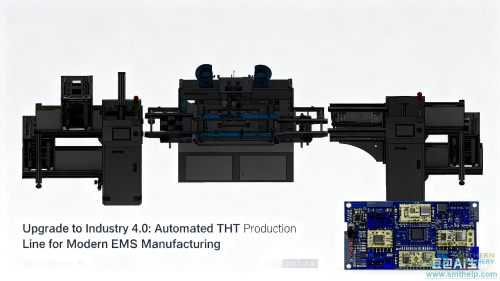
SMT Manual Insertion Machine: Efficient & Stable Electronic Assembly with Southern Machinery
In a mixed-technology PCB assembly line, not every through-hole component can be handed to an automatic inserter. Transformers, relays, fuse holders, terminal blocks, large connectors and other odd-form THT parts still need a human hand. The SMT manual insertion machine — the operator workstation that sits between the SMT line and the wave soldering machine — is what keeps that manual work organized, repeatable and fast.
Hand insertion is not the enemy. Unstructured hand insertion is. When components arrive in loose bags, when boards are passed by hand between stations, and when cycle time depends on which operator is on shift, the DIP line becomes the quiet bottleneck of the factory. A properly designed manual insertion station turns that same work into a predictable process with controlled presentation, ESD protection and a fixed takt time.
This guide explains what a manual insertion machine is used for, where it fits in a complete THT/DIP line, how to evaluate one, and how Southern Machinery combines manual stations with automatic insertion, wave soldering and board handling into one workflow.
Video: SMT Manual Insertion Machine in operation
What is this machine used for?
An SMT manual insertion machine is the operator-assisted insertion station used to place through-hole components onto a PCB before soldering. It is not a robot — it is a purpose-built work position: a stable board fixture or conveyor-mounted platform, controlled component presentation (bins, trays, tube racks or feeder racks), task lighting, ESD-safe surfaces, and tool holders for lead forming, clinching or screwdriving.
Its job is to make manual insertion efficient and stable rather than improvised. Practically, it answers four questions for the production manager:
- Where does the board sit while the operator works, and how is it fixed so it does not shift?
- How is each component presented so the operator does not waste seconds searching?
- How is the board transferred to the next station without manual lifting?
- How is ESD, ergonomics and insertion consistency controlled across shifts?
Manual insertion stations are used for the parts that automatic insertion equipment cannot economically handle: low-volume odd-form components, parts with irregular lead geometry, parts with high unit cost where a misinsertion is expensive, and parts whose annual volume does not justify a dedicated programmable feeder and tooling set.
Typical applications
Manual and semi-automatic insertion stations are common in mixed-technology PCB assembly across many industries served by Southern Machinery:
- Home appliance control boards — air conditioner, washing machine, microwave, induction cooker and electric kettle PCBs that carry relays, transformers, fuse holders and terminal blocks.
- Power supply and LED driver boards — vehicle power supplies, energy-saving power supplies and ballast boards with large magnetic components that must be seated to a controlled depth.
- LED lighting and display panels — lighting, luminous-character and control-system boards where connectors and terminal blocks are hand-placed before wave or selective soldering.
- Automotive and vehicle electronics — car audio and vehicle power boards where polarity-sensitive components cannot risk reverse insertion.
- General instruments and electronics — watches, meters and spare-part boards where product mix changes frequently and dedicated automation is not justified.
In each case the manual insertion station sits at the point of highest variety and lowest volume — and the goal is to make it as controlled as the automated stations around it.
How it fits into a complete PCB assembly line
A manual insertion station is never a standalone machine. It is a module inside a wider PCB assembly line, and its value comes from how cleanly it connects upstream and downstream.
1. SMT stage (top side). Solder paste printing, SMT pick-and-place, reflow and post-reflow inspection (3D SPI / AOI) build the surface-mount side of the board. Southern Machinery supplies SMT peripheral equipment and peripheral support for this stage.
2. THT / DIP insertion stage. This is where manual insertion stations sit — usually in parallel with automatic insertion machines. Southern Machinery's automatic insertion range includes the S-3010B radial insertion machine (off-line), the S3000 radial/DIP insertion machine, the S-70LD and S7900 odd-form insertion machines and the S7020 series PIN eyelet terminal insertion machine. High-volume, standard radial and odd-form parts go to the machines; the rest stays on manual stations.
3. Lead conditioning. Before soldering, leads may be cut and formed on equipment such as the S-320AT inline automatic lead cutter. Consistent lead length is what allows a clean wave solder joint.
4. Wave soldering. Boards then enter the wave solder. Southern Machinery supplies the S-WS450 wave soldering machine and the S-WS350B lead-free dual wave soldering machine with PC control for RoHS-compliant, lead-free processes. Insertion quality set at the manual station — fully seated parts, correct polarity — is what protects yield here.
5. Cleaning and inspection. Post-solder flux is removed on cleaning equipment such as the SME6200 PCBA online cleaning machine, and the assembled board is verified with AOI / 3D SPI or X-ray.
6. Depaneling and board handling. Panels are separated on PCB depaneling equipment such as the S-D601 LED MCPCB separator, then handled through magazine loaders, unloaders, conveyors and ESD anti-static products that move boards without manual lifting.
The critical integration detail is the conveyor interface. A manual insertion station should match the line's conveyor height, board-flow direction and SMEMA handshake so that boards transfer automatically between the SMT line, insertion section, wave solder and downstream stations — no lifting, no queueing, no dropped panels.
Key selection parameters
When specifying a manual insertion station — or a manual-to-auto THT line — evaluate the following categories. Southern Machinery confirms the actual configuration against your board and process data; these are the inputs to prepare:
- PCB dimensions and thickness — minimum and maximum board size and thickness the station must support, including panel borders and breakout rails.
- Component portfolio — which components remain manual, their package type, lead diameter, lead pitch, lead span and body size.
- Component presentation — loose bins, trays, tubes, bagged parts or feeder racks, and how the station should present them to the operator.
- Board fixation method — tooling pins, edge clamps, custom fixture or vacuum, so the board cannot shift during insertion.
- Throughput target and takt time — the required boards-per-hour at this station, and how many operator positions that requires.
- Number of stations and line length — how many manual positions the DIP section needs and the resulting floor space, including reserve positions for future products.
- Conveyor parameters — conveyor height, board-flow direction, transfer interface (SMEMA) and how the station links to upstream and downstream equipment.
- ESD and ergonomics — ESD-safe surfaces and grounding, task lighting, seated or standing height, tool balancers and anti-fatigue design.
- Integration with insertion automation — whether the manual station must hand off to an automatic inserter, the S-320AT lead cutter, a wave soldering machine or an AOI station.
- Process documentation — operation manuals, work instructions and training material, so the station is run the same way on every shift.
ROI and quality perspective
For a buyer, the business case for a proper manual insertion setup is arithmetic, and it runs on three lines:
Labour. Manual THT insertion consumes seconds per part, and that time is multiplied by every board, every shift and every year. Structured presentation and board fixation cut the non-value-added seconds — searching for a part, repositioning the board, re-orienting a component — that dominate manual station time. Multiply the recovered seconds by your annual volume to see the labour value.
Rework and scrap. Manual insertion defects — floating high, missing insertion, reversed polarity — are usually invisible until AOI or functional test, by which point the board has already passed wave soldering and cleaning. Rework then means desoldering, cleaning the through-hole, reinserting and re-soldering. Each defect carries far more cost than the original insertion. A controlled station attacks the cause, not the symptom.
Throughput predictability. The single biggest weakness of unstructured manual insertion is variance: a fast operator, a new hire and a shift change all produce different cycle times. That makes line balancing and delivery promises unreliable. A fixed station layout, standard presentation and defined takt time make manual output as forecastable as machine output.
The right answer is rarely "automate everything" or "keep doing it by hand". It is to route each component to the cheapest capable process: automatic insertion for high-volume standard parts, manual insertion stations for high-variety odd-form parts, and seamless board handling between them. That is the balancing act Southern Machinery designs into THT lines.
Frequently asked questions
What is an SMT manual insertion machine?
It is the operator workstation used to insert through-hole (THT) components onto a PCB before soldering. It typically combines a board fixture or conveyor-mounted platform, controlled component presentation, ESD-safe surfaces, task lighting and tool holders, so manual insertion is done consistently rather than ad hoc.
Do I still need manual insertion if I have automatic insertion machines?
Yes, for most mixed-technology boards. Automatic inserters such as the Southern Machinery S-3010B, S3000, S7900 and S7020 series handle high-volume standard radial, axial and odd-form parts. Low-volume odd-form parts, irregular components and frequently changing product mixes usually still run best on manual stations.
Which components are best inserted manually?
Parts with irregular lead geometry, low annual volume, or high unit cost where a misinsertion is expensive — transformers, relays, fuse holders, terminal blocks, large connectors and custom odd-form parts. If annual volume and component consistency justify the tooling, those parts can move to automated insertion.
How many manual insertion stations should a THT line have?
It depends on the number of manual components per board, the target takt time and the number of operators the station can support. The practical approach is to count the manual components per board, multiply by the daily quantity, measure the real insertion time on the floor, and size the number of stations from that figure — with reserve space for future products.
How does a manual insertion station connect to the wave soldering machine?
Through a matched conveyor interface. The station should match the line conveyor height and board-flow direction and support an SMEMA handshake so boards transfer automatically into the lead cutter, wave soldering machine, cleaning equipment and downstream inspection stations without manual lifting.
What information do I need before requesting a quotation?
PCB size and thickness, the component list and packages, which components stay manual, required output, conveyor height, board-flow direction, available floor space and any existing equipment models or photos. Sharing these lets Southern Machinery review board handling, insertion, soldering and post-solder processing together instead of quoting a single machine in isolation.
Talk to Southern Machinery
Southern Machinery (Shenzhen Southern Machinery Sales and Service Co., Ltd) has supplied SMT peripheral and THT automation equipment to EMS factories since 2011, serving 237+ global clients across 50+ countries. Our scope covers automatic insertion machines, manual insertion line support, board handling systems, wave soldering, PCB depaneling, cleaning equipment, AOI/SPI, spare parts, retrofits and operator training.
- Contact: Jason Wu — jasonwu@smthelp.com | +86 13602562576
- Website: https://www.smthelp.com
- Equipment catalog and documents: https://file.autoinsertion.com
- Product images: https://ph.smthelp.com
Send us your PCB dimensions, component details and production target, and our engineers will help you decide which components should run on automatic insertion machines and which belong on manual insertion stations — then design the board handling between them.
Comments