
SMT Label Feeder SLF100X for Roll Materials by Southern Machinery
An SMT label feeder moves labels and roll materials onto the pick-and-place machine instead of a manual bench. The SLF100X strips the liner, presents one piece at the pick position, and holds a published 1 second per feed with +/-0.2 mm accuracy on both axes - so QR labels, protective film, foam, double-sided tape, conductive adhesive, copper foil and steel stiffeners are placed by the machine that already places every other component. That removes a hidden labour bottleneck, stabilises label position and film placement, and puts the material into the same MES traceability record as the board. It mounts in one bank position, uses a documented IO handshake on Fuji, Juki, Panasonic, Yamaha, Samsung and Siemens mounters, and carries a published feeding rate of <=0.5% backed by a 500-consecutive-feed test.
Oct 6, 2026 · Updated Oct 6, 2026 · Southern Machinery

An SMT label feeder mounts on the pick-and-place machine and feeds labels and roll materials to the mounter's own nozzle, so a QR label, film patch or foam pad is placed like any other component. The SLF100X strips the liner, presents one piece at the pick position, and publishes 1 second per feed at ±0.2 mm on both axes. It covers labels, protective film, foam, double-sided tape, conductive adhesive, copper foil and steel sheet — the materials most EMS lines still apply by hand, off the traceability record.
What is an SMT label feeder used for?
It moves roll materials onto the mounter instead of a manual bench: QR-code labels for MES traceability, protective film, foam pads, double-sided tape, conductive adhesive, copper foil and steel stiffeners for flexible circuits. The feeder peels the material from its liner, and the mounter's nozzle lifts the released piece at a repeatable position.
It is not a component feeder
It feeds the consumables your process documents describe — the sticker, the film, the stiffener — and turns them into program steps. The mounter already has the nozzle and the cycle; it just lacked something new to pick.
The four documented application families
The product document groups applications as QR labels for MES traceability, 3C assembly materials, robotic-arm roll supply, and FPC steel-sheet reinforcement. All four share one problem: the material ships on a liner roll and is applied by hand today, so placement is invisible on the capacity sheet.
Which hand-applied materials can a label feeder take over?
The published window covers paper labels, protective film, foam, double-sided tape, conductive adhesive, copper foil and steel sheet, with material size from just over 3 mm up to the liner width, on liner thickness of 0.05–0.08 mm. Materials outside that window go to a documented one-month custom solution service.
Labels and QR codes for MES traceability
Hand-applied labels are slow, variable and undocumented: a label placed off-position, a sticker folded on itself, a batch label on the wrong panel — none of it reaches the MES, because the bench was never a machine step. Fed at mounter speed, the label enters that same record.
The materials manual placement cannot hold
Foam pads are compressible, so a hand never presses them the same way twice. Protective film is clingy and wants to fold. Copper foil tears and shorts a joint if it folds. Double-sided tape sticks to the glove and the next board's wrong side. Roll stripping frees the piece from its backing before the pick, which is what makes them feedable at all.
SLF100X specifications to check before you order
Every value below is quoted from the SLF100X SMT Label Feeder product document and the Label Feeder-SLF100X specification sheet.
- Mounter compatibility: Fuji, Juki, Panasonic, Yamaha, Samsung, Siemens
- Applicable materials: paper labels, protective film, foam, double-sided tape, conductive adhesive, copper foil, steel sheet
- Material and liner: material from just over 3 mm up to the liner width; liner 0.05–0.08 mm in PET film or paper tape; documented width variants 60 / 80 / 100 mm
- Feeding method and drive: roll stripping with threaded feeding; 42-type stepper motor, up to 600 RPM; ARM (STC32) or PLC; four adjustable gears at 1 second per feed
- Accuracy and published feeding rate: X ± 0.2 mm · Y ± 0.2 mm; ≤ 0.5%, backed by a 500-consecutive-feed test and a 48-hour aging test
- Tray and adjustment: 3-inch roll core (standard and customizable), maximum load 3 kg; X by limit adjustment, Y by software, Z by mechanical adjustment
- Sensing: fibre optic '1 in 1' standard, optional '1 in 12' for multi-column materials
- Utilities and interface: 24 V DC · 1.5 A average / 3 A peak · 0.4–0.6 MPa dry clean air · 8-core φ16 mm aviation plug, IO or standalone
- Footprint and weight: 650 × 165 × 320 mm · 7.5 kg
Two details that decide your build
Standard '1 in 1' sensing reads one label per index; multi-column rolls take the optional '1 in 12' head. Liner take-away is the lower belt conveyor, with an independent rewind motor optional for long runs.
Utilities the family manuals warn about
Run on 24 V DC and dry, clean air. Never short 24 V to 0 V — the family manuals warn this burns every electrical part. Clean the fibre head with alcohol so dust never shifts the placement datum.
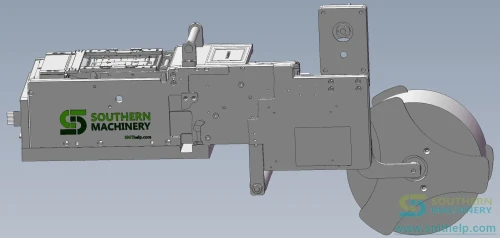
How does the SLF100X integrate into a complete PCB assembly line?
Integration is deliberately small: the feeder occupies one bank position, and the material joins the line as one more part number in the placement program.
At the mounter bank
Mount the feeder at the pick position and lock it to the machine datum — a loose mount is the most common cause of placement drift. At 7.5 kg one person installs it, and the tray carries up to 3 kg of roll material.
The handshake and the utilities
One 8-core φ16 mm aviation plug carries 24 V DC plus the IO handshake: the mounter requests, the feeder presents, the nozzle picks. Machine-controlled and standalone operation are both documented.
Upstream and downstream of the feeder
A label feeder sits inside the same line logic as your other SMT equipment. The one-stop PCB assembly solution for EMS shows how printing, placement, reflow and inspection are sequenced, and the SMT machine range covers the equipment the feeder bolts onto. Odd-form feeding families are in the feeder product category.
What is the ROI of an SMT label feeder?
A label feeder is bought against one cost: the seconds an operator spends applying labels and film by hand, multiplied by every board you will build. The product page supplies the method, not a price — enter your own volumes, time study and quotation.
The payback formula
Operator-hours freed per day = labels per board × boards per day × manual seconds per label × automation share ÷ 3600
Annual labour addressed     = operator-hours freed per day × working days per month × 12 × loaded wage per hour
Simple payback (years)      = feeder price ÷ annual labour addressed
A worked example — illustrative inputs, not a quotation
These inputs are an example only, depend on configuration, and are subject to final technical confirmation:
- Labels per board / boards per day: 4 / 2,000
- Manual time per label / automation share: 8 s / 70%
- Loaded wage / working days per month: $12 per hour / 21
- Feeder price, example: $9,000
- Operator-hours freed per day: ≈ 12.4 h/day
- Annual labour addressed: ≈ $37,600 per year
- Simple payback: ≈ 0.24 years, about 2.9 months
Substitute your own numbers before treating any figure as a cost case. The product document's guidance: under twelve months, this is a financial decision rather than a capital debate.
Three savings the simple formula leaves out
The method deliberately under-claims. It ignores the traceability escapes a manual bench lets through — the mis-read QR code that turns one defect into a batch recall; the machine slot a dedicated feeder frees; and the training cost of the bench itself.
Installation, training and lifecycle support
Commissioning is documented as six moves: inspect the body, stepper drive, fibre head and aviation plug; seat the feeder on the mounter datum; connect air and 24 V DC; load the roll and thread the liner; wire the IO handshake; then select the speed gear and verify X, Y and Z positions against the 500-consecutive-feed acceptance picture.
Support commitments in the source document
Free installation and training are included: guided mounting on the machine datum, roll loading and threading, and the speed-gear and position tuning procedure, so operators own the setup, not just the purchase. Southern Machinery documents 7 × 24 worldwide support with a 1-day spare parts lead-time.
Who this suits
Southern Machinery has built SMT/THT equipment since 2011 in Shenzhen for 237+ global customers, with line solutions across SMT, THT, wave soldering, board handling and inspection. A label feeder belongs on your line when labels, film, foam, tape, foil or stiffeners still cross a bench.
FAQ
What is an SMT label feeder used for?
It feeds labels and roll materials — protective film, foam, double-sided tape, conductive adhesive, copper foil and steel sheet — to the pick-and-place nozzle, so the mounter places them like components instead of an operator applying them by hand.
Which mounter brands does the SLF100X fit?
The product document lists Fuji, Juki, Panasonic, Yamaha, Samsung and Siemens. Send the machine and bank position to confirm the interface variant.
How fast and how accurate is the SLF100X?
1 second per feed across four speed gears, feeding accuracy of ±0.2 mm on both axes, and a published feeding rate of ≤ 0.5%.
What size material can it feed?
From just over 3 mm up to the liner width. Documented liner width variants are 60 / 80 / 100 mm — confirm your liner against the specification sheet.
Can it run standalone instead of on the mounter?
Yes. The 8-core φ16 mm aviation plug carries 24 V DC and the IO handshake, and standalone operation is documented too.
How much material does the tray hold?
The standard 3-inch roll core is customizable, with a maximum load of 3 kg. The lower belt conveyor removes the spent liner; an independent rewind motor is optional.
Next step: price the bench you already have
Count the labels one high-volume board must carry, time one hand placement, and multiply by your monthly volume. Then send Southern Machinery the label size, the liner width and the number you found, and ask for a feeding evaluation on your own material roll.
Take the SLF100X SMT Label Feeder product document and the Label Feeder-SLF100X specification sheet, or the Customized Feeder & Nozzle Catalog V03. If your material sits outside the published window, say so — the one-month custom solution service exists for that case.
Comments