
SMT Label Feeder & Automatic Label Mounter: Eliminate Manual Label Placement in PCB Assembly
Automate label placement on PCBs with Southern Machinery SMT label feeders and label mounters. Cut manual labor, improve traceability, keep EMS lines balanced.
Aug 9, 2026 · Updated Aug 9, 2026 · Southern Machinery
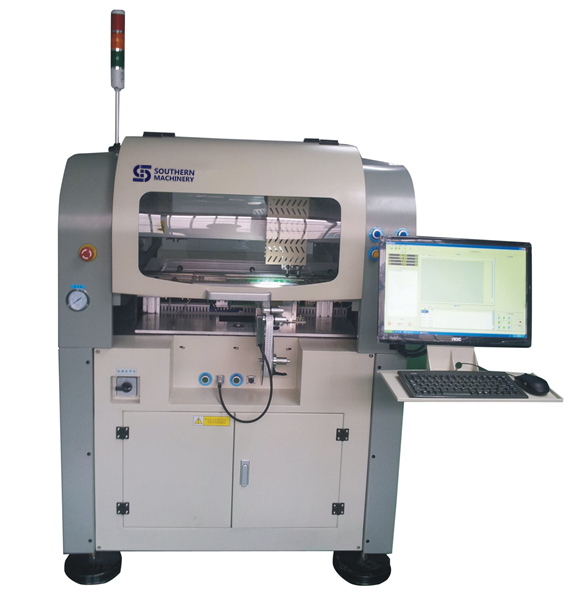
SMT Label Feeder & Automatic Label Mounter: Eliminate Manual Label Placement in PCB Assembly
Automated label placement is one of the easiest wins in a PCB assembly line that most EMS factories still do by hand. An SMT label feeder picks a label from a reel or stacked tube, orients it, and places it onto the PCB or finished PCBA automatically — replacing a repetitive manual step that costs time, causes misplacement, and slows down the line.
Southern Machinery designs and manufactures SMT label feeders and automatic label mounters (including the T-300 Automatic Label Mounter) for EMS factories, LED lighting, power supply, automotive electronics, and industrial control production. Founded in 2011 in Shenzhen, China, Southern Machinery has served 237+ customers worldwide with SMT/THT PCB assembly automation equipment, spare parts, and full-line solutions.
What is this machine used for?
A label feeder (also called a label pick-and-place machine or label mounter) is used to apply labels onto PCBs and PCBA automatically. Typical labels include:
- Traceability labels with serial numbers or 2D barcodes (DataMatrix / QR) for product tracking
- UL / CE / certification labels
- Date code and revision labels
- Customer-specific identification labels for finished assemblies
Instead of an operator peeling and pressing each label by hand, the machine feeds a label from a roll, separates it, and places it at a programmed position with a vacuum gripper. This is the same process family as SMT component placement, but purpose-built for thin, flexible, adhesive labels — including pick-up from foam or release liner and precise placement on curved or recessed board areas.
For high-mix EMS lines, the label feeder integrates with the rest of the SMT line so that labeling happens in-line, keeping traceability data consistent with the assembly sequence. For smaller operations, a standalone label mounter still removes the most repetitive manual task from the line.
Typical Application Scenarios
- EMS / contract manufacturing: automatic serial-number and 2D barcode labeling for traceability across multiple customer programs, without adding operators.
- Automotive electronics: durable, machine-placed labels on ECU boards and sensor modules where label position accuracy and readability are audited.
- Power supply and LED lighting: date-code and model labels on high-volume power supply, driver, and lighting boards.
- Medical and industrial control electronics: consistent labeling for regulatory identification and field-service traceability.
- Consumer electronics: labels on charger, appliance, and smart-home PCBA where volume is high and manual placement is a bottleneck.
In each case, the machine replaces manual peel-and-press work, which is slow, inconsistent in position, and prone to misalignment or finger contamination of the adhesive.
How It Integrates into a Complete PCB Assembly Line
A label mounter or label feeder fits into the line at two common points:
- After soldering and cleaning, before final inspection and packaging — the most common position. The board arrives via conveyor, the machine reads the board position (fiducial or edge), places the label, and releases the board to AOI, functional test, or packing. This keeps the label clean and readable and matches the final product configuration.
- At the start of the line, on bare boards — for boards that must carry a work-in-progress (WIP) barcode through the whole SMT process, the label can be applied to the bare PCB before stencil printing, so every downstream station can scan the same ID.
Either way, the machine communicates with the line the same way other SMT peripheral equipment does — through SMEMA-style handshake signaling and standard conveyor heights — so it can be inserted between existing stations without redesigning the line. Southern Machinery also supplies the accompanying label rerolling and material handling equipment so that label supply, splicing, and storage are managed together.
Key Selection Parameters
When choosing a label feeder or label mounter, buyers should confirm the following with the supplier (specific values depend on the label stock and board program):
- Label size and shape range — minimum and maximum label dimensions the machine can handle, including small 2D-barcode labels and larger certification labels.
- Label supply format — reel-fed (roll) versus stacked tube / sheet-fed formats, and how often the supply needs reloading.
- Placement accuracy and repeatability — required tolerance for label position relative to board fiducials or edges.
- Integration method — standalone bench-top unit versus inline conveyorized machine with SMEMA handshake.
- Throughput class — expected labeling cycle time versus line takt time, to confirm the machine does not become a new bottleneck.
- Board size range and handling — minimum and maximum PCB dimensions, thickness, and whether the board is handled edge-to-edge or on a carrier.
- Vacuum gripper design — ability to pick thin labels cleanly and place them without creasing or adhesive residue.
Southern Machinery can quote a configuration matched to the specific label stock, board size, and line speed.
ROI, Quality & Throughput Perspective
Manual label placement is a low-skill but high-frequency task. On a high-volume line, one or two operators may spend their entire shift peeling and placing labels. Automating this step delivers:
- Labor savings — operators are redeployed to inspection, changeover, or value-added tasks instead of repetitive labeling.
- Position consistency — machine placement is repeatable within the programmed tolerance, reducing label skew, bubbles, and re-labeling rework.
- Traceability integrity — automatic reading and placement of barcode labels supports a clean data chain from assembly through shipment.
- Line balance — removing a manual station from the conveyor flow reduces queuing and WIP between processes.
- Quality documentation — consistent label position and orientation make downstream vision inspection and customer audits easier to pass.
For most EMS applications, the payback is driven by labor displacement plus the reduction in misplaced-label rework — both of which are directly measurable on the production floor.
FAQ
Q: What types of labels can an SMT label feeder apply?
A: It handles typical PCB labels such as serial-number, barcode/2D code, UL/CE certification, date-code, and customer identification labels — in reel or stacked formats within the machine's size range.
Q: Does a label mounter integrate with an existing SMT line?
A: Yes. Inline models use SMEMA-style handshake and standard conveyor heights, so the machine can be inserted between printing, placement, soldering, and inspection stations. Standalone models work at the end of the line or in a separate labeling area.
Q: Where is the label placed in the production flow?
A: Most often after soldering and cleaning, before final inspection or packing. Some factories apply a WIP barcode label to the bare board at the start of the line so every station can scan the same ID.
Q: What industries use automatic label mounting?
A: EMS/contract manufacturers, automotive electronics, power supply, LED lighting, medical electronics, and industrial control — anywhere traceability labels must be applied accurately and repeatedly.
Q: What support does Southern Machinery provide?
A: Southern Machinery (founded 2011, Shenzhen, China; 237+ global customers) provides configuration advice, training, spare parts, and after-sales support for its SMT/THT equipment, including label feeders and mounters.
Q: Can I see the machine in operation?
A: Yes. Southern Machinery publishes working videos of its label feeder and label pick-and-place machines, and can arrange a demonstration or video call to review your specific label and board.
Contact Southern Machinery for Configuration Advice
For a label feeder or automatic label mounter matched to your label stock, board size, and line speed, contact Southern Machinery:
- Email: Jason Wu at jasonwu@smthelp.com
- Website: www.smthelp.com (product page: SMT Automatic Label Mounter T-300)
- Catalogs: file.autoinsertion.com
- Machine photos: ph.smthelp.com
- YouTube: youtube.com/c/Smthelping — watch the label feeder working videos
SMT/THT PCB assembly automation equipment — high efficiency, cost-effective, global support, spare parts, and training.
Comments