
SMT Intelligent Reel Storage Rack for Warehouse Control by Southern Machinery
For EMS, ODM, automotive electronics, medical electronics, and industrial control factories, SMT reel storage is no longer just a warehouse task. Wrong-part picking, slow kitting, hidden inventory gaps, and poor material traceability can stop a high-value PCB assembly line before placement even begins. Southern Machinery, founded in Shenzhen in 2011, provides an SMT Intelligent Reel Storage Rack designed to guide operators with LED pick-to-light workflow, sync material actions in real time, and connect component storage with SMT line planning. The result is a more controlled, cost-effective path to fewer material errors, faster line changeover, and stronger factory visibility.
Jul 25, 2026 · Updated Jul 25, 2026 · Southern Machinery
SMT Intelligent Reel Storage Rack for Warehouse Control by Southern Machinery
SMT production problems often look like placement-machine problems, but the root cause can sit one step upstream: material storage. If operators spend time searching for reels, correcting inventory records, or recovering from wrong-part picks, the SMT line loses capacity before solder paste printing or pick-and-place begins.
Southern Machinery's SMT Intelligent Reel Storage Rack is designed for EMS, ODM, automotive electronics, medical electronics, industrial control, lighting, and other PCB assembly factories that need better control of reel inventory, faster kitting, and cleaner traceability. Southern Machinery was founded in Shenzhen, China in 2011 and focuses on SMT/THT PCB assembly automation equipment for global customers, including SMT lines, THT insertion, wave soldering, board handling, inspection, and factory integration support.
What is this machine used for?
The SMT Intelligent Reel Storage Rack is used to store, locate, pick, and track SMT component reels before they are issued to production. In practical factory terms, it helps operators know where each reel is, which reel should be picked for the next job, and how inventory changes after each storage or retrieval action.
The source page describes four core workflow ideas:
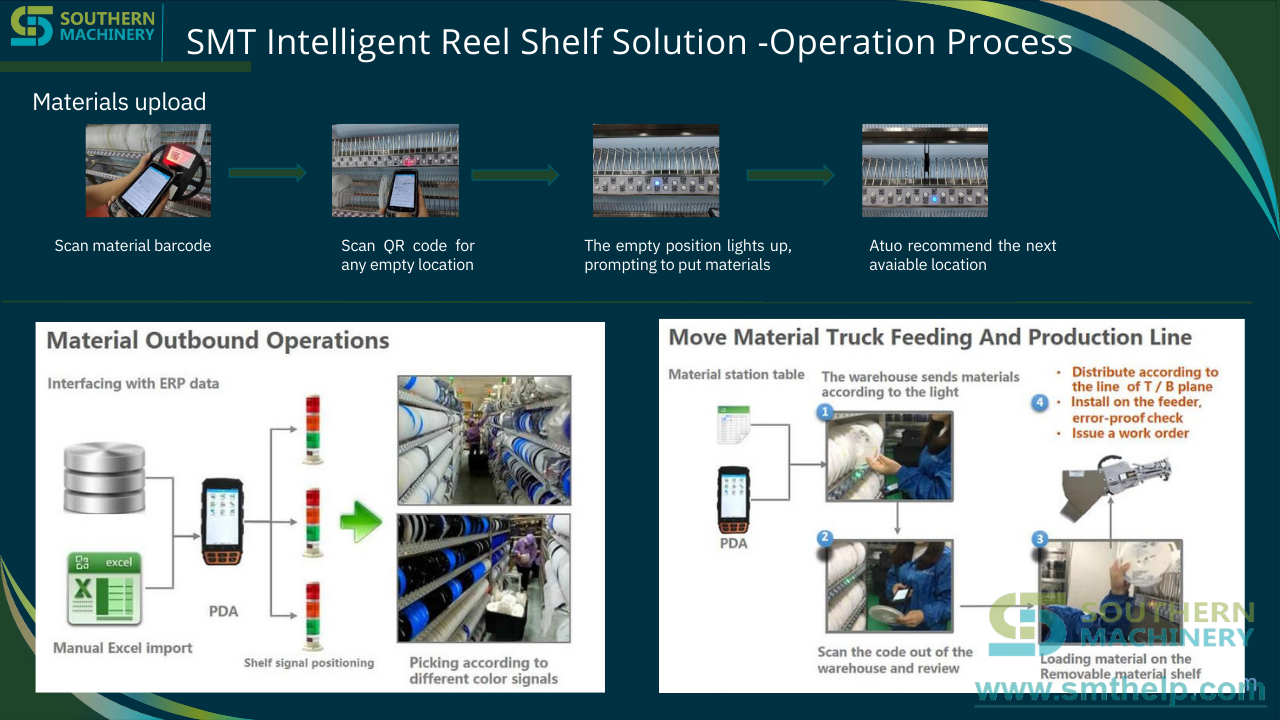
- Register the reel by scanning its barcode and assigning an identity.
- Store the reel with LED guidance to the correct rack slot.
- Import or follow a BOM so required reels are highlighted for kitting.
- Track material movement in real time as storage and picking actions happen.
This is not only a storage shelf. It is a controlled material interface between the component warehouse, SMT production plan, and PCB assembly line.
Why manual SMT reel storage becomes a bottleneck
Manual storage may look low-cost when a factory is small, but the cost model changes as SKUs, line changes, and material volume increase. The direct labor cost is only one part of the problem.
The more damaging losses are usually indirect:
- Search time when reels are misplaced or recorded incorrectly.
- Line stoppage when the next kit is not ready.
- Wrong-part risk from manual picking and weak barcode discipline.
- Inventory mismatch between the physical rack and the software record.
- Extra WIP because planners do not fully trust material availability data.
- Quality risk when materials with shelf-life or moisture sensitivity are not controlled well.
A pick-and-place machine cannot recover time lost in the material room. For high-mix EMS production, material preparation discipline is part of line capacity.
How the intelligent rack works in an SMT factory
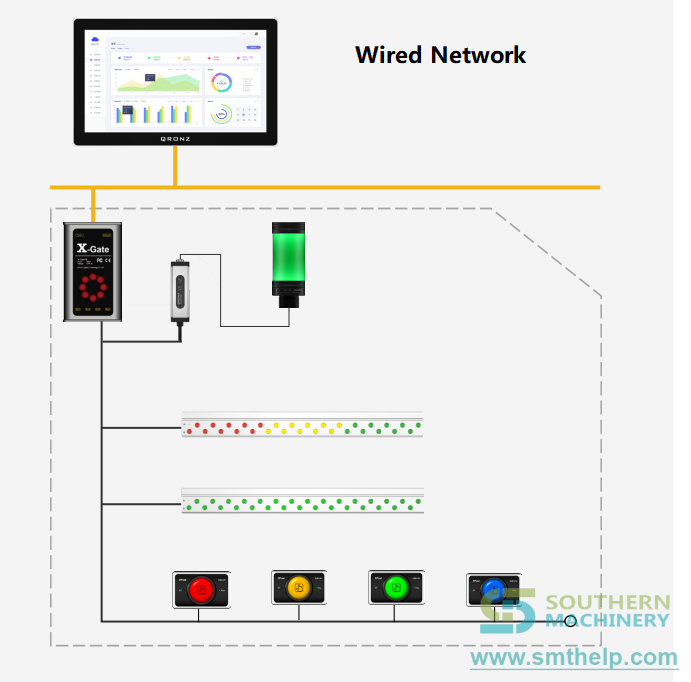
The rack is built around a guided material flow. Operators scan reels, place them into assigned storage positions, and use LED indication to find the required reel during kitting. Each movement can update the material record, giving the factory a more reliable view of what is actually available.
The source document highlights LED guidance, BOM-driven kitting, real-time inventory updates, and software connection as the main value points. These functions are especially useful when production teams must handle many reel sizes, frequent changeovers, or urgent engineering changes.
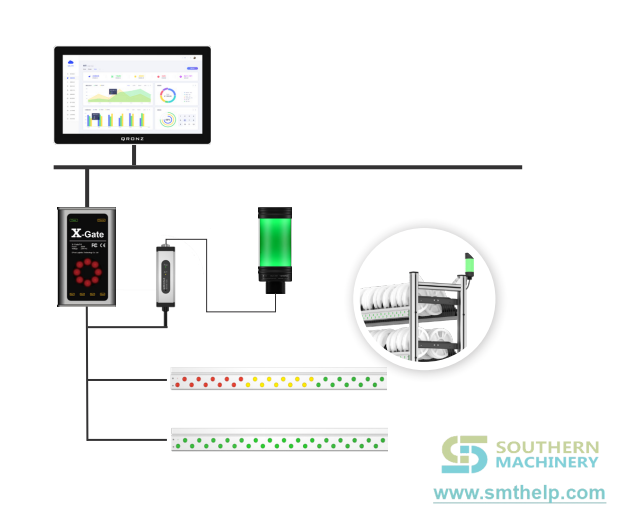
For factories using MES, ERP, or pick-and-place preparation software, the intelligent storage rack can become a practical bridge between physical component storage and digital production planning. Final communication method and integration scope should be confirmed against the customer's software environment.
Typical application scenarios
High-mix EMS production
High-mix factories change jobs often. The rack helps reduce searching and picking errors by giving operators a guided process instead of relying only on memory, paper lists, or static shelf labels.
Automotive and medical electronics
These sectors usually need stronger traceability discipline. A controlled reel storage process supports lot tracking, material issuing records, and more consistent preparation for quality audits. Any compliance workflow should still be validated against the customer's internal system and audit requirements.
Industrial control and power electronics
Industrial boards may use many BOM variations, alternative parts, and mixed production batches. Better material visibility helps planners confirm whether a job can be released before it reaches the SMT line.
SMT line-side replenishment
The rack can support faster preparation of kits for SMT printing, placement, reflow, and inspection flow. For factories with multiple placement lines, this can reduce pressure on warehouse staff and line leaders.
How it connects to a complete PCB assembly line
Southern Machinery's value is not limited to a single storage machine. The intelligent rack should be evaluated as part of a complete PCB assembly workflow:
- Incoming material receiving and barcode registration.
- SMT reel storage with guided slot assignment.
- BOM-based picking and kitting for each production order.
- SMT line preparation for printer, SPI, pick-and-place, reflow, and AOI.
- THT insertion, wave soldering or selective soldering where required.
- Board handling, buffering, inspection, and traceability data collection.
For a new line, Southern Machinery can help define the relationship between material storage, SMT equipment, THT equipment, board handling, and inspection stations. For an existing line, the priority is usually to identify where material handling is currently creating downtime, rework, or hidden planning errors.
Key selection parameters to confirm before buying
Before selecting the final configuration, procurement and manufacturing engineering teams should confirm:
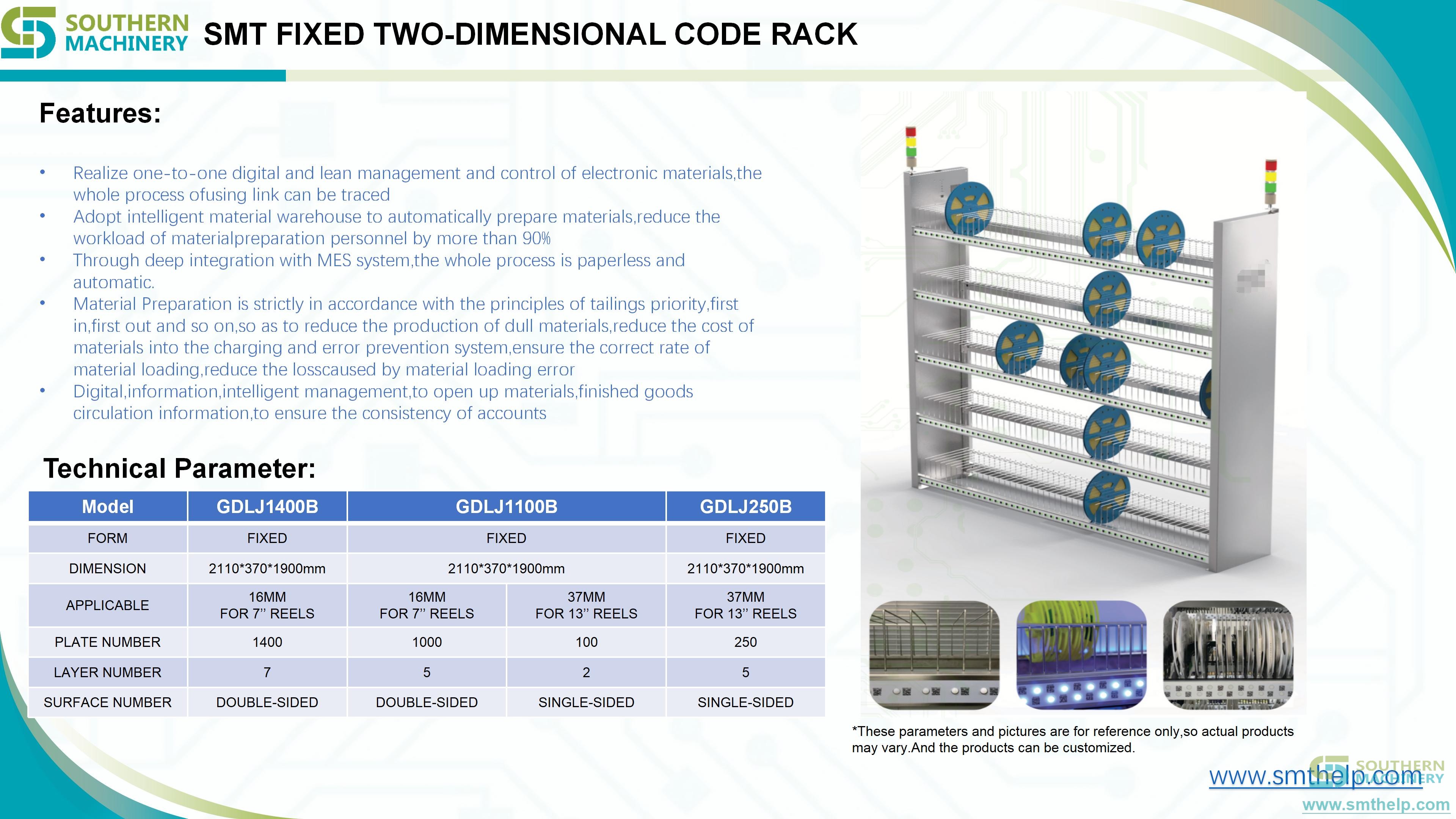
- Number of SMT reels to be stored at one time.
- Reel sizes, such as 7 inch, 10 inch, 13 inch, or larger formats.
- Required number of rack layers and available floor space.
- Whether the rack must be fixed, mobile, or line-side.
- Barcode rules and whether each reel already has a unique ID.
- Need for FIFO, FEFO, MSD, or humidity-controlled workflows.
- Required connection with MES, ERP, warehouse software, or pick-and-place software.
- Number of SMT lines and expected daily job changes.
- Operator workflow for receiving, storage, kitting, return material, and leftover reels.
- Required report fields for traceability and production management.
Some source-page examples mention rapid payback and strong picking accuracy. These should be treated as application-dependent examples, not universal guarantees. The actual ROI depends on labor cost, current error rate, reel volume, line stoppage frequency, production mix, and software integration depth.
ROI, quality, and capacity value
The strongest business case is usually built on three measurable areas.
First, labor and time savings. If operators spend less time searching for materials and preparing kits, the same team can support more changeovers with less disruption.
Second, quality stability. Guided picking reduces the chance of issuing the wrong component to the line. This is especially important when many reels have similar labels, package sizes, or alternative part numbers.
Third, line utilization. If material availability is more visible and kits are prepared earlier, SMT lines are less likely to wait for reels. For high-value production lines, avoiding even small stoppages can matter more than the storage equipment cost itself.
Southern Machinery positions this system as a high-efficiency, cost-effective material automation option for smart EMS factories. Spare parts support, professional training, and global service planning should be confirmed during project quotation based on country, line layout, and integration scope.
FAQ
Can this rack replace manual SMT material shelves?
Yes, it can replace or supplement manual shelving when the factory needs barcode-based storage, LED-guided picking, real-time material visibility, and more controlled kitting. The best configuration depends on current storage volume and production changeover frequency.
Does it connect with MES or ERP?
The source page describes MES/ERP/API style integration as a target use case. The exact interface, data fields, and development work must be confirmed against the customer's existing software and IT rules.
Is it only for large EMS factories?
No. Large factories benefit from scale, but high-mix medium-volume factories can also gain value when material mistakes or search time are already affecting line output.
Can it support FIFO or MSD control?
The source page describes FIFO/FEFO management and optional MSD-related control concepts. Final humidity, shelf-life, and floor-life management requirements should be confirmed before quotation.
What information is needed for a quotation?
A practical RFQ should include reel quantity, reel sizes, current storage method, SMT line count, software integration needs, available floor space, barcode workflow, and target improvement goals.
How should this be evaluated against a standard storage rack?
A standard rack mainly stores reels. An intelligent rack is selected when the factory needs guided picking, inventory synchronization, traceability, and reduced material handling errors. The decision should be based on line downtime, labor cost, wrong-part risk, and future expansion plans.
Talk to Southern Machinery
If your SMT warehouse is creating search time, wrong-part risk, or line stoppage, Southern Machinery can help review your current material flow and recommend a practical configuration. Share your reel count, SMT line quantity, BOM/kitting process, and software environment, and our team can suggest a rack layout and integration direction for your PCB assembly factory.
Comments